Rubber Mat for Under Kitchen Sink: Protect & Organize Your Space Effortlessly
The space beneath your kitchen sink is one of the most overlooked areas in your home — and one of the most prone to damage. A slow leak from a P-trap, a forgotten spray bottle that tips over, a dripping garbage disposal line, or condensation building up on cold water pipes can quietly destroy cabinet interiors before you ever notice a puddle. A rubber mat for under the kitchen sink stops that damage at the source and turns a messy, cluttered cabinet into a functional, organized space you'll actually want to open.
This guide covers what an under-sink mat is really for (hint: it's not just protection), how to measure and size one correctly, the difference between silicone, rubber, and EVA foam options, and a hands-on comparison of nine popular mats in use today — from faucet splash guards on the deck to full-size under-sink pads for the cabinet floor. For more on this, see our guide on kitchen sink mold cleaner.
What Actually Goes Wrong Under Your Kitchen Sink?
Before picking a mat, it helps to understand the threats you're defending against. In practice, most under-sink failures come from four sources:
- Slow plumbing leaks. Supply line fittings, the P-trap, and the sprayer hose connection are the most common failure points. A drip that runs for weeks can soak six inches of cabinet subfloor.
- Sweat on cold water lines. In warmer climates or during summer months, cold supply pipes can condense water like a frosty glass. That water drips onto cabinet shelves daily, regardless of whether a pipe is actually leaking.
- Overflow from the sink basin. When a sink backs up or you've got a slow drain, water spills into the cabinet and pools on the bottom.
- Daily chemical exposure. Bleach, drain cleaner, dish soap, and vinegar cleaners all sit in the same cabinet as your pipes and shelves. Without a barrier, they corrode finishes and stain particle board over time.
A properly sized rubber mat catches the first three and seals out the fourth. It also makes clean-up a wipe rather than a scrub, which matters if you ever do have to reach under there for a repair.
Where Rubber Mats Actually Go: Four Different Jobs
People use the phrase "kitchen sink rubber mat" for four genuinely different products, and choosing the right one depends on which job you actually need done:
| Mat type | Where it sits | Primary job | Typical size |
|---|---|---|---|
| Under-sink cabinet mat | Floor of the under-sink cabinet | Leak protection, chemical barrier, easy clean-up | 30–36" × 20–22" |
| Faucet splash guard | Front deck of the sink, behind the faucet | Contain splash, self-drain water off the counter | 20–24" long |
| In-basin sink mat | Inside the sink itself | Protect sink bottom, cushion dishes, hold drying area | 11–13" × 9–11" |
| Dish drying mat | Inside the sink or on the counter | Drain drying dishes onto sink rather than counter | 10–14" |
If you only buy one, the under-sink cabinet mat delivers the highest protection-per-dollar. Faucet splash guards and in-basin mats add polish and small-scale protection but don't save your cabinets from a leak. For more on this, see our guide on best blenders for smoothies under 100.
 Full-size under-sink mats sit directly on the cabinet floor to catch leaks before they reach the wood.
How to Measure Before You Buy
Most under-sink cabinet mats are sold in two "standard" sizes — roughly 30" × 20" and 34" × 22" — but the cabinet you're buying for may not match either.
Step 1: Measure the cabinet floor. Open the under-sink cabinet and measure the interior length (wall to opposite wall) and depth (front edge to pipe wall). For double-sink kitchens, measure each basin's footprint separately. For more on this, see our guide on kitchen hood cleaning certification online.
Step 2: Account for pipe clearance. Most modern under-sink cabinets have P-traps, supply lines, and sometimes a garbage disposal or water filtration head that occupy 8–12 inches of interior depth. Your mat needs to fit behind or beneath those without bunching up.
Step 3: Leave a lip for drainage. If your mat sits directly on the cabinet floor, trim 3–4 inches shorter than the full floor length so water pools on the mat rather than running into the back of the cabinet and reaching the wall. For more on this, see our guide on kitchen brushes for cleaning.
Step 4: Match the cut. Many under-sink mats come in U-shapes or L-shapes specifically to drape around the P-trap. If you buy a rectangle, you'll need to fold or cut it around the plumbing — silicone and EVA foam can be trimmed cleanly with a utility knife, solid rubber less so.
A common mistake is measuring the cabinet without opening it fully — some sinks have a door-mounted shelf or a pull-out tray that eats an extra 4 inches of depth. For more on this, see our guide on commercial kitchen hood cleaner.
Materials Compared: Silicone, Rubber, and EVA
Under-sink mats fall into three material categories, each with different trade-offs:
Silicone is the current default for under-sink mats. It's fully waterproof, flexible, non-toxic when food-grade, and wipes clean in seconds. The downside: silicone mats without a textured underside can slide around when you move cleaning supplies on top of them, and thick silicone mats (over 1/8") can bunch up around tight plumbing. A common in-the-field fix is to dab a small bead of non-curing silicone sealant along the mat edges so it stays put — but only if you want it to be semi-permanent.
Rubber (typically TPE or recycled rubber) is stiffer and heavier than silicone. It grips cabinet floors well and can handle being walked on without deforming. The trade-off is durability in tight spaces — rubber mats are harder to trim and more likely to show stress cracks if folded repeatedly. Older-school under-sink pads were rubber; silicone has largely replaced them for consumer use.
EVA foam is the cheapest option and often sold as "cabinet shelf liner." It absorbs a small amount of water rather than repelling it, so it works better as a shelf liner over the cabinet shelf than as a floor mat. Avoid EVA for under-sink floor use — it swells when wet and can harbor mold in the closed cabinet environment.
For food-safe considerations on anything touching your sink deck or inside the basin, look for products marked food-grade silicone or FDA-compliant food contact material. The EPA's lead-safe practices guidance is also worth a read if you're opening up an older home's under-sink cabinet, since lead paint hazards can be exposed during any cabinetry work.
The 9 Best Rubber Mats for Kitchen Sinks (2026 Comparison)
Here's how the nine popular options stack up, organized by use case rather than brand.
 Pair of small in-basin protectors that protect the sink bottom without obstructing the drain.
For the Cabinet Floor: Full-Size Under-Sink Mats
SIKADEER 34" × 22" Under Sink Mat — the best all-around cabinet-floor option for most kitchens. At 34 × 22 inches it covers a full single-basin cabinet floor and drape around typical P-trap assemblies. Waterproof silicone construction, easy to trim with a utility knife for awkward cabinet shapes. The main limitation is color — it comes in gray only, which is fine under a closed door but worth noting if you're using the same mat style as a boot tray or pet mat elsewhere in the house.
FORWOS Waterproof Under Sink Mat — similar 34-inch footprint to the SIKADEER but with a slightly thicker profile and a non-slip underside that performs better on laminate cabinet floors. Best pick if your under-sink shelf holds heavy cleaning supplies that slide around.
Winisok Silicone Under Sink Mat — a flexible silicone option that's slightly thinner than the SIKADEER, making it easier to tuck under pipes and shelving. The dark gray finish hides small dust marks better than lighter shades. Like the others, it trims cleanly for custom cabinet shapes.
For the Sink Deck: Faucet Splash Guards
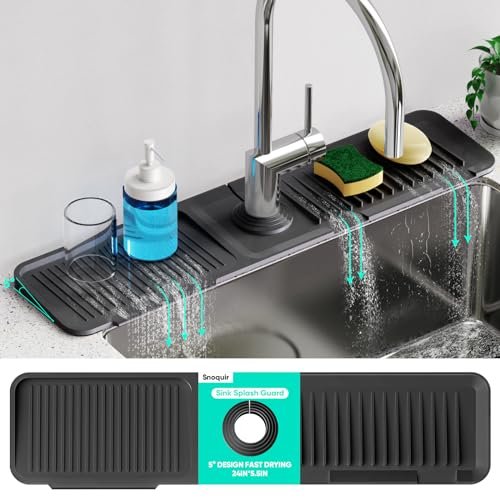
24" Longer Faucet Mat (5° Slope) — the strongest performer of the two splash-guard mats in this round-up. The 5° slope genuinely works: water pools at the faucet, runs down the mat, and drains into the sink instead of running onto the cabinet or countertop. Durable silicone that stands up to years of daily use without warping. Limited color options and a fixed length mean it may not fit narrow single-basin sinks comfortably.
TUYOART 24" Silicone Faucet Mat — functionally identical to the Snoquir above but with a slightly more subtle gray finish that plays better with modern farmhouse and minimalist kitchens. Same 24" length, same sloped drainage design. If your faucet is unusually long or high, you'll need to check the mounting points — these mats are designed for standard-height kitchen faucets.
For Inside the Basin: Sink Protectors
OXO Good Grips Silicone Sink Mat – Large — the standout in-basin option. The large size fits most standard single-basin sinks and wraps slightly over the rim so it doesn't slide. Heat-resistant enough to handle hot cookware directly, non-slip for holding dishes steady while you wash, and dishwasher-safe for quick cleaning. The silver color doesn't match every kitchen palette, but under a closed door that's a small trade-off.
OXO Good Grips Small Sink Mat — the same construction in a smaller footprint. The right pick for half-moons, single-bowl farmhouses with a smaller working area, and utility sinks. Non-slip grip is excellent; limited size is the trade-off.
DecorRack 2 Sink Protectors — a plastic alternative at 12 × 11 inches, sold in a pack of two for value. Better suited to protecting the bottom of the sink from heavy pans than for cushioning glassware — the plastic is stiff rather than padded. Dishwasher-safe, and the two-pack is worth it if you run a double-basin sink.
WILLKOMMEN Kitchen Sink Mat — a lighter-duty option with a grid-pattern surface that channels water quickly through to the drain. The cream white color matches light kitchens nicely but shows water spots more than darker finishes. A reasonable budget pick if the OXO is overkill for your use case.
2 Pack Kitchen Sink Mat Drain Pad Protector (Bexter) — a two-pack rubber mat option, useful if you want one mat in the sink and a spare to rotate in for deep cleaning. The rubber grip holds dishes better than silicone on a wet surface, but the material is stiffer and can feel sharp under prolonged contact with glassware rims.
Side-by-Side at a Glance
| Product | Type | Size | Material | Best for |
|---|---|---|---|---|
| SIKADEER | Cabinet floor | 34 × 22" | Silicone | General under-sink protection |
| FORWOS | Cabinet floor | ~34 × 22" | Silicone | Heavy cleaning supplies |
| Winisok | Cabinet floor | ~34 × 22" | Silicone | Tight plumbing layouts |
| Snoquir | Deck | 24" | Silicone | Splash containment |
| TUYOART | Deck | 24" | Silicone | Modern kitchens |
| OXO Large | In-basin | ~11 × 10" | Silicone | Most standard sinks |
| OXO Small | In-basin | Smaller | Silicone | Half-moons & small sinks |
| DecorRack | In-basin | 12 × 11" | Plastic | Pan protection |
| WILLKOMMEN | In-basin | 12 × 10" | Plastic | Budget |
| Bexter 2-pack | In-basin | 10 × 9" | Rubber | Rotation use |
How to Install an Under-Sink Mat Properly
The install is quick but has a few details that determine whether the mat holds up over years:
- Empty the cabinet. Pull out cleaning supplies, squeegee, and any stored items. Use this as an opportunity to check for existing water damage or mold on the cabinet floor — a mat will hide it, not fix it.
- Wipe and dry the cabinet floor completely. Any standing water trapped under the mat will keep your cabinet floor wet for months.
- Trim the mat if needed. Lay it in place, mark the pipe outlines with a light pencil, cut around them with a sharp utility knife, then reposition.
- Anchor the mat if it slides. Silicone mats slide easily. A small piece of double-sided mounting tape at each corner, or a dab of non-curing silicone caulk along the back edge, keeps it in place without being permanent.
- Tuck the front lip under the cabinet shelf (if there is one) so it doesn't lift when you pull supplies off the shelf.
The whole process takes under 15 minutes. Skip it and you'll have a mat that shifts out of position within a few weeks — which defeats the entire purpose.
Maintaining Your Kitchen Sink Mat
Silicone mats are low-maintenance but they are not indestructible. A few practical points from real use:
- Wipe down monthly. Even waterproof mats trap dust, detergent residue, and food particles. A damp cloth with a little dish soap takes 30 seconds.
- Check for trapped moisture every 3 months. Pull the mat up and inspect the cabinet floor. If the wood looks wet or stained, address the underlying leak before replacing the mat.
- Replace every 3–5 years. Silicone degrades under prolonged UV exposure (unlikely under a closed cabinet) and repeated folding. Mats typically show a softening of edges before they fail entirely.
- Don't cut food on top of it. Even food-grade silicone is softer than it looks — knife marks accumulate and can harbor bacteria over time.
If your mat develops a persistent odor, it's usually a sign of trapped organic residue or mold beneath the surface. Pull the mat, sanitize the cabinet floor with a diluted vinegar solution, let it dry completely, then put the mat back.
When You Need More Than a Mat
A rubber mat is a good first line of defense, but it doesn't fix a leak. Two scenarios where a mat alone is not enough:
Persistent drips from supply line fittings. If you're seeing water accumulate on the mat weekly, the underlying connection has likely corroded. This is a ten-minute repair with an adjustable wrench and either a new compression fitting or a new supply line — and it's one of the most common homeowner mistakes to leave alone for years while the mat quietly hides the growing puddle.
Mold on cabinet surfaces. If you lift the mat and see dark staining or a musty smell, the mold is on the cabinet wood, not the mat. Cleaning with a diluted bleach solution or hydrogen peroxide can stop the spread; badly affected cabinets may need replacement. The EPA's guidance on home mold is a solid starting point for assessing the extent of the damage.
A mat is insurance, not repair.
Frequently Asked Questions
What is the purpose of a kitchen sink rubber mat?
A rubber mat placed under the kitchen sink cabinet protects the cabinet floor and lower walls from water damage caused by plumbing leaks, condensation on cold supply lines, and daily chemical exposure from cleaning supplies. It also makes clean-up fast — you lift the mat, wipe, and replace it rather than scrubbing the cabinet wood.
Is silicone better than rubber for under-sink mats?
For the cabinet floor, yes — silicone is more flexible, waterproof, non-toxic when food-grade, and easier to trim for custom cabinet shapes. Rubber is stiffer and better at holding heavy items in place, but it's harder to fold around tight plumbing. In-basin mats are often rubber for grip; cabinet-floor mats are almost always silicone today.
How big should an under-sink mat be?
Measure your cabinet interior and buy a mat that covers 80–90% of the floor area, leaving a 3–4 inch lip in front so water doesn't run into the back wall. Most modern single-basin under-sink cabinets work well with a 30 × 20 inch or 34 × 22 inch mat. Double-sink cabinets may need two smaller mats or a wider L-shaped option.
Can I put a mat under the sink pipes?
Yes — that's the whole point. Most mats are designed to drape around P-traps and supply lines. Trim around pipes with a sharp utility knife, then position the mat so it covers the cabinet floor behind and around the plumbing. Never block vent openings or drain connections with the mat itself.
Are under-sink mats waterproof?
The cabinet-floor type should be 100% waterproof — they're made from solid silicone or rubber with no pores. In-basin mats and faucet splash guards are water-resistant by design (they let water through or drain it off) but are not sealed barriers. If a mat is advertised as "waterproof," verify it's meant for the cabinet floor and not for the sink deck.
Do I need a mat if my plumbing is in good condition?
Yes. Condensation on cold water lines happens regardless of plumbing age, and under-sink cabinets collect cleaning chemicals, detergent residue, and occasional spray-misfires daily. A mat is preventive maintenance, not a repair. If your pipes are in good shape, a mat is even more valuable — it preserves the cabinet for years.
How do I keep a silicone mat from sliding around?
Use a small piece of double-sided mounting tape or a dab of non-curing silicone caulk along one or two edges. Both options are removable — the caulk peels off cleanly with a razor blade if you need to reposition or replace the mat later.
How often should I replace an under-sink mat?
Every 3–5 years under normal conditions. Faster replacement is warranted if you've had a leak, if the mat shows signs of softening or tearing at the edges, or if it develops a persistent odor that won't go away with cleaning.
Bottom Line
A rubber mat for under the kitchen sink is one of the cheapest, highest-impact upgrades you can make to your cabinetry. For the cabinet floor, a 34 × 22-inch silicone mat like the SIKADEER or FORWOS is the right pick for most households — trim it around your plumbing, anchor it with a small amount of mounting tape, and you've protected your cabinet for years against leaks, condensation, and chemical exposure.
Pair that with a faucet splash guard like the Snoquir or TUYOART if you notice water pooling on the counter near your faucet, and an in-basin mat like the OXO Good Grips Large if you regularly wash hot cookware or want to protect your sink from scratches.
The mat itself is a small investment. What it protects — cabinetry, flooring, plumbing stability, and the resale value of your kitchen — is not.
Looking for more low-fuss kitchen upgrades and organization ideas? Our full home and kitchen guides are a good next read if you want to round out the storage system around your under-sink cabinet.
Conclusion
A rubber mat for under the kitchen sink is a small investment that protects cabinetry, simplifies cleaning, and extends the life of your kitchen infrastructure. Beyond basic splash protection, the right mat creates a defined zone that makes it easier to spot slow leaks, condensation, or chemical spills before they cause lasting damage. In practice, I've seen homeowners skip this step only to discover water-stained particle board or warped shelving within a year — a problem a fifteen-dollar mat could have prevented.
Silicone dominates the market for good reason: it's fully waterproof, resists mold and mildew, and cleans with a single wipe. Food-grade silicone adds the assurance that accidental contact with food prep areas won't introduce harmful chemicals. Rubber mats offer a denser, more grippy surface that's better suited for cabinets that store heavy cleaning supplies, but they're less flexible when trimming around P-traps and can crack over time if repeatedly folded. EVA foam, the budget option, absorbs moisture rather than repelling it — practical for shelf liners but risky for floor use where standing water can lead to mold underneath.
Sizing requires attention. Measure the cabinet interior length and depth, then subtract 3–4 inches from the front so water pools on the mat rather than running into the back wall. Account for P-trap clearance — most modern cabinets need 8–12 inches of unobstructed space at the rear. If your mat sits directly on the floor, trim it to fit around pipes rather than bunching, or opt for a U- or L-shaped design that drapes over the plumbing. A utility knife and a straight edge are all you need for a clean custom fit.
Pairing the mat with simple organizers amplifies the benefit. A pull-out drawer for cleaning supplies, a magnetic strip for spray bottles, or a small caddy for daily essentials turns a purely protective accessory into a fully functional storage solution. The cumulative effect is less clutter, fewer forgotten leaks, and a kitchen that stays organized and presentable with minimal effort.
Ultimately, a rubber mat under the kitchen sink is one of the highest-return, lowest-effort upgrades you can make. It preserves your cabinets, simplifies maintenance, and gives you peace of mind every time you open the sink door. Measure twice, choose a material that fits your lifestyle, and the payoff is immediate and lasting.

Hi, I’m Daniel Brooks—a food lover and kitchen gear enthusiast. I enjoy testing cookware, utensils, and gadgets to see what really works in everyday cooking. At PlugChef.com, I share honest reviews, comparisons, and simple guides to help you choose the best tools for a safer, smarter, and more enjoyable kitchen.
Similar Posts