Cheese Knife Set: Elevate Your Charcuterie Board with Style and Precision
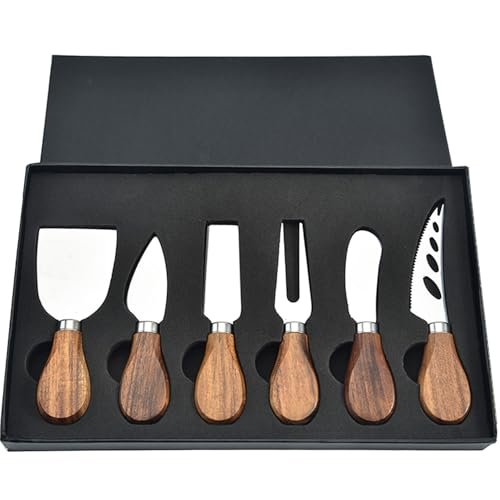
A cheese knife set is more than a collection of blades. It is the difference between a messy, torn wedge of brie and a clean, elegant slice that showcases the cheese's rind, paste, and texture at their best. Most kitchen drawers already hold a paring knife that "works fine" for cheese—but that tool pulls, smears, and crumbles exactly where precision matters most.
The right set gives you a purpose-built knife for each texture: a spreader for soft washed-rind cheeses, a tri-tip for crumbly blue, a hard knife for aged cheddar, and a slicer for semi-hard wheels. Choose one that matches how you actually host—whether that is a casual Tuesday snack or a dinner party for twelve—and the payoff is immediate. For more on this, see our guide on types of cheese for crackers.
This guide breaks down every cheese knife type, walks through the materials and handle choices that separate a durable set from a disappointing one, reviews ten solid options available in 2026, and closes with maintenance tips and board-building guidance that makes the knives do more work than you expect.
Why a Dedicated Cheese Knife Set Matters More Than You Think
A general paring knife cuts cheese the way a flathead screwdriver turns a Phillips head—it works, but everything is harder, messier, and less controlled. The geometry of a cheese knife is designed around one specific problem: moving through dairy fat without shattering it. For more on this, see our guide on browned butter and mizithra cheese.
Consider what happens when you cut a soft washed-rind cheese like brie with a sharp paring knife. The blade slices cleanly through the rind, then plunges into the paste and drags—leaving a smear, tears at the base, and a wedge that collapses when you try to plate it. A cheese spreader, by contrast, has a wider, flatter blade that pushes the soft interior forward ahead of the cutting edge, preserving the wedge shape from rind to tip.
The same principle applies across the spectrum. A hard cheese like 18-month Parmigiano-Reggiano has a crystal-structured paste that fractures predictably when you use a hard cheese knife with a wide, straight blade and a sharp tip—you crack off a chunk along the crystal lines rather than trying to push a knife through stone. A tri-tip press releases crumbly blue cheese in controlled fragments, leaving your board clean instead of dusted with blue mold residue. For more on this, see our guide on kitchenista mac and cheese recipe.
In practice, the biggest mistake I see is people buying a single "cheese knife" and trying to use it for everything. It handles most textures acceptably, which makes it tempting—but the gaps show up exactly when you are entertaining guests. A dedicated set removes that compromise entirely.
Types of Cheese Knives: Know the Difference Before You Buy
Most quality sets include four to six different tools, each shaped to solve a specific cutting problem. Understanding what each one is designed to do will help you read product descriptions, evaluate sets, and actually use the tools effectively. For more on this, see our guide on cooking concepts bamboo cutting board.
The Cheese Spreader
The spreader is your soft-ripened weapon. It has a wide, flat blade—usually about 2.5 to 3 inches long—with a rounded or squared-off tip. You lay the blade face-down against the rind and pull backward, letting the weight of the blade cut through the soft paste rather than relying on downward pressure.
Use it for brie, camembert, Taleggio, washed-rind Gouda, and any cheese soft enough that a wedge falls apart when you pick it up. The blade width matches the wedge width, so the entire cut is supported in one motion. For more on this, see our guide on marine first aid kit contents list.
The Tri-Tip (Y-Tip) Shredder
Three short prongs form a trident shape at the end of this short blade. You press the prongs into crumbly or semi-hard cheese and lift—the prongs separate in controlled shards rather than the broad, uneven chunks you get from a straight blade.
Blue cheese, stilton, manchego, ricotta salata, and other brittle cheeses benefit from this tool. The prongs also make it ideal for crumbling cheese onto pasta, salads, or grain bowls. In practice, you will find yourself reaching for the tri-tip far more often than you expect once you learn what it can do.
The Hard Cheese Knife
Built for wheels of Parmesan, aged Gouda, grana, pecorino, and any cheese aged beyond 12 months. This is a straight, stiff blade—about 4 to 5 inches long with a sharp point—wider than a paring knife but flatter. The straight edge lets you crack along natural fracture lines in the cheese crystal structure rather than forcing a slice through dense paste.
The trick with hard cheese is not pushing straight through; it is tapping the point into the surface at a 45-degree angle and rocking the blade gently to find the cleavage line. A sharp point makes this easy. A dull one will chip the blade against the crystals.
The Cheese Slicer
A semi-flexible blade, similar in concept to a flexible fillet knife, designed to slice through semi-hard cheeses like cheddar, provolone, havarti, and aged Gouda that sit between soft and hard on the spectrum. The slight flex lets the blade follow the cheese's curvature as it cuts, producing even, clean slices.
Some sets include a slicer with a wider, shallower blade that works especially well on wheels—laying the blade flat against the rind and drawing it around the circumference in one motion to produce uniform rounds.
The Butter Knife
Cheese knives often include a dedicated butter knife (or "butter spreader") that has a broader, more flexible blade than a standard dinner butter knife, with a wider tip and slight curvature on the edge. It is designed to spread soft cheese, cream cheese, chèvre, and soft spreads without tearing the cheese or dragging crumbs across the board.
This tool gets overlooked, but if you serve cream cheese, labneh, or soft spreads alongside your board, having a proper butter knife makes a real difference in texture and control.
Cheese Forks and Picks
A proper cheese knife set often includes small serving forks or toothpicks designed specifically for picking up pieces of cheese after cutting. These are shorter and more rigid than dining forks, with a blunter tip that does not pierce and break apart delicate cheese pieces.
For larger gatherings or family-style boards, these are essential—gives everyone a way to serve themselves without touching shared boards with hands that may have touched crackers, fruit, or other items.
Materials and Handle Types: What Actually Matters
The difference between a great cheese knife set and a disappointing one is rarely in the marketing copy. It is in the materials. Here is what to look for.
Blade Materials
Stainless steel dominates the market for good reasons: it resists rust, maintains its edge through normal kitchen use, and is generally affordable. Most sets in the $15–$40 range use 420 stainless steel, a soft alloy that is easy to machine and reasonably corrosion-resistant but dulls faster than harder steels. That is acceptable for home use, provided you maintain the edge.
High-carbon steel is found in premium sets and stays sharper longer, but it requires more care to prevent rust—especially after contact with salt from cured meats or acidic cheeses like Roquefort. If your climate is humid, this trade-off may not be worth it.
Non-stick coatings (like the PTFE coating on the BOSKA set below) solve the specific problem of soft cheese sticking to the blade during cutting. They are excellent for brie and other soft cheeses but can scratch if you use them on harder cheeses repeatedly. Treat them as a bonus rather than a replacement for a well-honed edge.
Handle Options
Wooden handles (walnut, oak, rubber wood, beech) feel warm and look elegant on a board. The trade-off is maintenance: they cannot go in a dishwasher, and they can swell, crack, or develop water marks if left soaking. Rubber wood handles are denser and more moisture-resistant than oak, which is why so many mid-range sets use them.
Stainless steel handles are dishwasher-safe, nearly indestructible, and weigh more than wood. Heavier handles add stability during the rocking motion of a hard cheese cut, which some people prefer. The downside is cold-to-the-touch in cool kitchens and less grip comfort during extended use.
Composite handles (fiberglass-reinforced plastic, silicone) are durable and inexpensive, but they tend to feel cheap and can flex slightly under pressure. Fine for a $15 set; not worth it at higher price points.
Build Quality Indicators
Three things separate a quality set from a budget one:
- Blade tang: A full tang (steel running the full length of the handle) means the blade is stronger and will not crack at the handle junction under pressure. Half tangs—where only part of the blade extends into the handle—are acceptable for spreaders and small knives but not for hard cheese knives.
- Edge geometry: Bevel angle matters. A 20-degree edge angle cuts sharper than a 30-degree angle. Most consumer stainless steel sets use 25–30 degree bevels; Japanese-style sets may use 15–20 degrees. Steeper angles are more durable; steeper angles cut less crisply.
- Handle-to-blade join: Look for rivets or a seamless tang-and-handle fit. If the handle looks glued on or the steel ends abruptly at the handle, that is where the knife will eventually separate.
How to Choose the Right Cheese Knife Set for Your Needs
Not every set suits every person. Here is how to narrow it down based on how you actually eat and host cheese.
Consider Your Cheese Collection
If you mostly eat one or two cheeses (say, cheddar and cream cheese), a three-piece set with a slicer, a spreader, and a butter knife is more than enough. If you rotate through 10–15 cheeses regularly—hard, soft, blue, crumbly—you want a set that covers all those textures. Buying a six-piece set to use three knives means three unused pieces taking up drawer space.
Think About Board Size
A small board with three cheeses does not need six knives scattered across it. A two-person evening with a board the size of a dinner plate is best served by two or three well-chosen knives. A large board for eight to ten people benefits from a full set with extra forks or picks so guests can self-serve without fighting over a single spreader.
Match the Set to Your Hosting Style
If you care about aesthetics as much as function—and charcuterie boards often do serve as a visual centerpiece—prioritize handle material and finish. A polished walnut or brushed stainless set looks more intentional than a generic black plastic one, and that matters when the board is a focal point of the table.
If your kitchen runs small and you want to toss everything in the dishwasher, stainless steel handles and a compact four-piece set will keep more of its life in active use than a wood-handled set you put away because "it takes too much effort."
How to Use Different Cheese Knives for Clean, Beautiful Cuts
Knowing which knife to use is only half the battle. Here are practical techniques that make the difference between a torn wedge and a clean slice.
For soft cheeses with a spreader: Lay the blade flat against the rind, with the handle pulled back from the cheese. Apply steady downward and backward pressure—do not force the tip through. Let the blade weight do the work. Cut to the center of the wheel and remove the wedge from the rind first, then trim the wedge into a point.
For hard cheeses with a hard knife: Position the point at the rind's edge at about a 45-degree angle to the board surface. Rock the blade back and forth gently until you feel the blade find the natural fracture line in the cheese. Push forward to complete the cut. If the cheese is very hard, you can use a tapping motion to start the crack before drawing the blade through.
For crumbly cheese with a tri-tip: Do not pull or saw. Press the prongs vertically into the cheese surface with moderate pressure, then lift straight up. If the cheese crumbles into too many small pieces, press at a slightly shallower angle to create larger, more cohesive chunks.
For semi-hard cheese with a slicer: Draw the blade from the center of the board outward, letting the cheese roll ahead of the blade. This technique produces even slices without crushing the paste. If you are cutting wheels rather than blocks, lay the slicer flat against the rind and draw it around the curve in one motion.
Our Top 10 Cheese Knife Set Reviews for 2026
Each set below has been evaluated for blade quality, handle durability, versatility, and value for money. Prices and availability may vary by retailer.
1. 6-Piece Cheese Knife Set (Stainless Steel, Wood Handle)
 This six-piece set from GXIQYL (manufactured by Ranthx) pairs brushed stainless blades with wooden handles for a warm, traditional look.
The GXIQYL set is a straightforward six-piece package covering the spreader, tri-tip, hard cheese knife, slicer, butter knife, and fork. It sits at the lower end of the price range, which makes it a solid entry point for someone who wants to stop cutting cheese with a paring knife.
The standout feature here is the balance. Despite the compact size and modest blade profile, each knife has enough weight to the blade to make the cutting motion feel controlled rather than twitchy. The wood handles are a touch rough out of the box (a common issue with mass-produced hardwood handles) but smooth down with a light oiling and a few days of use.
Pros:
- Covers all six standard cheese knife types
- Well-balanced blades for the price point
- Handles smooth down nicely with seasonal oiling
- Good gift value for an under-$25 price
Cons:
- Wood handles need hand washing and periodic maintenance
- Blade edges are decent but not razor-sharp; best for soft to semi-hard cheeses
- Not suitable for very hard aged cheeses out of the box
Best for: Beginners building a first serious cheese set, and gift buyers looking for a complete package.
2. Guojanfon 6-Piece Cheese Knives Set (Stainless Steel, Wood Handle)
 A compact six-piece Guojanfon set, with wood handles and stainless steel blades suited to everyday cheese and butter service.
The Guojanfon set is similar in concept to the GXIQYL above but differentiates itself with a slightly more refined handle finish and a tighter tolerance between blade and handle join. The blades are noticeably stiffer than the GXIQYL, which makes them more comfortable for cutting through denser semi-hard cheeses like aged Gouda and cheddar.
In practice, the Guojanfon set holds up better in a dishwasher-safe-adjacent environment. That is not to say it is dishwasher-safe—none of these wood-handled sets are—but the handle construction tolerates occasional brief soaking better than softer hardwoods. The blades also retain their edge noticeably longer than the GXIQYL after 6–8 weeks of regular use.
Pros:
- Stiffer blade construction tolerates firmer cheeses
- Handles show better resistance to moisture damage
- Blades stay sharper longer than competing budget sets
- Compact and easy to store
Cons:
- Still requires hand washing to preserve wood
- Designed primarily for cheese and butter, not other kitchen tasks
- The slicer blade is slightly thin for very large wheels
Best for: Home cooks who entertain regularly and want a set that works harder than a basic beginner set.
3. Charcuterie Board Accessories — Gold Utensils, 169-Piece Set
 A large gold-finish charcuterie accessory set with spreaders, forks, tongs, spoons, and decorative picks.
This is not a cheese knife set in the traditional sense—it is a serving accessories collection—but it earns a spot here because it completes the presentation side of charcuterie that many people overlook. The 169 pieces include multiple serving tongs, small forks, spoons, dipping bowls, toothpick flags, a honey dipper, and cheese spreader knives.
The gold finish is the real draw. For themed entertaining—gold-toned dinnerware, brass candlesticks, metallic party decor—this set makes the board look curated rather than assembled. It is not ideal for everyday casual use, but for a wedding, holiday gathering, or any event where the table setting is part of the experience, it elevates the presentation noticeably.
The knives in this set are functional but not exceptional—think of them as accessories to the larger serving collection, not as cutting tools you would rely on for hard cheeses.
Pros:
- Extraordinary piece count makes it useful for large gatherings
- Gold finish adds a sophisticated look to themed tables
- Includes cheese spreader knives as part of a broader serving set
- Great for events where the table is the statement
Cons:
- Large storage footprint and heavy pieces
- Gold finish can scratch or tarnish with aggressive handling
- Knife blades are decorative-grade, not cutting-grade
- Overkill for small, casual boards
Best for: Formal entertaining, event styling, and hosts who want a visually cohesive serving set.
4. BOSKA Stainless Steel 4-Piece Cheese Knife Set
 A four-piece BOSKA cheese knife set with silver non-stick coated stainless steel blades, designed for easy cleaning.
BOSKA is a Dutch cutlery brand with decades of heritage in knife-making, and this four-piece set carries that reputation in a compact, accessible package. The non-stick silver coating is the key feature here: it solves the soft cheese sticking problem that plagues even the sharpest uncoated blades, and it allows you to rinse and dry knives after use without them dragging cream cheese across your sink.
The four pieces are well-chosen for a compact set: a spreader, a tri-tip, a hard cheese knife, and a slicer. No butter knife, no fork—just the four tools that do the most work for most cheese types. For a two-person household, this is the ideal footprint: four knives that cover nearly every cheese you are likely to eat.
The dishwasher-safe claim is genuine. The coating is rated for dishwasher use at standard temperatures, and BOSKA stands behind it. This is rare in a cheese knife context and makes this set genuinely low-maintenance.
Pros:
- Non-stick coating prevents soft cheese adhesion
- Genuinely dishwasher-safe
- Compact four-piece design is easy to store
- Heritage brand with reliable manufacturing
Cons:
- Small blade size is limiting for large cheese blocks
- Lacks a butter knife or fork
- Non-stick coating can scratch with hard cheeses over time
- Not suited for very heavy-duty cheese work
Best for: Small households, renters, and anyone who wants a low-maintenance set that works for most cheeses without daily maintenance.
5. ICOSA Living Lunar 6-Piece Cheese Knife Set
 A Lunar Collection six-piece cheese knife set with premium stainless steel blades and a boxed presentation format.
The ICOSA Lunar set is designed with gifting in mind, and it shows. The packaging is box-shaped and printed, making it presentation-ready without additional wrapping. The blades are stainless steel with a polished finish, and the six-piece lineup covers spreader, tri-tip, hard cheese knife, slicer, butter knife, and fork.
The included recipe booklet is the real differentiator. Fifteen board-building recipes are included, ranging from a simple three-cheese pairing to a complex international board. For someone who is new to board building and feels unsure about what to pair together, these recipes serve as a practical starting point. They are not Michelin-level, but they cover the fundamentals: complementary textures, flavor balance, and seasonal considerations.
Pros:
- Gift-ready box packaging saves time and effort
- Fifteen board recipes provide a useful learning resource
- Premium stainless steel construction with polished finish
- Complete six-piece coverage for all cheese types
Cons:
- Slightly heavier than competing sets of similar size
- Limited to a single color option
- Wooden handles require hand washing and maintenance
Best for: Gift buyers, and self-purchasers who want a set that doubles as a cheese pairing education.
6. 4-Piece Cheese Knives Set (Stainless Steel, Wood Handle)
 An economical four-piece cheese knife set with wood handles and stainless steel blades, sized for small boards and casual use.
This four-piece set is the minimal option for someone who does not want to over-invest in a set they may not use every week. The four pieces—knife, spreader, slicer, and butter knife—cover the majority of cheese types without the extra tri-tip or fork that a six-piece set would add.
The trade-off is obvious: without a tri-tip, crumbly cheeses require a different approach (a gentle pressing motion with the tip of the hard cheese knife works in a pinch). For someone who only eats sliced cheddar and spreadable brie, this is enough. For a cheese enthusiast who rotates through blue, aged, and soft varieties, the missing tri-tip is a gap you will feel.
The wood handles are functional and comfortable, and the set is one of the most affordable on this list—making it a practical entry point for someone who wants to stop improvising but has not yet committed to a larger investment.
Pros:
- Most affordable entry point on this list
- Compact four-piece design keeps clutter minimal
- Wood handles are comfortable and look good on a board
- Stainless steel blades are durable and easy to clean
Cons:
- Missing tri-tip limits crumbly cheese handling
- Wood handles require hand washing
- Blade edges are functional but not exceptional
- Not suitable for very large cheese wheels
Best for: Budget-conscious buyers, small households, and anyone testing the waters before committing to a larger set.
7. Charcuterie Board Accessories — Cheese Butter Spreader Set
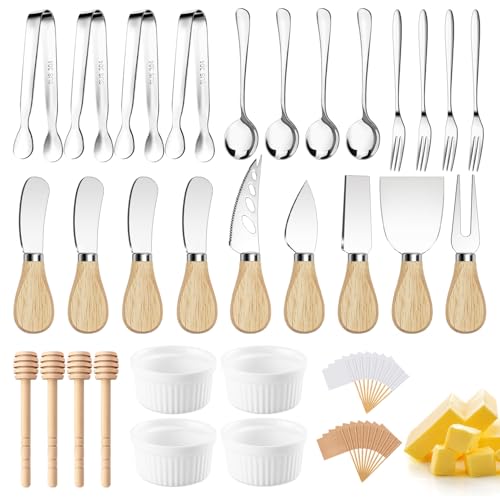 A comprehensive silver-finish charcuterie spreader set by Mlurcu, including serving forks, tongs, spoons, and cheese knives.
The Mlurcu set is similar in concept to the gold 169-piece set above but with a silver finish and a more focused piece count. It includes cheese spreader knives, butter knives, small serving tongs, forks, spoons, dipping bowls, honey dippers, and toothpick flags—enough serving hardware for a board that includes cheese, spreads, fruits, meats, and sauces.
Where this set excels is in small serving pieces. The forks, tongs, and spoons are sized correctly for individual portions—no awkward oversized serving utensils that dominate a small board. The toothpick flags and honey dippers add a level of detail to the board that makes it look finished rather than assembled.
The blades in this set are functional but basic. They work for spreading and light slicing of soft cheeses but should not be expected to handle hard cheeses effectively. This is a serving set first, a cutting set second.
Pros:
- Well-proportioned serving utensils for small boards
- Toothpick flags and dippers add visual polish
- Silver finish is versatile across many table settings
- Includes a good range of serving piece types
Cons:
- Knife blades are not designed for hard cheese cutting
- Silver finish requires gentle cleaning to prevent scratches
- Limited color and finish options
- Not a complete replacement for a dedicated cheese knife set
Best for: Hosts who want to complement an existing knife set with polished serving hardware.
8. Clarmonde Premium Stainless Steel Cheese Tool Set
 Clarmonde's six-piece premium cheese tool set features polished stainless steel construction and an elegant modern finish.
The Clarmonde set targets a middle ground between the budget sets and high-end cutlery brands. It includes six pieces—spreader, tri-tip, hard cheese knife, slicer, butter knife, and fork—with polished stainless steel blades and ergonomically shaped handles. The weight and balance are noticeably better than the GXIQYL and Guojanfon sets above, making cuts feel more controlled and less like you are wrestling a small blade.
In practice, the Clarmonde set feels like it was designed for someone who cares about the experience of cutting cheese—not just the outcome. The handle contours grip comfortably without requiring a tight fist, and the blade thickness is enough to keep the edges from flexing on harder cheeses.
The trade-off is price. At roughly double the price of the budget sets on this list, you are paying for better materials and more careful construction—but if you entertain weekly and want a set that lasts, the premium is justified.
Pros:
- Superior weight and balance compared to budget sets
- Polished finish elevates table presentation
- Six-piece coverage for all cheese types
- Handles resist grip fatigue during extended use
Cons:
- Higher price point than most sets here
- Requires hand washing despite stainless steel construction
- Limited to cheese use—not a multi-purpose set
- Not dishwasher-safe
Best for: Serious home entertainers who want a set that works well, looks good, and lasts for years.
9. YEVEETTE 4-Piece Cheese Knives Set
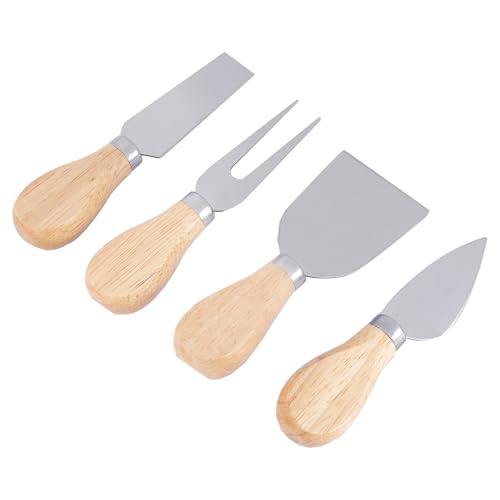 A four-piece YEVEETTE cheese knife set with rubber wood handles and stainless steel blades, including a fork.
The YEVEETTE set covers four pieces—knife, spreader, slicer, and butter knife, plus a fork—making it one of the few four-piece sets that includes a serving fork. The rubber wood handles are denser than standard hardwood, which gives them better resistance to moisture and cracking over time. The silver and brown color scheme gives the set a slightly more rustic appearance than the all-silver options.
What stands out about this set is the inclusion of the fork. Most four-piece sets omit the fork to reduce piece count, which forces users to share a single set of serving utensils or improvise. The YEVEETTE's fork means a two-person board can be served cleanly without cross-contact issues.
The blade geometry is functional rather than exceptional. It cuts soft and semi-hard cheeses without trouble, but the hard cheese knife in particular benefits from a slight honing after a few weeks of use to maintain crisp edges.
Pros:
- Includes a serving fork, which most four-piece sets omit
- Rubber wood handles are more moisture-resistant than standard hardwood
- Rustic color scheme suits many kitchen aesthetics
- Good price-to-piece-count ratio
Cons:
- Not dishwasher-safe; requires hand washing
- Blades may need periodic honing to stay sharp
- Limited piece count compared to six-piece sets
- Handle color variation may not suit every kitchen
Best for: Budget-conscious buyers who want a serving fork included and prefer a warmer, more rustic look.
10. LifeMusican Charcuterie Board Accessories — Wooden Cheese Spreader Set (23 Pieces)
 A 23-piece LifeMusican wooden-handled cheese spreader set with serving utensils, knives, tongs, spoons, and honey dippers.
The LifeMusican set is the largest knife and utensil collection in this review, combining mini cheese knives, slicers, tongs, spoons, forks, and a honey dipper in a single package. It is designed for people who host frequently and want a single storage location for all their board-serving hardware.
The wooden handles are the set's defining characteristic. They feel substantial in the hand and give the board a cohesive rustic look when all the pieces are laid out together. The density of rubber wood also means the handles hold up better to occasional moisture exposure than softer woods.
The main drawback is storage. Twenty-three pieces take up significant drawer space, and keeping them organized requires either a dedicated compartment or a rolling cart. For a small kitchen, this set may feel like more tool than you actually use on a regular basis.
Pros:
- Comprehensive piece count covers all serving needs
- Dense rubber wood handles are durable and comfortable
- Rustic aesthetic works well for home-style boards
- Includes a honey dipper, which is rarely included in other sets
Cons:
- Large storage footprint is challenging in small kitchens
- Requires hand washing for all wooden pieces
- Some pieces may remain unused for most casual board builders
- No dedicated hard cheese knife in the set
Best for: Frequent entertainers with adequate storage and a preference for rustic, cohesive serving sets.
Cleaning and Maintaining Your Cheese Knife Set
Cheese knives are one of the most neglected maintenance items in most kitchens. They accumulate protein residue that oxidizes over time, and handles—especially wooden ones—dry out and crack if not cared for. A few minutes of maintenance after each use keeps your set performing and looking good for years.
Immediate Post-Use Cleaning
Wash knives by hand in warm (not hot) soapy water within 15 minutes of use. Leaving protein residue to dry creates a biofilm that is difficult to remove and can harbor bacteria. Soak the blade in soapy water for no more than five minutes to loosen stuck-on cheese, then gently clean with a soft sponge or cloth.
Never leave cheese knives soaking overnight in water. Even stainless steel blades can develop corrosion at the blade-handle junction if exposed to prolonged water contact. Hand dry immediately and store blades pointing down or in a knife roll to protect both the edge and the blade tip.
Blade Maintenance
Stainless steel cheese knives do not need sharpening as frequently as high-carbon knives, but they still lose edge over time. Check your knives after about three months of regular use: if soft cheese sticks to the blade or you find yourself pressing harder than usual to cut through semi-hard cheese, it is time to hone.
A honing steel (not a sharpening steel, but a honing steel) used once or twice a month keeps edges aligned and cutting crisp. If the edge is damaged or truly dull—meaning honing does not restore it—a professional sharpening service or a quality whetstone will bring it back. Budget sets with soft stainless steel blades may need sharpening every 6–12 months depending on use.
Wooden Handle Care
Wooden handles are the most vulnerable part of most cheese knife sets. They absorb moisture, swell, and eventually crack if neglected. Apply a thin coat of food-safe mineral oil every 4–6 weeks to keep the wood sealed and supple.
A common mistake is using olive oil or vegetable oil on wooden handles. These oils oxidize over time, creating a rancid smell and a sticky residue that traps food particles. Mineral oil is inert and food-safe, which makes it the correct choice. Apply a small amount, rub it into the wood, and wipe off excess with a clean cloth.
Store wooden-handled knives in a dry environment. The bottom of a knife drawer with a silica gel packet is ideal. Avoid storing them next to a sink or in a damp cabinet.
When to Replace a Knife
Replace a cheese knife if the blade is rusted, the handle is cracked or wobbly, or the edge cannot be restored through sharpening. Most quality sets will last 5–10 years with proper maintenance. Budget sets may need replacement every 2–3 years depending on frequency of use and cleaning habits.
Building a Better Charcuterie Board: Knife-to-Cheese Pairings
Having the right knife for each cheese is one thing. Actually using the right knife in the right context is what makes a board feel intentional rather than assembled. Here is a practical pairing guide based on cheese texture.
| Cheese Type | Examples | Best Knife | Technique |
|---|---|---|---|
| Soft, washed rind | Brie, camembert, Taleggio | Spreader | Draw blade flat against rind, pull backward |
| Soft, bloomy rind | Camembert, brie (very soft) | Spreader or butter knife | Push cut, do not press tip |
| Semi-hard | Aged cheddar, havarti, provolone | Slicer | Draw outward from center; let cheese roll ahead |
| Hard, aged | Parmesan, grana, pecorino, aged Gouda | Hard cheese knife | Angle at 45 degrees, tap to find fracture line |
| Crumbly | Blue cheese, stilton, ricotta salata | Tri-tip shredder | Press vertically, lift straight up |
| Semi-soft, spreadable | Chèvre, cream cheese, labneh | Butter knife | Spread with gentle pressure |
| Wheel-format (any texture) | Wheel of brie, wheel of Gouda | Slicer (wedge cut) | Lay flat against rind, draw around curve |
One rule that covers most situations: match the knife's blade stiffness to the cheese's density. Soft cheese needs a wide, slightly flexible blade. Hard cheese needs a stiff, straight blade. Crumbly cheese needs prongs, not a flat surface. This heuristic works for 90% of board scenarios without requiring you to memorize every pairing.
A Note on Food Safety
When serving cheese and other ready-to-eat foods, food handling practices matter. The USDA Food Safety and Inspection Service recommends keeping cold cheeses at 40°F (4°C) or below and serving them within two hours of exposure to room temperature. If you are building a board ahead of time, keep cheeses on ice or in a chilled compartment until you are ready to assemble, and discard any cheese that has been at room temperature for more than two hours (one hour if the ambient temperature is above 90°F).
Wash your hands before handling cheese, and use clean utensils for each food group on the board—this prevents cross-contact between cheeses, spreads, and other items. If your set includes serving forks, use them as intended: individual guests should not be sharing a single set of forks across multiple cheeses.
Frequently Asked Questions
What is the difference between a cheese knife and a regular kitchen knife?
A cheese knife is shaped to cut through dairy fat without shattering or smearing it. A regular paring knife is sharp and thin, which is designed for vegetable and fruit work—not for cutting through soft, dense, or crumbly textures. Cheese knives have wider blades for support, specific tip geometries for different textures, and weight distributions that make cutting cheese controlled rather than forceful. You can use a paring knife for cheese in a pinch, but the result will be messier and less controlled every time.
How many cheese knives should a beginner buy?
Three to four is a good starting point: a spreader, a slicer, a hard cheese knife, and a butter knife. This covers soft, semi-hard, hard, and spreadable cheeses—which is most of what a beginner eats. You can add a tri-tip later once you start incorporating crumbly blue cheeses into your rotation. Buying a full six-piece set is not a mistake, but you will not use all the pieces consistently in your first few months.
Are wood-handled cheese knives better than metal ones?
Neither is universally better. Wood handles feel warmer and more comfortable during extended use, but they require hand washing and periodic oiling. Metal handles are dishwasher-safe, nearly indestructible, and heavier, which some people prefer for control. The choice comes down to your priorities: aesthetics and comfort favor wood; convenience and durability favor metal. If you are a dishwasher household, metal handles are the practical choice. If you care about the look of the board and do not mind a few minutes of hand washing, wood handles are rewarding.
How often should I sharpen cheese knives?
Once every six to twelve months for quality stainless steel knives in regular home use. You may need to hone them every few weeks to keep the edge aligned, but true sharpening (removing metal to create a new edge) is infrequent. If soft cheese is sticking to the blade, or you find yourself pressing harder to cut through semi-hard cheese, hone first before resorting to sharpening. A honing steel takes about 30 seconds and will restore performance if the edge is simply bent rather than dull.
Can I put cheese knives in the dishwasher?
Only if the knife is specifically labeled dishwasher-safe. Most wooden-handled sets are not, and even some stainless steel-handled sets with coatings (like non-stick finishes) can be damaged by the heat and chemistry of a dishwasher cycle. The safest rule is to hand wash all cheese knives unless the manufacturer explicitly states they are dishwasher-safe. The BOSKA set in this review is labeled dishwasher-safe and stands behind that claim; all others require hand washing.
How do I store cheese knives without damaging them?
Store them in a knife roll, a magnetic strip, or a dedicated drawer with a soft divider. Avoid tossing them loose in a drawer with other utensils—cheese knife edges are fine and can chip against harder materials. Keep wooden-handled knives away from moisture and heat sources (no next to the stove, no in a damp drawer). A silica gel packet in a drawer is a cheap, effective way to keep the environment dry.
Is a cheese knife set a good gift?
Yes, especially for someone who already hosts meals or shows interest in food and entertaining. A well-chosen set is more useful and more personal than a generic gift card, and the presentation-ready packaging of many sets (ICOSA, Clarmonde) makes it easy to gift without additional wrapping. The main caution is price: a $20 budget set and a $60+ premium set are both cheese knife sets, but the recipient's reaction to one versus the other depends entirely on their familiarity with kitchen tools. When in doubt, go with a mid-range set that has a quality handle and a complete six-piece coverage.
What makes the Guojanfon set better than a similar budget option?
The Guojanfon set uses stiffer blade steel than many comparable price-point sets, which means it holds up better to firmer cheeses and resists edge damage longer. The handle join is also tighter, reducing the risk of handle separation under pressure. It is not a dramatically better set, but for someone using the knives weekly rather than monthly, the durability difference pays off over time.
Can I use cheese knives for anything other than cheese?
Yes, though not efficiently for every task. A cheese spreader works well for spreading butter, jam, and soft spreads on bread. A butter knife is, by definition, a bread tool. A tri-tip works for crumbling herbs, breaking up croutons, and handling soft fish. A hard cheese knife can handle small cutting tasks but is not a substitute for a paring knife. If you buy a set with extra pieces, you get extra kitchen utility as a bonus.
Conclusion
A cheese knife set earns its place in your kitchen the moment you stop cutting brie with a paring knife and start cutting it with a spreader. The improvement is not dramatic enough to make you gasp—but it is consistent enough that you will never go back.
The right set for you depends on three things: how many cheeses you actually rotate through, how you host (casual versus formal), and whether you prioritize convenience (stainless, dishwasher-safe) or aesthetics (wood handles, elegant finish). A four-piece set serves most casual needs. A six-piece set covers every cheese type you are likely to encounter. A serving accessories set complements your knives for larger boards.
Start with a set that covers the cheeses you eat most, maintain it with hand washing and periodic oiling, and build from there. The goal is not to own every type of cheese knife—it is to cut the cheese you actually eat with the tool designed for it. That is the difference between a charcuterie board that looks like a pile of food and one that looks like it was made by someone who knows what they are doing.
Explore the sets above and find the one that fits your kitchen, your board, and your style. The right cheese knife set turns every board into an intentional choice.

Hi, I’m Daniel Brooks—a food lover and kitchen gear enthusiast. I enjoy testing cookware, utensils, and gadgets to see what really works in everyday cooking. At PlugChef.com, I share honest reviews, comparisons, and simple guides to help you choose the best tools for a safer, smarter, and more enjoyable kitchen.
Similar Posts