Washable Rug for Under Kitchen Table: A 2026 Buying Guide with 10 Reviewed Picks
A washable rug under the kitchen table is one of the highest-return small upgrades you can make to a home. It turns a hard, cold floor into something you actually want to sit at, catches the crumbs and spills that would otherwise reach the tile, and adds warmth and texture in under five minutes of labor.
The catch is that "washable" is often used loosely by marketers. In practice, not every rug that goes in the washer comes out of it looking the same — some shrink, some curl, some lose their backing adhesion after a few cycles. That's why this guide does three things: walks you through how to actually choose a washable rug for under a kitchen table (size, construction, materials, backing), reviews ten solid options across budgets and styles, and covers how to keep whatever you buy looking fresh for years. There's a quick-reference comparison table up front if you'd rather skip to the picks, a practical care section after, and an FAQ toward the end. For more on this, see our guide on non slip washable kitchen rugs.
By 2026, the washable kitchen rug category has matured considerably — polypropylene and olefin blends dominate the market, backing technology has improved meaningfully, and most brands finally label pile and dimensions in centimeters and inches consistently. If you're replacing a rug older than five years, you'll notice the difference immediately.
How to Choose the Right Washable Rug for Under a Kitchen Table
Before you compare individual products, four decisions matter more than any other. Get these right and most of the market opens up; get them wrong and no amount of style will save the purchase.
Size: the number that trips most buyers up
The single most common sizing mistake is buying a rug that fits under the table but not around the chairs. When someone pulls a chair back mid-conversation, the front legs of that chair are going to catch on the rug edge, trip, and drag — or worse, yank the rug out from under everyone.
For a rectangular kitchen table, add 6–10 inches to each dimension. A 60 × 36 in table calls for roughly 80 × 56 in, and a 72 × 36 in table wants something closer to 90 × 60 in. Leave that full 6-inch minimum on the sides where chairs swing out; you can go tighter on the ends where no chair normally sits.
For a round table, target a rug diameter of 15–20 inches larger than the tabletop. A 40 in round table pairs well with a 55–60 in round rug. Round rugs eliminate the corner-curling problem entirely and look more intentional under round tables — the trade-off is that they take up more square footage than the footprint might suggest.
For narrow or small kitchens, you have three honest options:
- An oversized single rug that covers the whole dining area including the walkway to the table — most cohesive, most expensive, most maintenance.
- A long runner (typically 50 × 150 cm or wider) that runs the full length of a galley or peninsula — great for narrow spaces, less forgiving on width.
- A multi-piece set of two or three rectangular rugs laid end-to-end with small gaps — most affordable and easiest to rotate, but the seams are visible.
In practice, I measure with the chairs pulled out. Put a chair in its normal eating position, push it back the way a real person would, and trace the leg path with tape. Then buy a rug that comfortably contains that trace. Most product listings under-describe their usable footprint.
Materials: what actually survives the washer
Every rug you're tempted to call "washable" is made from a limited set of fibers, and the fiber choice determines everything downstream — how it feels underfoot, how long it takes to dry, how many washes it can take before it degrades.
Polypropylene (olefin) is the workhorse of the washable rug category. It's synthetic, moisture-resistant, dries in hours instead of days, holds dye exceptionally well, and tolerates machine washing without shrinking. Almost every product under $100 that calls itself washable is polypropylene. The trade-offs: it doesn't breathe, so it can feel less luxurious underfoot, and low-grade polypropylene can pill after heavy use.
Cotton is the natural-fiber favorite for kitchens — soft, breathable, and it feels good after a long day of standing. The trade-offs are significant: cotton takes far longer to dry, shrinks noticeably in the dryer, and holds pet hair and food debris more aggressively. Choose it if you value comfort and don't have heavy mess situations; expect to wash it less often than polypropylene.
Microfiber is a synthetic that feels like wool. It's durable, soft, and machine-washable, but it picks up oils and food residues faster than polypropylene and needs more frequent washing. A fine balance between comfort and practicality.
Wool is the premium option — naturally stain-resistant, durable, and it doesn't pill in the same way synthetics do. But it's expensive, often not machine-washable, and prone to felting if washed too hot. Most wool rugs in a kitchen are hand-raked between washes, not thrown in the washer.
If you're trying to decode a fiber-content label on any rug, the FTC's textile standards are the governing rules: FTC Textile Standards Information Guides explain what each fiber designation means under 16 CFR Part 303. It's a useful 15-minute read if you're serious about buying the right material.
Backing: the difference between "washable" and "washable that stays put"
Backing is where most washable rugs quietly fail. It's also where most of the practical value lives, because a rug that drifts under a chair leg is a hazard regardless of how nice it looks.
Latex backing is the most common on midrange washable rugs. It's a rubber-latex blend that grips hardwood and most finished floors well, isn't too heavy, and doesn't typically leave marks. The trade-offs: it can yellow with age, it's not truly waterproof, and heavy use can cause the adhesive layer to separate from the rug face.
Rubber backing is the heavy-duty option. It's genuinely dense, doesn't move under chair legs or pets, and cleans up with a damp cloth. The trade-offs: it's heavier (1.5–3 lb per sq ft vs. roughly 0.5–1 lb for latex), it's more expensive, and some lower-quality rubbers have a noticeable off-gassing smell when new — let it air out in an unfurnished room for 24–48 hours before bringing it into a kitchen.
Felt backing is the softest and most comfortable on hardwood. It's also the least functional as a non-slip backing — it slides on any surface with a small amount of moisture. Felt-back rugs are usually paired with a separate rug gripper or underlay if you want them to hold in place.
Silicone dot backing is the third wave of non-slip technology. The dots create friction against tile, LVP, and vinyl without adhesive. It works well on hard surfaces and is completely harmless to floors, but the grip is less aggressive than full rubber — expect some movement under heavy chair drag.
Tape-edge backing is the budget option — literally a strip of tape glued to the underside of the rug. It's the least durable backing and the most likely to lift, peel, or delaminate over time. Fine for a low-use entryway mat; borderline for a kitchen table that gets daily chair traffic.
Pile height and edge construction
Pile height is the thickness of the rug face, measured from backing to the top of the fibers. Three categories matter:
- Low pile (under ¼ in): Best for under-kitchen-table use. Easiest to clean, doesn't trap crumbs, dries fastest, doesn't catch chair legs.
- Medium pile (¼ – 3/4 in): More comfort underfoot, still manageable for kitchen use. Slightly more maintenance.
- High pile (over 3/4 in): Rarely makes sense under a dining table. Traps food, takes forever to dry, drags chair legs. Save it for bedrooms.
For a kitchen table rug specifically, low pile is almost always the right call.
Edge construction affects longevity more than aesthetics. Tucked (or double-serged) edges are the strongest — the fibers are wrapped twice, so they resist fraying. Stitched edges are fine and slightly softer. Fringed edges look great but fray first and are the least practical on washable rugs.
The honest truth about "washable"
This is the part most buying guides skip. Any rug will technically survive a machine-wash cycle. The real question is whether it comes out looking like itself — same size, same color, same shape, same backing adhesion.
A well-constructed polypropylene rug with tape-edge backing can typically survive 50+ washes with minimal degradation. A cheaper blend with latex backing that gets washed monthly in hot water can start curling after four or five cycles. The difference isn't in the marketing — it's in the material quality and how you treat the rug.
A common mistake I see: tossing a washable rug in with the rest of the laundry, using hot water, and drying it on high. Three problems — hot water dyes can bleed, hot washes shrink synthetic blends, and high-heat drying melts rubber and latex backings into a permanent curl. Cold wash, mild detergent, gentle cycle, air-dry flat. That's it. Save the high-heat drying for your towels.
Quick Comparison: Ten Washable Rugs Side by Side
| Rug | Best For | Approx. Size | Material | Backing | Style |
|---|---|---|---|---|---|
| BLADO Barrier Mat | Commercial-style traffic | Multi-size | Rubber | Rubber | Solid |
| NETLINE HOME | Families, kids, pets | 80 × 150 cm | Microfiber blend | Non-slip | Oriental |
| HEBE Set of 3 | Full-room coverage | Varies by piece | Polypropylene | Non-slip | Boho |
| Homaxy Door Mat | Entryway + kitchen | 60 × 90 cm | Microfiber | Non-slip | Solid grey |
| RLAVBL Set of 2 | Colorful accents | 120 × 44 + 75 × 44 cm | Polypropylene | Non-slip | Floral |
| Moscow Utility | Heavy-duty utility | 50 × 80 cm | Rubber-backed | Heavy rubber | Multicolor |
| DEXI Set of 2 | Hallway + dining | 43.5 × 75 + 43.5 × 150 cm | Polypropylene | Rubber | Beige |
| SHACOS Runner | Entryways | 50 × 150 cm | Polypropylene | Non-slip | Grey |
| Homcomodar Distressed | Vintage/rustic | 60 × 150 cm | Polypropylene | Non-slip | Distressed |
| MELAJIA Set of 3 | Maximum coverage | 50 × 80 + 120 + 150 cm | Polypropylene | Non-slip | Grey |
The table gives you the shape of each pick; the reviews below explain why each one lands where it does.
10 Washable Kitchen Table Rugs Reviewed
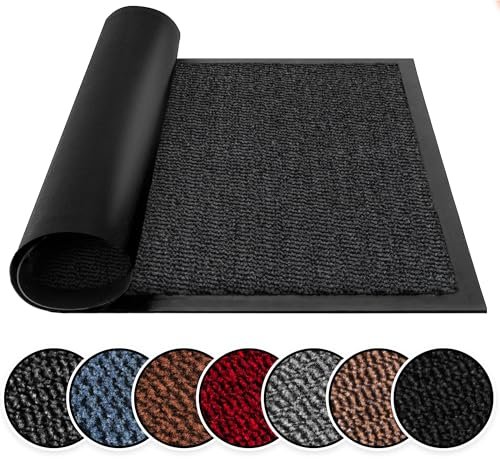
BLADO Barrier Mat Non-Slip Door Mat

BLADO's rubber-backed barrier mat in the anthracite colorway.
BLADO's Barrier Mat is the closest thing in this category to a commercial-grade entryway mat that happens to work well in a kitchen. The construction is genuinely rubber throughout — not a rubber backing on a synthetic face — which gives it real weight and grip. It traps grit, absorbs moisture well, and shrugs off whatever spills land on it.
The mat is available in multiple colors and sizes, which is helpful for matching the rest of your floor plan. It's lightweight enough to lift off for cleaning but dense enough that it doesn't curl at the edges or slide under chair legs. If your kitchen gets heavy daily traffic — kids' lunchtime chaos, guests bringing muddy shoes, a family dog — this is the closest thing to a set-it-and-forget-it solution.
Pros:
- Genuine rubber construction holds up under heavy daily use.
- Washable without any special treatment — wipe or hose down as needed.
- Lightweight enough to move for deep cleaning, dense enough to stay in place.
- Available in multiple sizes and colors to match varied spaces.
- Especially strong non-slip performance on tile and LVP.
Cons:
- Anthracite is a darker color than many kitchens call for — may feel heavy against bright cabinetry.
- Size options are more limited than some brands; measure carefully before ordering.
- Less "cozy" underfoot than a fabric rug; reads more as a mat than a rug.
Find current pricing on BLADO Barrier Mat
NETLINE HOME Machine Washable Area Rug

NETLINE's oriental-patterned area rug in the Multicolor 2 way.
NETLINE's rug is a family-focused pick that leans into comfort without giving up washability. The multicolor oriental pattern reads as traditional but not fussy, and the low pile keeps the maintenance light. Kids and pets can drag whatever they want across it, and a gentle cold wash brings it back.
The rug is 80 × 150 cm — long enough to sit under a small-to-medium dining table, short enough to work as a runner along a galley kitchen or entryway. The non-slip backing holds under chair legs and pet paws, and the fabric is soft enough that a barefoot kid isn't standing on something that feels like plastic. In practice, this rug works best for families who want the feel of a traditional rug with the practicality of a synthetic mat.
Pros:
- Machine-washable with gentle cycle and cold water — survives real family use.
- Kid- and pet-friendly fabric with low-pile comfort.
- Non-slip backing that holds under active household traffic.
- Oriental design adds pattern without feeling decorative or formal.
- 80 × 150 cm dimensions work for dining tables or as a hallway runner.
Cons:
- Limited colorway range — Multicolor 2 is the primary SKU.
- Small-to-medium size may not cover larger dining setups.
- Low pile offers less cushion than medium-pile options.
See NETLINE HOME's current selection
HEBE Farmhouse Kitchen Rugs — Set of 3

HEBE's three-piece boho rug set in the light grey colorway.
HEBE's set of three is the answer to "I want coverage but I'm not sure how to arrange rugs" — you get three matching pieces and can lay them out in whichever configuration fits your kitchen. Two common layouts: a long hallway-style run, or a single-piece kitchen with a runner to the pantry.
The boho design is subtle rather than loud — thin geometric patterns on a light grey base — so it reads as modern farmhouse without overwhelming other décor. The washable surface handles spills and crumbs well, and the non-slip backing holds on hardwood and tile. In practice, the light grey is where the trade-off lives: it photographs beautifully but shows every speck of soil. Plan for a wash every two to three weeks if your kitchen sees heavy traffic.
Pros:
- Set of three pieces offers real layout flexibility.
- Non-slip backing on all three pieces.
- Washable surface with no special treatment needed.
- Boho pattern is subtle enough to blend with most modern and rustic kitchens.
- Coverage-friendly without a single large rug's high price tag.
Cons:
- Light grey shows visible dirt and crumbs between washes.
- Thickness is minimal — more of a decorative layer than a comfort pad.
- Smaller pieces may not cover a wide dining area on their own.
View the HEBE set of 3 in detail
Homaxy Door Mats Indoor

Homaxy's absorbent grey entry rug, 60 × 90 cm.
Homaxy's indoor door mat is designed primarily for entryways, but the absorbent microfiber surface and non-slip backing make it a strong second life as a small kitchen or under-sink mat. If you have a pet that shakes wet fur across the floor, this mat is built to catch it.
The grey colorway is neutral and works with almost any kitchen palette. The 60 × 90 cm footprint is compact enough to tuck in tight spots — under a window sill, along a narrow hallway, beside the fridge. It's slightly heavier than it looks, which keeps it from shifting but makes it a bit of a lift when you want to move it around.
Pros:
- Machine-washable without any special products.
- Non-slip backing holds on hardwood, tile, and LVP.
- Absorbent surface traps pet fur, grit, and moisture effectively.
- Compact 60 × 90 cm size fits narrow kitchen spots.
- Grey colorway is genuinely neutral for most kitchens.
Cons:
- Only grey colorway available in most SKUs.
- Heavier than it looks — around 1.85 lb for the standard size.
- Designed as a mat rather than a comfort rug; less underfoot softness.
Check Homaxy's indoor mat options
RLAVBL 2-Piece Kitchen Rug Set

RLAVBL's two-piece floral set — the 120 × 44 cm and 75 × 44 cm runners.
RLAVBL's two-piece set is the most color-forward option in this group. The floral pattern is genuinely playful — not the "floral" of your grandmother's kitchen, but a modernized take that adds warmth to a smaller kitchen or breakfast nook. The two runners (120 × 44 cm and 75 × 44 cm) lay out cleanly along a galley kitchen or as two matching pieces flanking a narrow dining table.
The washable construction is solid — it takes a cold wash without trouble and dries without noticeable shrinkage. The trade-off is the same one the color invites: bright florals show dust and crumbs more than solid or neutral patterns. If your kitchen is high-traffic, expect to spot-clean weekly and machine-wash monthly.
Pros:
- Two-piece set with flexible runner-style dimensions.
- Washable and machine-washable without special care.
- Non-slip backing holds on hard floors.
- Vibrant floral pattern adds warmth and personality.
- Compact runners fit tight kitchens and galley layouts.
Cons:
- Bright color shows dirt and crumbs more than neutral patterns.
- Two-piece layout means visible seams where runners meet.
- Runner-style dimensions won't cover wide dining areas.
Moscow Heavy-Duty Rubber-Backed Machine Washable Utility Rug
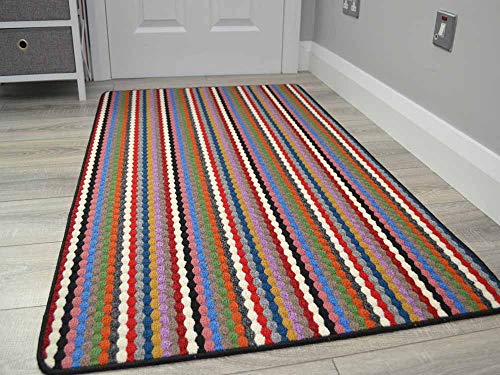
Moscow's rubber-backed utility rug in the multicolor pattern, 50 × 80 cm.
Moscow's utility rug is built the way you'd want a work-mat built — heavy rubber backing, dense synthetic face, and a color palette that hides scuffs and wear. It's the most rugged single piece in this guide and makes the most sense in a kitchen that sees daily cooking traffic and regular cleaning.
The 50 × 80 cm footprint is on the smaller side, which limits it to one spot — under a small kitchen table, along a narrow hallway, or beside the washing machine. But in that spot it's hard to beat for durability. The rubber backing is heavy enough that it genuinely doesn't move, and the multicolor pattern hides the wear that would otherwise show on a solid surface after months of use.
Pros:
- Heavy rubber backing is genuinely non-slip and doesn't shift.
- Durable enough for high-traffic kitchens with daily washing.
- Multicolor pattern hides dirt and wear over time.
- Machine-washable with cold water and gentle cycle.
- Utility-scale dimensions work for tight kitchen and laundry spaces.
Cons:
- Heavier than average — a bit awkward to move for deep cleaning.
- Single-piece size is on the smaller side for larger dining setups.
- New rubber backing can have an initial off-gassing smell; air it out first.
See Moscow's rubber-backed utility rugs
DEXI Kitchen Rug Mat Set — 2 Pieces

DEXI's two-piece beige set — 43.5 × 75 cm and 43.5 × 150 cm runners.
DEXI's set of two runs the length-first layout: a long 43.5 × 150 cm runner paired with a shorter 43.5 × 75 cm mat. It's a smart setup for galley kitchens, entryways that open into dining areas, or any kitchen where you want a continuous floor run without buying one oversized rug.
The beige colorway is one of the more forgiving neutrals — warmer than grey, less saturated than tan. It photographs well and hides the small crumbs that light grey shows. The rubber backing is dense and holds on tile and LVP, though it's slightly less aggressive than full latex on hardwood. The set is washable with no special treatment.
Pros:
- Two-piece layout covers more ground than most single rugs.
- Rubber backing grips tile, LVP, and sealed hardwood well.
- Washable with no special products or cycles.
- Warm beige colorway is forgiving and versatile.
- Long-runner dimensions suit galley and open-plan kitchens.
Cons:
- Limited colorway range — beige is the primary option.
- Narrower width (43.5 cm) may feel cramped under a large dining table.
- Two-piece layout means visible seam between runners.
Explore DEXI's kitchen rug sets
SHACOS Runner Rug for Hallway

SHACOS's grey hallway runner, 50 × 150 cm.
SHACOS's 50 × 150 cm runner is the narrow-strip solution for any kitchen that doesn't have room for a full rectangular rug. If your dining area sits along one wall of a galley or small apartment kitchen, this is the piece that solves it — long enough to sit under the table, narrow enough to leave walking clearance on either side.
The grey colorway is a neutral that plays well with wood, stone, and painted cabinetry. The absorbent surface handles splashes from the sink or a dropped drink, and the non-slip backing holds on most hard floor types. In practice, this is one of the easier runner rugs to keep fresh — small enough to fold and toss in the washer without drama, light enough to dry in a few hours.
Pros:
- Compact runner dimensions fit tight kitchens and galley layouts.
- Washable and non-slip — the two must-haves for a kitchen floor.
- Absorbent surface handles minor spills and splashes.
- Grey colorway blends with most kitchen palettes.
- Lightweight enough to lift for washing without strain.
Cons:
- Thin profile offers little cushion for long periods of standing.
- Single-piece size means it covers only a narrow strip of floor.
- Grey color can show dust and hair between washes.
Homcomodar Distressed Runner Rug for Hallway

Homcomodar's distressed grey-beige hallway runner.
Homcomodar's distressed runner is the piece for anyone whose kitchen has rustic or vintage cabinetry and wants a rug that reads as worn-in rather than new. The pattern deliberately shows frayed-edge aesthetics that read as character rather than damage, which means everyday wear actually improves the look over time.
At 60 × 150 cm, it's a long runner — the same proportion as SHACOS but wider by 10 cm. That extra width makes it feel more like a runner than a hallway strip, and it works under a small dining table without feeling cramped. The washable surface handles standard kitchen spills without issue, and the non-slip backing holds on hardwood and tile.
Pros:
- Distressed pattern masks everyday wear as intended character.
- 60 × 150 cm dimensions suit narrow kitchens and small dining tables.
- Non-slip backing on hardwood and tile.
- Machine-washable with cold water.
- Grey-beige palette blends with rustic, vintage, and modern farmhouse kitchens.
Cons:
- Limited to grey-beige colorway.
- Thin profile offers less comfort underfoot than medium-pile options.
- Distressed aesthetic doesn't suit very formal or minimalist kitchens.
See Homcomodar's distressed runners
MELAJIA Kitchen Mats — Non-Slip Washable Set of 3
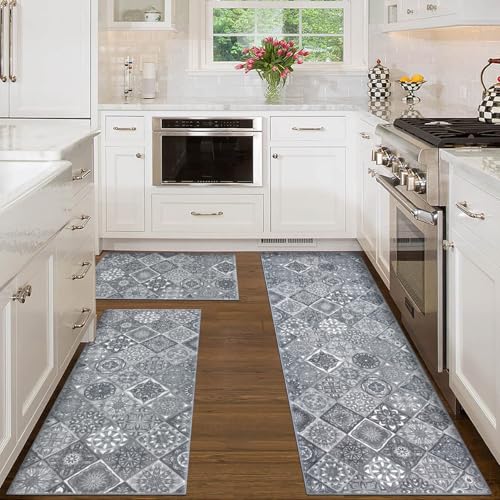
MELAJIA's three-piece grey set — 50 × 80 cm, 50 × 120 cm, and 50 × 150 cm pieces.
MELAJIA's set of three is the most coverage-oriented pick in this guide. You get a short 50 × 80 cm mat, a mid-length 50 × 120 cm piece, and a long 50 × 150 cm runner — enough material to lay across a full galley kitchen or a small dining area with a walkway extension.
The grey colorway is neutral and low-maintenance; it matches most cabinetry and hides the light dust that shows on lighter rugs. Each piece is individually washable, which matters — if the long runner gets a heavy spill, you can wash just that piece without removing the other two. The non-slip backing is solid on tile and LVP but slightly less aggressive on hardwood.
Pros:
- Three-piece set offers the most layout flexibility in this guide.
- Washable without special care on any piece.
- Non-slip backing on all three pieces.
- Grey colorway blends with nearly any kitchen palette.
- Multi-size set lets you reconfigure as your kitchen changes.
Cons:
- Thin profile means less comfort underfoot than a single padded rug.
- Grey color shows more wear over time than patterned options.
- Smaller pieces won't cover a wide dining table on their own.
How to Wash and Maintain a Washable Kitchen Rug
The rug only lasts as long as you let it. Three practices — proper washing, smart stain response, and consistent rotation — extend any rug's life by years.
The wash routine
- Use cold water. Hot water sets stains permanently in synthetic fibers and can shrink polypropylene. Cold is your baseline, always.
- Mild, diluted detergent. Regular laundry detergent, but diluted. Concentrated detergent leaves residue that makes the rug feel sticky and attracts more dirt in the first wash cycle.
- Gentle cycle only. Aggressive agitation frays fibers and can lift the backing adhesion. Delicate or hand-wash cycle.
- Extra rinse, no spin if possible. Residue in the fibers is what makes rugs smell musty after drying. If you can run a second rinse cycle without spinning, do it.
- One rug at a time, unless it's small. Mixing rug fiber with other laundry can transfer oils and lint. If your rug is small enough to share a load, keep the load light.
Stain response — the first 30 seconds matter
When a spill hits, do this in order:
- Blot, don't rub. Rubbing pushes the liquid deeper into the pile. A clean towel, a few gentle presses, and the worst of the stain is out.
- Cool water first. Cool water lifts most food and drink residues. Hot water sets proteins.
- Diluted vinegar for stains. One part white vinegar to two parts water lifts most organic stains without damaging fibers.
- Hydrogen peroxide for stubborn food. Works well on tomato, wine, and berry stains — but test on an inconspicuous spot first, since peroxide can lighten color.
- Club soda for oils and grease. Carbonation helps lift oils without soaking the pile.
A common mistake: reaching for bleach or a harsh chemical right away. Bleach yellows most synthetic rugs permanently, and it can damage the backing adhesive. If you're dealing with a genuinely stubborn stain, cold wash first, then targeted treatment.
If you're sensitive to chemicals or have kids and pets who might come into contact with cleaning agents, the shift toward plant-based and non-toxic alternatives is genuinely useful — see non-toxic first aid kit options for a broader look at what "non-toxic household products" actually means in practice. The same principle applies to rug cleaners and general household products: avoid anything you can't pronounce, and don't assume "fragrance-free" means "chemical-free."
Drying: where most people get it wrong
- Air dry flat is the gold standard. Lay the rug on a rack or clean floor, weighted at the corners with books or towels. A 60 × 100 cm rug typically needs four to six hours.
- Rotate mid-dry. Flip it over halfway through and check for damp spots at the edges — that's where they hide.
- Machine dry only if labeled OK. Low heat is the maximum. High heat melts latex and rubber backings into permanent curl. When in doubt, air dry.
- No direct sun, no radiator. UV fades dyes; heat damages backings. If you must dry near heat, keep the rug at least 18 inches away.
- Full dry before putting back on the floor. A rug that's still slightly damp underneath traps moisture between the rug and the floor — a mildew and odor problem waiting to happen.
Rotation and care cadence
- Rotate every 4–6 weeks. Turn the rug 180° so the sides that bear chair-leg traffic switch. Even wear extends life considerably.
- Vacuum weekly in high-traffic areas. A small handheld works fine; you're mostly removing surface crumbs and dust.
- Deep wash monthly or when visibly soiled. Don't wait for the rug to become a health problem. Two or three washes a year is a reasonable target.
- Spot-clean daily when needed. A damp cloth and mild detergent handles 90% of daily messes without a full wash.
Home Safety Beyond the Rug
A non-slip rug prevents the most common kitchen accident — the slip on a dropped glass or a wet floor — but a rug is a layer of protection, not a complete solution. OSHA's national emphasis on slip, trip, and fall hazards documents how frequently these incidents happen and how small environmental changes can reduce their impact. In a home kitchen, the same principles apply: a rug that grips, non-slip footwear, mats at the sink and stove, and clear walkways all compound to a safer space.
The next layer of readiness is what happens when a small cut or minor burn happens mid-prep. Keep a small mini first-aid kit somewhere accessible — a drawer near the sink, a backpack for anyone who carries one, or even tucked into a tote — with the essentials: adhesive bandages in three sizes, gauze pads, antiseptic wipes, a pair of gloves, and a small pair of tweezers. A few minutes of stockkeeping now saves a trip to the pharmacy later.
If you do invest in a proper home kit, keep the first aid kit refill supplies you need on hand to top it off after use — gauze and antiseptic run out first, and restocking them before you're short keeps the kit usable. For smaller living spaces — college apartments, rentals, dorm rooms — a first aid kit for college is often the most practical format, sized to fit in a desk drawer without crowding anything else.
Frequently Asked Questions
How do I clean a washable kitchen rug?
Shake off loose crumbs and debris, then machine wash in cold water on the gentle cycle with diluted mild detergent. Skip bleach and harsh chemicals — they damage synthetic fibers and backing. Air dry flat for 4–6 hours, rotate mid-dry, and don't put the rug back on the floor until it's fully dry.
Are washable kitchen rugs actually durable?
The ones that are built correctly, yes. A polypropylene rug with a well-constructed backing survives 50+ wash cycles without significant degradation. Durability depends more on the material and backing than on price — a $30 polypropylene rug with rubber backing will outlast a $60 cotton rug with tape-edge backing in a busy kitchen.
Do washable kitchen rugs slip on hard floors?
Quality ones shouldn't. Latex, rubber, and silicone dot backings all create friction that holds on hardwood, tile, and LVP. The risk is cheap tape-edge backing, which peels over time and stops gripping. If you have hardwood and want extra insurance, add a non-slip rug pad under the rug — it adds roughly $15 to $30 and eliminates most movement.
Can washable rugs really trap dirt effectively?
Yes — low-pile polypropylene and microfiber are actually quite good at catching fine dust and small food particles that a broom misses. The trade-off is that these materials show the debris more visibly than hardwood, so you'll spot-clean more often. That's a feature, not a bug, if your priority is a floor you can wipe with a damp cloth rather than vacuum daily.
Are washable rugs suitable for homes with pets?
Very. Washable rugs handle pet hair, muddy paws, and the occasional accident better than any other rug type. Non-slip backing also reduces pet-related slip risk, which matters more than people realize — a dog with wet paws on a slip-resistant rug has dramatically more traction than on bare hardwood. Just wash monthly or more in a heavy-pet household.
What sizes do washable kitchen rugs come in?
Common sizes for under a kitchen table: 60 × 90 cm, 80 × 150 cm, and 100 × 150 cm for rectangular rugs; 120 × 120 cm or 130 × 130 cm for round rugs; 50 × 150 cm for runners. Multi-piece sets come in combinations like 50 × 80 cm, 50 × 120 cm, and 50 × 150 cm. Measure your table and chairs with the chairs pulled out, then add 6–10 inches to each dimension for clearance.
How often should I wash a kitchen table rug?
Every 4–8 weeks for average kitchen use. Every 2–3 weeks for high-traffic kitchens, homes with young kids, or multi-pet households. Spot-clean daily when you see debris, and don't wait for the rug to become visibly soiled to wash it — the fibers wear faster when they're constantly covered in grit.
Can I dry a washable rug in the dryer?
Only if the manufacturer's care label explicitly allows it, and only on the lowest heat setting. Most washable rugs lose color, curl at the edges, or damage the backing in a dryer. Air-drying flat is faster (4–6 hours), gentler on the materials, and eliminates the risk of heat damage entirely.
Do I need a non-slip pad under a washable kitchen rug?
If your rug has a real rubber, latex, or silicone-dot backing, no — the rug holds on its own. If your rug is a thinner or budget option with tape-edge backing, yes — a $15 non-slip rug pad underneath doubles as a cushion and adds grip. Hardwood floors especially benefit from an under-pad, both for grip and to prevent the rug from scratching the finish.
Is a washable rug better than a non-washable one for a kitchen?
For a kitchen, almost always yes. Kitchens produce food debris, moisture, and occasional spills at a rate that non-washable rugs can't keep up with. A washable rug lets you reset the floor on your own schedule; a non-washable rug waits until it's a health problem before you can clean it. The only real counter-case is a formal dining room where you want the aesthetic of a wool or sisal rug and don't expect daily mess — even then, a washable rug underneath with a decorative layer on top is often a smarter combination.
Conclusion
The right washable rug under a kitchen table is the intersection of four things: the right size for your specific table and chairs, the right material for your traffic and cleaning habits, the right backing for your floor, and a pattern that you'll still like in three years. Pick along those lines and the search shortens fast.
For most kitchens, a polypropylene rug with rubber or latex backing in a low pile is the safe default. BLADO's rubber mat wins on ruggedness, HEBE's and MELAJIA's sets of three win on coverage, and Homcomodar's distressed runner is the best fit if your kitchen has a vintage or rustic feel. If your kitchen is small and galley-style, SHACOS's runner solves the problem cleanly.
Whichever rug you choose, treat it like the durable piece of equipment it is — cold wash, mild detergent, air dry, rotate quarterly. A well-treated washable rug lasts five to eight years, which beats the two-to-three year replacement cycle of most cheaper rugs on the market.
That's a warmer kitchen floor, less daily vacuuming, and fewer spills reaching the tile underneath. Not much else in a small-home upgrade pays off at that ratio.

Hi, I’m Daniel Brooks—a food lover and kitchen gear enthusiast. I enjoy testing cookware, utensils, and gadgets to see what really works in everyday cooking. At PlugChef.com, I share honest reviews, comparisons, and simple guides to help you choose the best tools for a safer, smarter, and more enjoyable kitchen.
Similar Posts