Under Cabinet LED Lighting Kitchen: Illuminate Your Space With Style
Under cabinet LED lighting transforms a kitchen from merely functional to genuinely enjoyable. The right fixtures eliminate shadows on countertops, reveal true ingredient colors, and add a layer of ambiance that overhead cans never achieve. Whether you're retrofitting a rental or specifying a new build, the fundamentals haven't changed: pick the right color quality, enough lumens for the task, and a power method that fits your wiring reality. This guide walks through the decisions that actually matter, then breaks down ten current models so you can match product to project.
Why Under Cabinet Lighting Matters
Overhead lighting casts your body shadow exactly where you chop, measure, and read recipes. A well-placed LED bar or strip fills that gap with focused, high-CRI light. The U.S. Department of Energy notes that quality LEDs now deliver 90+ CRI at 80+ lumens per watt, making them the most efficient way to hit the 500 lux target the Illuminating Engineering Society recommends for food-prep surfaces. In practice, the difference between a 2700 K "warm" bar and a 4000 K "neutral" bar is the difference between seeing salmon as appetizing pink versus dull gray. For more on this, see our guide on best blenders for smoothies under 100.
Types of Under Cabinet LED Lights
Hardwired, Plug-In, or Battery-Powered
| Power Method | Best For | Trade-Off |
|---|---|---|
| Hardwired (120 V or 24 V driver) | New construction, major remodels | Cleanest look; requires electrician or confident DIY with permit |
| Plug-in (transformer + outlet) | Existing kitchens with nearby receptacle | Visible cord unless you add an under-cabinet outlet |
| Battery / USB-rechargeable | Renters, quick upgrades, inside cabinets | Limited runtime; motion sensors extend battery life significantly |
Form Factor: Bar, Puck, or Strip
- Linear bars (profile lights) mount flush, distribute light evenly, and hide the LED dots behind a diffuser. Ideal for continuous runs.
- Puck lights create pools of light; space them 8–12 in. apart for even coverage. Good for accenting glass-front cabinets.
- Flexible strip / tape light bends around corners and fits ultra-shallow recesses. Requires an aluminum channel for heat sinking and a clean finish.
Key Specifications to Compare
Color Temperature (CCT) and CRI
- 2700 K – 3000 K: Warm, residential feel; flatters wood tones and warm stone.
- 3500 K – 4000 K: Neutral "clean" white; best color accuracy for chopping and reading labels.
- 5000 K +: Cool daylight; can feel clinical in a home kitchen.
- CRI ≥ 90 is non-negotiable for food prep. Below 85, reds and greens shift noticeably.
Lumens and Brightness Needs
Aim for 300–500 lumens per linear foot of countertop. A 24 in. bar at 400 lm/ft delivers ~800 lm total — plenty for a standard sink run. Dimmable fixtures let you drop to 10 % for late-night ambiance without a second circuit.
Dimming Capabilities
- Phase-cut (TRIAC/ELV): Works with standard wall dimmers; check driver compatibility.
- 0–10 V / PWM: Common on 24 V systems; requires dedicated dimmer.
- Stepless onboard / remote: Battery units often use a long-press button or RF remote. Smoothness varies — test before mounting.
Power Source and Installation Reality
Hardwired 24 V systems with a remote driver (tucked in a nearby cabinet) stay cooler and last longer than 120 V bars with onboard drivers. For plug-in units, a cable-management raceway painted to match the cabinet underside keeps the cord invisible. Battery bars with magnetic mounts let you reposition in seconds — useful when you reorganize pantry shelves seasonally. For more on this, see our guide on kitchen hood cleaning certification online.
How to Choose the Right Light for Your Kitchen
- Measure every run — note outlet locations, cabinet depth, and front-frame lip height.
- Pick CCT first — match adjacent lighting (can lights, pendants) within 200 K.
- Select power method — if no outlet above cabinets, battery or plug-in with a new receptacle are your only code-compliant options.
- Verify dimming — if you want wall-dimmer control, buy a 24 V bar + compatible driver + ELV dimmer.
- Check depth — ultra-slim bars (< 10 mm) fit behind shallow European hinges; deeper profiles need 15 mm+ clearance.
Installation Overview: What to Expect
- Hardwired: Turn off breaker, fish NM-B or MC cable to driver location, mount driver in accessible junction box, run low-voltage wire to each bar, secure bars with screws or 3M VHB tape, connect, test, label circuit.
- Plug-in: Mount transformer atop cabinet or in adjacent cavity, route cord through ½ in. grommet hole, secure bars, plug in, pair dimmer if wireless.
- Battery: Clean mounting surface with isopropyl alcohol, apply magnetic strip or VHB tape, press bar on, charge via USB-C before first use.
Code check: NEC 411.16(A) permits Class 2 low-voltage lighting in cabinets without conduit. 120 V fixtures require a listed connection method and GFCI protection at the receptacle. When in doubt, pull a permit — it's cheaper than a failed inspection.
Product Roundup: Top Picks for 2026
FLYNGO Plastic Motion Sensor Under Cabinet LED Light
 Compact 40 cm bar with onboard motion sensor and three CCT settings
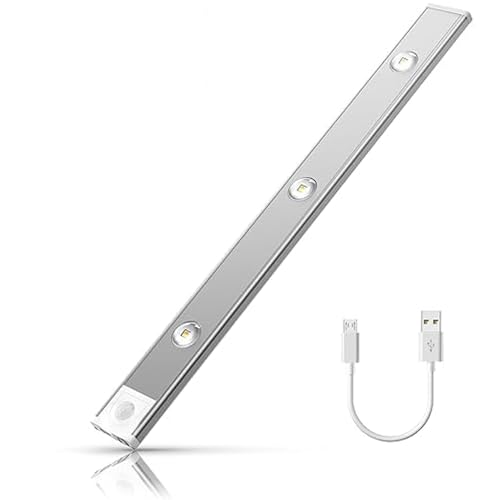
The FLYNGO bar packs a PIR sensor, 3000 K / 4000 K / 6500 K toggle, and smooth stepless dimming into a 40 cm white housing. Motion timeout is fixed at ~20 seconds — fine for pantry trips, less so for extended prep. The diffuser softens diode imaging well for the price. Best for: rental pantries, laundry nooks, or secondary prep zones where wiring isn't an option. For more on this, see our guide on kitchen brushes for cleaning.
Murphy 1 ft LED Under Cabinet Lighting (Warm White)
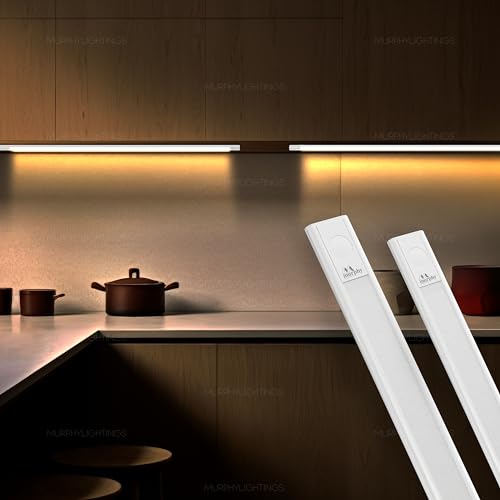 Slim 0.2 in. profile disappears under shallow cabinets
At 4 W and 12 in. long, this aluminum bar delivers a consistent 2700 K wash with minimal diode spotting. The ultra-thin profile (5 mm) clears even tight European hinge clearances. No onboard dimming — pair with a plug-in PWM dimmer if you need level control. Best for: continuous runs under upper cabinets where you want a permanent, hardwired-look installation without the electrician.
NIRDAMBHAY Under Cabinet Light (Black, 40 cm)
 Wireless 1200 mAh unit with three CCT modes and magnetic mount
The matte-black housing blends into dark cabinet interiors. Three CCTs (3000 K / 4000 K / 6000 K) and a 1200 mAh cell yield ~6–8 hours at full output; motion-only stretch reaches weeks. Magnetic rail allows tool-free repositioning. Best for: renters, glass-front upper cabinets, or anywhere you want zero wiring and a modern finish. For more on this, see our guide on commercial kitchen hood cleaner.
GITGRNTH Under Cabinet Ultra-Thin Lights (3-Pack)
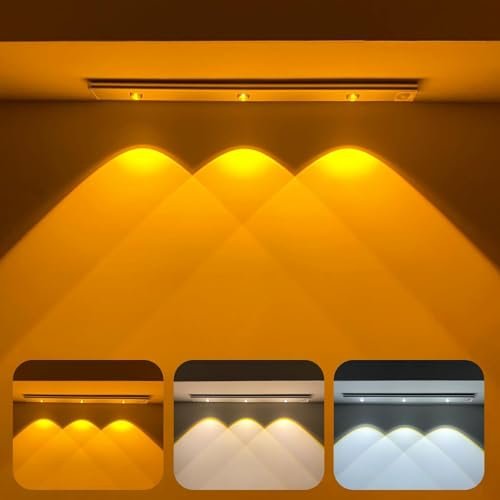
 Three 30 mm pucks with hill-effect diffusion and USB-C charging
Each 1.18 in. puck weighs 28 g and adheres via magnetic discs. The "hill effect" dome spreads light wider than flat pucks, reducing hotspots. USB-C charging takes ~2 hours; runtime ~4 hours at max. No motion sensor — manual tap cycle only. Best for: accent lighting inside cabinets, wine racks, or stair treads where a bar won't fit.
DEVICE OF J With JANISH 24 in. 8 W LED Profile Light
 24 in. warm white bar with 0.4 in. profile and GU10-compatible driver
An 8 W, 2700 K bar that spans a full sink base. The aluminum body acts as heatsink, keeping diode junction temps low for 50,000 hr rated life. Fixed warm white only — choose this when your design locks to 2700 K. Best for: primary prep runs where you want a single, continuous, hardwired-quality fixture. For more on this, see our guide on industrial kitchen cleaning companies.
AHUJA INTERNATIONAL LED Profile Light (3 ft Warm White)
 36 in. ultra-slim bar for long continuous runs
The 3 ft length covers a standard 36 in. cabinet run with one fixture. 17 mm wide × 8 mm tall profile tucks behind most face frames. Warm white only; no onboard controls. Pair with a 24 V constant-voltage driver and your preferred dimming method. Best for: new-build spec or full remodel where you want fewer seams and a single driver.
Wishbone Wireless Magnetic USB Rechargeable Light Strip (50 cm)
 Flexible 50 cm strip with magnetic mount and motion activation
A true strip form factor — bends to 30 mm radius — with integrated 1500 mAh cell and PIR sensor. Magnetic rail + 3M backup tape handles textured surfaces. Motion sensitivity is adjustable via a recessed switch (rare at this price). Best for: curved cabinet crown molding, toe-kick lighting, or irregular shelving where rigid bars won't follow the contour.
libtit Motion Sensor Under Cabinet Lighting (23 cm)
 Short 23 cm bar, 1500 mAh battery, fixed 6500 K daylight
The shortest bar here, fixed at a cool 6500 K. High CRI claim (unverified) but the blue-heavy spectrum can wash out warm wood tones. 1500 mAh cell lasts longer than the NIRDAMBHAY at similar draw. Magnetic mount only — no screw holes. Best for: task-specific spots (spice pull-out, knife block) where you want crisp, automatic light and don't mind the cool cast.
Murphy 2 ft LED Under Cabinet Lighting (2-Pack, Cool White)
 Two 24 in. bars at 8 W each, 4000 K output
Pair covers a 4 ft run (typical sink + prep zone) with matched bins. 4000 K hits the neutral sweet spot for food prep. Same 0.2 in. profile as the 1 ft model. No onboard dimming; wire both to one 24 V driver and a single PWM dimmer for unified control. Best for: primary kitchen runs where you want consistent, neutral task light across a long span.
Wipro Garnet 10 W LED Linear Cabinet Light (2 ft)
 Established brand, 2700 K, 17 mm × 8 mm profile, 10 W
Wipro's pedigree shows in tighter binning and a rated 50,000 hr L70. The 2700 K output is notably consistent unit-to-unit. Driver is external (included), so the bar stays cool and thin. Best for: buyers who value brand-backed warranty and color consistency over feature count.
Common Mistakes to Avoid
- Mixing CCTs on the same countertop run — the eye sees the transition line every time.
- Undersizing lumens — 150 lm/ft looks fine in a showroom; at 9 pm it's a flashlight.
- Skipping a diffuser on raw strip — diode dots reflect off polished stone and glass backsplashes.
- Mounting too far back — push the fixture to the front lip of the cabinet; every inch back loses 15 % countertop illuminance.
- Forgetting the driver location — a 24 V driver buried behind a toe-kick with no access panel is a future service call.
Maintenance and Longevity Tips
- Dust the diffuser quarterly — a microfiber cloth restores 5–10 % output lost to kitchen grease film.
- Check magnetic mounts annually — heat cycles can weaken 3M VHB adhesion; re-press or replace tape.
- Cycle battery units monthly if stored — lithium cells self-discharge; deep discharge kills capacity.
- Verify dimmer compatibility before buying — an ELV dimmer on a magnetic low-voltage driver causes flicker and early driver death.
- Replace only the bar, not the driver — quality 24 V drivers outlast three generations of LED bars.
Frequently Asked Questions
How Do Motion Sensor LED Lights Work?
Passive infrared (PIR) sensors detect body-heat movement across their detection zones. When the sensor registers a rapid temperature change, it closes an internal MOSFET switch to power the LEDs. Timeout is typically 15–30 seconds after the last detected motion. In practice, narrow cabinets sometimes create "blind spots" where the sensor misses you — test placement with a phone camera (PIR shows as a faint purple glow) before final mounting.
Can Under Cabinet Lights Be Dimmed?
Yes, but the method must match the driver. Phase-cut dimmers work only with TRIAC/ELV-rated 120 V drivers or 24 V drivers explicitly labeled "dimmable with leading/trailing edge." PWM or 0–10 V dimmers require their own control wire. Battery units use onboard PWM — smoothness varies; some step in 10 % increments, others are truly stepless. Always dim to 10 % before buying multiples — flicker at low end is the most common regret.
Are Rechargeable LED Lights Energy-Efficient?
They're efficient at the diode level (same LEDs as wired units), but the charge/discharge cycle adds ~20 % round-trip loss versus direct line power. For occasional-use spaces (pantry, closet) the convenience outweighs the loss. For daily 4+ hour runs, wired pays back in under a year at current U.S. residential rates.
What Are the Benefits of LED Profile Lights?
Aluminum profiles act as heatsinks, keeping junction temperatures 15–20 °C lower than bare strip on wood. Lower temperature = slower lumen depreciation and tighter color stability. The rigid channel also straightens flexible strip, eliminating the "wavy" look that screams DIY. In practice, a $15/m channel pays for itself in two extra years of service life.
How Do Wireless LED Lights Improve Convenience?
No fishing wire through cabinets, no drilling countertop backsplashes, no scheduling an electrician. Magnetic mounts let you reposition in seconds when you add a spice rack or change shelf heights. The trade-off is battery management — set a calendar reminder to recharge quarterly unless the unit has a low-battery indicator (few do).
Final Thoughts
Match the fixture to the reality of your wiring, your cabinet geometry, and the color temperature of the rest of the kitchen. A 4000 K, 400 lm/ft, 24 V hardwired run on an ELV dimmer is the gold standard for a primary prep zone. A magnetic 3000 K bar with a motion sensor solves the rental pantry in five minutes. Both are "under cabinet LED lighting" — only one fits your project. Measure twice, order once, and enjoy counters that finally show you what you're cooking.

Hi, I’m Daniel Brooks—a food lover and kitchen gear enthusiast. I enjoy testing cookware, utensils, and gadgets to see what really works in everyday cooking. At PlugChef.com, I share honest reviews, comparisons, and simple guides to help you choose the best tools for a safer, smarter, and more enjoyable kitchen.
Similar Posts