Sustainable Kitchen Products: Elevate Your Eco-Friendly Cooking Experience
Sustainable kitchen products have moved from niche gift-shop curiosity to mainstream choice. In 2026, home cooks are swapping throwaway plastic utensils and disposable wipes for tools made of bamboo, coconut shell, cellulose, and reclaimed wood — not just because they’re lighter on the planet, but because they feel better to use. The bamboo spoon glides over a nonstick skillet without scarring the coating. The cellulose cloth dries in an hour instead of sitting damp overnight. The coconut bowl holds a cold smoothie longer than glass.
The catch is that “eco-friendly” is a crowded label. Some products are genuinely renewable and long-lived; others are greenwashed plastic with a leaf sticker. This guide walks through the material science behind the most popular sustainable kitchen categories, then walks through ten specific products that hold up in real kitchens — including their true trade-offs, care requirements, and where they shine. For more on this, see our guide on kitchen hood cleaning certification online.
Why Sustainable Kitchenware Matters More Than Ever
Kitchens generate a surprisingly large share of household plastic waste. Utensil handles snap, spatulas bend under a wooden spoon of pasta, storage lids go missing, and single-use scrub sponges cycle through the trash faster than most households can track. Replacing a handful of high-use items with durable alternatives pays off both in landfill volume and in daily convenience — you stop hunting for a clean wipe mid-dinner.
For context on what “sustainable” actually means in product materials, the U.S. Environmental Protection Agency publishes guidance on reducing, reusing, and recycling consumer goods that lays out the hierarchy: reduce first, reuse second, recycle last. Every product in this guide is selected to land at the top of that hierarchy — items you’ll reuse for years, not recycle once. For more on this, see our guide on kitchen brushes for cleaning.
Beyond materials, durable wood and bamboo tools protect the cookware they’re used with. A scratched nonstick pan is a wasted pan — and replacement pans mean more energy, more plastic packaging, more waste. Wooden utensils, chosen correctly, extend the life of every pot on the stove.
How to Choose Sustainable Kitchen Products That Actually Last
Sustainable doesn’t mean cheapest, and it doesn’t mean every wooden item you see online. Three criteria separate lasting tools from landfill-bound “eco” products:
Material Source and Growth Cycle
- Bamboo grows in 3–5 years (a fraction of hardwood timelines) and doesn’t require pesticides when sustainably farmed. It’s a renewable grass, not a tree.
- Coconut shell is a byproduct of coconut farming — buying a coconut bowl gives a second life to something that would otherwise be waste.
- Rain tree, teak, and similar hardwoods are durable but must be verified as FSC-certified or from sustainably managed forests. The USDA Forest Service maintains certified wood products and chain-of-custody programs worth checking before buying unfamiliar hardwoods.
- Cellulose in cleaning cloths is typically made from wood pulp or cotton linters, biodegradable in home compost when unbleached.
Durability and Care Requirements
A wooden utensil that warps after one dishwasher cycle is not sustainable — it becomes plastic-in-waiting. Look for:
- Solid bamboo (not bamboo fiber composite with resin binders)
- Hand-oiled or finished hardwood rather than varnished MDF
- Hand-wash-only instructions from the maker — a sign they understand their material
- Clear replacement-part availability (brush heads, lids, etc.)
Fit for Your Actual Cooking Style
A 5-piece bamboo set is overkill if you cook twice a week. Match tools to real usage: heavy saucier cooks need a full utensil set; light meal-preppers may only need a cutting board and a few storage containers. The sustainability math only works if the tools actually get used. For more on this, see our guide on commercial kitchen hood cleaner.
Tip from real kitchens: store wooden and bamboo utensils upright in a crock or drawer, never loose in a dishwasher rack or submersed in water for hours. Moisture is the enemy of both materials.
Cooking Utensils: Bamboo and Wood Sets That Handle Real Use
Top Notch Kitchenware Premium Bamboo Kitchen Utensils Set

- Durable and Long-lasting: Crafted from 100% natural bamboo, kitchen cooking utensils offer a long lifespan with beauty, …
- Easy Clean & Eco-Friendly: Our kitchen spatula set is easily washes with warm water or soap. Fully biodegradable, it con…
- Non-stick & Scratch-free: Perfect for use with non-stick cookware, our bamboo cooking utensil tools offer a smooth, comf…
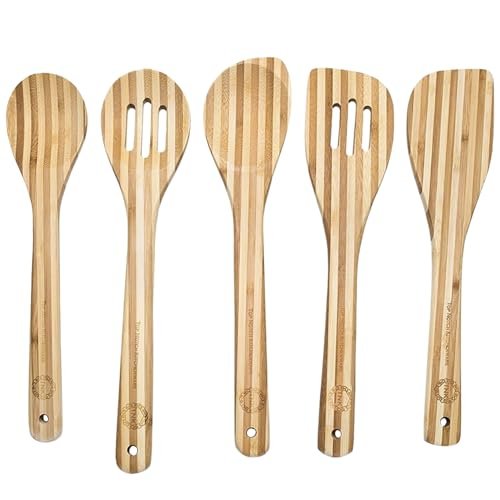
Five-piece bamboo set with dark and light horizontal stripes — a compact, cohesive starter kit for nonstick cookware.
The Top Notch Kitchenware Premium Bamboo Kitchen Utensils Set is one of the more balanced options for cooks who want a complete, coordinated set without committing to a dozen pieces. It ships with five bamboo utensils — typically a cooking spoon, serving spoon, slotted spoon, spatula, and fork — sized around 10.5 inches in height, 4.5 inches in length, and 1.1 inches in width, which fits most hand sizes comfortably. For more on this, see our guide on industrial kitchen cleaning companies.
The alternating dark and light brown stripe pattern is more than decoration: the tonal variation hides the small scuffs and knife marks that accumulate on any active cooking surface over time. That’s a practical longevity perk, not a stylistic one.
Pros
- Made from solid bamboo, a fast-growing renewable grass
- Durable under daily stirring and serving
- Balanced proportions suit small and large hands
- Coordinated set means you don’t have to source pieces separately
Cons
- Requires hand washing — the dishwasher will eventually warp or delaminate the finish
- Bamboo can absorb strong odors (onion, garlic) if left in soapy water
- Not suitable for extended high-heat frying where silicone is safer
In practice, this set performs best when it’s the dedicated set for nonstick pans and low- to medium-heat stovetop work. Reserve it for those jobs and it will outlast any plastic alternative you’ve ever owned. For more on this, see our guide on kitchen hood cleaner spray.
Forestroot 9-Piece Wooden Cooking Utensil Set

- WHAT’S INCLUDED — A THOUGHTFULLY CURATED 9-PIECE SET: This Forest Fork set includes 9 essential teak wood utensils: Turn…
- 10-YEAR HASSLE FREE WARRANTY: We stand behind our craftsmanship and believe in it so deeply that every Forest Fork utens…
- QUALITY STANDARDS YOU CAN VERIFY — A FULLY TRANSPARENT BRAND: We believe our customers deserve visibility into what they…
The Forestroot nine-piece set — a full utensil lineup in a warm teak-brown tone built for nonstick cookware.
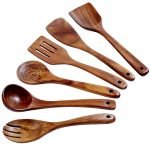
If the Top Notch set is the starter kit, the Forestroot 9-Piece Wooden Cooking Utensil Set is the working cook’s set. It covers more ground — stir spoons, slotted skimmers, slotted turners, solid spatulas, serving pieces — and gives you a proper tool for nearly every stovetop and pot task without needing to grab a random plastic utensil from the junk drawer.
Each piece is crafted from premium hardwood with heat resistance that lets it sit inside a warm pot of sauce without warping. The teak brown finish is intentionally rustic; the natural grain varies from piece to piece, which is worth accepting as a feature rather than a defect.
Pros
- Nine pieces cover essentially every stovetop cooking task
- Premium wood offers genuine heat resistance for warm pots and pans
- Fully non-scratch on nonstick, ceramic, enamel, and cast iron
- Lightweight enough for extended use without fatigue
Cons
- Hand-wash only; dishwashers will crack or discolor the wood
- Teak brown tone may clash with starkly modern kitchen palettes
- Requires occasional oiling to keep wood from drying out
A common mistake with larger wooden sets is buying them all at once and never using half the pieces. If you cook three or more times a week and want a single drawer that covers every job, this set earns its footprint. Otherwise, start smaller.
2 Pack Bamboo Smiley Face Kitchenware Cooking Utensil Set

- Bamboo Kitchen Spoons: Made of selected bamboo, this funny cooking utensil set features a smooth finish and solid constr…
- Cooking Utensils Size: Each face wooden cooking spoon measures 2.4 x 11.8 inch(6 x 30cm), offering a balanced length and…
- Funny Wood Spoon: Featuring a funny smile face pattern, these cute wooden cooking utensils add a playful and cheerful to…
A two-piece bamboo stir-fry set with a playful engraved smiley face — small-batch cooking, big personality.
Not every sustainable utensil set needs to look serious. The 2 Pack Bamboo Smiley Face Kitchenware Cooking Utensil Set is a small, focused two-piece set designed primarily for stir-frying and pan sautéing. The engraved smiley face is charming enough to be memorable, and it does double duty as an orientation mark — you’ll always know which way the spatula is facing on the stovetop.
Pros
- Lightweight bamboo keeps stir-fry work comfortable
- Engraved design resists wear from knife marks and daily use
- Two-piece size fits smaller kitchens without drawer crowding
- Eco-friendly material without any obvious greenwashing
Cons
- Not dishwasher safe — hand-wash only
- Not ideal for direct high-heat dry searing
- Two pieces may not cover every cooking task on its own
Best suited for cooks who mostly cook in one wok or skillet and want a purpose-built, low-maintenance pair. Pair it with a hardwood cutting board and you have a functional stir-fry station.
Prep Surfaces: Cutting Boards That Go the Distance
Aeravida Natural Rain Tree Wood Handmade Cutting Board
- Material Mango Tree Wood
- Color: Brown | Finish: Mango Tree Wood
- Style Bowl, Handmade, Decor, Tray, Nature, Kitchen
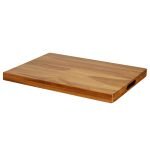
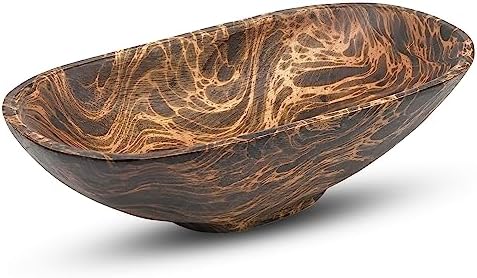
Handmade rain tree wood cutting board — dense grain, natural patina, ideal for both prep and serving.
Cutting boards are where sustainability and durability intersect most visibly. Plastic boards warp, harbor bacteria in microscopic scratches, and eventually end up in the trash. The Aeravida Natural Rain Tree Wood Handmade Cutting Board takes a different approach: a solid slab of rain tree wood, hand-finished and built to last for years of daily use.
Rain tree wood is dense and naturally antimicrobial to a degree, which is why it appears in traditional Asian kitchenware across Southeast Asia. It’s also heavy enough to stay stable on the counter while you chop, without needing a rubber grip strip glued to the bottom.
Pros
- Dense hardwood handles sharp knife work without excessive gouging
- Naturally antimicrobial compared to plastic equivalents
- Doubles as a serving board for bread, cheese, or charcuterie
- Fully biodegradable at end of life
Cons
- Requires regular maintenance with food-grade mineral oil
- Heavier than plastic or bamboo — may be awkward in small kitchens
- Compact dimensions limit use for large cutting jobs
Maintenance matters: oil the board every four to six weeks, wipe it dry immediately after washing, and let it air-dry fully. Do that and it will patina into a distinctive piece of the kitchen over time. Skip it and the wood will dry, crack, and eventually fall apart — a frustrating learning curve for first-time hardwood board owners.
Serving and Storage: From Bowl to Lunchbox
10 Inch Bamboo Salad Bowl With 2 Utensils

- Quality wood construction: constructed from wild wood sourced from high altitudes, ensuring superb density and durabilit…
- Generous size: with a diameter of 10.2 inches and height of 3.1 inches, ideal for serving larger portions for gatherings…
- Superior craftsmanship: emphasizing quality, made from carefully selected materials; precision machinery combined with m…
A 10-inch bamboo salad bowl with two coordinating serving utensils — a matched set for family-style meals.
The 10 Inch Bamboo Salad Bowl With 2 Utensils is a simple, functional upgrade for anyone still pulling a random glass mixing bowl out of the cabinet to serve dinner. The 10-inch diameter comfortably holds a family-sized salad, fruit platter, or cooked grain dish, and the two included serving utensils mean the whole set lives together in one drawer.
Pros
- Made from eco-friendly bamboo, fully renewable
- Versatile for salads, fruit, snacks, and dry serving
- Two matching utensils included — no hunting for serving tools
- Natural wood tone works in both modern and rustic kitchens
Cons
- Hand-wash only to preserve the finish
- Listing doesn’t clearly state exact bowl dimensions beyond diameter
- Generic brand means less warranty or support backing
The unmarked dimensions are the main caveat here — verify the depth against your counter space before buying if you’re tight on storage. Otherwise this is a low-fuss, long-lasting piece that beats any plastic serving bowl in durability.
Forest & Twelfth Peaches Bamboo Food Storage Containers

- [Optimal Size & Included White Clip] This Bamboo Cube Bin Organizer measures 12″ x 9″ x 6″ and includes a white clip for…
- [Sturdy & Stackable Design for Versatile Shelving] Designed for both strength and space efficiency, these bins are perfe…
- [Dual Handles for Effortless Portability] Equipped with dual handles, this bin allows for easy carrying and transportati…
Three peaches-colored bamboo food storage containers with airtight lids — 13.5 oz each, ideal for meal prep.
Plastic storage containers are the largest single category of household kitchen plastic — and the ones that leak into our produce drawers every day. The Forest & Twelfth Peaches Bamboo Food Storage Containers, set of three at 13.5 oz each, offer a genuinely reusable alternative with airtight lids that keep salads, leftovers, and prepped lunches fresh for days.
The peach finish is soft enough to work with warm wood tones and cool modern kitchens alike. Each container is small enough for individual lunch portions but sturdy enough to travel.
Pros
- Organic bamboo body is durable and fully biodegradable
- Airtight lids preserve food freshness through multiple days
- Reusable design cuts down on daily plastic container replacement
- Compact size perfect for meal prep and on-the-go lunches
Cons
- Limited color selection (peaches only in this line)
- 13.5 oz is small for family-sized portions
- Bamboo body isn’t microwave safe — lid off and transfer food
A practical note: bamboo isn’t microwave safe, so these containers work best as storage and transport vessels, not reheating vessels. Pop the contents into a microwave-safe bowl when it’s time to heat up.
Frymmx Natural Coconut Bowls & Spoons Set of 2

Two hand-polished coconut-shell bowls with matching spoons — smoothie-bowl ready and lightweight.
Coconut shell bowls have become a symbol of the sustainable kitchen for good reason: they’re made from shells that would otherwise be agricultural waste, and their natural density makes them excellent for cold servings. The frymmx Natural Coconut Bowls & Spoons Set of 2 gives two hand-polished bowls with matching spoons, each 5.2 inches tall and 2.6 inches wide — right in the sweet spot for smoothie bowls, poke, or single-serve salads.
Each bowl is hand-finished with organic oil, which is both an aesthetic and functional touch. The oil seeps into the shell’s micro-pores, sealing out water and giving the surface a smooth, non-porous feel.
Pros
- Made from coconut shells, a true agricultural byproduct
- Hand-polished with organic oil for a smooth, natural finish
- Lightweight yet surprisingly sturdy for cold serving
- Distinctive look that elevates casual meals
Cons
- Small size limits use for larger portions
- Hand-wash only; extended water contact will damage the shell
- Best for cold food — not for hot soups or reheated dishes

- Natural Coconut Shell Craftsmanship — Hand‑crafted from genuine coconut shells, every bowl boasts one‑of‑a‑kind natural …
- Plant‑Oil Hand‑Polished Surface — Hand polished with plant oil to deliver a smooth, wear‑resistant surface. It offers go…
- Multi‑Purpose Daily Bowl Set — Ideal for acai bowls, salads, smoothies, oatmeal and other foods. It can also serve as a …
Coconut bowls perform their best with cold or room-temperature food. Serving a hot soup in one is uncomfortable for the diner and shortens the bowl’s life. Match them to smoothies, salads, poke, and cold sides for maximum utility.
Handmade Natural Coconut Bowl
A single handmade natural coconut bowl — small, individual-serve, equally at home on the table or as decor.
If you want the coconut bowl aesthetic without committing to a matching set, the Handmade Natural Coconut Bowl is a strong entry point. It’s a single bowl, roughly 2.75 inches tall and 4.5 inches wide, crafted from a discarded coconut shell and finished for kitchen use.
Pros
- Made from coconut shell waste — genuinely upcycled material
- Vegan-friendly and suitable for raw food enthusiasts
- Natural variation in color and grain from piece to piece
- Doubles as a decor piece for catchalls and small snacks
Cons
- Handmade production means size and color variance between pieces
- Requires gentle care and hand washing only
- Small size limits its use to individual portions

- Pure natural materials: made of pure natural coconut shell, which ensures safety and non-toxic for a healthy dining expe…
- Handmade and environmentally friendly: each bowl is carefully handmade from environmentally friendly materials and adds …
- Easy to clean: Easy maintenance ensures trouble-free use and ensures cleanliness and comfort.
The handmade variance is worth understanding before you buy: no two pieces are identical, and slight asymmetry is part of what makes each one feel unique rather than factory-produced. If that appeals to you, this bowl delivers. If you want strict uniformity, look at the paired frymmx set instead.
Cleaning Without the Plastic Fuss
ECOLULU Natural Bamboo Dish Brush & Wood Bottle Brush

- ♻️ECO FRIENDLY PRODUCTS, ZERO WASTE: Go green and switch to plastic free cleaning tools! Both bamboo dish brush and wo…
- 💪DURABLE & EASY-TO-CLEAN KIT: Bamboo dish brush is ideal for scrubbing your everyday kitchenware. Will not scratch even …
- 👍NON STICKY AND HEAT-RESISTANT BRISTLES: Plant-based sisal bristles dry quicker then plastic ones, making them less grea…
Natural bamboo dish brush and wood bottle brush with four replacement heads included — a biodegradable cleaning kit.
Brush-style dishware tools beat scrub sponges in every metric that matters for the planet and your skin. The ECOLULU Natural Bamboo Dish Brush & Wood Bottle Brush is a kit of four pieces: a dish brush for plates and pans, a wood bottle brush for wide-mouth bottles and jars, plus two spare replacement heads.
Pros
- Made from bamboo and wood — fully biodegradable materials
- Includes two replacement heads for extended product life
- Wide-mouth bottle brush handles jars, bottles, and cups
- Replaces dozens of plastic scrub sponges over its lifespan
Cons
- Wide-mouth bottle brush won’t fit narrow-neck bottles
- Requires manual scrubbing effort (no electric alternative)
- Heads need replacing eventually — plan on swapping every several months
In practice, these brushes work best with a mild dish soap and a little elbow grease. They won’t clean a burnt-on skillet as fast as a synthetic sponge might, but they don’t leave microplastic residue in your dishes and don’t disintegrate into fuzzy lint after a few washes. For everyday dishwashing, they’re the more sensible long-term choice.
Rainflow 10 Pack Kitchen Cellulose Sponge Cloths

- Absorbent Daily Cleanup: Swedish dishcloths tackle spills and wash dishes; use these reusable paper towels as kitchen to…
- 10 Cloths in 4 Colors: Keep dish rags for washing dishes separate from kitchen rags used on counters and sinks; this set…
- Soft When Wet: Made from cellulose and cotton, these dish cloths for washing dishes fold around plates and bowls when we…
A ten-pack of cellulose sponge cloths — absorbent, quick-drying, and washable — replacing single-use wipes.
Paper towels are a quiet environmental tax: the average household uses dozens of sheets every day, most ending up in the trash within minutes. The Rainflow 10 Pack Kitchen Cellulose Sponge Cloths is a straightforward replacement — ten 6 x 8 inch cloths made from plant-based cellulose, in mixed colors for easy task separation.
Cellulose is essentially a refined wood-pulp fabric that’s soft to the touch but absorbs water several times its weight, dries fast enough to resist mold growth, and can be laundered dozens of times before being composted at end of life.
Pros
- Highly absorbent for spill and drip cleanup
- Quick-drying to prevent mold and musty odors
- Reusable dozens of times before composting
- Mixed colors let you assign cloths to different tasks
- Replaces paper towels and synthetic dish rags simultaneously
Cons
- Thinner than heavy-duty mops or industrial shop cloths
- Must be laundered regularly to maintain performance
- Not ideal for soaking up large volumes of liquid at once
The mixed colors solve a real problem: without color coding, washable cloths end up doing everything from wiping up tomato juice to drying hands after the sink, and the resulting smell tells you they’ve been doing both. Assign each cloth a job — one for counters, one for dishes, one for hands — and the whole system stays fresh.
- Absorbent Daily Cleanup: Swedish dishcloths tackle spills and wash dishes; use these reusable paper towels as kitchen to…
- 10 Cloths in 4 Colors: Keep dish rags for washing dishes separate from kitchen rags used on counters and sinks; this set…
- Soft When Wet: Made from cellulose and cotton, these dish cloths for washing dishes fold around plates and bowls when we…
Comparing Your Sustainable Kitchen Options at a Glance
| Product | Primary Use | Material | Care Required | Best For |
|---|---|---|---|---|
| Top Notch 5-Piece Bamboo Set | Stovetop cooking | Bamboo | Hand-wash, dry flat | Small-to-medium cooking households |
| Forestroot 9-Piece Wood Set | All-around cooking | Hardwood | Hand-wash, occasional oiling | Working cooks with varied diets |
| Smiley Face 2-Pack | Stir-fry & sauté | Bamboo | Hand-wash only | Focused wok or skillet users |
| Aeravida Rain Tree Board | Prep & serving | Rain tree wood | Regular mineral oiling | Daily knife work |
| 10-Inch Bamboo Salad Bowl | Serving & mixing | Bamboo | Hand-wash only | Family-style serving |
| Forest & Twelfth Bamboo Containers | Storage & lunch prep | Bamboo | Hand-wash, avoid microwave | Meal prep and on-the-go |
| Frymmx Coconut Bowl Set | Cold serving | Coconut shell | Hand-wash, avoid heat | Smoothie bowls and poke |
| Handmade Coconut Bowl | Individual serving & decor | Coconut shell | Hand-wash, gentle handling | Raw food and home decor |
| ECOLULU Bamboo Brush Kit | Dish & bottle cleaning | Bamboo & wood | Replace heads as needed | Sustainable everyday cleaning |
| Rainflow Cellulose Cloths | Wiping & drying | Cellulose | Launder regularly | Replacing paper towels and rags |
Material Comparison: Bamboo vs. Wood vs. Coconut vs. Cellulose
Different sustainable materials fit different jobs. Here’s how they compare across the metrics that matter most:
Bamboo
- Durability: High for utensils and boards; softer than hardwood for heavy chopping
- Maintenance: Moderate — hand-wash, occasional conditioning
- Ideal Use: Utensils, bowls, serving pieces, containers
- Weak Point: Can absorb strong food odors if stored damp
Hardwood (Rain Tree, Teak, Acacia)
- Durability: Very high, especially when oiled
- Maintenance: Higher — regular mineral oiling required
- Ideal Use: Cutting boards, heavy-duty prep surfaces
- Weak Point: Requires verification of sustainable sourcing
Coconut Shell
- Durability: Very high, naturally dense
- Maintenance: Low, but hand-wash only and avoid heat
- Ideal Use: Cold serving, small bowls, individual portions
- Weak Point: Small sizes limit versatility for large meals
Cellulose
- Durability: Good over many wash cycles
- Maintenance: Launder regularly; replace when frayed
- Ideal Use: Dish cloths, wipe cloths, surface drying
- Weak Point: Not heavy-duty; not suited for industrial cleaning
Common Mistakes That Shorten the Life of Sustainable Kitchenware
The sustainability math falls apart when the “eco” tools don’t actually last. Here are the most common errors and how to avoid them:
- Running wooden or bamboo utensils through the dishwasher. Dishwasher detergent is caustic and the heat warps wood fibers. Hand-wash with mild soap and air-dry flat.
- Leaving wood utensils submerged in water overnight. Bamboo and wood are porous. Waterlogged for hours, they swell and eventually crack.
- Skipping the mineral oil on cutting boards. A dry hardwood board will crack and split within months of use. Re-oil every 4–6 weeks, or more often if you chop daily.
- Using coconut bowls for hot food. The shell can crack from thermal shock, and the hot liquid can transfer to the shell oils. Cold and room-temperature only.
- Letting cellulose cloths dry in a damp pile. Even quick-drying cloths develop mildew if they sit wet. Hang or lay flat to dry after each use.
- Buying “bamboo” products without checking the composition. Some bamboo products are actually bamboo-fiber composites bound with plastic resins — durable, yes, but not as renewable as marketed. Look for solid bamboo construction.
- Never replacing worn items. A cracked cutting board harbors bacteria in the fissures. Repair or replace rather than keep using a compromised tool.
FAQ
Are bamboo utensils really eco-friendly, or is that just marketing?
Genuinely eco-friendly — with one important caveat. Solid bamboo utensils are made from a fast-growing grass that doesn’t require pesticides and decomposes naturally. The caveat is that some products labeled “bamboo” are actually bamboo-fiber composites blended with plastic resin, which look identical to solid bamboo but don’t biodegrade as quickly. Check product descriptions for “solid bamboo” rather than “bamboo fiber” if you want the genuine renewable version.
Will wooden utensils scratch my nonstick pans?
No — wooden utensils are one of the safest materials you can use on nonstick cookware. Wood is softer than the nonstick coating, so it will abrade before the coating does. This is why premium cookware manufacturers routinely recommend wooden, bamboo, silicone, or nylon utensils for nonstick pans, and specifically warn against metal utensils.
How long do coconut bowls actually last?
With hand-washing, careful handling, and use with cold or room-temperature food, a well-made coconut bowl can last several years. They’ll wear more slowly than a ceramic bowl in most situations because the shell material is naturally resistant to minor impacts. What kills coconut bowls quickly is thermal shock — moving them from cold to hot, or filling them with boiling water — which can crack the shell.
Are cellulose cloths really washable, and how many times?
Yes. Quality cellulose cloths can typically be machine-washed 100+ times before the fabric begins to fray. Some households report 200+ washes from a single cloth, depending on care. When the fabric starts to thin significantly or tear at the seams, that’s the signal to compost it and move to a fresh cloth.
Should I replace all my plastic utensils at once?
Not necessarily — and doing so can be wasteful if the plastic ones still work. A better approach is incremental replacement: retire one plastic utensil every time one breaks, and replace it with a sustainable equivalent. Over 6 to 12 months you’ll have a full set without any extra cost beyond normal purchases.
How do I care for a hardwood cutting board?
Wash by hand with mild soap, dry immediately (never soak), and apply food-grade mineral oil every 4–6 weeks. Let the board air-dry fully between oiling applications — oiling a damp board traps moisture inside. Some cooks use a beeswax-based conditioner on top of mineral oil for extra water resistance and shelf life.
Are these sustainable products safe for all foods?
Generally, yes — solid bamboo, hardwood, coconut shell, and cellulose are all food-safe materials when finished with food-grade oils. The main caution is with coconut bowls: use them for cold or room-temperature food only, as the shell oils aren’t designed for prolonged exposure to hot liquids. All items in this guide work well for fruits, vegetables, prepared salads, cold grains, and light serving duties.
Conclusion: Building a Sustainable Kitchen One Tool at a Time
Sustainable kitchen products aren’t about perfectionism — they’re about replacing the highest-use, shortest-lived items first. Start with the cutting board (the single biggest kitchen tool you’ll own) and the dish cloths (the biggest source of disposable waste). Add a bamboo or wood utensil set next. Storage containers and serving bowls can follow as your existing plastic pieces wear out.
Every product in this guide was chosen for a reason: it lasts long enough that its environmental cost of production gets amortized across years of use, it doesn’t contain hidden plastics masquerading as sustainability, and it improves — not degrades — how you cook, clean, and serve food. The bamboo set feels great over nonstick pans. The cellulose cloths stay fresh between washes. The rain tree board doesn’t warp after three months.
The math favors small, deliberate swaps over dramatic decluttering events. One good cutting board replaces four mediocre plastic ones. One ten-pack of cellulose cloths replaces hundreds of rolls of paper towels. One wooden utensil set replaces a rotating cast of damaged plastic replacements.
Start where your kitchen feels the pinch most — the drawer full of half-broken utensils, the cabinet of warped plastic storage, the endless pile of damp paper towels — and build from there. Your kitchen, and the planet, will both feel the difference.

I’m Abby Lu, a passionate home cook who loves simplifying everyday meals. At PlugChef.com, I share product reviews and cooking guides to help you find the best tools for your kitchen.
Similar Posts