LED Lights Kitchen Under Cabinet: Transform Your Space with Easy Installation

Under-cabinet lighting is the single fastest upgrade you can make to a kitchen that feels underused, dim, or "just okay." The overhead range hood alone almost never lights the countertop evenly — you'll get a bright pool where your hands are and harsh shadows everywhere else. A row of LEDs tucked beneath the cabinets kills that problem, turns cutting boards and recipe cards readable, and pulls the whole room into a warmer, more intentional look.
The best part: modern LED under-cabinet kits don't require a licensed electrician. Between magnetic stick-on strips, USB-rechargeable puck lights, adhesive LED tape, and true plug-in bars, you can go from unboxing to installed in under an hour — even if you've never touched a wiring job. For more on this, see our guide on easy care first aid kit.
This guide walks through how to size the right lighting for your kitchen, the trade-offs between wired and wireless systems, and ten top-rated options you can actually install this weekend.
Why Under-Cabinet LEDs Actually Matter
Ceiling fixtures light the room. They don't light the task. When you're julienning onions, reading fine print on a spice jar, or wiping down a stovetop, you need light pointed exactly where your hands are — and the surface should be lit evenly, not in patches. Under-cabinet LEDs deliver that focused, shadow-reducing illumination and typically cut eye strain on long cooking sessions dramatically. For more on this, see our guide on best blenders for smoothies under 100.
They also work on electricity budgets. LED under-cabinet strips usually sip power compared to halogen under-cabinet tubes of the early 2000s, and the U.S. Department of Energy's energy savings program has long recommended LEDs as the default for residential task lighting for exactly that reason. In practice, you'll notice the difference on your electric bill more than you might expect — especially if you leave kitchen lights on through long meals.
For the design side, the right color temperature matters more than brightness. A kitchen built on the principle of "natural light at the counter" will look right at roughly 3000–5000 K depending on whether the space feels warm or modern. The Illuminating Engineering Society publishes guidance on color rendering and lighting levels for residential spaces if you want to dial things in precisely. For more on this, see our guide on kitchen hood cleaning certification online.
Finally, under-cabinet lighting is invisible when it's not being looked at directly. Unlike overhead pendants or recessed cans, the fixtures themselves disappear into the cabinet soffit, leaving only the pool of light on the counter — which is the whole aesthetic point.
How to Choose the Right LED Under-Cabinet System
Before you open any box, decide three things.
Wired vs. wireless
Hardwired (plug-in or direct-wire) systems run continuously, dim smoothly, and never need batteries. They're the right answer for cabinets with easy access to an outlet or an existing junction box. Trade-off: you may need a pro if you want them on a dedicated circuit or dimmer. For more on this, see our guide on kitchen brushes for cleaning.
Wireless (battery, rechargeable, or USB) systems trade a little brightness for total flexibility. Magnetic bases, adhesive strips, and motion sensors mean you can move them to a new cabinet, a stairwell, or a closet in seconds. Trade-off: you'll need a charging routine and the beam is usually a bit softer than a hardwired fixture.
For most kitchens, a hybrid works beautifully — hardwired strips over the main work counter, rechargeable motion-sensor pucks for the pantry, stairs, and secondary storage. For more on this, see our guide on commercial kitchen hood cleaner.
Color temperature and color rendering
Color temperature controls warmth. Rough guidance:
- 2700–3000 K — warm white. Cozy, works in kitchens with wood, brass, and warm tile.
- 3500–4000 K — neutral white. The sweet spot for most modern kitchens.
- 5000–6500 K — cool / daylight white. Great for detailed work, less cozy for eating.
Color rendering (CRI) tells you how true to life colors look under the light. Below ~80, red tomatoes and herbs can look waxy. Aim for CRI 85+ on anything you'll cook or read under. A lower-CRI strip is fine for accent lighting behind open shelving.
Brightness in lumens
Small under-cabinet pucks put out 50–150 lumens each. LED strip tape runs about 450–600 lumens per meter for standard kitchen brightness. A 12-inch under-cabinet puck or plug-in bar typically lands around 350–450 lumens — enough to light a standard 24-inch-wide work zone. If you're lighting a long peninsula, add strips rather than cramming a single fixture.
Dimming and controls
Dimming matters more than people expect. You'll want 100% brightness for chopping and cleaning, 40% for reading a recipe at the counter, and maybe 15% for late-night snack runs. Some strips dim smoothly over a wide range; cheap ones are essentially three-step switches. A remote or app control gives you repeatable presets without climbing a step-stool.
Installation Steps You Can Actually Do
Whether you're running hardwired strips or sticking on a magnetic puck, the install flow is similar:
- Measure. Lay masking tape under the cabinet front to preview where the light line will sit. Check for clearance above the cabinet's back panel — some strips need 25–30 mm for airflow.
- Plan the power path. For plug-in strips, trace where the outlet will be and how the cord will route (usually behind the cabinet, along the wall). For rechargeable units, note where you'll keep the charging dock so it's in reach but not visible.
- Clean the surface. This is the step everyone skips. Isopropyl alcohol on a paper towel, wiped left to right, dries the surface completely. Adhesive-backed strips and magnetic bases both grip far better on a clean surface — and last years rather than weeks.
- Install fixtures. Magnetic pucks click into place by hand. Strip tape usually ships with a 3M-style adhesive backing; peel and press firmly along the cabinet soffit. Direct-wire fixtures need a qualified electrician for code compliance — don't try to tap a new circuit yourself.
- Run or charge. For plug-in strips, hide the cord behind the cabinet back or along the crown molding. For USB rechargeable lights, plug in at night or while you're in the shower.
- Test and adjust. Turn everything on at full brightness. Notice any dark spots, hotspots, or glare off glossy surfaces. Reposition or trim strips if needed.
Safety notes
- Never run under-cabinet LED fixtures directly over a gas cooktop with no clearance. Heat kills LED drivers.
- Don't use adhesive strips on freshly painted cabinets (wait at least 30 days for the paint to cure fully).
- For any hardwired work — new outlets, new circuits, direct-wire fixtures — use a licensed electrician. This is non-negotiable for insurance and code reasons.
Top-Rated LED Under-Cabinet Options
Gritin 10.2-inch Under Cabinet Lighting (Rechargeable, 2-Pack)

Rechargeable 10.2-inch magnetic under-cabinet light with three color temperatures and a built-in motion sensor.
The Gritin 10.2-inch Under Cabinet Lighting is a strong pick for homeowners who want the look of a hardwired puck light without the wiring project. It pairs well with renters too — you can move it to a new lease without a single hole. In practice, the 84-LED board covers roughly a 30-inch counter run, which fits most base-cabinet widths.
The three color temperatures (warm, natural, cool) plus five brightness levels give you more flexibility than a lot of cheap magnetic pucks. The motion sensor is genuinely useful — it triggers a soft glow when you walk by and ramps up if you pause, which is ideal for late-night trips to the fridge without hunting for a switch. The magnetic base is stronger than the average puck light and holds firmly on a painted cabinet soffit without sliding after months.
Best for: Renters, secondary kitchens, pantries, closets, and anyone who wants the convenience of wireless lighting without running a cord. Not ideal for: High-traffic areas where you need constant full-brightness lighting, since you'll be recharging every few days under heavy use.
- Pros: Rechargeable, 84 LEDs, 3 color temps, 5 brightness levels, motion sensor, magnetic mount
- Cons: Recharge cycle adds maintenance; not a permanent hardwired fixture
MCGOR 14.7-inch Under Cabinet Lighting (Rechargeable, Dimmable)

14.7-inch dimmable rechargeable under-cabinet light with magnetic mount and motion sensor.
The MCGOR 14.7-inch Under Cabinet Lighting stretches longer than the average puck light, which matters if your cabinets are the newer 36-inch width. At 0.94 pounds and a low-profile profile, it sits flat against the soffit without catching on cookware handles. The single white output is intentionally neutral — no warm/cool toggle — which is fine if you want consistent counter lighting without fiddling with settings.
The dimmer dial is on the fixture itself rather than remote-controlled. This is a design trade-off: fewer parts to lose, but you'll have to reach the fixture to change brightness. The motion sensor runs on a similar ambient + motion logic to most puck lights and works well for hallways and stairs alongside the kitchen use.
Best for: Kitchens, stairwells, hallways, and hall-of-shoes setups where you want one light to work in multiple rooms. Not ideal for: Anyone who wants warm-to-cool color range without buying a second unit.
- Pros: Long 14.7-inch form, dimmable dial, magnetic mount, motion sensor, rechargeable
- Cons: Single color temperature; battery life depends on brightness setting
Govee RGBIC LED Strip Lights (16.4 ft, Smart App)

16.4-foot smart RGBIC LED strip with multiple independent colors on one line and app control.
The Govee RGBIC LED Strip Lights sit in a different category from the pucks and single-color strips above. Instead of lighting a counter for cooking, they light a scene — behind a kitchen pass-through, along the underside of open shelving, or around a bar. The "RGBIC" designation means multiple independent colors can occupy the same line at once, which is what enables gradient effects and multi-zone scenes.
Bluetooth control is enough for most users; the app lets you save scenes, set timers, and pair with smart-home voice assistants through bridges. Music sync is a gimmick for most, but in a kitchen open to a living area it can actually work as ambient party lighting.
The important caveat: this strip is not primarily a task light. It's a decorative or accent fixture. If your goal is to replace the overhead and light the counter evenly, you'll want a white strip instead — see the Govee White Strip option below.
Best for: Decorative accent lighting, open shelving backlight, bar setups, and mood lighting for entertaining. Not ideal for: Primary counter illumination; anyone wanting a pure white output.
- Pros: Multi-color on one line, app control, music sync, long 16.4-ft run
- Cons: Bluetooth range can be inconsistent; not a task-lighting strip
DAYBETTER 6-Piece Under Cabinet Lighting Kit (Remote, Dimmable, 2700–6500 K)

Six 9.8-foot-piece dimmable LED under-cabinet kit with remote and 2700–6500 K range.
The DAYBETTER 6-Piece Under Cabinet Lighting is one of the more complete wireless kits on the market. The 2700–6500 K color range covers both warm and cool white on a single strip, so you can switch the same light between dinner-ambience and cutting-board-precision. The remote is the kind you'd keep in a kitchen drawer, not something you lose between rooms.
The 9.8-foot total length (spread across the six pieces) is designed for a standard galley or U-shaped kitchen layout. Each strip mounts with adhesive and comes with a controller board. In practice, the controller box is the one thing that requires a little planning — you'll want it out of the cabinet's way, ideally above the soffit or tucked behind a microwave.
Best for: Whole-kitchen upgrades where you want one light to handle both warm evenings and bright weekday cooking. Not ideal for: Very small kitchens — you may not need six pieces; the remote battery will need replacing eventually.
- Pros: Remote control, dimmable, wide 2700–6500 K range, adhesive install, six-piece kit
- Cons: Controller box is bulky; remote batteries will need replacing
EZVALO 6-Pack Under Cabinet Lighting (Charging Station Included)

Six-pc 2000 mAh rechargeable under-cabinet kit with charging station, dimming, and remote.
The EZVALO 6-Pack Under Cabinet Lighting is a strong choice for whole-house lighting — the included charging station is the reason most people buy this kit. You set the six pucks on the station at night and they recharge on USB, so there's no hunting for individual cables or a charger buried in a drawer.
The 2000 mAh cells are on the larger side for puck lights, which translates to longer runtime at lower brightness levels. Motion sensor plus dimmer plus three color temperatures plus remote — this kit has every control on the fixture you might actually want. It's a well-rounded "one kit to do everything" option.
Best for: Anyone lighting more than one area — kitchen plus hallway plus a closet. The charging station earns its keep. Not ideal for: Permanent hardwired setups where you don't want to think about charging at all.
- Pros: Six-pack with charging station, 2000 mAh cells, motion sensor, dimmable, three color temps, remote, magnetic
- Cons: Charging habit required; motion sensor may not suit every room
Maylit 3-Piece Plug-In Under Cabinet Lighting (12-inch, 6000 K)

Three ultra-thin 12-inch plug-in daylight under-cabinet bars with dimming.
The Maylit 3-Piece Plug-In Under Cabinet Lighting is the "boring in a good way" option — a straightforward set of plug-in daylight bars that do exactly what they say. 6000 K cool white delivers maximum color clarity, which matters if you're plating food or checking the freshness of produce. The ultra-thin profile means they disappear under the cabinet edge.
The dimmer runs smoothly, which is a step up from many budget plug-in bars. Installation is a two-minute job: find the outlet, route the cord behind the cabinet, and attach the bars. The main trade-off is the cord — you'll want it hidden to keep the effect clean.
Best for: Anyone who wants a simple, always-on counter light without batteries or wireless control. Not ideal for: Wet areas (this isn't rated for it), or setups where cord routing is difficult.
- Pros: Ultra-thin profile, bright 6000 K, dimmable, plug-in install, three-piece kit
- Cons: Cord routing needed; not waterproof
Under Cabinet Lighting 2-Pack (Magnetic, USB Rechargeable, Motion Sensor)

Two-pack 2200 mAh USB rechargeable magnetic motion sensor under-cabinet lights.
The Under Cabinet Lighting 2-Pack is another solid magnetic puck option with a slightly larger 2200 mAh battery than the EZVALO pack. The stick-on magnetic design means you can mount and unmount these lights without adhesive residue — handy if you're rearranging a kitchen or move every couple of years.
Motion sensor operation here is hands-free in the classic sense: approach the cabinet, the light comes on, and it fades when you leave. Dimming is button-controlled directly on the fixture. It's a simple, predictable setup — which for many kitchens is exactly what you want.
Best for: Renters, closets, secondary kitchen lighting, and anyone who wants a low-fuss puck. Not ideal for: Permanent kitchens; you'll want to charge these regularly under heavy use.
- Pros: Motion sensor, 2200 mAh rechargeable, dimmable, magnetic stick-on, USB charging
- Cons: Indoor-only; battery life depends on brightness
Vovamo 2-Piece Plug-In Under Cabinet Lighting (Linkable, 6000 K)

Two 12-inch plug-in 6000 K linkable under-cabinet daylight bars.
The Vovamo 2-Piece Plug-In Under Cabinet Lighting has a linkable USB design that lets you chain multiple bars together off a single cord. That's genuinely useful on long counters where running two separate cords looks messy. The 6000 K cool white matches the Maylit bars in output but the linking makes this a better fit for wider kitchens.
The dimmer is a physical dial — no remote, no app. That's a feature for many, since the brightness setting just stays where you set it. The units are compact enough to fit under tight cabinet soffit clearances.
Best for: Long counters where linking bars gives you continuous illumination. Not ideal for: Setups without easy outlet access; very short cabinets where a single 12-inch bar is overkill.
- Pros: Linkable USB design, dimmable dial, 6000 K cool white, compact
- Cons: Wired install; length may be more than some need
Govee White LED Strip Lights (16.4 ft, 6500 K, 300 LEDs)
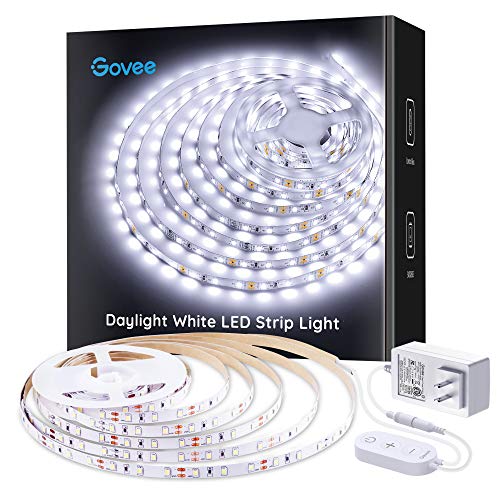
16.4-foot 6500 K 300-LED daylight strip with strong adhesive for cabinets and mirrors.
The Govee White LED Strip Lights are the "I want one long continuous strip" pick. 300 LEDs spread across 16.4 feet gives smooth, non-spotty light — the exact opposite of what happens when you string together separate pucks. The 6500 K daylight output reads as crisp and modern, which works in kitchens with stainless steel or matte finishes.
The strong adhesive backing is what separates this strip from the cheap no-name versions. Govee uses a 3M-grade adhesive that actually holds for years if you prep the surface properly. You can cut the strip at marked points to trim to size.
Best for: Continuous counter lighting on standard or U-shaped kitchens; mirror lighting; long hallways. Not ideal for: Spaces where you need warm-to-cool flexibility.
- Pros: Long continuous run, 300 LEDs, 6500 K, dimmable, strong adhesive, cuttable
- Cons: Single color temperature; length may need trimming
Nicor 18-inch Direct-Wire Under Cabinet Light (Hardwired, Dimmable, 9 W)

18-inch hardwired dimmable under-cabinet light with selectable 2700–5000 K color range.
The Nicor 18-inch Direct-Wire Under Cabinet Light is the "permanent install" option — the fixture you'd spec into a kitchen remodel. It's hardwired, meaning it's on a circuit and doesn't depend on batteries, USB cords, or a plug. The 9-watt draw for 612–648 lumens puts it in the efficient range for this fixture class.
The selectable CCT (2700 K to 5000 K) is genuinely useful on a permanent fixture — you can run it warm in the morning and cooler for evening cooking. Dimming works with a standard household dimmer switch (make sure to use an LED-compatible dimmer, not a legacy incandescent one).
Best for: Kitchen remodels, dedicated under-cabinet circuits, anyone who wants maintenance-free permanent lighting. Not ideal for: Renters or anyone unwilling to hire an electrician.
- Pros: Hardwired, dimmable, selectable 2700–5000 K, 9 W, 612–648 lumens, sleek
- Cons: Requires electrician install; single color at any given time
Maintenance and Troubleshooting
Under-cabinet LEDs are nearly maintenance-free, but three things will actually fail over the years.
Adhesive failure. This is the #1 cause of strip lights sliding off cabinets. It's almost always a cleaning or paint-cure issue. Fix by thoroughly cleaning with isopropyl, waiting for any new paint to cure (30+ days is safest), and reinstalling. Some kits ship with a separate stronger adhesive you can add on.
Battery degradation on rechargeable units. Li-ion cells wear down over 300–500 charge cycles. If your magnetic puck used to run for two nights and now runs for four hours, it's time to replace the pack or the unit.
Driver failures on hardwired fixtures. These are uncommon but do happen, especially on cheap driver boards. If a hardwired fixture dies, it's usually the driver rather than the LEDs themselves. For anything under warranty, replace the whole fixture; for older units, a qualified electrician can swap the driver.
If a dimmer isn't working smoothly, the almost universal cause is a non-LED-compatible dimmer. LED strips and puck lights need a dimmer rated for low-wattage LED loads, otherwise they'll flicker at low settings.
Frequently Asked Questions
How many under-cabinet lights do I actually need?
As a rule of thumb, one puck light per 24–30 inches of cabinet front works for most kitchens. For a standard galley kitchen with two 6-foot runs, four pucks is usually enough. If you're using strip tape, aim for 400–600 lumens per meter and cover the whole run — continuous light beats patchy illumination.
What's the difference between 2700 K, 3000 K, 4000 K, and 5000 K?
2700 K reads warm and golden; 3000 K is a slightly brighter warm; 4000 K is neutral "off-white"; 5000 K and above is cool, bluish daylight. Kitchens with warm wood or brass work better with 2700–3500 K; kitchens with stainless steel, concrete, or a modern feel work better with 4000–5000 K. If you're choosing a single option, the 2700–5000 K selectable range on the Nicor or DAYBETTER fixtures covers all cases.
Do I need a dimmer switch for under-cabinet LEDs?
Not strictly, but a dimmer dramatically extends the usefulness of the fixture. You don't need 100% brightness all the time. Choose an LED-compatible dimmer if you install one — legacy incandescent dimmers will flicker or buzz with LEDs.
How long do LED under-cabinet lights actually last?
Quality LED strips and pucks are rated in the 25,000–50,000 hour range, which translates to well over a decade of normal use. Battery recharge cycles on wireless units are the limiting factor rather than the LEDs themselves — plan on 2–4 years before battery performance is noticeably reduced.
Can I install under-cabinet lighting as a renter?
Yes, easily. Magnetic pucks, adhesive strips, and plug-in bars leave zero permanent marks when removed. Avoid anything that requires drilling or direct wiring — those change the game from "upgrade" to "potential deposit hit."
Which is better, an LED strip or individual puck lights?
Strips give smoother, more even coverage — no gaps between light sources. Pucks give you more flexibility to reposition, are easier to remove, and typically cost less per fixture. For kitchens, many people run strips on the main counter and pucks in secondary spots (pantry, open shelves).
Do under-cabinet lights reduce eye strain?
They do, meaningfully. Task lighting that's pointed at the surface reduces the contrast between the counter and the surrounding darker areas of the kitchen. If you've been reading fine print at the stove under only overhead lighting, adding under-cabinet lights is one of the fastest ways to eliminate that eye-strain feeling.
Are RGB LED strips a good idea for a kitchen?
They're great for accent and entertainment lighting, not primary counter illumination. The Govee RGBIC strips are best installed behind open shelving, along a pass-through, or under a bar — spaces where decorative color adds to the vibe. Keep your counter lit by a solid white strip or puck light.
Is there a wiring code I need to worry about?
For hardwired under-cabinet fixtures, yes. The National Electrical Code governs any new circuit work, and kitchen lighting installations should be done by a licensed electrician — especially in areas near water, gas, or range hoods. Rechargeable and plug-in fixtures don't touch code-critical wiring.
What if my cabinets aren't a standard depth?
Under-cabinet fixtures fit shallow and deep cabinets alike, but strip tape especially needs enough clearance behind it for airflow. Measure the space between the cabinet back panel and the soffit; if you're below 25 mm, a puck light is a safer choice than a strip.
Conclusion
Under-cabinet LED lighting is one of the rare home upgrades where the effort-to-impact ratio is genuinely high. For most kitchens, the right kit is a set of rechargeable magnetic pucks for flexible placement, a continuous white strip over the main counter, and optionally an RGB strip behind open shelving for accent lighting. If you're remodeling and willing to run wiring, a hardwired fixture like the Nicor 18-inch strip gives you the most permanent, maintenance-free solution.
Whichever path you pick, spend ten minutes measuring and cleaning the surface before you install. That small prep step is what separates a light fixture that holds in place for years from one that slides off in a month.
Ready to light the counter? Start with the EZVALO 6-pack with charging station if you want one kit that covers the whole kitchen and beyond — it's the best all-around starting point for most homes.

Hi, I’m Daniel Brooks—a food lover and kitchen gear enthusiast. I enjoy testing cookware, utensils, and gadgets to see what really works in everyday cooking. At PlugChef.com, I share honest reviews, comparisons, and simple guides to help you choose the best tools for a safer, smarter, and more enjoyable kitchen.
Similar Posts