Under Counter Kitchen LED Lights: Illuminate Your Space with Style
Under-cabinet lighting is the single most impactful upgrade you can make to a kitchen without a remodel. It eliminates shadows on countertops, reduces eye strain during prep work, and adds a layer of ambiance that overhead fixtures simply cannot deliver. In 2026, LED technology has matured: efficiency is a given, and the real differences lie in color quality, control flexibility, and how cleanly the fixture disappears into your cabinetry. This guide breaks down every decision — power source, form factor, color temperature, installation method — so you can match the right product to your kitchen, your budget, and your willingness to drill holes.
Why Under-Cabinet Lighting Matters
Task lighting at the countertop level solves the fundamental problem of overhead cabinets casting shadows exactly where you chop, read recipes, or plate food. A well-lit work surface improves safety (knife work), accuracy (measuring, checking doneness), and comfort (less leaning in to see). Beyond utility, a warm wash of light across a backsplash transforms the kitchen's evening mood from utilitarian to inviting. The Department of Energy notes that directional LED task lighting can reduce overall kitchen lighting energy use by 30–50 percent compared to relying solely on ceiling fixtures, since you illuminate only the zone in use. For more on this, see our guide on best blenders for smoothies under 100.
Types of Under-Counter LED Lights
Plug-In Bar Lights
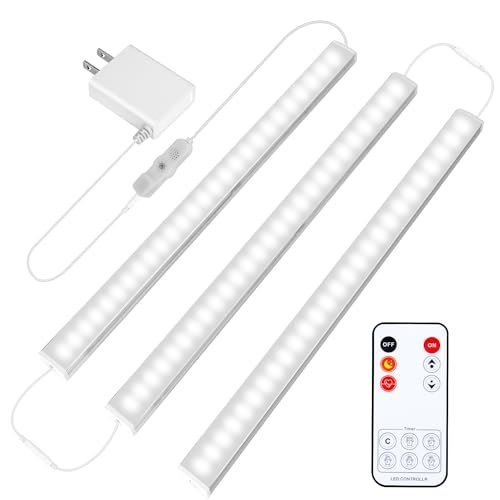
Rigid linear fixtures (typically 12–16 inches) that connect to a standard outlet. They deliver the most consistent output per foot, often 300–600 lumens per bar, and many link end-to-end for longer runs. Installation is minutes: mount with screws or magnets, plug in, done. The trade-off is visible cord management — cable raceways or a strategically placed outlet keep it tidy.
 Three 12-inch bars linked together span a standard 36-inch base cabinet run.
Rechargeable & Battery-Operated Lights
Self-contained units with built-in lithium cells (usually 2000–2600 mAh) and USB-C charging. Zero wiring makes them ideal for rentals, pantries, or upper cabinets far from outlets. Expect 8–30 hours per charge depending on brightness; motion sensors extend runtime significantly. Output tops out around 200–350 lumens — enough for a coffee station, thin for a primary prep zone. For more on this, see our guide on kitchen hood cleaning certification online.
 Magnetic mounting lets you pull the unit off for charging without removing the base plate.
 Five dimming levels and warm white output suit both task and accent roles.
Hardwired Fixtures
Permanent, code-compliant installations fed from a wall switch or dedicated circuit. They support higher outputs (600–1000+ lumens per foot), multi-color-temperature selectors (often 2700K/4000K/5000K), and seamless aesthetics — no cords, no battery doors. Required for new builds or major remodels where electrical plans include under-cabinet circuits. In 2026, most hardwired bars still need a low-voltage driver; confirm the driver fits inside your cabinet cavity before buying.
 Field-selectable CCT switch on the driver lets you dial in warm, neutral, or cool white at install.
LED Strip Lights (Tape Light)
Flexible PCB strips on adhesive backing, sold in 5–16 ft reels or cut-to-length kits. They conform to curved cabinets, toe-kicks, and glass shelves. Density matters: look for 30+ LEDs/meter (high-density) to avoid visible dots on glossy countertops. Most kits include a plug-in driver and inline dimmer; hardwired drivers are available for clean installs. Adhesion on textured melamine or oaky grain can fail — mechanical clips or aluminum channel are insurance. For more on this, see our guide on kitchen brushes for cleaning.
 Six short segments connect via quick-disconnect plugs for L-shaped and U-shaped runs.
 Thin 8 mm PCB bends around corner cabinets without kinking.
 Continuous reel allows custom lengths; cut points every 2 inches marked on the strip.
Motion-Activated & Gesture-Control Lights
Passive infrared (PIR) sensors trigger on movement within 10–15 ft; some add hand-wave IR proximity sensors for manual override without touching a switch. Best for pantries, closet-depth cabinets, and secondary zones. Sensitivity and timeout are adjustable on better models (15 sec–5 min). False triggers from pets or passing traffic are the main complaint — aim the sensor away from doorways.
 Wave sensor on the end cap toggles on/off; hold to dim — no remote to lose.
Key Specifications to Compare
| Spec | What It Means | Target Range for Kitchen Tasks |
|---|---|---|
| Color Temperature (CCT) | Warmth/coolness of white light | 3000K–4000K (neutral) for prep; 2700K for dining ambiance |
| CRI (Color Rendering Index) | Fidelity of colors vs. natural light | ≥90 for food prep; ≥95 for serious cooking/baking |
| Lumens per Foot | Total visible light output | 300–500 lm/ft for task; 150–250 lm/ft for accent |
| Dimming Range | Lowest stable output | Down to 5–10 % without flicker |
| Driver Type | Constant current vs. constant voltage | Constant current for bars; constant voltage (12 V/24 V) for strips |
Color temperature is not a preference — it's a task decision. 2700K flatters wood tones and skin but reduces contrast for reading labels. 5000K+ maximizes contrast but feels clinical at night. A 3000K–3500K neutral white hits the sweet spot for most kitchens; tunable-white (2700K–6500K) products let you shift by time of day. For more on this, see our guide on commercial kitchen hood cleaner.
Installation Methods Compared
| Method | Tools Needed | Permanence | Best For |
|---|---|---|---|
| Peel-and-stick (included tape) | None | Low (removable) | Renters, smooth melamine, short-term |
| 3M VHB / foam mounting tape | None | Medium | Textured surfaces, heavier bars |
| Magnetic base + steel plate | None | Low | Rechargeable units, frequent removal |
| Screw mount (included brackets) | Drill, 1/8″ bit | High | Hardwired bars, heavy plug-in units |
| Aluminum channel + clips | Miter saw, screws | High | Strip lights, heat sinking, dot-free diffusion |
Pro tip: Clean the mounting surface with isopropyl alcohol, not household cleaner — residue kills adhesion. For screw mounts, pre-drill pilot holes in particleboard to avoid splitting.
Power Source Decision Guide
| Scenario | Recommended Power | Why |
|---|---|---|
| Outlet under/above cabinet, owner | Plug-in bar or strip | Highest output, simplest install, linkable |
| No outlet, owner willing to wire | Hardwired bar | Cleanest look, switch-controlled, highest output |
| Renter / no outlet / low usage | Rechargeable motion | Zero damage, portable, auto-off saves charge |
| Complex shapes (curves, glass shelves) | Strip light in channel | Only form factor that bends; channel hides dots |
| Multi-zone control desired | Strip + multi-channel driver | Independent dimming per cabinet run |
Product Recommendations by Use Case
| Use Case | Top Pick | Why It Wins |
|---|---|---|
| Best all-around plug-in | Maylit 12″ 3-pack (daylight white) | Ultra-thin 0.2″ profile, linkable, smooth dimming, 550 lm/bar |
| Best rechargeable for renters | DiDiSky 2-pack magnetic | 2200 mAh lasts 2–3 weeks per charge, strong magnets, USB-C |
| Best hardwired for remodels | UltraPro 12″ 3-CCT | Field-selectable 2700K/4000K/5000K, 90+ CRI, low-profile driver |
| Best strip for custom runs | DAYBETTER 6-pcs tunable kit | 2700K–6500K via remote, quick-disconnect segments, 9.8 ft total |
| Best budget strip | MYPLUS 16.4 ft 3000K kit | 1050 lm total, inline dimmer, adhesive holds on clean melamine |
| Best linkable plug-in system | Vovamo 12″ 2-pack USB linkable | Daisy-chain up to 6 units from one outlet, 6000K crisp task light |
| Best gesture control | MYPLUS 16″ hand-wave | No remote needed, memory function recalls last level, 4000K neutral |
Common Mistakes to Avoid
- Undersizing lumens — 150 lm/ft looks fine on the box but leaves knife marks invisible. Target 300+ lm/ft for primary prep zones.
- Ignoring CRI — Cheap strips at 80 CRI make salmon look gray and herbs dull. Spend the extra $10–15 for 90+.
- Mounting too far back — Push fixtures to the front lip of the cabinet (1–2″ from door edge) to wash the backsplash and counter evenly. Deep mounting creates a cave effect.
- Skipping heat sinking for strips — Runs over 6 ft in a 12 V strip without aluminum channel will color-shift and dim at the far end. 24 V strips tolerate longer runs.
- Mixing color temperatures — A 2700K strip next to a 4000K bar is jarring. Buy all fixtures from the same product family or verify CCT specs match.
- No dedicated switch — Plugging into a countertop appliance outlet means the lights die when you run the mixer. Use a switched outlet, smart plug, or inline switch.
Maintenance & Longevity
- Dust quarterly with a microfiber cloth; buildup cuts output 15–20 % and traps heat.
- Rechargeable units: Top off every 60 days if unused; deep discharge kills lithium cells.
- Drivers fail before LEDs. A flickering bar usually means the external driver (plug-in or hardwired) has degraded — replace the $15 driver, not the $60 fixture.
- Adhesive check: Press strip ends annually; re-tape with VHB if lifting.
- Expected life: Quality LEDs (LM-80 tested) maintain 70 % output at 50,000 hours — ~17 years at 8 hrs/day. Cheap unbranded strips often hit L70 at 15,000 hrs.
Frequently Asked Questions
How do I install under-counter LED lights without an outlet?
Use rechargeable magnetic bars for zero wiring, or hire an electrician to fish a circuit from the nearest receptacle — typically $150–300 per run. Battery-operated puck lights are a third option but require frequent battery swaps. For more on this, see our guide on industrial kitchen cleaning companies.
Are motion-sensor lights practical for main kitchen counters?
Only if the sensor faces away from the primary traffic path. In practice, they trigger on passersby and stay on during long prep sessions, negating the energy benefit. Reserve them for pantries, closets, and toe-kick lighting.
Can I dim any LED under-cabinet light?
No. The fixture must have a dimmable driver and a compatible control (inline, remote, wall dimmer, or app). Non-dimmable drivers will buzz, flicker, or fail if paired with a dimmer. Check the spec sheet for "dimmable" and the dimming protocol (TRIAC, 0–10 V, PWM).
What color temperature is best for food prep?
3000K–3500K neutral white renders ingredients accurately without the harshness of 5000K+. If you bake, 90+ CRI at 3500K lets you see dough texture and crust color reliably.
Do LED strips need aluminum channel?
For runs over 4 ft, yes — it acts as a heat sink and diffuses the diode pattern. Without it, strips on wood or laminate can overheat, accelerating lumen depreciation. Channel also protects the fragile PCB from impacts.
How many lumens per foot do I actually need?
Task zones (sink, stove, main prep): 300–500 lm/ft. Accent/ambient (upper cabinets, toe-kick, glass shelves): 150–250 lm/ft. Multiply by linear feet to size your driver.
Can I hardwire a plug-in fixture?
Only if the manufacturer lists a hardwire kit and the fixture is UL-listed for permanent installation. Cutting the plug off a plug-only unit voids the listing and creates a code violation. Buy the correct hardwired model instead.
Will under-cabinet lights interfere with my smart home?
Most 2026 models use IR remotes or proprietary RF — not Wi-Fi/Thread/Matter. For smart integration, choose a Matter-enabled strip controller (e.g., Govee, Nanoleaf, or a Zigbee/Thread driver paired with a hub) and dumb fixtures.
Conclusion
The right under-counter lighting is invisible until you need it — then it makes every kitchen task easier, safer, and better looking. Match the power source to your ownership situation: plug-in bars for outlet-accessible owners, rechargeable magnets for renters, hardwired for remodels, strips for curves and custom lengths. Prioritize 90+ CRI and 3000K–3500K for prep zones; add tunable white only if you genuinely want to shift mood by hour. Mount at the front lip, use aluminum channel for strips, and put the switch where you'll actually use it. Your counters — and your eyes — will notice the difference every single day.
Ready to pick a system? Measure your linear cabinet feet, note outlet locations, and choose the category above that fits your install comfort level — then grab the corresponding pick and be done by weekend.

Hi, I’m Daniel Brooks—a food lover and kitchen gear enthusiast. I enjoy testing cookware, utensils, and gadgets to see what really works in everyday cooking. At PlugChef.com, I share honest reviews, comparisons, and simple guides to help you choose the best tools for a safer, smarter, and more enjoyable kitchen.
Similar Posts