The kitchen is the most hazard-prone room in homes with young children, with under-sink cleaning supplies, sharp utensils, hot appliances, and small choking hazards stored within easy reach of curious toddlers. According to the CDC, children under 5 account for 70% of all non-fatal household poisoning incidents, with cleaning products stored under kitchen sinks as the top culprit. No-drill kitchen safety locks provide a non-invasive, damage-free layer of protection that takes minutes to install, making them ideal for renters, new parents, and anyone who wants to avoid marring cabinetry with drill holes. This guide breaks down the best lock types, what to look for when shopping, top 2026 picks, and pro tips for long-term security.
Why Kitchen Cabinet Locks Are Non-Negotiable for Families with Young Kids
Standard cabinet latches are no match for determined toddlers: most children can figure out how to open basic push-button latches by 18 months, and even simple slide locks can be manipulated with a little persistence. No-drill locks add an extra layer of security that keeps dangerous items out of reach while remaining easy for adults to operate. For renters, these solutions are especially valuable, as they leave no permanent damage to cabinets, ensuring you get your full security deposit back when you move. They also work for pet owners, keeping dogs and cats out of trash cans, food storage, and toxic cleaning supplies to reduce mess and prevent accidental poisoning. While active adult supervision is the first line of defense in the kitchen, locks are a critical backup for the seconds you turn your back to grab a dish or answer the door. For more on this, see our guide on safety locks for cabinets.
The 4 Most Common Types of No-Drill Kitchen Safety Locks
No-drill locks fall into four distinct categories, each with unique strengths and ideal use cases:
Adhesive Magnetic Locks
These locks use a small magnet mounted inside the cabinet and a corresponding latch on the outside of the door, unlocked with a small magnetic key. They are nearly invisible from the outside, making them a top pick for families who want a discreet look. They work best on standard cabinet doors and drawers, and are ideal for high-traffic cabinets you use daily, like utensil drawers. The main downside is that magnetic keys can be misplaced, and adhesive may fail on textured or porous surfaces.
Adjustable Strap Locks
Flexible nylon or silicone straps stretch across cabinet doors or appliance openings and buckle to lock. They are the most versatile option, fitting openings from 10 to 30 inches wide, and work on cabinets, drawers, fridge doors, oven handles, toilet seats, and trash cans. Many models use minimal adhesive, while others require no adhesive at all for knobbed cabinets. They are visible from the outside, so they may not be ideal for high-end cabinetry, but they are perfect for large pantry openings or odd-shaped storage.
U-Shaped Handle Locks
These locks loop around existing cabinet knobs and lock the two handles together, with no adhesive required. They are the easiest to install and remove, making them a great pick for temporary childproofing or for families who move frequently. They only work on cabinets with knobs, not flat-panel doors, and are best for older toddlers who have learned to manipulate simpler latch locks, as the U-shape is harder for small hands to operate.
Invisible Internal Latches
These locks mount entirely inside the cabinet door and frame, with no external hardware visible from the outside. They use a spring-loaded latch that requires a small included tool to unlock, making them extremely secure and perfect for custom, high-end cabinetry where visible hardware would detract from the design. They require precise alignment during installation and may not fit very thin cabinet doors, but they are the most aesthetically seamless option on the market.
What to Look for When Shopping for No-Dill Kitchen Safety Locks
Not all no-drill locks are created equal — these key features will help you choose a durable, reliable option:
- Adhesive Quality: Opt for locks with 3M VHB or equivalent heavy-duty adhesive. Generic cheap adhesives often peel after 2–3 months, especially in humid kitchen environments. Always prep surfaces by wiping with rubbing alcohol and letting dry fully for 24 hours before application — a common mistake is applying locks immediately after cleaning with soap, which leaves a residue that weakens the bond.
- Weight Capacity: Standard kitchen cabinet doors weigh 5–12 lbs, so look for locks rated for at least 15 lbs of pulling force to ensure they hold up to determined toddlers (the average 2-year-old can pull with 8–10 lbs of force).
- Adjustability: If you have odd-sized cabinets or want to use the locks on multiple appliances, adjustable straps or U-shaped locks are more versatile than fixed-size magnetic locks.
- Ease of Adult Use: You’ll use these locks dozens of times a day, so look for one-hand operation, easy-grip magnetic keys, or simple unbuckling mechanisms. Avoid locks that require fine motor skills to open when your hands are full of hot food.
- Reusability: If you rent or plan to move soon, choose locks with reusable adhesive or no-adhesive designs. Most high-quality adhesive locks can be removed and repositioned 2–3 times if you use a hair dryer on low heat to warm the adhesive before peeling.
- Safety Certification: Look for locks that meet CPSC guidelines for child-resistant hardware, which are tested to resist tampering from children up to age 5.
Top Rated No-Drill Kitchen Safety Locks for 2026
All picks below use no-drill installation, meet child safety standards, and are suited for common kitchen cabinet and appliance types.
1. SKYLA HOMES 8-Pack Adhesive Cabinet Locks
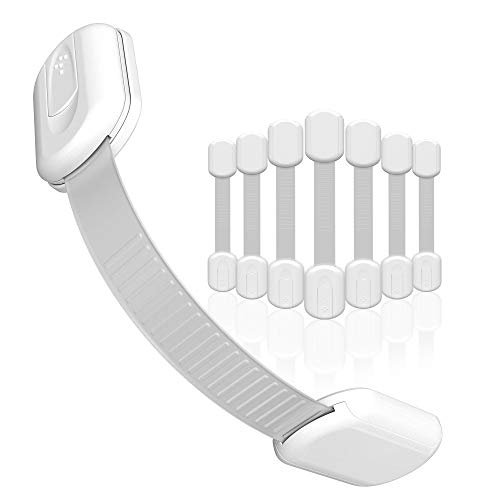
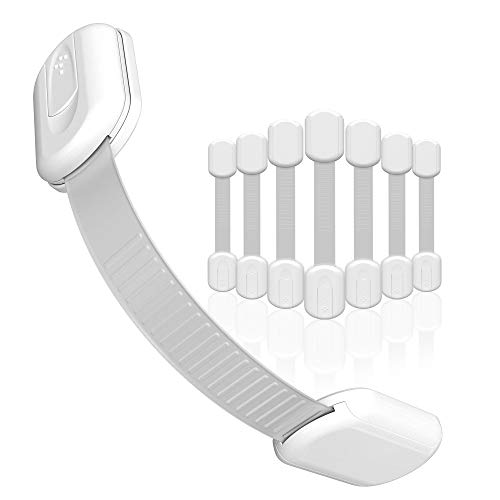 This 8-pack from SKYLA HOMES is a top pick for renters and families with multiple hazard zones to secure.
The SKYLA HOMES 8-pack is one of the most popular no-drill options on the market, ideal for families who want a low-profile, easy-to-install solution for standard cabinet doors and drawers. It uses heavy-duty 3M adhesive that bonds well to smooth, clean surfaces, and the slim 0.39-inch profile blends seamlessly with most cabinetry.
Pros:
This 8-pack from SKYLA HOMES is a top pick for renters and families with multiple hazard zones to secure.
The SKYLA HOMES 8-pack is one of the most popular no-drill options on the market, ideal for families who want a low-profile, easy-to-install solution for standard cabinet doors and drawers. It uses heavy-duty 3M adhesive that bonds well to smooth, clean surfaces, and the slim 0.39-inch profile blends seamlessly with most cabinetry.
Pros:
- Heavy-duty 3M adhesive holds up to 15 lbs of pulling force
- No tools or drilling required, installs in 30 seconds per lock
- Slim, discreet white design matches most cabinet finishes
- Works on cabinets, drawers, ovens, toilet seats, and trash cans
- Includes 8 locks to cover high-risk zones in a standard kitchen Cons:
- Adhesive may fail on textured, porous, or glossy surfaces
- Not reusable once removed, as the adhesive backing is single-use
- Requires thorough surface cleaning before installation for maximum hold In practice, these locks hold up well to daily use for 6–12 months before the adhesive starts to weaken, making them a great value for the price. They’re a solid choice for families who don’t need locks for textured surfaces like unfinished wood or beadboard cabinets.
2. Suniry 12-Pack Adhesive Cabinet Locks
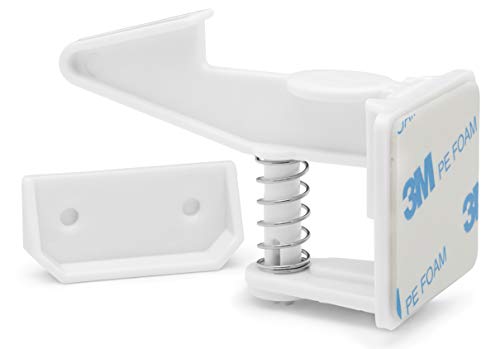 The 12-pack from Suniry offers the most locks per dollar for families covering large kitchens.
For families with a large kitchen or multiple hazard zones (under-sink cabinets, pantry, bathroom cabinets, etc.), the Suniry 12-pack is the most cost-effective option. It uses the same heavy-duty 3M adhesive as the SKYLA HOMES locks, with a slightly larger 2×4 inch latch that fits wider cabinet doors and drawers.
Pros:
The 12-pack from Suniry offers the most locks per dollar for families covering large kitchens.
For families with a large kitchen or multiple hazard zones (under-sink cabinets, pantry, bathroom cabinets, etc.), the Suniry 12-pack is the most cost-effective option. It uses the same heavy-duty 3M adhesive as the SKYLA HOMES locks, with a slightly larger 2×4 inch latch that fits wider cabinet doors and drawers.
Pros:
- 12 locks per pack, enough to cover a full kitchen and bathroom
- Strong 3M adhesive holds up to standard cabinet weight
- Compact white design is unobtrusive
- Works on most smooth cabinet surfaces
- Affordable price point, less than $1 per lock Cons:
- Adhesive may leave light residue on painted surfaces when removed
- Not reusable, single-use adhesive backing
- Latch is slightly larger, so may not fit very small cabinet doors These are a great pick for first-time childproofers who want to cover all their bases without breaking the bank. Just be sure to test the adhesive on a small, hidden area of your cabinet first if you have painted finishes. Pair them with a safe non-stick cooking utensil set to reduce injury risk if a child does access a cabinet with kitchen tools.
3. Upgraded Invisible Internal Cabinet Latches (10-Pack)
 These internal latches are completely hidden from view, perfect for high-end cabinetry.
If you want to maintain the seamless look of your custom kitchen cabinets, these invisible internal latches are the best option. They mount entirely inside the cabinet door and frame, with no external hardware visible from the outside. They use a spring-loaded latch that requires a small included tool to unlock from the outside, so kids can’t manipulate them.
Pros:
These internal latches are completely hidden from view, perfect for high-end cabinetry.
If you want to maintain the seamless look of your custom kitchen cabinets, these invisible internal latches are the best option. They mount entirely inside the cabinet door and frame, with no external hardware visible from the outside. They use a spring-loaded latch that requires a small included tool to unlock from the outside, so kids can’t manipulate them.
Pros:
- Totally invisible from the outside, preserves cabinet aesthetics
- Extremely secure, tested to resist tampering from kids up to age 5
- Works with most standard cabinet doors, including those with countertop overhangs
- No drilling required for installation Cons:
- Requires precise alignment during installation for proper function
- May not fit very thin cabinet doors (less than 0.5 inches thick)
- More expensive than standard adhesive locks
- Unlocking tool can be misplaced if not stored consistently These are ideal for families with custom, high-end cabinetry where visible hardware would detract from the design. They’re also a good pick for older toddlers who have learned to manipulate standard latch locks.
4. Vmaisi 20-Pack Magnetic Cabinet Locks
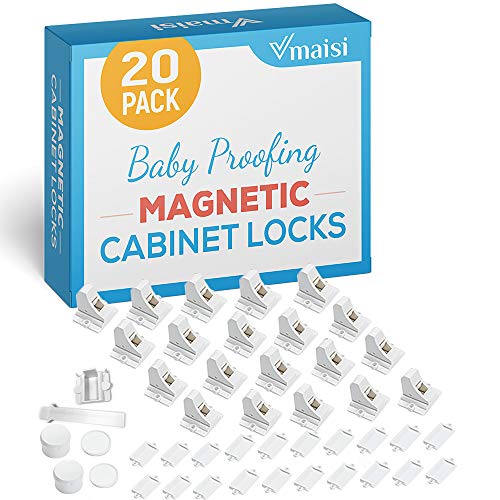 The 20-pack from Vmaisi offers the most locks for families with dozens of cabinets to secure.
Magnetic locks are a favorite for many parents because they’re nearly invisible and extremely secure. The Vmaisi 20-pack includes 20 small magnetic latches and 3 magnetic keys, so you can secure every cabinet in your home and keep spare keys in different rooms for convenience.
Pros:
The 20-pack from Vmaisi offers the most locks for families with dozens of cabinets to secure.
Magnetic locks are a favorite for many parents because they’re nearly invisible and extremely secure. The Vmaisi 20-pack includes 20 small magnetic latches and 3 magnetic keys, so you can secure every cabinet in your home and keep spare keys in different rooms for convenience.
Pros:
- Nearly invisible design, only a small 1.4×1.8 inch latch on the outside of the cabinet
- Strong magnetic hold resists pulling from toddlers
- 20 locks per pack, enough for a full home childproofing project
- Includes 3 spare magnetic keys to avoid lockouts
- Reusable, can be removed and repositioned without damage Cons:
- Adhesive may fail on textured or greasy surfaces
- Magnetic keys can be misplaced if not stored in a consistent spot
- Not suitable for very thick cabinet doors (over 1.5 inches) A common mistake with magnetic locks is applying them to metal cabinets without testing first — the metal can interfere with the magnetic hold, so always test the lock before installing it permanently. For households with a well-organized fridge layout, these locks are also a good pick for securing fridge doors.
5. 4our Kiddies 14-Pack Adjustable Strap Locks
 Adjustable strap locks like these from 4our Kiddies are perfect for odd-sized cabinets and appliances.
These adjustable strap locks are the most versatile option on the market, as they fit almost any cabinet, drawer, or appliance opening. They use strong 3M adhesive on the ends of the strap, and the adjustable length lets you customize the fit for pantries, fridge doors, oven handles, and even toilet seats.
Pros:
Adjustable strap locks like these from 4our Kiddies are perfect for odd-sized cabinets and appliances.
These adjustable strap locks are the most versatile option on the market, as they fit almost any cabinet, drawer, or appliance opening. They use strong 3M adhesive on the ends of the strap, and the adjustable length lets you customize the fit for pantries, fridge doors, oven handles, and even toilet seats.
Pros:
- Adjustable length fits openings from 10 to 30 inches wide
- Works on cabinets, drawers, fridges, ovens, trash cans, and toilet seats
- Includes 12 extra adhesive strips for replacements
- Strong 3M adhesive holds up to 20 lbs of pulling force
- 14 locks per pack, enough for a full home Cons:
- Visible design may not be ideal for high-end cabinetry
- Adhesive may weaken on greasy surfaces like oven fronts
- Requires careful placement to ensure the strap is tight enough to lock These are a great pick for families who want to lock down appliances as well as cabinets, as most standard magnetic or latch locks don’t work on fridge or oven doors. They also work well in bathrooms, making them a good addition to a full home childproofing routine alongside your preferred kitchen cleaning tools.
6. Jetec 10-Pack U-Shaped Cabinet Locks
 U-shaped locks like these from Jetec are a no-adhesive option for cabinets with knobs.
If you have cabinets with existing knobs and don’t want to use adhesive, these U-shaped locks are the perfect solution. They loop around the two knobs of a cabinet door and lock in place, with no adhesive or tools required. They’re adjustable to fit most standard knob sizes and spacing.
Pros:
U-shaped locks like these from Jetec are a no-adhesive option for cabinets with knobs.
If you have cabinets with existing knobs and don’t want to use adhesive, these U-shaped locks are the perfect solution. They loop around the two knobs of a cabinet door and lock in place, with no adhesive or tools required. They’re adjustable to fit most standard knob sizes and spacing.
Pros:
- No adhesive required, works on any cabinet with knobs
- Adjustable to fit knob spacing from 2 to 6 inches
- Durable plastic construction holds up to daily use
- Easy to install and remove in seconds
- 10 locks per pack, enough for most kitchens Cons:
- Only works on cabinets with knobs, not flat-panel doors
- May not fit oversized or unusually shaped knobs
- Visible design may not be ideal for some decor styles These are a great pick for families with older toddlers who have learned to open standard adhesive latch locks, as the U-shape is harder for small hands to manipulate. They work seamlessly with existing cabinet organization systems without extra hardware.
7. Goodv 10-Pack Adjustable Strap Locks
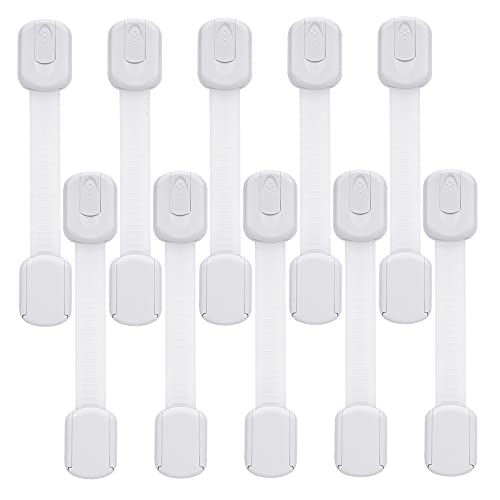 The Goodv 10-pack offers a budget-friendly adjustable strap option for small kitchens.
The Goodv adjustable strap locks are a more affordable alternative to the 4our Kiddies set, with the same adjustable design and strong 3M adhesive. They’re perfect for small kitchens or families who only need a few locks for high-risk zones.
Pros:
The Goodv 10-pack offers a budget-friendly adjustable strap option for small kitchens.
The Goodv adjustable strap locks are a more affordable alternative to the 4our Kiddies set, with the same adjustable design and strong 3M adhesive. They’re perfect for small kitchens or families who only need a few locks for high-risk zones.
Pros:
- Adjustable length fits most cabinet and appliance openings
- Strong 3M adhesive holds up to daily use
- Works on cabinets, drawers, fridges, ovens, and trash cans
- Affordable price point
- Slim white design blends with most decor Cons:
- Only 10 locks per pack, may not cover a full large kitchen
- Adhesive may leave residue on painted surfaces when removed
- Strap may be too short for very large pantry openings These are a solid choice for families living in apartments or small homes with limited cabinet space. They also work well for securing trash cans, reducing the need for frequent cupboard safety latch checks to keep them closed.
8. SPISPI 2-Pack U-Shaped Cabinet Locks
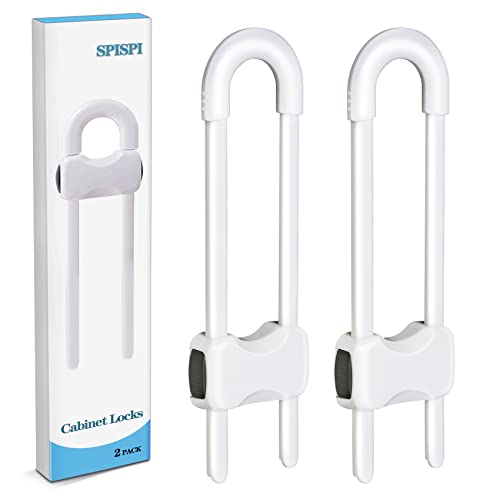 The SPISPI 2-pack is a great trial option for parents new to childproofing.
If you’re not sure if U-shaped locks are right for your cabinets, the SPISPI 2-pack is a low-cost way to test them out. They’re adjustable to fit most standard knob sizes, and the durable plastic construction holds up to daily use.
Pros:
The SPISPI 2-pack is a great trial option for parents new to childproofing.
If you’re not sure if U-shaped locks are right for your cabinets, the SPISPI 2-pack is a low-cost way to test them out. They’re adjustable to fit most standard knob sizes, and the durable plastic construction holds up to daily use.
Pros:
- Low cost, perfect for testing before buying a larger pack
- No adhesive required, no damage to cabinets
- Adjustable to fit most knob sizes
- Easy to install and remove Cons:
- Only 2 locks per pack, not enough for a full kitchen
- May not fit oversized or unusually shaped knobs
- Visible design may not be ideal for some decor styles These are a great pick for new parents who want to secure one or two high-risk cabinets first before investing in a full set.
9. Syican 8-Pack Multi-Purpose Cabinet Locks
 The Syican 8-pack is a versatile option that works on cabinets, drawers, and small appliances.
The Syican 8-pack is a versatile set of adjustable strap locks that work on almost any surface in your home. They’re perfect for securing small appliances like toaster ovens or coffee makers, as well as standard cabinets and drawers.
Pros:
The Syican 8-pack is a versatile option that works on cabinets, drawers, and small appliances.
The Syican 8-pack is a versatile set of adjustable strap locks that work on almost any surface in your home. They’re perfect for securing small appliances like toaster ovens or coffee makers, as well as standard cabinets and drawers.
Pros:
- Adjustable design fits most openings
- Works on cabinets, drawers, fridges, toilet seats, and small appliances
- Strong 3M adhesive holds up to daily use
- Compact white design blends with most decor
- Affordable price point Cons:
- Only 8 locks per pack, may not cover a full large kitchen
- Adhesive may weaken on greasy surfaces over time
- Requires practice to lock and unlock quickly when hands are full These are a great pick for families who want to secure small appliances in addition to cabinets, as most standard locks don’t work on countertop appliances.
10. Vmaisi 12-Pack Magnetic Cabinet Locks with Keys
 The Vmaisi 12-pack magnetic lock set includes spare keys for added convenience.
This set from Vmaisi is a step up from their 20-pack, with a more compact design and included spare keys. The magnetic locks are nearly invisible, and the included 2 keys mean you can keep one in the kitchen and one in the bathroom for convenience.
Pros:
The Vmaisi 12-pack magnetic lock set includes spare keys for added convenience.
This set from Vmaisi is a step up from their 20-pack, with a more compact design and included spare keys. The magnetic locks are nearly invisible, and the included 2 keys mean you can keep one in the kitchen and one in the bathroom for convenience.
Pros:
- Compact 1.4×1.8 inch latch is nearly invisible
- Strong magnetic hold resists pulling from toddlers
- 12 locks per pack, enough for most kitchens
- Includes 2 spare magnetic keys to avoid lockouts
- Reusable, can be removed and repositioned without damage Cons:
- Adhesive may fail on textured or greasy surfaces
- Magnetic keys can be misplaced if not stored consistently
- Not suitable for very thick cabinet doors These are a great pick for families who want a discreet, secure option and don’t want to worry about misplacing their only key.
Pro Tips for Installing and Maintaining No-Drill Kitchen Safety Locks
- Always prep surfaces properly: wipe with rubbing alcohol, let dry fully for 24 hours before applying adhesive. This can double the lifespan of the lock. For wooden cabinets, avoid harsh abrasives when prepping, using the same gentle method you’d use to seal wood cutting boards to avoid damaging finishes.
- Place locks on the upper portion of cabinet doors, out of reach of toddlers (most 2-year-olds can reach up to 36 inches, so install locks at least 40 inches from the floor for lower cabinets).
- Test each lock after installation to make sure it holds up to pulling force, and that you can open and close it easily with one hand.
- Check locks monthly for weak adhesive or broken parts, and replace them as needed. Add this to your routine kitchen equipment maintenance schedule to stay on top of it.
- Keep spare keys or unlocking tools in a consistent, out-of-reach spot (like the top of the fridge) so you don’t get locked out during an emergency.
- For renters, take photos of the cabinet surfaces before applying locks, and use a hair dryer on low heat to warm the adhesive for 30 seconds before removing when you move out to avoid residue.
Frequently Asked Questions
Do no-drill cabinet locks damage cabinets when removed?
Most high-quality adhesive locks leave no residue if removed carefully. Use a hair dryer on low heat to warm the adhesive for 30 seconds before peeling, then wipe away any leftover residue with rubbing alcohol. Avoid cheap generic locks that use permanent adhesive, as they can peel off cabinet finish. For stubborn residue on wooden cabinets, use the same gentle method you’d use to remove cutting board stains to avoid damaging the finish.
How many no-drill locks do I need for a standard kitchen?
Most families need 8–12 locks to cover high-risk zones: 2–3 for under-sink cabinets holding cleaning supplies, 1–2 for the pantry, 3–4 for lower kitchen cabinets with utensils and dishes, 1 for the oven, 1 for the fridge, and 1 for the trash can cabinet. Adjust based on your kitchen layout and the number of hazard zones. For smaller kitchens, 4–6 locks may be sufficient to cover the most dangerous areas.
Are no-drill locks strong enough to stop determined toddlers?
Yes, as long as you choose a lock that meets CPSC child-resistant hardware standards. Most no-drill locks are rated to withstand 15+ lbs of pulling force, while the average 2-year-old can only pull with 8–10 lbs of force. Just be sure to apply locks to clean, smooth surfaces for maximum hold, and avoid using them on textured or porous surfaces where adhesive will fail.
Can I use no-drill locks on metal or glass cabinet doors?
Yes, but choose the right type for your surface. Magnetic locks work best on metal cabinets, as the metal enhances the magnetic hold. Adjustable strap locks work well on glass doors with metal frames, as they don’t rely on adhesive bonding to the glass. Avoid standard adhesive latch locks on glass, as the adhesive may not bond properly to the smooth surface.
What’s the best no-drill lock for renters?
Adjustable strap locks or U-shaped knob locks are the best options for renters, as they either use minimal adhesive (which leaves no residue when removed) or no adhesive at all. If you prefer adhesive locks, choose ones with reusable adhesive backing, and always remove them carefully when moving out to avoid damaging your security deposit. For renters with small kitchen layouts, adjustable strap locks are especially versatile, as they can be moved between apartments easily.
Do no-drill locks work on appliance doors (fridge, oven)?
Yes, adjustable strap locks work on most fridge, oven, and dishwasher doors, as they can be adjusted to fit the width of the appliance. Avoid magnetic locks on ovens, as the heat can weaken the magnetic hold over time. For oven doors, choose a heat-resistant strap lock to avoid melting. Pair appliance locks with regular sink drain maintenance to keep kitchen floors dry and reduce slip hazards near hot surfaces.
Conclusion
Kitchen safety locks are one of the simplest, most cost-effective ways to reduce the risk of accidental injuries for young kids in the home. No-drill solutions make it easy to secure cabinets, drawers, and appliances without damaging your cabinetry, and they’re quick enough to install in an afternoon, even for first-time childproofers. When shopping for locks, prioritize heavy-duty adhesive, CPSC certification, and ease of use for adults to find a solution that works for your family’s needs. Even a minimalist kitchen layout can have hidden hazards, so taking the time to secure high-risk zones will give you peace of mind as your kids explore their environment.
Remember, no lock replaces active adult supervision, especially in the kitchen where hot surfaces and sharp objects pose ongoing risks. Pair locks with other safety measures, like storing cleaning supplies in locked cabinets and keeping pot handles turned inward on the stove, to create a fully childproofed space. Ready to get started? Pick one high-risk cabinet (like the one under your sink holding cleaning supplies) to secure today, and add locks to additional zones over the course of a week to avoid overwhelm. For more tips on keeping your kitchen safe and organized, check out our guides to cabinet storage layout to reduce clutter and eliminate tripping hazards. Safety first, always.

I’m Abby Lu, a passionate home cook who loves simplifying everyday meals. At PlugChef.com, I share product reviews and cooking guides to help you find the best tools for your kitchen.
Related posts:
 Child Safety Strap Locks: Secure Your Cabinets with Easy No-Drill Solutions
 Kitchen Drawer Safety Latches for Childproofing: Easy No-Drill Solutions
 10 Best Child Proof Drawer Locks for Ultimate Safety and Easy Installation
 Grillaholics Bristle Free Grill Brush: Safe, Durable, and Efficient Grill Cleaner
 Non-Slip Christmas Kitchen Rugs: Cozy, Safe, and Festive Floor Decor
 Geedel Rotary Cheese Grater Review: Ultimate Kitchen Slicer and Shredder Guide