Must-Have Cake Baking Tools: Elevate Your Creations with Essential Kits
Baking a cake that is both delicious and visually stunning is rarely about luck; it is about control. While high-quality ingredients form the foundation of great taste, the right equipment is what allows you to execute your vision with precision, consistency, and professional finish. For home bakers, the jump from “good enough” to “gallery-worthy” often hinges on whether you have a few specific, high-leverage tools that eliminate the guesswork involved in leveling, portioning, and decorating.
This guide moves beyond generic advice to provide a practical breakdown of the essential kit components that genuinely change the outcome of your baking. We will examine the mechanical advantages of turntables, the structural integrity provided by levelers, and the consistency gained through precise portioning tools. Whether you are building a toolkit for a hobby or preparing for a side business, understanding why these specific items matter will help you avoid wasted spending and create a workflow that is faster and less frustrating. For more on this, see our guide on free first aid kits for nonprofits by mail.
The Core Toolkit: Beyond the Basics
Before diving into specific products, it is crucial to understand the hierarchy of tools. Not every item in a massive “kit” is equally important. A true essential toolkit prioritizes function over form. The three pillars of a successful cake are structure (leveling and stacking), portioning (consistent sizes for even baking), and finishing (smoothing and detailing).
Why a Turntable Is Non-Negotiable
The single most transformative tool for cake decorating is a heavy-duty turntable. In practice, attempting to smooth a crumb coat or apply intricate piping without a rotating base leads to lopsided cakes and inconsistent pressure. A turntable allows you to keep your working hand stationary while the cake rotates, ensuring that gravity pulls the icing evenly across the surface. For more on this, see our guide on class a first aid kits.
When selecting a turntable, prioritize heft and mechanism quality. A lightweight plastic model will slide around the counter, ruining your focus. Look for a base with a non-slip bottom and a ball-bearing mechanism that spins smoothly without wobble. For beginners, a standard 10–14 inch diameter is ideal, accommodating the most common 6–9 inch cake pans.
- Pro Tip: Place a damp paper towel under the turntable base to prevent it from sliding on polished countertops.
The Role of Cake Levelers in Layer Stability
Most home ovens have “hot spots,” and gravity affects batter distribution. Even in a perfectly flat pan, cakes often rise with a domed top. If you stack two domed layers, you end up with a curved, unstable tower that is prone to tipping. A cake leveler solves this by slicing off the domes to create flat, uniform surfaces.
- Adjustable vs. Fixed: Adjustable levelers offer versatility for different cake sizes, allowing you to change the cutting angle. Fixed levelers are cheaper but limited to specific pan sizes.
- Accuracy Tip: Always run the wire taut and straight through the cake in one confident motion. A wobbly cut creates jagged edges that show through the frosting.
For more on how to manage the structural integrity of your baked goods, understanding the importance of proper timing and technique is key, similar to how one might approach routine upkeep for equipment to ensure long-term reliability. While that link refers to a different domain, the principle of maintaining your tools—such as keeping leveler wires sharp and turntable bearings clean—applies to any kit.
Essential Measuring and Portioning Tools
Consistency is the enemy of chaos. If your cupcakes bake to different heights or your cookies are irregularly shaped, it is almost always a portioning issue. Relying on a standard tablespoon or “eyeballing” dough amounts is the most common mistake amateur bakers make.
Precision Cookie and Cupcake Scoops
Scoop sets typically come in three sizes (1 tbsp, 2 tbsp, 3 tbsp), corresponding to 15ml, 30ml, and 45ml portions.
- Stainless Steel Durability: Look for 18/8 stainless steel. These resist rust and withstand the thermal shock of moving from freezer dough to hot kitchens.
- The Slide-Off Mechanism: A high-quality scraper mechanism is essential for smooth doughs that stick. Cheaper scoops often require you to break the dough off manually, leading to uneven shapes.
Using a scoop ensures that every piece of baked good has the same mass, which means they bake at the same rate. This is critical for sheet pan cookies where edge expansion can vary wildly if one ball is double the size of the next.
The Cake Tester: Knowing When to Stop
Baking times are guidelines, not guarantees. Oven variances, altitude, and humidity all affect how long a cake takes to be fully cooked. A toothpick is the traditional test, but it often leaves a messy, visible hole in the final product. A dedicated, thin-gauge stainless steel cake tester is superior.
- Why Thin Matters: A slim skewer (like the 7.9-inch models) penetrates the crumb without collapsing the structure or leaving a wide void that becomes a weak point in the cake.
- The Test: Insert the tester into the thickest part of the cake. If it comes out clean or with just a few moist crumbs, it is done. If batter sticks to it, keep baking.
 Slim stainless steel testers are ideal for dense cakes and cupcakes, ensuring a clean check.

- Ideal Bakery Tools: Our cake tester, used for checking baking doneness, is made from tough 304 stainless steel for durab…
- Cake Testing Stick: These baking checker testers are suitable for helping gauge when all types of cakes are ready to com…
- With Included Package: A package includes 4 cake tester sticks, each measuring 7.9 inches in length and 1.6 inches in wi…
Evaluating Top-Performing Decorating Kits
While you can buy tools individually, pre-assembled kits offer curated convenience. However, not all kits are created equal. We evaluated several popular options based on material quality, inclusion of educational resources, and the practicality of their components.
Kootek 71-Piece Cake Decorating Kit
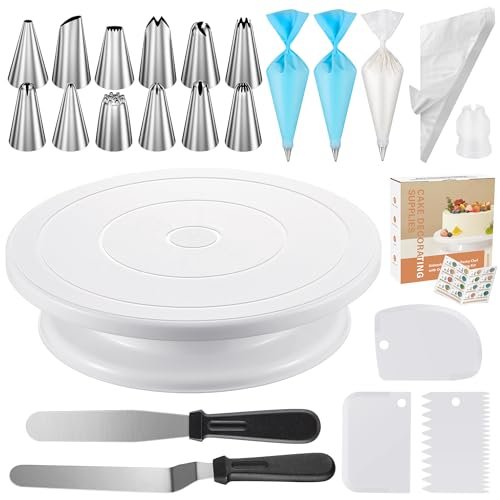
This kit strikes a balance between price and utility. It includes a turntable, 12 piping tips, and essential spatulas.
- Strengths: The inclusion of video tutorials is a significant E-E-A-T booster for beginners, offering guidance on techniques like star borders and rosettes. The turntable is sturdy enough for standard cakes.
- Trade-offs: The plastic components of the turntable may wear out faster than metal alternatives under heavy, professional use.
- Best For: The “starter” baker who wants a low-risk entry point with learning materials included.
 The Kootek kit offers a comprehensive entry point with guided tutorials.

- All-in-One Cake Decorating Kit Supplies: Perfect for beginners & pros! Unsure which cake decorating tools to buy? This c…
- 360° Spinning Cake Turntable: This essential baking supplies tool features a cake stand with an 11-inch diameter that sp…
- Complete Piping Bags & Tips Set: Unlock your creativity with 12 numbered icing tips, 50 disposable piping bags, 2 reusab…
RFAQK 64-Piece Beginner-Friendly Set
Distinguished by its numbering system on the piping tips, this kit reduces the guesswork of matching tips to couplers.
- Strengths: The numbered tips are a clever design feature. Beginners often struggle to remember which tip creates which pattern; the numbers allow for easy reference in recipe books or online tutorials. The video course is structured specifically for novices.
- Trade-offs: The blue plastic stand is functional but lacks the aesthetic polish of neutral tones. The weight is on the higher end, making it less portable.
- Best For: Those who learn best from structured, step-by-step visual instruction.

- All-in-One: Cake decorating supplies includes everything you need to start decorating your cakes: a cake turntable, leve…
- 360° Smooth revolving turntable: RFAQK Cake decorating turntable revolves smoothly with hidden ball bearings and helps y…
- 64 Piping tips 16 Styles: We have selected the top 64 piping tips (34 standard size icing tips, 14 large icing tips, 8 j…
Riccle 88-Piece Comprehensive Kit
This is the “everything bag” of kits, including 50 disposable and 2 reusable piping bags.
- Strengths: The mix of disposable and reusable bags is practical. Disposables are great for one-off projects to avoid cleaning nightmares; reusables are cost-effective for frequent bakers. The 24-tip variety allows for complex Russian piping techniques.
- Trade-offs: The sheer volume of pieces can be overwhelming. Storage is a major consideration; you need a dedicated drawer or bin to keep couplers and tips organized.
- Best For: Enthusiasts ready to tackle intricate, multi-stage decorating projects.
 The Riccle kit prioritizes variety and sustainable options with reusable piping bags.

- Complete Cake Decorating Supplies: This all-in-one baking kit includes a rotating cake stand, 24 icing piping tips, 2 ca…
- Durable Baking Tools: Our cake turntable for decorating is designed with high-quality materials for stability and smooth…
- Versatile Cake Decorating Tools: This set features a cake spinner stand, frosting piping kit, fondant tools, and cake ic…
Specialized Smoothing and Cutting Tools
Kits provide breadth, but specialized tools provide depth. These are the items that elevate a cake from “homemade” to “showstopper.”
Stainless Steel Scrapers and Smoothers
The difference between a matte, textured finish and a sleek, mirror finish is often just the tool used for the final pass.
- Patterned Scrapers: These create visual interest by adding stripes, diamonds, or waves to the sides of the cake. The “2 Pieces 8.7 Inch Stainless Steel Cake Scraper” set is excellent for this. The double-sided design offers two distinct textures without needing to switch tools.
- Professional Technique: When using a patterned scraper, pull it upwards from the bottom to the top in one smooth, consistent motion. Stop in the middle, and the pattern will misalign.
 Patterned scrapers add professional texture to the sides of frosted cakes.


The Dough Scraper: The Underrated Hero
Most bakers overlook the pastry scraper, yet it is the backbone of efficient prep. A high-quality, mirror-polished stainless steel scraper (like the Pro Dough model) serves three critical functions:
- Portioning: Divide dough into equal pieces before rolling or scooping.
- Cleaning: “Scrape” the work surface clean as you bake to prevent cross-contamination and maintain a sterile zone.
- Shaping: The rigid edge helps shape dough rounds uniformly.
Unlike a knife, a scraper does not dull, and it is safe to use on silicone mats. Its compact, flat design means it doesn’t take up drawer space.
Selecting the Right Piping Supplies
Piping is the artistic peak of cake decorating, but it requires specific gear to avoid frustration.
Piping Bags: Disposable vs. Reusable
- Disposable Bags: Inexpensive and hygienic. Use these for cakes with multiple colors or when you don’t want to wash out a thick, dried icing.
- Reusable Bags: Made of canvas or silicone. They are durable and environmentally friendly but require immediate washing to prevent clogging. Always ensure you buy bags that are compatible with the couplers included in your kit.
Couplers: The Key to Efficiency
A coupler consists of two parts: a large cup and a small cone. You place the piping bag over the cup, insert the tip into the cone, and screw them together. This allows you to switch tips without changing bags.
- Why It Matters: Changing bags means wasting icing and introducing air bubbles. The coupler keeps the bag full and ready, saving time and product.
Russian vs. American Piping
Most kits include standard “American” tips (open holes, like stars or rounds). However, kits like the 137-piece Boyun set include “Russian” tips.
- Russian Tips: These have intricate patterns engraved inside the tip. When you pipe, the pattern comes out as a single, consistent shape. This reduces the need for outlining and detailing, making it faster for complex floral designs.
- Consideration: Russian piping requires slightly thicker icing (9+ consistency) and is a different skill set than standard piping. It is a premium skill to learn.
 Russian piping tips allow for complex floral designs with a single pass of the piping bag.
Building Your Kit: Strategic Purchasing Advice
You do not need to buy everything at once. A strategic approach saves money and reduces clutter.
- Start with the Turntable and Spatulas: These are the workhorses. Without them, decorating is inefficient.
- Add a Scoop Set: For portioning cookies and cupcakes. This is a high-use, low-cost item.
- Invest in a Tester: Essential for quality control.
- Upgrade to a Full Kit: Once you have the basics, buy a comprehensive kit like the Kootek or RFAQK to fill in the gaps with piping tips and extra scrapers.
- Specialize Later: If you love specific styles (e.g., Russian piping or patterned sides), buy those specialized tools later.
Storage and Maintenance
- Clean Tips Immediately: Icing cements in the tip holes within hours. Soak metal tips in hot, soapy water and use a tip cleaner tool to remove blockages.
- Store Scrapers Flat: Prevent warping by keeping stainless steel scrapers stored flat or hung.
- Organize Couplers: Keep the large cup and small cone separated in a dedicated container. Losing one half makes the coupler useless.
Frequently Asked Questions
Are cake decorating kits worth it for beginners?
Yes, if they include educational materials (videos/booklets) and a turntable. Buying individual tools requires knowledge of which tips match which couplers, which can be confusing. A curated kit removes that decision fatigue and provides a “known good” set of compatible items.
What is the difference between a cake leveler and a crumb scraper?
A cake leveler uses a taut wire or blade to cut off the domed top of a baked cake layer to create a flat surface for stacking. A crumb scraper (usually a bench scraper or large plastic scraper) is used to remove loose crumbs from the sides of the cake before frosting, creating a clean canvas. They serve different stages of the process.
Can I use a toothpick to test if a cake is done?
While possible, a toothpick is blunt and leaves a large hole. It can also tear the crumb if inserted into a delicate sponge. A thin, stainless steel cake tester is superior as it minimizes damage to the structure and provides a clearer indication of moisture content.
How do I clean reusable piping bags?
Turn the bag inside out immediately after use. Soak in hot soapy water. Use a wet brush or specific piping bag cleaner to scrub the interior. Never put canvas bags in the dishwasher, as the heat can warp the fabric. Hang to dry completely before storing to prevent mildew.
Is it better to buy a big kit or buy tools individually?
If you are unsure about your commitment, start with a mid-sized kit (60–80 pieces). It gives you the essential turntable, basic tips, and spatulas. Once you identify what you actually use (e.g., you only use round tips, never stars), you can buy specific additions. Buying individually allows for higher quality control on specific items like the turntable.
Conclusion
Elevating your cake creations is not about having the most expensive tools; it is about having the right tools for the specific tasks you perform. A sturdy turntable stabilizes your hand, a precise leveler ensures structural integrity, and high-quality scrapers unlock the finishing touches that make a cake look professional.
Start by identifying your bottleneck. If your cakes are lopsided, invest in a heavy turntable. If your layers don’t stack straight, buy an adjustable leveler. If your cookies bake unevenly, adopt a scoop set. By integrating these specific tools into your workflow, you move from improvising to executing. The joy of baking comes from the craft; the right kit gives you the confidence to master it.
To explore how you can maintain your kitchen tools for longevity and check for specific cleaning protocols, consider reviewing our guide on kitchen tool maintenance as a parallel for caring for your specialized equipment. For more on safe handling practices in any kitchen, see our overview of safety standards. Happy baking.

Hi, I’m Daniel Brooks—a food lover and kitchen gear enthusiast. I enjoy testing cookware, utensils, and gadgets to see what really works in everyday cooking. At PlugChef.com, I share honest reviews, comparisons, and simple guides to help you choose the best tools for a safer, smarter, and more enjoyable kitchen.
Similar Posts