Battery Operated Under Kitchen Cabinet Lights: Illuminate Your Space Effortlessly

Battery-operated under kitchen cabinet lights solve a frustrating problem most homeowners face: the dark work zone underneath your cabinets. Task lighting is one of the most underused improvements you can make to a kitchen — and battery-powered options remove the biggest barrier to entry: wiring. No electrician, no drilling into studs, no hunting for the nearest outlet. Just peel-and-stick illumination that transforms how you cook, clean, and navigate your kitchen.
The market in 2026 has shifted significantly toward smarter, longer-lasting battery technologies. Rechargeable lithium-ion packs now rival or exceed alkaline options in cost-per-hour-of-use, motion sensors have gotten more reliable in low-light conditions, and energy-efficient LED diodes have pushed lumen output well beyond the limitations of earlier generations. According to Energy Star, LED lighting uses roughly 75 percent less energy than traditional incandescent bulbs — a statistic that scales dramatically when you consider a row of always-on cabinet lights. For more on this, see our guide on best blenders for smoothies under 100.
This guide walks through ten vetted battery-operated options across the major categories — puck lights, strip lights, motion sensor bars, and touch-activated pucks — with practical insights drawn from real-world installation. Whether you are a renter who cannot modify fixtures or a homeowner looking to add targeted task lighting without a rewiring project, you will find a clear recommendation and actionable installation advice here.
Why Battery-Operated Lights Beat Hardwired Alternatives for Many Kitchens
Hardwired under-cabinet lighting is the gold standard for full-time illumination, but it comes with costs and constraints that often make battery-operated models the better first step. For more on this, see our guide on kitchen hood cleaning certification online.
Installation simplicity. Hardwired fixtures require connecting to a junction box, running wire, potentially updating the circuit panel, and in many cases hiring an electrician at $75 to $150 per hour. Battery lights install in under ten minutes with nothing more than a microfiber cloth and the adhesive backing already included.
Flexibility for renters and leaseholders. Many rental agreements prohibit permanent alterations to the kitchen. Battery-operated lights leave no holes, no wiring, and no electrical modifications behind when you move out. For more on this, see our guide on kitchen brushes for cleaning.
Targeted task lighting without overhead glare. Overhead kitchen lights cast harsh downward shadows that fall directly on cutting boards and countertops. Under-cabinet lights illuminate the work surface directly, reducing eye strain and improving safety when using knives.
Room to grow your lighting setup. Start with two or three pucks in the darkest cabinet and expand over time as you identify additional needs — pantry interior, bathroom vanity, garage workbench, staircase steps. For more on this, see our guide on commercial kitchen hood cleaner.
The trade-off is clear: battery lights will never match the continuous, wired output of hardwired LED strips. The right battery model, however, covers 80 to 90 percent of use cases at a fraction of the installation cost and effort.
Types of Battery-Operated Under Cabinet Lights Explained
The category encompasses four distinct form factors, each with different strengths.
Puck Lights
Compact, circular fixtures that produce focused, downward light. Best for individual dark spots — inside a tall pantry, under a single shelf, at the end of a counter run. They are the easiest to hide and reposition. For more on this, see our guide on industrial kitchen cleaning companies.
Strip Lights
Continuous linear fixtures that run the length of a cabinet or countertop. They provide the most even coverage and the most natural "continuous lighting" look. Best for full-length under-cabinet runs where you want a built-in appearance.
Motion Sensor Bars
Longer linear units that activate automatically when motion is detected. Ideal for spaces you do not want to manually reach into — hallways, stairwells, deep closets, and garage storage areas. They also serve well under a primary cabinet where you want hands-free operation.
Touch/Tap Lights
Puck or bar units with a touch-sensitive top surface. A single tap cycles between on, dimmed, and off. They eliminate the need for remotes or switches but require a fingertip tap each time, which may be inconvenient when your hands are full of food or cleaning supplies.
Key Features to Prioritize When Buying
Not all battery-operated lights perform equally. A few specifications matter far more than marketing copy suggests.
Lumen Output
Lumens measure total visible light. For under-cabinet task lighting, aim for at least 200 to 300 lumens per foot of cabinet run. A single puck light typically outputs between 20 and 100 lumens, meaning a row of four pucks covers roughly 2 feet of counter. Strip lights rated at 200 to 400 lumens cover similar runs in a single unit. Always check the actual lumen rating on packaging — "bright LED" in marketing copy means nothing without a number.
Color Temperature
Color temperature affects both task performance and room mood. Under-cabinet lighting benefits from 3000K (warm white) for dining areas where you want a cozy feel, and 4000K (neutral white) for prep areas where color accuracy matters — slicing vegetables, reading labels, applying makeup. Avoid cool daylight temperatures above 5000K under cabinets; they create an institutional feel and wash out warm cabinetry tones.
Battery Type and Runtime
Alkaline batteries are inexpensive upfront but drain unpredictably in LED devices due to high initial draw. Lithium batteries deliver steadier voltage and longer runtime but cost more per pack. Rechargeable packs (usually 18650 or custom lithium-ion) eliminate recurring battery costs entirely after the initial charge.
For motion sensor and timer-equipped lights, runtime varies dramatically based on sensor sensitivity settings. A light that stays on for 30 seconds after motion is detected will drain batteries far faster than one configured for a 10-second hold time.
Adhesive Quality
Adhesive mounting is the weakest link in most budget under-cabinet lights. Standard adhesive strips lose hold over 6 to 12 months in warm environments (kitchens average 70 to 75°F). For long-term reliability, look for magnets or a combination of adhesive and clip-on mounting. In practice, magnetic mounting allows you to remove lights for recharging or repositioning without damaging cabinetry.
Connectivity Options
Some models include Bluetooth or Wi-Fi connectivity for app-based scheduling and brightness control. While attractive, Wi-Fi-connected lights draw significantly more battery power than comparable non-connected units. Unless you actively want phone integration, the simpler remote-control or touch-activated models will deliver more reliable battery life.
Product Reviews
Tecomlight LED Puck Lights With Remote Control
 Six-puck kit with color-changing capability and remote control — ideal for versatile task and accent lighting.
The Tecomlight six-pack targets users who want one lighting system to handle both functional and decorative needs. The color-changing feature — cycling through multiple hues and warm white via the included remote — lets you set a warm ambient glow for dinner entertaining or switch to bright white for food prep.
Best for: Kitchen island edges, open shelving, and spaces where decorative lighting adds value alongside task lighting.
Practical notes: At 24 lumens per puck, these deliver modest task lighting. They work well as accent lights alongside other illumination but should not be your sole light source in a dark work area. The remote operates from roughly 30 feet, which is generous for a typical kitchen. Alkaline battery usage means budgeting for quarterly replacements under regular use.
Pros: Remote-controlled operation, color-changing for mood customization, six-pack value, compact low-profile design. Cons: Modest lumen output limits task-lighting usefulness, frequent battery replacement required.
View the Tecomlight puck lights on Amazon
STAR-SPANGLED Push Tap Light
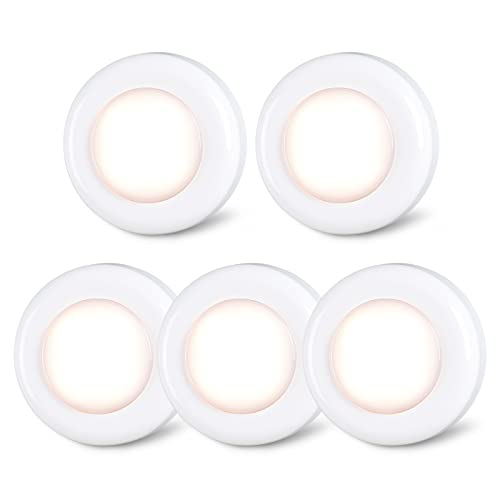 Compact touch-activated pucks designed for quick tap-on operation in tight spaces.
The STAR-SPANGLED Push Tap Light uses the simplest interaction model available: tap the top surface to cycle on, dim, and off. No remote, no buttons, no setup. The 2.8-inch diameter fits behind cabinet doors and under tight shelves without obstruction.
Best for: Renters who want the lowest-commitment lighting solution, small dark spaces, and closets where a brief task light is sufficient.
Practical notes: The warm white color temperature suits kitchen use well, though it will not provide high-contrast task lighting for detailed prep work. AAA batteries are widely available and inexpensive, though LED pucks drain AAA cells relatively quickly — expect two to four weeks of intermittent use per set. The adhesive backing holds well on smooth painted wood and laminate but may struggle on textured or curved surfaces.
Pros: Inexpensive five-pack value, simplest operation model, warm white suits most kitchens, compact footprint. Cons: Warm white only — no color temperature options, brightness insufficient for large work areas, short AAA runtime.
View the STAR-SPANGLED pucks on Amazon
LDOPTO Under Cabinet Lights With Remote Control
 Four-pack dimmable lights with timer function — a feature-rich pick for adjustable kitchen lighting.
The LDOPTO four-pack combines three desirable features in a single unit: remote control, dimming, and a programmable auto-off timer. The timer is the standout here — set the light to shut off after 5, 10, or 15 minutes of manual activation, eliminating the "I forgot to turn off the under-cabinet light" battery drain problem entirely.
Best for: Users who want adjustable brightness without smart-home complexity and who value battery conservation features.
Practical notes: The dimmable function cycles through multiple brightness levels, letting you dial down light during evening browsing or dial up for prep work. The remote range is adequate for a single kitchen but may not reach a separate island or peninsula from the primary remote location. Multiple color options at purchase give flexibility between warm and neutral tones, though individual pucks are not color-changing after purchase.
Pros: Dimming plus timer in one unit, remote control for easy adjustment, four-pack covers a full counter run, multiple color options. Cons: Indoor use only, alkaline battery replacement required, timer must be manually reset after each activation cycle on some units.
View the LDOPTO lights on Amazon
DiDiSky Under Cabinet Lighting — 3200mAh Rechargeable
 3200mAh rechargeable motion-sensor bar — extended runtime without battery swapping.
The DiDiSky 3200mAh unit is the highest-capacity battery system in this roundup. At 3200mAh, the rechargeable lithium-ion pack delivers significantly longer runtime than standard alkaline equivalents — weeks to months depending on motion sensor sensitivity and usage patterns. The motion sensor activates automatically and adjusts behavior based on occupancy, making it a set-and-forget option for frequently accessed spaces.
Best for: Full-time kitchen lighting where recharging is preferable to ongoing battery purchases.
Practical notes: The 13-inch length covers a substantial counter run in a single unit. The dimming function offers multiple brightness tiers, though the dimmable range on motion-activated units is often narrower than on manually controlled variants. A common mistake with motion sensor lights is mounting them too close to a reflective surface — glossy cabinet finishes can trigger false motion detection and shorten battery life. Mounting 6 to 8 inches from a reflective surface mitigates this. The USB charging port adds convenience but requires access to an outlet during recharge, which is trivial in a kitchen setting.
Pros: High-capacity rechargeable battery, motion sensor for hands-free operation, dimmable, 13-inch coverage per unit. Cons: Motion sensor sensitivity varies with ambient light, requires periodic USB recharging, limited to white light output.
View the DiDiSky 3200mAh lights on Amazon
BLACK+DECKER Battery Operated Under Cabinet Lighting
 Two-bar motion-sensor kit from a trusted tool brand — reliable and straightforward.
BLACK+DECKER brings brand-name reliability to a category often dominated by lesser-known manufacturers. The two-bar kit uses their established motion sensor technology, which is known for consistent detection without excessive false triggers. The warm white LED output suits most kitchen environments and complements standard home lighting color temperatures.
Best for: Users who prefer a recognizable brand with established warranty and quality control.
Practical notes: The stick-on installation requires no tools and adheres to standard cabinet finishes. Motion sensor sensitivity is adjustable on some units via a side switch, allowing you to tune detection range to avoid triggering from adjacent room activity. The two-bar kit covers approximately 20 inches of counter space, suitable for a single cabinet run or two smaller installations. Battery life in alkaline cells is moderate — expect monthly replacement with regular use. The warm white output pairs well with existing kitchen lighting rather than conflicting with it.
Pros: Trusted brand reputation, motion sensor with consistent detection, warm white suits most kitchens, tool-free installation. Cons: Alkaline battery replacement required regularly, limited brightness for larger work areas, two-bar kit covers modest space.
View the BLACK+DECKER lights on Amazon
DiDiSky Under Cabinet Lighting — 2200mAh USB Rechargeable
 2200mAh rechargeable magnetic light bar — combines rechargeable convenience with magnetic mounting.
This DiDiSky variant adds magnetic mounting to the rechargeable formula, addressing the most common long-term complaint about adhesive-mounted lights. The magnetic base allows you to lift lights off for charging without any adhesive residue or damage to cabinetry. The 2200mAh pack is smaller than the 3200mAh variant but still significantly outperforms standard alkaline setups in total runtime.
Best for: Renters and homeowners who want rechargeable convenience plus easy repositioning.
Practical notes: The magnetic backing requires a ferrous mounting surface — standard particle-board cabinets with painted finishes may not provide sufficient pull force. A thin steel backing plate (often included) solves this, though it adds a few millimeters of total thickness. The USB recharge cycle is straightforward: unclip, plug in, wait. Most full recharge cycles complete in three to four hours. The dimmable motion sensor provides a practical balance — the light activates automatically but can also be manually dimmed for reduced brightness or extended runtime in lower-usage spaces.
Pros: USB rechargeable eliminates recurring battery costs, magnetic mounting for easy repositioning, motion sensor with dimming, two-pack covers a full counter run. Cons: Magnetic backing may require steel plate for non-metallic surfaces, limited to white output, periodic USB recharging required.
View the DiDiSky 2200mAh lights on Amazon
BestLuz Battery Powered LED Strip Lights
 Three 40-inch cordless strip lights in neutral 4000K — continuous lighting for full counter coverage.
The BestLuz strip lights deliver the most continuous, even illumination of any option here. Each 40-inch strip covers roughly a third of a standard kitchen cabinet run, and the three-pack provides coverage for a full 100+ inches of under-cabinet space. The neutral 4000K color temperature is the practical choice for food prep, where accurate color rendering matters for reading labels and judging doneness.
Best for: Full under-cabinet runs where continuous, even lighting replaces the piecemeal coverage of puck lights.
Practical notes: Strip lights offer the most "built-in" appearance of any battery-operated option — they look like permanent fixtures rather than supplemental lighting. The click-on activation is simple but lacks the dimming and remote features of puck-based systems. Batteries are replaced per strip, so one dying strip in the middle of your run leaves a noticeable gap. For longer-term reliability, purchasing spare batteries ahead of time is wise. The 4000K output renders colors accurately but may feel slightly cool next to warm kitchen overheads — testing one strip before buying a full run is a sensible approach.
Pros: Continuous even lighting across full counter runs, neutral 4000K ideal for task work, cordless click activation, three-pack covers extensive space. Cons: Individual strip failure creates lighting gaps, limited to 40 inches per strip, no dimming or remote control, 4000K may clash with warm kitchen overheads.
View the BestLuz strip lights on Amazon
6 Pack LED Motion Sensor Lights
 Six magnetic motion-sensor bars — extensive coverage for multiple dark spaces at once.
This six-pack is the most versatile and highest-quantity option in the roundup. Each bar contains 10 LEDs producing 150 to 200 lumens per unit, with motion sensor activation and magnetic stick-on mounting. Six bars cover multiple cabinets, closets, and stairwells in a single purchase.
Best for: Homeowners lighting multiple dark spaces at once — kitchen, pantry, hallways, garage — in a single purchase.
Practical notes: The compact 7.32-inch length fits into tight spaces that larger bars cannot reach, including the interior of cabinet door frames. Magnetic mounting means removal and repositioning is frictionless. The motion sensor range is moderate — typically 3 to 6 feet with a 10 to 12-degree detection angle, which covers the space you occupy directly below. Six batteries drain simultaneously, so budget for a full battery swap rather than piecemeal replacements. The all-white housing blends with most cabinetry finishes and does not draw attention when installed.
Pros: Six-pack covers multiple spaces, motion sensor for hands-free operation, compact fits tight spaces, magnetic mounting. Cons: Six batteries drain simultaneously requiring bulk replacement, all-white may not match dark cabinetry, modest lumen output per unit.
View the 6-pack motion sensor lights on Amazon
Brilliant Evolution 0.6" Ultra-Thin Wireless Under Cabinet Lights
 Ultra-thin 0.6-inch profile design — nearly invisible once installed under a cabinet.
The Brilliant Evolution lights solve a specific aesthetic problem: the visible profile of thicker under-cabinet fixtures. At 0.6 inches in height, these units sit flush against cabinet undersides and become virtually invisible in normal viewing angles. The built-in timer provides automatic shutoff, addressing the battery waste problem common with manually controlled lights.
Best for: Users with a minimalist aesthetic who want under-cabinet lighting without visible hardware.
Practical notes: The 65-lumen output is intentionally modest, positioning these as accent and supplemental lighting rather than primary task illumination. For a kitchen where overhead lights provide primary illumination and you want subtle under-cabinet enhancement, this profile is ideal. The timer eliminates the need to remember to turn lights off — set to 10 or 15 minutes and walk away. Stick-on installation is straightforward, though the thin profile makes the adhesive strip proportionally small, so surface preparation (cleaning with isopropyl alcohol) is especially important for long-term hold. Battery life is usage-dependent but generally adequate for intermittent task lighting.
Pros: Ultra-thin 0.6-inch profile nearly invisible when installed, built-in timer saves battery life, stick-on installation requires no tools, suitable for minimalist kitchens. Cons: 65 lumens limits usefulness as primary task lighting, thin adhesive strip requires careful surface prep, battery life varies significantly with usage patterns.
View the Brilliant Evolution lights on Amazon
GE Wireless LED Puck Lights
 GE-brand touch-activated puck lights — trusted name, simple tap operation, six-pack value.
GE brings household-name credibility to the puck light category with a straightforward touch-activated design. The six-pack delivers good value and the 20-lumen output per puck is well-suited for supplemental cabinet lighting rather than primary task illumination. The compact white housing is unobtrusive against most cabinet finishes.
Best for: Users who prioritize brand reliability and simple tap operation over advanced features.
Practical notes: The touch activation is intuitive but requires a clean fingertip — cooking with wet or greasy hands can trigger false activations. The 20-lumen output per puck is lower than several competitors, meaning more units are needed to cover the same area. The six-pack covers a moderate cabinet run when spaced 6 to 8 inches apart, which is the recommended spacing for even coverage at this lumen level. Adhesive backing holds well on standard painted wood but may loosen on warm surfaces (above 80°F ambient). As a household brand, GE pucks benefit from established warranty support and are widely available for individual replacement purchases.
Pros: Trusted GE brand, touch-activated for simple operation, six-pack value, compact unobtrusive white housing. Cons: 20 lumens per puck is modest for task lighting, touch activation can be tricky with wet hands, adhesive may loosen in warm environments.
View the GE puck lights on Amazon
Quick Comparison Table
| Product | Type | Lumens/Unit | Battery Type | Controls | Best Use Case |
|---|---|---|---|---|---|
| Tecomlight 6-Pack | Puck | ~24 | Alkaline | Remote | Accent + color mood |
| STAR-SPANGLED 5-Pack | Puck | Modest | AAA | Tap | Budget renters |
| LDOPTO 4-Pack | Puck | Moderate | Alkaline | Remote + timer | Adjustable kitchen task |
| DiDiSky 3200mAh | Motion bar | High | Rechargeable Li-ion | Motion sensor | Full-time kitchen lighting |
| BLACK+DECKER 2-Pack | Motion bar | Moderate | Alkaline | Motion sensor | Brand-reliable option |
| DiDiSky 2200mAh | Motion bar | Moderate | Rechargeable Li-ion | Motion + magnetic | Repositionable rechargeable |
| BestLuz 3-Pack | Strip | Per strip high | Alkaline | Click | Continuous counter runs |
| 6-Pack Sensor Bars | Motion bar | ~150–200 | Alkaline | Motion sensor | Multi-space coverage |
| Brilliant Evolution | Puck | 65 | Alkaline | Timer | Minimalist aesthetic |
| GE 6-Pack | Puck | 20 | Alkaline | Tap | Budget brand-reliable |
Step-by-Step Installation Guide
Proper installation matters as much as product selection. Follow these steps for a clean, lasting result.
Step 1: Plan your layout. Before opening any package, stand at the counter and trace where you need light. Most kitchens benefit from light concentrated at the cutting board and sink area rather than evenly spread. Mark light positions with painter's tape — never adhesive tape, which leaves residue.
Step 2: Measure and space. Puck lights should be spaced 6 to 8 inches apart for even coverage. Strip lights run the full cabinet depth with a 1-inch overhang at each end for the adhesive backing to reach. For motion sensor bars, position sensors so the detection cone covers the standing zone directly below the cabinet — mounting too far forward or backward creates dead zones.
Step 3: Clean surfaces thoroughly. This step separates long-lasting installations from failures. Dust, grease, and cooking residue destroy adhesive bonding. Clean each mounting surface with isopropyl alcohol (70 percent or higher) using a lint-free cloth. Allow full evaporation — 2 to 3 minutes — before proceeding. Mounting to unwashed kitchen surfaces is the number one cause of lights falling off after a few weeks.
Step 4: Peel and position. Peel the adhesive backing and press each light firmly for 30 seconds, applying even pressure across the full contact area. For magnetic units, test pull force before committing to a position — a strong pull of 15 to 20 pounds is the target. If the pull is weak, clean the surface and retry rather than accepting a loose installation.
Step 5: Insert fresh batteries. Install fresh batteries before mounting, not after — the weight of a fully stocked light makes initial positioning harder. Use alkaline batteries rated for LED applications (look for "LED" or "low drain" labeling). Lithium batteries deliver more consistent voltage but at a higher cost per pack; alkaline works fine for intermittent use.
Step 6: Verify and fine-tune. Turn on each light and step back. Adjust spacing if you notice dark gaps or overlapping hot spots. For motion sensor units, test the detection range and adjust sensitivity if the light triggers from unrelated activity in adjacent rooms.
Step 7: Set reminders. Adhesive degrades over 6 to 12 months in warm environments. Set a calendar reminder to check and potentially re-mount lights after the first year. For rechargeable units, set a reminder to check battery levels monthly.
Battery Maintenance and Maximizing Runtime
Battery performance is the recurring maintenance challenge with all wireless lighting. A few strategies dramatically extend battery life and reduce long-term cost.
Match battery chemistry to usage
Continuous-use lights (motion sensors triggered daily, always-on under cabinets) should use lithium-ion rechargeable packs or lithium alkaline cells, which maintain voltage under load better than standard alkaline. Intermittent-use lights (closet lights activated a few times weekly) work fine with standard alkaline, where the low-draw LED circuit does not stress the battery chemistry.
Adjust motion sensor sensitivity
Motion sensor lights left at maximum sensitivity trigger unnecessarily from sunlight shifts, HVAC airflow across window-mounted sensors, and household pets. Reduce sensitivity to the lowest setting that still reliably detects human movement — most units offer a low/medium/high range. In practice, medium sensitivity is the right setting for most kitchens; low sensitivity misses users entering from the side.
Use lithium batteries in cold environments
Alkaline batteries lose up to 50 percent of their available capacity below 40°F. If you are lighting a garage or utility room that drops below this temperature, lithium batteries are worth the extra cost. They maintain voltage in cold conditions and also deliver longer runtime in warm kitchen environments due to lower internal resistance.
Avoid always-on dimming as a battery-saver
Some users dim their lights to a low level instead of turning them off, hoping to conserve battery. In practice, LED power draw at low brightness is only marginally lower than at full brightness, and the constant draw still depletes the battery. Turning lights fully off when not in use saves significantly more power. The exception is motion sensor units, which draw near-zero power while in standby.
How to Choose the Right Light for Your Kitchen
Your choice should flow from your specific situation. Use these decision paths.
If you are a renter who cannot drill or hardwire: Prioritize the STAR-SPANGLED tap lights, GE pucks, or DiDiSky 2200mAh magnetic units. The magnetic mounting leaves zero damage when removed. Battery life is secondary to ease of installation and removal.
If you want continuous kitchen task lighting without rewiring: The DiDiSky 3200mAh rechargeable units are the best option. Motion sensor activation eliminates manual interaction, and the large battery pack means recharging is infrequent rather than constant.
If you need coverage for multiple dark spaces: The 6-pack motion sensor bars give you the most coverage per dollar and handle kitchen, pantry, hallway, and garage in a single purchase.
If you prefer continuous linear lighting under a full counter run: BestLuz strip lights deliver the most natural built-in appearance. The trade-off is limited to white output and no dimming, but the visual result is superior to spaced puck lights.
If you want the simplest possible operation: The STAR-SPANGLED or GE tap lights are the lowest-friction option — no remote, no buttons, no setup. Tap the top and go.
Frequently Asked Questions
How long do batteries last in under cabinet lights?
Battery life ranges from two weeks to several months depending on light type, brightness setting, and usage pattern. Motion sensor lights with low sensitivity settings and minimal use can run for six months or more on a single set of alkaline batteries. Always-on puck lights at full brightness will consume alkaline batteries in two to four weeks. Rechargeable lithium-ion packs generally deliver equivalent runtime per charge to a full alkaline set, but eliminate the recurring cost of battery purchases.
Are battery-operated lights good enough for food prep?
They are good enough for light prep tasks like gathering ingredients, organizing dishes, and assembling sandwiches. For precision tasks like slicing raw vegetables or using a small knife, battery puck lights may not provide sufficient lumen output at close range. Strip lights rated at 200+ lumens handle prep work well. For consistent high-precision task lighting, hardwired LED strips remain superior.
Can I use these lights in a bathroom or laundry room?
Yes, provided the light is mounted at least 12 inches from any water source and the battery compartment is sealed against moisture. Most battery-operated under-cabinet lights are not rated for direct water contact, but their indoor-rated housing handles the ambient humidity of typical bathroom and laundry room environments. Avoid mounting directly above sinks or tubs.
What is the safest way to store spare batteries?
Store spare batteries in a cool, dry location — a drawer or closet shelf in an interior room is ideal. Avoid high-heat locations like above the stove or in a garage during summer. Standard alkaline batteries last two to three years in storage before losing charge. Lithium batteries have a longer shelf life. Mark the purchase date on the battery packaging for reference.
Do I need to worry about adhesive damaging my cabinets?
Standard adhesive-backed lights use industrial-strength adhesive that holds firmly but may leave residue when removed after extended use. For cabinets with painted finishes, test adhesive strength on a hidden area first. For high-value cabinetry, magnetic mounting with a steel backing plate is the safest option — it removes cleanly with zero residue. In practice, most users report that adhesive removal is clean within the first year, with increasing residue difficulty after 18 to 24 months of continuous exposure to kitchen heat and humidity.
Can I mix different types of under-cabinet lights?
You can, and many users find a combination works well — puck lights for dark cabinet interiors and strip lights for the main counter run. The primary consideration is color temperature consistency. Mixing 3000K and 4000K lights in the same view creates a visually distracting warm/cool split. Standardize on one color temperature across all lights in a contiguous run, and use a different temperature only when separating distinct areas like a dining zone versus a prep area.
Conclusion
Battery-operated under cabinet lighting has matured from a convenience product for renters into a genuinely capable alternative for homeowners who want targeted task lighting without rewiring. The right model depends on your specific priorities: rechargeable convenience points to the DiDiSky 3200mAh bar, multi-space coverage calls for the 6-pack sensor bars, continuous counter lighting favors the BestLuz strips, and minimalist aesthetic demands point to the Brilliant Evolution ultra-thin design.
Whatever you choose, invest in surface preparation before installation — a 30-second alcohol wipe is the difference between lights that hold for a year and lights that fall off in two weeks. Match battery chemistry to your usage pattern, keep spare batteries on hand, and set a calendar reminder to check adhesive hold after twelve months.
These lights will not replace a full hardwired kitchen lighting system, but they will fix the specific dark zones that frustrate daily kitchen use. Start with two or three units in your most-used cabinet, evaluate the results after a week, and expand from there. Your kitchen work zone will thank you.

Hi, I’m Daniel Brooks—a food lover and kitchen gear enthusiast. I enjoy testing cookware, utensils, and gadgets to see what really works in everyday cooking. At PlugChef.com, I share honest reviews, comparisons, and simple guides to help you choose the best tools for a safer, smarter, and more enjoyable kitchen.
Similar Posts