Kitchen Table With Storage: Maximize Space and Style in Your Home
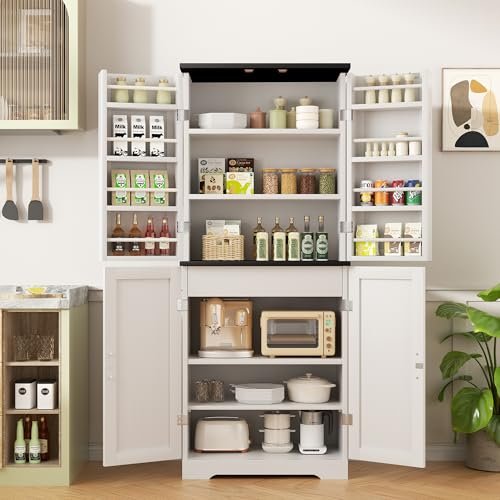
Walking into a kitchen where every pot, spice jar, and utensil has a designated home — all within arm's reach — is something most homeowners wish they could do. A kitchen table with storage is one of the most practical ways to get there without sacrificing style or eating into precious floor space.
In 2026, kitchen design trends lean heavily toward multi-functional furniture. Homeowners no longer want separate pieces for dining, prep, and storage; they want one well-thought-out piece that does all three. Whether you live in a 400-square-foot studio or a sprawling open-concept kitchen, a storage-equipped table adapts to your space, your routine, and your aesthetic. For more on this, see our guide on kitchen table with bench storage.
Below you'll find a comprehensive guide covering the major types of kitchen tables with storage, key features to prioritize, detailed product breakdowns, placement strategies, and honest maintenance tips — so you can choose with confidence and set up with clarity.
Why a Kitchen Table With Storage Is Worth Every Inch
The most common mistake homeowners make is treating a kitchen table as purely a dining surface. In practice, kitchens function as prep stations, casual workspaces, and the main organizing hub of the home. A plain table offers seating and a place to set a plate — nothing more. For more on this, see our guide on kitchen island with storage on both sides.
A kitchen table with storage solves several real problems simultaneously:
- Clutter reduction. Open countertops are the fastest source of visual stress in a kitchen. Bakers racks, islands, and carts pull cookware, linens, and small appliances off the counter and into a visible, accessible system.
- Workflow efficiency. When your can opener, measuring cups, and frequently used spices are stored on a table positioned near the stove, you eliminate unnecessary trips across the kitchen. In daily cooking, those micro-trips add up.
- Flexible dining. Drop-leaf and extendable tables let you seat two people for a quick breakfast and four to six for a dinner party — without permanently occupying the footprint a larger table would demand.
- Appliance home. Built-in power outlets on bakers racks and islands mean your microwave, kettle, or phone charger doesn't require a tangled extension cord reaching from the wall.
- Value retention. Well-designed, durable furniture improves home functionality in ways that matter at resale time, especially in compact markets where buyers scrutinize usable square footage closely.
The National Kitchen & Bath Association (NKBA) maintains published guidelines on kitchen layout, traffic flow, and appliance clearances. Following their dimensional recommendations when planning a kitchen table with storage ensures your furniture serves you without creating bottlenecks.
Types of Kitchen Tables With Storage
Understanding the main categories helps you narrow your search before comparing individual products. Each type excels in different situations. For more on this, see our guide on kitchen pantry with trash can storage.
Bakers Racks
Bakers racks are freestanding shelving units — typically four to six tiers — designed to hold cookware, spice jars, small appliances, and serving dishes. They're the most popular entry into kitchen storage furniture because they're affordable, don't require assembly as complex as built-in cabinetry, and come in finishes ranging from rustic brown to modern white.
Many modern bakers racks now include integrated power outlets, a feature that has become standard among competitive models. Some also include S-hooks or towel bars for hanging utensils. For more on this, see our guide on kitchen island with seating for 4 and storage.
Best for: Home cooks who want vertical storage near a cooking zone; small kitchens where a floor-standing table would crowd the space.
Kitchen Islands
Kitchen islands are larger, heavier pieces that serve as both a dining surface and a substantial storage unit. They typically feature multiple shelves, a large worktop for prep, and sometimes a built-in seating area. Some include drop-leaf extensions, drawers, and even built-in power. For more on this, see our guide on kitchen utensils storage containers with lids.
Islands work best in kitchens with enough open floor space — ideally at least 36 inches of clearance between the island and any adjacent counter or cabinet. In very small kitchens, a rolling island on wheels offers the benefits of an island without permanently blocking traffic.
Best for: Medium to large kitchens; families who do significant meal prep; households that entertain regularly.
Folding Drop-Leaf Tables
Drop-leaf tables have a hinged section that folds down when not needed. This makes them ideal for compact dining nooks, kitchenette areas, or any space where a full-size table would feel overwhelming during solo meals.
When the leaf is up, the table provides a full dining surface and often includes storage compartments underneath or on the sides. When folded down, it reverts to a slim profile that fits into tight spaces.
Best for: Apartment dwellers; one- to two-person households; flex spaces that serve as both dining and work areas.
Slim Storage Carts
These are narrow, wheeled shelving units — often under 14 inches wide — that slide into gaps between cabinets, along walls, or even into hallway nooks. They're not traditional "tables," but many serve as functional kitchen surfaces and store small items efficiently.
Best for: Tight gaps between appliances; bathrooms and kitchens combined; laundry rooms that double as kitchen spaces.
Counter-Height Dining Tables
Counter-height tables sit at 36 inches rather than the standard 30 inches, which makes them easier to transition between a dining function and a casual work surface. Many include built-in drawers or under-table storage compartments.
Best for: Open-concept kitchens; households that want a table compatible with standard counter-height stools; entertaining setups where the table doubles as a serving station.
Rolling Kitchen Carts
These are essentially mobile islands — on wheels, with varied storage configurations including drawers, cabinets, spice racks, and sometimes drop leaves. Their mobility is the key advantage: you can move the cart to wherever you need prep space, then roll it away.
Best for: Small kitchens where a permanent island isn't feasible; households that want flexibility in layout.
Key Features to Prioritize When Shopping
Not all kitchen tables with storage are created equal. Here's what to evaluate before you commit:
| Feature | Why It Matters | What to Look For |
|---|---|---|
| Power outlet | Eliminates extension cord clutter | Look for at least one GFCI-protected outlet; two or more is better |
| Number of storage tiers | Determines how much you can organize | 3–4 tiers covers most kitchens; 5+ for heavy storage needs |
| Material quality | Affects durability and longevity | Solid wood or metal frames outperform particle board for daily use |
| Weight capacity | Critical if you'll place heavy appliances on it | Check specs; some bakers racks max at 25 lbs per tier |
| Assembly complexity | Determines your setup time | Flat-pack tables with numbered parts are fastest; built-in storage adds steps |
| Mobility | Flexibility for layout changes | Caster wheels allow repositioning; locking wheels prevent drift |
| Finish durability | Resists scratches, spills, and daily wear | Sealed wood, powder-coated metal, or laminate tops handle kitchen conditions |
| Wheels (for carts) | Enables mobility without sacrificing stability | Look for swivel casters with brakes for controlled movement |
A common mistake is choosing a piece based solely on how it looks in product photos, then discovering it can't hold the items you actually need. In practice, checking weight capacity per shelf and the actual interior dimensions of drawers before buying saves you from a piece that looks great but frustrates you daily.
How to Measure and Plan for Your Kitchen
Before you shop, take time to assess your space. Here's a practical process:
Measure your floor area. Note the length and width of your kitchen, including any nook or alcove you plan to use. Subtract any permanent fixtures — ovens, fridges, pantry doors, window treatments — from available space.
Check traffic clearance. The Consumer Product Safety Commission recommends that furniture and appliances in the home be placed with enough clearance to prevent trip hazards. For kitchen tables, aim for at least 36 inches of clear walking space between the table and any other permanent fixture. If your kitchen is tighter than that, a drop-leaf or folding model gives you the most flexibility.
Identify your workflow zone. Where do you cook, prep, and plate food? Place your storage table within 60 centimeters of that zone so you're not crossing the room for a spatula. Many people underestimate how much time is saved by having cooking tools within arm's reach of the stove.
Match the table height to your use case. Standard dining tables sit at 29–30 inches. Counter-height tables sit at 36 inches. If you plan to eat at the table, match the height to your seating. If you plan to use it primarily as a prep surface, counter-height aligns better with standard counter tops.
Consider power source proximity. If you want a bakers rack with a built-in outlet, check whether a grounded outlet is available nearby. Even with a built-in outlet, the table may need to be plugged in. Verify the outlet location before committing to a position.
Product Reviews: Top Kitchen Tables With Storage
Furologee Kitchen Bakers Rack with Power Outlet

Four-tier rack with built-in power outlet and S-hooks for hanging utensils
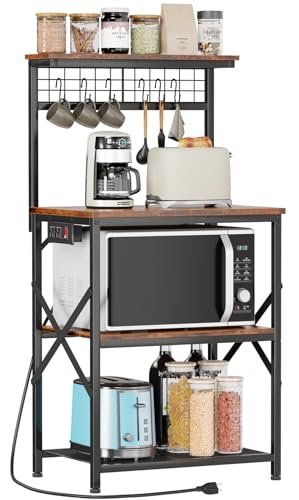
The Furologee Kitchen Bakers Rack is a strong choice for home cooks who want vertical storage near their cooking zone. At four tiers, it provides enough surface area to keep spice jars, cooking utensils, and small appliances organized without crowding a countertop. The built-in power outlet is a standout feature — in practice, it eliminates the need for extension cords reaching across the floor, which not only looks better but also reduces tripping risk.
The six S-hooks are more useful than they first appear. They let you hang measuring cups, cooking spoons, and ladles so they're immediately accessible while you cook, rather than searching through drawers. For someone who cooks several times a week, that convenience adds up.
Pros:
- Built-in power outlet removes extension cord clutter and trip hazards
- Four storage tiers offer generous vertical organization for a freestanding rack
- Six S-hooks keep utensils hanging and accessible during active cooking
- Rustic brown finish complements farmhouse, traditional, and modern kitchen styles
- Compact footprint fits between cabinets or along a wall without blocking traffic
Cons:
- Assembly involves multiple parts; expect 30–45 minutes with clear instructions and a second set of hands
- Weight capacity per tier may limit placement of heavy microwave ovens or canning equipment
- S-hooks are not adjustable — if you need to reposition them, some models don't allow easy relocation
Who it's best for: Home cooks with limited counter space who want their tools and spices within arm's reach of the stove. The built-in power outlet makes it especially valuable in kitchens where the nearest wall outlet is across the room.
Practical tip: Place the top tier under a range hood or away from direct steam. The sealed wood finish handles everyday kitchen conditions well, but prolonged steam exposure can degrade certain finishes over time.
Order the Furologee bakers rack and eliminate messy extension cords from your cooking zone.
VASAGLE Kitchen Island with 3 Shelves
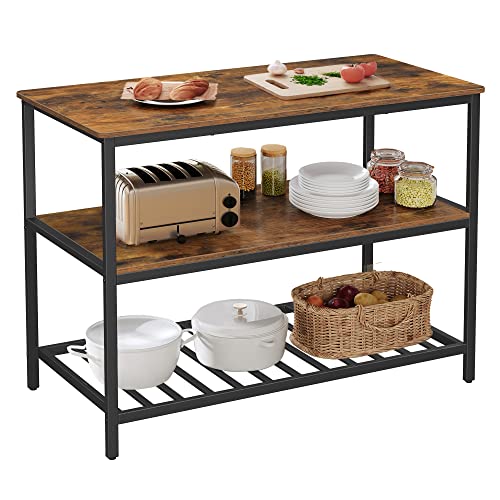
Industrial-style island with three open shelves and large prep surface
The VASAGLE Kitchen Island with 3 Shelves is built for people who need a substantial prep surface combined with organized storage. At 47.2 inches wide, the worktop provides genuine workspace — enough to roll dough, plate multiple dishes, or stage a buffet setup. The three open shelves below offer visual and physical access to stored items without the friction of opening drawers.
The industrial aesthetic — rustic brown and black steel — works well in modern, open-concept, and minimalist kitchens. In practice, this design language also ages well because it doesn't rely on trendy finishes that may look dated in a few years.
The assembly is straightforward for a piece of this size. Clear instructions and a labeled hardware package make the process manageable in under an hour, though two people make it significantly easier given the 55.2-pound weight.
Pros:
- Large worktop (47.2 inches) provides genuine meal prep surface area
- Stable steel frame ensures long-term durability under daily use
- Three open shelves make stored items visible and easy to retrieve
- Industrial brown-and-black design blends with a wide range of kitchen aesthetics
- Assembly instructions are clear and parts are well-labeled
Cons:
- At 55.2 pounds, this island is not a one-person setup — factor in help
- Dimensions may be too large for kitchens under 10 feet in width
- Open shelves expose stored items to dust; pair with decorative bins if aesthetics matter
Who it's best for: Cooks who need significant prep space and prefer open, visible storage. The industrial look suits contemporary and modern kitchens, but the design is neutral enough to work in traditional spaces too.
Practical tip: Use decorative baskets or bins on the open shelves to contain smaller items. This prevents visual clutter and keeps the surface looking tidy without sacrificing access.
Order the VASAGLE island for a spacious prep area with visible, accessible storage.
Shintenchi Kitchen Island with Folding Drop Leaf

Folding leaf adds seating or workspace in seconds when you need it
The Shintenchi Kitchen Island is designed for flexibility. The folding drop leaf transforms the surface area in seconds — fold it up for extra dining or prep space, fold it down when you need to clear the room for foot traffic. This makes it particularly valuable in small kitchens or open-concept layouts where a permanently large table would crowd the space.
The rolling wheels give you the ability to reposition the island as your kitchen needs change. Set it up for meal prep near the stove, then roll it to the dining area for serving. When you need to vacuum or mop, rolling it aside takes seconds.
The built-in cabinet provides enclosed storage for items you'd rather not see — extra cookware, cleaning supplies, or pantry items. The seating area on one side makes it a quick casual dining spot, perfect for breakfasts or coffee with a guest.
Pros:
- Folding drop leaf provides extra surface area only when needed, then retracts
- Rolling wheels enable easy repositioning for different tasks or cleaning
- Built-in cabinet offers enclosed storage for clutter-prone items
- Compact white finish complements modern and minimalist kitchen styles
- Integrated seating area adds a casual dining spot without requiring extra chairs
Cons:
- Assembly is required; expect some time investment depending on your experience
- Weight can make repositioning a two-person job despite the wheels
- Limited seating area may not accommodate more than one or two people comfortably
Who it's best for: Apartment dwellers and small-home owners who need a piece of furniture that adapts to their daily routine. The folding leaf and wheels make this island the most flexible option in this guide for households that change their kitchen layout frequently.
Practical tip: Lock the wheels whenever the island is in active use. Without brakes engaged, the unit can drift when bumped, which is a minor annoyance that builds frustration over time.
Order the Shintenchi island for a folding, rolling, all-in-one solution that adapts to your kitchen.
Space-Saving Folding Dining Table

Extendable leaf makes this table work for solo meals or guest gatherings
The Space-Saving Folding Dining Table is purpose-built for compact living. The extendable drop leaf means you can keep the table small during solo meals or everyday use, then unfold it when guests arrive or you need more surface area. This is one of the most practical designs for households that occasionally entertain but don't want a full-size table occupying space permanently.
The two-tier storage underneath provides a hidden home for dining essentials — napkins, cutlery sets, placemats, or small serving dishes. In practice, this eliminates the need to open a cabinet every time you set the table, which streamlines the routine.
The Carlo Grey finish adds a contemporary look that works well in modern apartments and small homes. The collapsible design means the table can be stored flat in a closet or against a wall when not in use at all, which is a genuine advantage in multi-purpose rooms.
Pros:
- Extendable drop leaf adjusts surface area to match your needs — solo to group dining
- Two-tier storage keeps dining essentials organized and within easy reach
- Carlo Grey finish offers a modern, neutral look that fits most decor styles
- Collapsible design enables full storage when the table isn't in use
- Lightweight enough for one person to position or move
Cons:
- Weight may feel cumbersome if you're moving it frequently for cleaning or layout changes
- Seating capacity is limited to four; larger gatherings will require extra seating
- Assembly is required; hinges and leaf mechanisms add complexity compared to a fixed table
Who it's best for: Apartment dwellers, small-home owners, and anyone who values versatility over permanence. If your kitchen-dining space serves multiple functions — dining, working, entertaining — this table adapts to each mode.
Practical tip: After extending the leaf, tighten any locking mechanism or clamp fully. A loose leaf can create instability during use, and you don't want the table shifting while you're eating or working.
Order the folding dining table for a space-efficient surface that grows when you need it.
Signature Design by Ashley Caitbrook Rustic Counter-Height Dining Table

Counter-height design with built-in storage for plates and linens
The Signature Design by Ashley Caitbrook Rustic Counter-Height Dining Table is built for households that want a substantial, permanent piece of dining furniture with genuine storage capacity. The counter-height design (36 inches) makes it easier to transition between dining and casual prep — many people find this height more comfortable for extended meals and conversation.
The built-in storage compartments provide enclosed space for plates, linens, cutlery, and serving ware. This is a meaningful advantage over tables with only open shelving, because enclosed storage keeps stored items dust-free and visually tidy. In kitchens where cabinet space is limited, these under-table compartments function as a small secondary pantry.
The dark gray finish is distinctive without being overwrought. It works well in modern, industrial, and transitional kitchen styles, and the rustic elements add warmth that prevents the piece from feeling cold or corporate.
Pros:
- Ample built-in storage keeps dining essentials organized and dust-free
- Sturdy construction with quality materials ensures long-term durability
- Counter-height design (36 inches) suits both dining and casual prep use
- Dark gray finish adds sophistication while complementing a wide range of decor styles
- Versatile design works in traditional, modern, and farmhouse kitchen settings
Cons:
- Heavy weight may require two people for assembly and repositioning
- Limited color options; dark gray is the primary finish available
- Bulkier footprint requires adequate kitchen space to function without crowding
Who it's best for: Families and individuals who want a permanent, substantial dining table with enclosed storage. The counter-height design makes it ideal for households that use the table for more than just eating — think work-from-home, school projects, or casual prep.
Practical tip: Use the storage compartments for daily-use items only. Storing rarely accessed items inside means opening and closing drawers frequently for items you reach for once a month, which builds annoyance quickly.
Order the Caitbrook counter-height table for a permanent, substantial dining and storage solution.
SUPERJARE Kitchen Bakers Rack

Power outlet and S-hooks keep tools and appliances within easy reach
The SUPERJARE Kitchen Bakers Rack shares many features with the Furologee model above — four tiers, S-hooks, and a built-in power outlet — but offers a slightly different aesthetic and footprint. The rustic brown finish is warm and inviting, suiting farmhouse and traditional kitchen styles well. The overall proportions make it feel slightly more substantial than some competitors, which gives it a more grounded presence in a room.
The power outlet placement is well-thought-out, positioning the outlet where you'd naturally reach for it when using a small appliance on the rack — a coffee maker, toaster, or microwave. In practice, this placement detail matters more than marketing copy suggests, because a poorly positioned outlet forces you to reach awkwardly or use a cord that drapes over the edge.
The four tiers provide enough vertical storage for a full kitchen pantry setup — spices on the top, mugs and small appliances in the middle, larger items like canning jars and serving dishes on the bottom. The S-hooks are practical for hanging frequently used tools, reducing the need to dig through drawers.
Pros:
- Power outlet positioned for convenient appliance access without cord tangle
- Four storage tiers accommodate a full range of kitchen items from small to large
- Six S-shaped hooks keep frequently used tools hanging and immediately accessible
- Rustic brown finish adds warmth and suits farmhouse and traditional aesthetics
- Sturdy construction supports daily kitchen use without wobbling
Cons:
- May be too large for kitchens under 8 feet in width
- Assembly is required; complexity is moderate depending on your experience
- S-hooks are fixed in position, limiting reconfiguration flexibility
Who it's best for: Home cooks in farmhouse-style or traditional kitchens who want a substantial bakers rack with a built-in power outlet. If you use small appliances frequently and want them permanently stationed on the rack, this model is a strong fit.
Practical tip: Place a shelf liner on each tier to protect the surface from moisture and provide a non-slip base for items like glass jars or ceramic mugs. This small addition prevents slips and makes cleaning easier.
GarveeHome Dining Table Set for 4

Compact four-seat set with storage rack for tableware
The GarveeHome Dining Table Set is designed for small spaces that need a complete dining solution — table and seating included. At 30.7 inches tall, 27.5 inches wide, and 46.5 inches long, it fits comfortably in kitchens, breakfast nooks, and studio apartments where space is measured carefully. The set includes two chairs and a bench, seating four people total without requiring additional furniture purchases.
The storage rack and drawers built into the table base provide enclosed space for tableware, napkins, and small serving items. In practice, this is particularly valuable in compact kitchens where every cabinet door counts, and you don't want to dedicate a full cabinet to dining essentials you use daily.
The grey finish is neutral and modern, blending seamlessly with contemporary, minimalist, and farmhouse-style kitchens. The sturdy construction means this set can handle daily use without showing wear prematurely.
Pros:
- Complete set includes table and seating for four — no additional purchases needed
- Storage rack and drawers keep tableware and dining essentials organized
- Compact dimensions (27.5" W x 46.5" L) fit in tight kitchen and nook spaces
- Sturdy construction resists daily wear and maintains stability over time
- Grey finish complements modern, farmhouse, and minimalist decor styles
Cons:
- Seating limited to four people; larger gatherings require additional seating
- Assembly is required for all components; expect 30–60 minutes for setup
- Storage compartments are sized for small items; large cookware won't fit inside
Who it's best for: Apartment dwellers and small-home owners who want a complete dining setup in a single purchase. If you're furnishing a studio or small apartment and need a table, chairs, and storage without buying separate pieces, this set handles all three.
Practical tip: Rotate items stored in the drawers every few months to keep your most-used tableware closest to hand. Items buried at the back of a drawer tend to be forgotten, leading to duplicate purchases.
Order the GarveeHome set for a complete, space-saving dining solution with built-in storage.
SPACELEAD Slim Storage Cart 4 Tier

Narrow width fits between cabinets or in tight hallway spaces
The SPACELEAD Slim Storage Cart is not a traditional kitchen table, but it earns a place in this guide because it solves a specific kitchen problem that full-sized tables can't address: storage in gaps. Measuring under 14 inches wide, this cart slides into spaces between cabinets, along walls, or even into narrow hallway nooks that would be too tight for any standard kitchen furniture.
The four-tier design provides vertical storage without requiring horizontal floor space. This makes it ideal for kitchens where every inch of counter and floor area is already occupied. The rolling design means you can pull it out when you need to access stored items, then slide it back into place when you don't.
The white finish is clean and modern, blending with a wide range of kitchen aesthetics without drawing attention. It works well in both kitchens and adjacent spaces like bathrooms, laundry rooms, and offices where multi-purpose storage is valued.
Pros:
- Ultra-slim width fits into narrow gaps that standard furniture can't reach
- Four-tier design maximizes vertical storage without consuming floor space
- Rolling design enables easy access to stored items on any tier
- Durable construction withstands regular use in kitchens and other rooms
- White finish blends seamlessly with most decor styles
Cons:
- Narrow width limits storage to smaller items only; large cookware or appliances won't fit
- Assembly is required; moderate complexity for a piece of this size
- Not a substitute for a full kitchen table; best used as a complementary storage piece
Who it's best for: Homeowners with tight kitchens who want to add storage without permanently occupying floor space. This cart works best as a complement to other kitchen furniture, not as a replacement for a dining table.
Practical tip: Use this cart for items you access frequently — everyday spices, small appliances, cleaning supplies. Items stored on the bottom tier are less accessible on a slim cart, so keep heavier or more frequently used items toward the top.
Order the SPACELEAD slim cart for gap-filling storage in tight kitchens.
IRONCK Rolling Kitchen Island on Wheels

Drop leaf, drawer, and spice rack combine prep and storage in one
The IRONCK Rolling Kitchen Island combines several storage features into one mobile unit: a drop leaf that expands the work surface, a drawer for small items, a storage cabinet for larger items, and a spice rack for easy access to seasonings. For kitchens where counter space is limited and you need a flexible prep and storage solution, this island covers a wide range of needs.
The drop leaf is particularly practical — fold it out for meal prep or serving, fold it down when you need to clear the space. The rolling wheels let you reposition the island whenever your kitchen workflow changes. The white finish is clean and versatile, working well in modern, contemporary, and minimalist kitchen styles.
Pros:
- Drop leaf expands workspace when needed, then retracts for compact storage
- Rolling wheels enable easy repositioning for different tasks and cleaning
- Multiple storage types — cabinet, drawer, and spice rack — accommodate various item sizes
- White finish complements modern and minimalist kitchen aesthetics
- All-in-one design reduces the need for multiple separate storage pieces
Cons:
- Assembly is required; moderate to high complexity depending on your experience
- Weight can make repositioning a two-person effort despite the wheels
- Spice rack holds a limited number of items; expandable options may be needed for larger collections
Who it's best for: Homeowners in small kitchens who want a mobile, all-in-one prep and storage solution. The combination of drop leaf, drawer, cabinet, and spice rack in one piece makes it particularly valuable for kitchens where every square foot counts.
Practical tip: Group similar items together — all spices on the spice rack, small utensils in the drawer, larger cookware in the cabinet. This reduces visual clutter and makes it easier to find what you need quickly.
Order the IRONCK rolling island for a mobile, all-in-one prep and storage solution.
Casual Home Kitchen Island with Solid American Hardwood Top

Solid hardwood top supports heavy kitchen tools and daily use
The Casual Home Kitchen Island stands out for its use of solid American hardwood for the tabletop — a material choice that prioritizes longevity and durability over cost reduction. In practice, a solid hardwood surface resists scratches, dents, and moisture damage far better than particle board or MDF, which means this island can handle the rigors of daily meal prep without showing wear.
The 40-inch-wide surface provides a generous workspace for chopping, rolling, plating, and staging. The natural and white finish is clean and modern, working well in contemporary, farmhouse, and transitional kitchen styles. The lightweight design (around 38 pounds) makes repositioning manageable for one person, which is a genuine advantage in smaller kitchens where you might need to move the island for cleaning or layout changes.
Pros:
- Solid American hardwood top resists scratches, dents, and daily wear
- 40-inch-wide surface provides genuine prep space for cooking and serving
- Natural and white finish blends with contemporary, farmhouse, and modern styles
- Lightweight design (around 38 lbs) enables one-person repositioning
- Quality materials ensure long-term durability and structural integrity
Cons:
- Assembly is required; moderate complexity for a hardwood piece
- Weight capacity may not support very heavy kitchen appliances like a large stand mixer
- Limited color options; natural and white finish may not suit all kitchen aesthetics
Who it's best for: Homeowners who prioritize durability and quality materials. If you do significant meal prep and want a surface that holds up over years of daily use, the solid hardwood top is a meaningful investment. This island works best for kitchens with enough space to accommodate its 40-inch width comfortably.
Practical tip: Apply a food-safe wood oil or beeswax finish to the hardwood top every six to twelve months. This protects the surface from moisture and extends the life of the wood significantly without any special equipment or professional help.
Order the Casual Home hardwood island for a durable, long-lasting prep surface built to last.
Product Comparison at a Glance
| Product | Type | Storage Tiers | Power Outlet | Mobility | Best For |
|---|---|---|---|---|---|
| Furologee Bakers Rack | Bakers Rack | 4 | Yes | Fixed | Home cooks near stove |
| VASAGLE Kitchen Island | Kitchen Island | 3 shelves | No | Fixed | Large prep + visible storage |
| Shintenchi Kitchen Island | Kitchen Island | Cabinet + leaf | No | Wheels | Small flexible kitchens |
| Space-Saving Folding Table | Folding Table | 2 tiers | No | Collapsible | Apartments, multi-use rooms |
| Ashley Caitbrook | Dining Table | Under-table | No | Fixed | Permanent family dining |
| SUPERJARE Bakers Rack | Bakers Rack | 4 | Yes | Fixed | Farmhouse kitchens |
| GarveeHome Set | Dining Set | Rack + drawers | No | Fixed | Complete small-space dining |
| SPACELEAD Slim Cart | Storage Cart | 4 | No | Wheels | Gap-filling, narrow spaces |
| IRONCK Kitchen Island | Kitchen Cart | Drawer + cabinet + leaf | No | Wheels | All-in-one mobile prep |
| Casual Home Island | Kitchen Island | Under-table | No | Fixed | Durable hardwood prep |
Placement and Layout Tips for Small Kitchens
Getting the placement right is where the practical value of a kitchen table with storage either delivers or falls short. Here's how to position your piece effectively:
Place it near your primary work zone. If you cook at the stove, position your bakers rack or island within arm's reach of the stove area. This eliminates unnecessary trips across the kitchen for utensils, spices, and tools. In practice, even a 3-foot difference between where your stove is and where your tools are stored adds measurable time to every cooking session.
Maintain traffic clearance. Leave at least 36 inches between your kitchen table and any fixed appliance or cabinet. This ensures you can move around the table comfortably without bumping into counters or doors. If your kitchen is smaller than that, prioritize a drop-leaf or folding model that retracts when you need to pass.
Use vertical space above the table. If you have wall space above your kitchen table, add a floating shelf or pegboard for additional storage. This extends the utility of the table without adding floor space. A simple shelf above a bakers rack can hold serving dishes or decorative items, adding function and visual interest.
Consider lighting. A kitchen table with storage works best where you can see what's stored on it. Position it near a window or under good overhead lighting. In dim corners, stored items become invisible, and you end up relying on memory rather than sight to find what you need.
For rolling islands, define a "parking spot." Rolling furniture is great until it ends up in the middle of the room because you don't remember where you put it. Designate a specific spot — near the stove, against a wall, in a corner — and return it there after each use. A small floor sticker or paint mark helps if the space is ambiguous.
Maintaining Your Kitchen Table With Storage
A well-chosen kitchen table with storage lasts for years if you maintain it properly. Here are practical, specific tips:
Wipe down surfaces after use. Food residue, oil, and moisture left on wood or metal surfaces can cause staining, warping, or corrosion over time. A quick wipe with a damp cloth after each use prevents buildup and keeps finishes intact. For sealed wood surfaces, a microfiber cloth with mild dish soap is sufficient — avoid harsh chemicals that can strip finishes.
Check hardware regularly. Drawer slides, hinges, and wheel casters all experience wear over time. Every three to six months, check that drawers open and close smoothly, that hinges don't sag, and that wheels rotate freely. Tighten any loose screws you find — a small adjustment now prevents a sagging drawer or drifting cart later.
Clean and dry storage areas. Open shelves and enclosed cabinets collect dust and moisture. Wipe down shelves every few weeks, and dry any moisture that accumulates from condensation or food handling. For enclosed storage, leave drawers and cabinet doors slightly open between uses to allow air circulation.
Apply protective finishes as needed. Solid wood surfaces benefit from periodic application of food-safe wood oil or beeswax finish. Metal surfaces benefit from a light coat of protective wax or oil to prevent rust, especially in humid climates. Follow manufacturer recommendations for the specific finish or material of your table.
Inspect structural integrity periodically. The Consumer Product Safety Commission encourages regular inspection of household furniture for stability issues, especially pieces that bear significant weight. Check for wobbles, loose joints, or signs of material fatigue. If you notice instability, disassemble and tighten the affected area rather than continuing to use a piece that may shift or tip.
Address damage early. Chips, scratches, and dents can be repaired with basic supplies — wood filler, touch-up stain, or paint. Addressing damage promptly prevents it from spreading and keeps the piece looking good year after year.
Frequently Asked Questions
What features does a kitchen table with storage offer?
Kitchen tables with storage include a range of organizational features depending on the type:
- Open shelving for visible access to stored items like cookware, dishes, and small appliances
- Drawers for enclosed storage of tableware, utensils, and small items
- Cabinets for larger enclosed storage, often for cleaning supplies or rarely used items
- S-hooks or towel bars for hanging frequently used tools like spatulas, ladles, and kitchen towels
- Built-in power outlets for charging devices and powering small appliances without extension cords
- Drop leaves for expandable surface area that retracts when not needed
- Spice racks for dedicated, visible storage of seasonings
- Rolling casters for mobility and easy repositioning
Not every model includes all of these features — most focus on 2–4 depending on their type and design.
How can a kitchen table with storage enhance my kitchen?
A kitchen table with storage enhances your kitchen in several measurable ways:
- Reduces countertop clutter by moving cookware, spices, and small appliances to the table's storage compartments, freeing up counter space for active prep
- Improves workflow efficiency by keeping frequently used tools within arm's reach of your cooking zone, eliminating unnecessary trips across the kitchen
- Provides additional prep surface for meal prep, plating, and staging, especially in kitchens with limited counter space
- Adds casual dining or seating without requiring a separate table, saving floor space
- Creates a designated home for appliances like microwaves, coffee makers, and toasters, reducing the visual chaos of small appliances scattered across counters
- Supports flexible layout changes when your cooking routine or entertaining needs shift
In practice, the most noticeable benefit is reduced clutter and improved access to your daily cooking tools. Homeowners who use a kitchen table with storage consistently report spending less time searching for items and more time actually cooking.
Are there kitchen tables with storage suitable for small kitchens?
Yes, several types are specifically designed for small kitchens:
- Folding drop-leaf tables retract to a slim profile when not in use, making them ideal for tight spaces
- Slim storage carts under 14 inches wide fit into gaps between cabinets or along walls
- Rolling kitchen islands can be moved to different areas as needed, rather than permanently occupying one spot
- Compact bakers racks with a narrow footprint add vertical storage without consuming much floor area
- Counter-height tables with under-table storage maximize vertical space in compact dining areas
When choosing for a small kitchen, prioritize pieces with retractable, folding, or rolling features that allow you to adjust the footprint as your needs change.
How do I choose the right kitchen table with storage for my home?
Follow this decision process:
Measure your space before shopping. Note the dimensions of your available area and subtract fixed fixtures like appliances, cabinets, and window treatments.
Identify your primary use case. Are you looking for additional prep space, dining seating, appliance storage, or all three? This determines the type of table you need.
Check weight capacity and material quality. If you plan to place heavy items on the table, verify the manufacturer's weight rating. Look for solid wood or metal construction for durability.
Consider mobility needs. If you want to reposition the table frequently, choose models with locking casters; otherwise, a fixed base offers more stability.
Evaluate storage configuration. Determine whether you prefer open shelves for quick access, enclosed drawers for dust protection, or a mix of both based on what you plan to store.
Match finish to existing décor. Bring home swatches or photos of your kitchen's colors and materials to ensure the table's finish complements rather than clashes.
Read verified buyer reviews. Focus on comments about assembly difficulty, long-term durability, and real-world weight capacity — not just star ratings.
Budget Considerations
Kitchen tables with storage span a wide price range, from budget-friendly options under $100 to premium hardwood pieces exceeding $800. Understanding what drives cost helps you allocate funds where they matter most.
Under $150
Typically features particle board or MDF frames with laminate finishes, basic open shelving, and minimal hardware. These models work well for light storage — spices, linens, or lightweight appliances — but may show wear sooner under heavy daily use. Look for reinforced corners and cam-lock fasteners to improve longevity.
$150–$350
Includes solid wood or metal frames, better-quality finishes (powder-coated steel, veneered wood), and added features like drawers, power outlets, or locking casters. This range offers the best balance of durability and functionality for most households.
$350–$600
Often showcases solid hardwood tops, dovetail drawer construction, thicker gauge steel, and designer touches such as tapered legs or mixed materials. Expect higher weight capacities and more refined aesthetics.
Over $600
Reserved for premium brands, custom craftsmanship, or designer collaborations. These pieces may include hand-finished wood, integrated lighting, or modular components that can be reconfigured. Choose this tier only if specific design or material qualities are non-negotiable for your space.
Where to save: Prioritize investing in the tabletop and frame — surfaces that take daily wear and structural elements that support weight. You can often save on decorative hardware (handles, knobs) by upgrading them later if desired.
Where not to skip: Avoid the cheapest particle board options if you plan to store a microwave, stand mixer, or stack of cast‑iron cookware. The risk of sagging or fastener pull‑out outweighs the initial savings.
Assembly and Setup Tips
Most kitchen tables with storage arrive flat‑packed. A smooth assembly experience saves time and frustration.
- Clear a workspace. Lay out all parts on a clean floor or large table, keeping hardware sorted in small bowls or a muffin tin to avoid losing screws or cam locks.
- Read the manual fully before starting. Identify any steps that require two people (e.g., lifting a heavy tabletop) and gather any tools not included — usually a Phillips screwdriver and rubber mallet.
- Follow the sequence. Skipping ahead can lead to misaligned holes or unnecessary disassembly. If a step feels off, double‑check that you haven’t missed a preceding sub‑step.
- Use hand tools for final tightening. Over‑tightening with a power driver can strip screws in particle board or split wood. Snug is sufficient; you can always tighten a bit more later if needed.
- Check for wobble before loading. Once assembled, gently shake the table. If it rocks, adjust the leveling feet or tighten any loose joints before placing items on it.
- Protect the finish during assembly. Lay a soft blanket or cardboard underneath the tabletop while you work to prevent scratches from tools or hardware.
Styling Your Storage Table
A functional piece can also enhance your kitchen’s visual appeal. Consider these simple styling tricks:
- Group items by use. Keep morning coffee supplies (mugs, beans, scoop) together on one shelf, baking supplies (measuring cups, spatulas, mixers) on another, and everyday dinnerware in a third zone.
- Add texture. Woven baskets, ceramic canisters, or linen napkins introduce visual interest while keeping contents contained.
- Use lighting. A small battery‑operated LED puck light underneath a shelf illuminates stored items and adds a warm ambiance during evening meals.
- Keep a clear work zone. Reserve at least 6–8 inches of the tabletop free for active prep or plating; this prevents the surface from feeling cluttered despite ample storage below.
- Rotate seasonal items. Swap out heavy holiday serveware for lighter summer accessories every few months to keep the arrangement fresh and relevant.
Final Thoughts
A kitchen table with storage is more than a piece of furniture — it’s a workflow enhancer, a clutter reducer, and a style anchor all in one. By measuring your space honestly, prioritizing the features that match your daily habits, and choosing quality materials where they count, you’ll end up with a table that serves you reliably for years. Take the time to assess your needs, compare a few models side‑by‑side, and enjoy the payoff of a kitchen that feels both organized and inviting.

Hi, I’m Daniel Brooks—a food lover and kitchen gear enthusiast. I enjoy testing cookware, utensils, and gadgets to see what really works in everyday cooking. At PlugChef.com, I share honest reviews, comparisons, and simple guides to help you choose the best tools for a safer, smarter, and more enjoyable kitchen.
Similar Posts