Round Rug Under Kitchen Table: Transform Your Dining Space with Style
A round rug is one of the few additions to a kitchen dining space that pays off on two fronts at once — it visually anchors the table in a way a rectangular rug can't, and it softens a floor that gets walked on, dripped on, and scraped by chair legs every single day. Done right, it takes about thirty minutes to shop and a single weekend to feel like it's been there for years.
Done wrong, it's a slip hazard, a permanent stain magnet, or a shape that fights with your table instead of supporting it. This guide walks through the actual decisions that matter in 2026 — sizing math, placement scenarios, material trade-offs, cleaning rules, safety, and ten solid options across natural fiber, machine-washable, and indoor-outdoor styles — so you can pick one with confidence instead of guesswork. For more on this, see our guide on kitchen table with bench storage.
How to Size a Round Rug for a Dining Table
Sizing is the most common mistake, and it's almost always the same mistake: buying a rug that only covers the footprint of the table. That looks fine in a showroom, but in real use, chair legs slide off the edge the moment someone pulls out, and you've created a tripping edge in your most active foot zone.
The rule that works in practice:
- Formal or semi-formal dining (4+ chairs): allow 18–24 inches of rug extending past every edge of the table, so all four chair legs sit fully on the rug when pulled out. For a 60-inch table, that means a 10-foot diameter rug minimum.
- Everyday kitchen dining (2–4 chairs, casual setup): allow 6–12 inches of overlap. The front legs touch down on the rug, back legs rest on the floor. A 5- or 6-foot rug handles most tables 36–48 inches wide.
- Nook or half-moon table against a wall: allow 12–18 inches on the open sides, less or none against the wall. This is where 4-foot round rugs actually look good.
If you can't get all chair legs on the rug, at least get the front two on. Half-on/half-off chair legs are the single most frequent cause of rug curl and trip hazards. For more on this, see our guide on best coffee table accessories.
Measuring Your Actual Dining Footprint
Before you shop, measure three things with a tape:
- The table's outer edge to outer edge, measured across the widest point (not just the tabletop if it overhangs the base).
- The space between the table edge and the wall or other furniture, on both sides — this tells you the maximum rug width you can fit without blocking traffic.
- The foot traffic path from the stove or pantry to the table. Your rug should never cross a path people walk through daily to get something else.
Three Placement Scenarios That Actually Work
The right placement depends less on the rug and more on how your kitchen is laid out. Here's what works in practice:
Scenario 1 — All four chair legs on the rug. The classic approach. Requires a rug at least 10 feet across for a standard 60-inch table. Works in dedicated dining rooms, larger open-plan kitchens, and spaces with wide walkways. The rug becomes the room's anchor.
Scenario 2 — Front chair legs on the rug, back legs off. The workhorse option for real kitchens. A 5- to 6-foot round rug fits a 36–48 inch table with chairs pulled around all four sides. This is the size and placement most of the rugs reviewed below are designed for. For more on this, see our guide on best blenders for smoothies under 100.
Scenario 3 — Table on the rug, chairs off. Best for breakfast nooks, half-moon tables against a wall, or compact galley kitchens where a larger rug would block the doorway. A 4-foot round rug here works as a decorative focal point, not a full dining foundation.
The wrong version of any of these three: a rug so small that chairs sit completely outside it, or so big that it crowds into walkways. Both make the room feel smaller and messier, not larger. For more on this, see our guide on kitchen hood cleaning certification online.
Matching Round Rug Style to Your Table
A round rug reads differently depending on what's sitting on top of it. Match the rug's material family to the table's material family, and the room stops feeling like two competing design decisions.
- Wood or reclaimed-wood table — pair with natural fiber rugs (jute, sisal, seagrass). The organic texture amplifies the warmth of the wood without competing.
- Metal or glass table — pair with a short-pile synthetic in a soft tone (grey, ivory, taupe). The contrast between the hard table surface and a soft underfoot rug is where the round shape shines.
- Painted or farmhouse white table — jute or handwoven in natural tones. This is the combination most farmhouse kitchens land on.
- Marble, stone, or concrete table — a low-pile chenille or flatweave synthetic in a muted tone. Delicate fibers under heavy stone tables tend to mat quickly; keep the pile thin.
Color matching matters less than you'd think. Neutral rugs (ivory, taupe, grey, natural) work in virtually every kitchen. Bold patterns only earn their place when they complement, not compete with, existing cabinetry — and even then, a small 4-foot round is often the safer bet than a large statement piece. For more on this, see our guide on kitchen brushes for cleaning.
Material Comparison for Kitchen Tables
Kitchen rugs get dripped on, scraped by chair legs, and walked on barefoot. Material choice is where longevity is won or lost, so here's what actually holds up.
| Material | Durability | Stain Resistance | Machine Washable | Underfoot Feel | Best For |
|---|---|---|---|---|---|
| Jute / braided jute | High | Low | No (spot clean only) | Medium-firm, textured | Farmhouse, rustic, dry kitchens |
| Sisal | Very high | Low | No | Firm, coarse | Traditional, coastal |
| Wool | High | Medium | Hand clean only | Soft, warm | Family dining, moderate traffic |
| Polyester | High | High | Yes | Medium | High-traffic kitchens, spill-prone homes |
| Chenille | Medium | Medium | Yes (usually) | Soft, plush | Low-to-medium traffic, vintage feel |
| Polypropylene / indoor-outdoor | Very high | Very high | Yes (hose off) | Low-medium | Outdoor patios, kitchens with pets |
| Cotton blend | Medium | Medium | Yes | Soft | Casual kitchens, smaller rugs |
Polyester and polypropylene rugs have taken over most round rug options in the last few years because they handle the messy reality of kitchens better than natural fibers do. Jute still wins on aesthetic — and it's a genuinely biodegradable fiber, with durability and fiber standard testing documented through the National Institute of Standards and Technology materials programs if you want to look at objective metrics rather than marketing claims. The trade-off is real: jute stains and needs care, synthetics barely do.
Safety: Non-Slip Backing, Rug Pads, and Standards
"A non-slip backing" on a rug is often just a light latex coating — enough to slow the rug down, not enough to stop it. In practice, the rug still slides when someone leans back in a chair, and that's when the trip happens.
Two things worth doing every time:
1. Always use a rug pad. A 3mm latex pad or a 6mm cork-latex pad is the single biggest upgrade you can make. It stops edge curl, adds real grip against hardwood or tile, and adds cushion under the rug so chairs don't scrape the floor. For a 6-foot round rug, a standard round pad in 6 or 6'6" fits most spaces. Pads are cheap; trip hazards aren't.
2. Check for flammability compliance. Rugs sold in the U.S. must meet the federal flammability standard 16 CFR 1610, which is part of the broader consumer product safety framework maintained by the U.S. Consumer Product Safety Commission. Most rugs sold through major retailers are pre-compliant, but checking the product tag or listing for a 16 CFR 1610 reference is worth 10 seconds when you're buying an import.
If your kitchen gets barefoot kids, pets, or both, treat the rug pad as non-negotiable. A non-slip backing claim on the rug alone is not the same thing as a properly installed rug on a proper pad.
Cleaning and Maintenance: Rules by Material
Kitchen rugs live or die by maintenance. Here's what works in practice, by fiber type.
Jute and Sisal
- Vacuum frequently — ideally once a week in high-traffic kitchens.
- Never machine wash — jute loses structure when wet and will curl or distort.
- Spot clean only — a solution of warm water, a small amount of mild dish soap, and a clean cloth for stains. Blot, don't scrub.
- Flip quarterly if the rug is reversible, to distribute wear evenly.
- Blot spills immediately — jute stains are nearly impossible to remove once set.
Washable Polyester and Chenille
- Machine washable on a gentle cycle, cold water, mild detergent, low heat or air dry.
- Read the manufacturer's label first — not every "washable" rug survives a washer equally well.
- Rotate and flip every few months for even wear.
- Rug pads are also machine washable in most cases; check the pad's care label.
Indoor-Outdoor Polypropylene
- Hose down or hand wash with mild soap. This is the easiest-to-clean category, full stop.
- Air dry completely before putting it back down.
- Great for kitchens with pets or children where spills are frequent and cleanup needs to be fast.
A common mistake is treating washable rugs like they need no care at all. They still need vacuuming between washes, and they still curl at the edges when exposed to humidity — that's what the pad is there to fix.
Curated Round Rug Picks for Kitchen Tables
Each of these is a real option in a specific price or style lane. Sizing ranges from 4 to 8 feet to match different kitchen footprints.
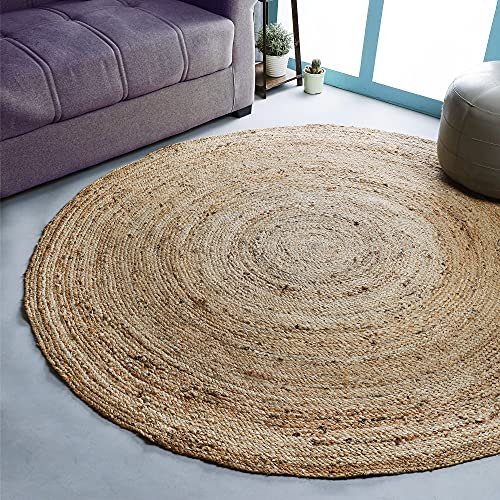
Hausattire Hand Woven Jute Braided Rug

The Hausattire 4-foot braided jute rug — natural fiber, reversible, sized for nooks and small dining areas.
The Hausattire braided jute rug is the most forgiving entry into natural-fiber dining rugs. At 4 feet round, it sits well under half-moon breakfast tables and small counter stools — the setup that struggles to find a rug that isn't either too small or too big. The braided construction means the weave is tight enough to handle regular foot traffic without fraying at the edges, which is the failure point on many cheaper jute rugs after a year.
The reversible design is the real value here. When one side gets worn or stained in a kitchen, you flip it and you've effectively doubled the useful life.
Pros
- Reversible — doubles functional lifespan
- Tight braided weave resists fraying better than looser jute weaves
- Natural material; biodegradable at end of life
- Lightweight enough to move for deep cleaning
Cons
- Only 4-foot size limits use to smaller tables or nooks
- Off-white / natural palette only — won't fit a bold color scheme
- Not machine washable; strict spot-clean-only maintenance
Best for: a farmhouse or modern-farmhouse nook with a small table where a full-size dining rug won't fit.
To buy this rug, click here.
GENIMO 5FT Round Chenille Area Rug

The GENIMO 5-foot chenille rug — machine-washable and sized to fit most 36-to-48-inch dining tables with chairs pulled around all four sides.
The GENIMO 5-foot round rug hits the exact size and construction sweet spot for everyday kitchen dining: big enough to hold a chair fully on the front legs, small enough to fit between cabinetry in a standard kitchen, and machine washable without requiring dry cleaning or hand washing. The low-pile chenille construction keeps it under a chair leg without catching — that's the specific failure mode you want to avoid in a dining area.
The taupe color is a safe neutral that reads well against white, shaker-style, or painted cabinetry. It's the option I'd shortlist for a family kitchen where coffee spills and pasta drips are weekly occurrences.
Pros
- Machine washable on gentle cycle
- 5-foot diameter fits most standard kitchen tables
- Low pile sits cleanly under chair legs
- Non-slip backing (still use a rug pad)
- Vintage taupe tone flatters most cabinetry
Cons
- Taupe is essentially the only color option at this size
- Single 5-foot size — won't scale up for larger tables
- Chenille piles can mat over time in high-traffic zones
Best for: standard kitchen dining with frequent cleanup needs and a neutral color palette.
To buy this rug, click here.
UERMEI 6ft Round Area Rug

The UERMEI 6-foot thin-pile rug — washable, non-slip, and thin enough to slip under most table bases without lifting chair legs.
The UERMEI 6-foot round rug is the thinnest and most flexible option in this roundup. That thinness is a feature, not a bug: it means the rug slides under tighter furniture clearances that a plush rug would catch on, and it lays flat against chair legs instead of bunching. The brown-grey abstract pattern gives it a bit more visual interest than a plain solid without overpowering a room.
At 6 feet, this covers the standard 48-inch-diameter dining table with room for chair overlap on all four sides. The washability is the practical win for a kitchen.
Pros
- Very thin profile fits under tight furniture clearances
- Machine washable
- Abstract pattern adds interest without loud visual weight
- Non-slip backing (still use a rug pad)
- 6-foot diameter suits most standard dining tables
Cons
- Thin pile offers minimal cushion underfoot
- May require a rug pad for meaningful support
- Pattern is subtle — won't hold a room together on its own
Best for: modern or contemporary kitchens where a subtle, easy-care rug is preferable to a plush one.
To buy this rug, click here.
Soalmost 6×6 Grey Round Rug

The Soalmost 6-foot grey vintage rug — a versatile neutral for kitchens, dining rooms, or bedrooms that need a soft underfoot feel.
The Soalmost 6×6 grey round rug is the quiet workhorse of this list. Grey is arguably the most forgiving neutral in a kitchen — it hides crumbs, doesn't show the faintest oil sheen, and doesn't clash with warm wood tones the way pure white sometimes does. The vintage-style pattern adds just enough texture to feel like an intentional design choice rather than a plain grey square with curves cut out of it.
The durability of the construction means it holds up in a real kitchen environment — chairs getting scraped back and forth don't ruin the pile.
Pros
- Grey palette is forgiving of everyday mess
- Vintage design adds subtle texture without loud color
- 72-inch diameter works well for standard dining setups
- Durable pile holds up to regular chair scraping
- Non-slip backing (still use a rug pad)
Cons
- Limited color options — grey only at this size
- Underfoot thickness is medium, not plush
- Vintage pattern may feel dated in very modern kitchens
Best for: kitchens where you want a rug that hides mess without demanding attention.
To buy this rug, click here.
Safavieh Natural Fiber Collection Area Rug

The Safavieh Natural Fiber 4-foot round rug — handmade ivory jute built for high-traffic spaces that want natural character.
The Safavieh Natural Fiber Collection rug is the strongest handmade-jute option in this roundup. The ivory tone is warmer and lighter than typical tan jute, which means it fits brighter kitchens and white cabinetry better than the darker natural jute options. Handmade construction shows in the weave consistency — the fibers are tighter and less prone to fraying at the edges than mass-produced jute rugs.
The 4-foot diameter is the trade-off: this is a nook-sized rug, not a full dining foundation. For a small breakfast nook or a table against a wall, though, it's a strong choice.
Pros
- Handmade construction with tight, durable jute weave
- Ivory tone fits brighter kitchens better than standard tan jute
- Rated for high-traffic areas
- Biodegradable natural fiber
Cons
- 4-foot size limits placement to small tables
- Jute requires careful maintenance — no machine washing
- Handmade rugs show the occasional irregular weave; that's authentic, not a defect
Best for: small nook setups that want a handmade natural fiber over a synthetic alternative.
To buy this rug, click here.
Safavieh Adirondack Collection Area Rug (Silver & Black)

The Safavieh Adirondack 6-foot rug — a non-shedding silver-and-black abstract pattern that anchors modern kitchens without loud color.
The Safavieh Adirondack in silver and black is the strongest option if your kitchen leans modern and your color palette is more metallic or dark wood. The abstract pattern gives visual interest without being loud — enough to look intentional, subtle enough to not fight with a patterned countertop or a strong backsplash.
The non-shedding construction is the practical reason to pick this one over a cheaper synthetic: it means less loose fiber on chair legs and shoes at the end of every meal.
Pros
- Non-shedding construction — cleaner long-term
- Silver-and-black palette works with modern kitchens
- Abstract design adds interest without dominating the room
- Durable enough for high-traffic dining use
Cons
- Silver-and-black is a limited palette; won't fit warm-traditional kitchens
- Single 6-foot size
- Weight makes it harder to reposition for cleaning
Best for: modern or contemporary kitchens with metallic, dark wood, or industrial elements.
To buy this rug, click here.
Safavieh Adirondack Collection Area Rug (Ivory & Beige)

The Safavieh Adirondack 6-foot ivory-and-beige round rug — a medallion pattern built to anchor a dining space in a warm neutral tone.
This is the warmer sibling of the silver-and-black Adirondack above, and it's the one that fits most traditional and farmhouse kitchens best. The oriental medallion pattern is a specific design shape — a central focal medallion with radiating borders — and it reads well on a round rug because the medallion naturally centers on the round surface. The ivory-and-beige palette is forgiving of crumbs and light kitchen grime without feeling plain.
At 6 feet and roughly 15.5 pounds with a 1-inch profile, it sits with real presence under a table without adding trip hazard.
Pros
- Medallion pattern suits traditional and farmhouse kitchens
- Ivory-and-beige palette hides light grime well
- Non-shedding fibers keep the room cleaner
- 1-inch profile adds underfoot cushion
Cons
- Pattern will read dated in strictly minimalist kitchens
- Round shape may not align with rectangular room proportions
- Weight makes repositioning more effort than lighter rugs
Best for: traditional, farmhouse, or mid-century kitchens with warm wood tones.
To buy this rug, click here.
Nourison Essentials Indoor/Outdoor Round Rug

The Nourison Essentials 4-foot indoor-outdoor rug — non-shedding and hose-washable, sized for kitchens with pets or an outdoor dining setup.
The Nourison Essentials indoor-outdoor rug is the practical pick for anyone whose kitchen also hosts a dog, a cat, or small kids — or anyone who wants one rug that can rotate between a kitchen and a covered patio in the same week. Polypropylene construction makes it essentially impervious to liquid spills; you hose it off and let it dry. No soap gymnastics, no drying cycle concerns.
The 0.25-inch pile is thin — this is a durability-first rug, not a comfort-first one. It does the job of grounding a dining space without pretending to be plush.
Pros
- True indoor-outdoor use — rotate between kitchen and patio
- Non-shedding polypropylene construction
- Hose-washable; no machine required
- Lightweight at 2.7 pounds
- Non-slip backing for high-traffic zones
Cons
- 0.25-inch pile is very thin — minimal underfoot cushion
- Single 4-foot size
- Ivory-beige is a limited color option
- Doesn't hold warmth like wool or thick synthetics
Best for: high-traffic kitchens with pets or kids, or anyone who wants one rug for indoor and outdoor dining.
To buy this rug, click here.
FRELISH DECOR Handwoven Jute Area Rug

The FRELISH DECOR 8-foot handwoven jute rug — a large, reversible natural fiber piece for anchor-worthy dining spaces.
The FRELISH DECOR 8-foot jute rug is the largest natural-fiber option in this roundup, and it's the one to pick if your dining space is open-plan or has a large table (60+ inches wide) that needs a proper anchor. The handwoven off-white tone is lighter and cleaner than standard tan jute, which works especially well with shaker-style or painted cabinetry.
The reversible design doubles its usable life, which is the practical argument for a larger jute rug in a kitchen — you can flip it when one side gets worn.
Pros
- 8-foot diameter anchors a full-size dining space
- Handwoven construction with tight weave
- Reversible for extended functional life
- Off-white tone is lighter than standard jute
Cons
- Jute still requires spot-clean-only maintenance
- Off-white is limited in color options
- Large rug means more effort to rotate or flip
- Won't fit smaller kitchen footprints
Best for: open-plan kitchens or dining areas with a large table that needs a real anchor.
To buy this rug, click here.
Ciicool 4ft Round Washable Rug

The Ciicool 4-foot washable rug — a modern navy-grey abstract print that works in a compact kitchen or entryway setup.
The Ciicool 4-foot washable rug rounds out this list as a modern-pattern option in a small size. The navy-grey abstract print is more saturated than most of the neutrals above, which makes it the pick if your kitchen is very neutral and you want a single pop of color under the table. The low-pile construction keeps it clear of chair legs, and the machine washability handles the cleanup reality of a kitchen.
At 4 feet, this fits nooks and small tables better than full dining setups.
Pros
- Machine washable for easy kitchen cleanup
- Low-pile design clears chair legs cleanly
- Navy-grey palette adds color to neutral kitchens
- Non-slip backing for stability
- Lightweight for easy repositioning
Cons
- 4-foot size limits to small tables
- Thin pile offers minimal cushion
- Bold color may not suit warm-traditional kitchens
- Limited size availability
Best for: compact kitchens that want a single pop of color under a small dining table.
To buy this rug, click here.
Comparison at a Glance
| Rug | Size | Material | Machine Washable | Best For |
|---|---|---|---|---|
| Hausattire Braided Jute | 4 ft | Jute | No (spot only) | Farmhouse nooks |
| GENIMO Chenille | 5 ft | Chenille | Yes | Everyday kitchens |
| UERMEI Modern | 6 ft | Polyester | Yes | Modern, tight clearances |
| Soalmost Grey | 6 ft | Poly blend | Yes | Mess-tolerant neutrals |
| Safavieh Natural Fiber | 4 ft | Handmade jute | No | Small natural setups |
| Safavieh Adirondack Silver | 6 ft | Synthetic | Yes | Modern, metallic palettes |
| Safavieh Adirondack Ivory | 6 ft | Synthetic | Yes | Traditional, warm wood |
| Nourison Indoor/Outdoor | 4 ft | Polypropylene | Yes (hose) | Pets, kitchen + patio |
| FRELISH DECOR Jute | 8 ft | Handwoven jute | No (spot only) | Open-plan anchors |
| Ciicool Washable | 4 ft | Polyester | Yes | Small pop of color |
Frequently Asked Questions
What Size Round Rug Fits a Kitchen Table?
For most kitchen tables 36–48 inches wide, a 5- or 6-foot round rug works. For tables 60+ inches wide with a dedicated dining setup, go to 8 or 10 feet. For small nooks or half-moon tables against a wall, a 4-foot rug is usually right. The rule of thumb: allow 6–12 inches of overlap past the table edge so chair legs touch the rug when pulled out.
Are Jute Rugs Suitable for High-Traffic Kitchens?
Jute is durable enough for regular foot traffic, but it's the wrong choice if your kitchen sees frequent spills or you can't commit to spot cleaning. Jute can't be machine washed, so a single coffee spill means a stained spot that won't fully clean out. Polyester or polypropylene rugs handle real kitchen use better; jute wins when aesthetics matter more than spill tolerance.
How Do I Clean a Washable Round Rug?
Machine wash on a gentle cycle with cold water and mild detergent. Air dry or use low heat only. For rugs over 6 feet, a large-capacity commercial washer is often more practical than a home machine. Always check the manufacturer's label — not every rug marketed as "washable" survives every washing method.
Is a Non-Slip Backing Actually Necessary Under a Dining Table?
In practice, the answer is a non-slip backing helps but isn't enough on its own. Always add a rug pad underneath. The pad provides real grip against the floor, prevents edge curl, and adds cushion under the rug so chair legs don't scrape the floor.
Can Round Rugs Work in a Farmhouse Kitchen?
Yes — jute and handwoven natural-fiber rugs are the classic farmhouse choice. The Hausattire braided jute and the FRELISH DECOR handwoven jute are the two strongest picks in this roundup for that aesthetic. Pair with white or painted cabinetry and reclaimed-wood tables for the classic farmhouse look.
What Color Round Rug Works Best Under a Kitchen Table?
Neutral tones (ivory, taupe, grey, natural jute) work in nearly every kitchen. They hide crumbs, don't clash with strong cabinetry colors, and are easier to live with long-term than bold patterns. If you want a pop of color, a small 4-foot round rug is a safer bet than a full-size one.
How Do I Keep a Round Rug From Curling at the Edges?
Use a properly sized rug pad. That's the primary fix. Rotate the rug 180 degrees every few months for even wear, and for washable rugs, air dry fully flat after washing — hanging a round rug to dry will warp it.
Are Round Rugs Easier to Move Than Rectangular Rugs?
For the same diameter, yes — a round rug rolls up more easily than a square or rectangle of equivalent area. That matters in kitchens where you'll vacuum under and around the rug regularly, or where you want to rotate it seasonally.
Final Verdict
A round rug under a kitchen table pays off when the sizing is right and the material matches how the kitchen actually gets used. Three decisions matter most:
- Match the size to the chair overlap you can actually afford. A rug that only covers the table footprint creates a trip hazard, not a dining foundation.
- Match the material to the cleanup reality. Jute looks beautiful and breaks down under spills. Polyester and polypropylene hold up better.
- Always add a rug pad. It's the cheapest safety upgrade in the room.
From this list, most kitchens land on the GENIMO 5-foot chenille (for everyday practical use), the Safavieh Adirondack (for style-forward modern or traditional spaces), or the Nourison indoor-outdoor (for high-mess or pet households). If your kitchen is a small nook, the Hausattire braided jute in 4-foot is the simplest good answer.
An hour measuring the room and a weekend of use will tell you if the choice worked — but the decisions above are the ones that hold up past the first few days.

Hi, I’m Daniel Brooks—a food lover and kitchen gear enthusiast. I enjoy testing cookware, utensils, and gadgets to see what really works in everyday cooking. At PlugChef.com, I share honest reviews, comparisons, and simple guides to help you choose the best tools for a safer, smarter, and more enjoyable kitchen.
Similar Posts