In a high-volume commercial kitchen, every second counts: time spent searching for misplaced ingredients, dealing with spoiled food due to poor storage, or cleaning up cross-contamination incidents adds up to thousands in lost labor and waste costs each year. Commercial food storage containers with lids are far more than simple storage vessels—they are foundational tools for streamlining workflows, cutting food waste, and maintaining strict food safety standards. Unlike generic household storage containers, commercial-grade models are built to withstand heavy daily use, extreme temperatures, and frequent sanitization, making them a high-ROI investment for restaurants, catering businesses, and even serious home meal prep enthusiasts. This guide breaks down the key features to prioritize, top product picks for every use case, and best practices to get the most efficiency out of your lidded storage setup.
Why Commercial Food Storage Containers With Lids Are a Kitchen Efficiency Cornerstone
The right lidded storage containers solve some of the most common pain points in food service operations:
- Reduced food waste: Airtight seals block moisture, air, and pests that cause spoilage, while clear walls let staff identify contents at a glance to avoid duplicate purchases. According to USDA food storage safety guidelines, proper sealed storage is one of the most effective ways to extend ingredient shelf life and reduce cross-contamination risks.
- Faster workflows: No more digging through unlabeled bins or opening multiple containers to find the ingredient you need. Standardized sizes and stackable designs also cut down on time spent reorganizing shelves and walk-in storage.
- Simplified compliance: Certified commercial containers meet local health department sanitation standards, making inspections faster and reducing the risk of costly fines for improper food storage.
- Space optimization: Square, stackable designs eliminate the wasted gaps common with round household containers, letting you fit 20-30% more inventory in the same shelf or fridge space.
A common mistake for new kitchen operators is cutting costs by using generic plastic Tupperware or repurposed food packaging, which often lacks airtight seals, is not food-grade safe, and cannot withstand repeated commercial sanitization. Investing in purpose-built commercial containers with lids pays for itself quickly in reduced waste and labor savings.
Key Features to Prioritize for Maximum Efficiency
Not all commercial food storage containers are built the same. Prioritizing these features will ensure you get a set that holds up to your kitchen’s demands:
Material and Safety
Most commercial containers are made from either BPA-free polycarbonate or acrylic. Polycarbonate is impact-resistant and can withstand temperatures from -40°F to 210°F, making it ideal for both hot and cold storage, though it can scratch over time and warp if exposed to direct high heat (e.g., under a broiler). Acrylic is more scratch-resistant and stays clear longer, but it is brittle and can crack if dropped, and is almost never microwave or hot-filled safe. Always opt for BPA-free materials to avoid chemical leaching into food, especially for operations that serve children or elderly populations.
Lid Design
Look for lids with airtight silicone seals for dry goods like flour, sugar, and rice to block moisture and pests. Vented lids are ideal for containers holding hot food, as they let steam escape during cooling to prevent bacterial growth. Color-coded lids are a low-effort way to implement a cross-contamination prevention system: assign red to raw meat, green to produce, blue to dairy, and yellow to dry goods, for example.
Certification
For commercial kitchens, look for NSF certification, a third-party validation from NSF International that the container meets strict public health and safety standards for food contact. Certified containers are tested to resist bacterial growth, withstand repeated high-temperature sanitization, and use materials that will not leach harmful chemicals into food. Many local health departments require NSF-certified containers for commercial operations.
Size and Stackability
Stick to a standardized set of sizes (2-quart, 4-quart, 6-quart, and 8-quart are most common) to make stacking and inventory management seamless. Square containers fit together without gaps, making them far more space-efficient than round models for tight commercial shelving and walk-in fridges.
Top Commercial Food Storage Containers With Lids for Every Use Case
We’ve evaluated the most popular models on the market to find the best picks for different kitchen needs:
Best for General Purpose Prep and Pantry Storage
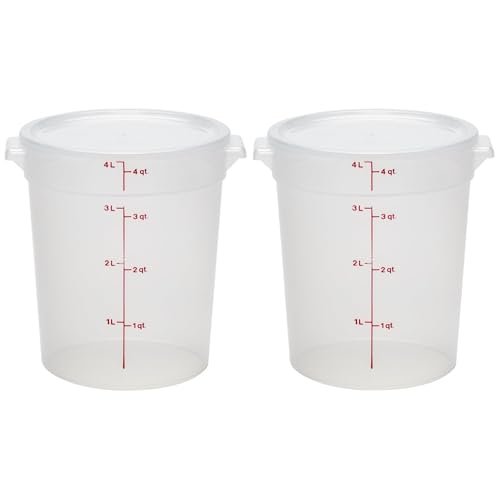
Cambro 4 Quart Food Storage Containers with Lids (2 Pack)
 Ideal for batch prep and pantry staple storage, the translucent design eliminates the need for labeling.
Cambro is a longstanding leader in commercial food service storage, with products designed to meet the demands of high-volume kitchens. This 2-pack of 4-quart containers is a versatile staple for any operation: the translucent walls let you identify contents at a glance, the BPA-free polycarbonate construction resists cracks and warping, and the standard 4-quart size fits most commercial fridge and pantry shelving. The secure snap-on lid creates an airtight seal for dry goods, prepped vegetables, and batch-cooked meals.
Pros:
Ideal for batch prep and pantry staple storage, the translucent design eliminates the need for labeling.
Cambro is a longstanding leader in commercial food service storage, with products designed to meet the demands of high-volume kitchens. This 2-pack of 4-quart containers is a versatile staple for any operation: the translucent walls let you identify contents at a glance, the BPA-free polycarbonate construction resists cracks and warping, and the standard 4-quart size fits most commercial fridge and pantry shelving. The secure snap-on lid creates an airtight seal for dry goods, prepped vegetables, and batch-cooked meals.
Pros:
- BPA-free, food-grade polycarbonate construction
- Translucent design for no-label content identification
- Durable enough for heavy daily commercial use
- Stackable for vertical space savings Cons:
- Not microwave safe, requiring food transfer for reheating
- Slightly higher price point than budget no-name brands
CURTA 4 Pack 4Qt NSF Commercial Food Storage Containers
 NSF certification ensures these containers meet strict commercial sanitation standards for food contact.
For operations that need to pass health inspections, this NSF-certified 4-pack from CURTA is a reliable pick. The clear polycarbonate walls resist scratches, the green lids create a tight airtight seal, and the square shape fits neatly into standard commercial shelving. The 4-quart size is perfect for storing prepped ingredients, marinated meat, or batch-cooked sauces.
Pros:
NSF certification ensures these containers meet strict commercial sanitation standards for food contact.
For operations that need to pass health inspections, this NSF-certified 4-pack from CURTA is a reliable pick. The clear polycarbonate walls resist scratches, the green lids create a tight airtight seal, and the square shape fits neatly into standard commercial shelving. The 4-quart size is perfect for storing prepped ingredients, marinated meat, or batch-cooked sauces.
Pros:
- NSF-certified for commercial food safety compliance
- Clear, scratch-resistant polycarbonate construction
- Color-coded green lids for easy cross-contamination prevention
- Stackable design for space optimization Cons:
- Not suitable for microwave or high-heat use
- Limited color options beyond the standard green lid
Best for Bulk Storage and Transport
Wekioger 3 Pack 13L Commercial Bus Tubs
 Oversized bus tubs are designed for bulk ingredient storage and transport between kitchen stations.
Bus tubs are a staple in commercial kitchens for moving large volumes of prepped ingredients from the prep station to the service line, or for storing bulk meat, poultry, and produce deliveries. This 3-pack of 13-liter tubs from Wekioger is built for heavy use: the durable polycarbonate construction resists cracks and impacts, the tight-fitting lid prevents spills during transport, and the smooth interior is easy to sanitize. Each tub holds roughly 30 pounds of produce or 20 pounds of raw meat, making it ideal for high-volume operations.
Pros:
Oversized bus tubs are designed for bulk ingredient storage and transport between kitchen stations.
Bus tubs are a staple in commercial kitchens for moving large volumes of prepped ingredients from the prep station to the service line, or for storing bulk meat, poultry, and produce deliveries. This 3-pack of 13-liter tubs from Wekioger is built for heavy use: the durable polycarbonate construction resists cracks and impacts, the tight-fitting lid prevents spills during transport, and the smooth interior is easy to sanitize. Each tub holds roughly 30 pounds of produce or 20 pounds of raw meat, making it ideal for high-volume operations.
Pros:
- Durable, impact-resistant polycarbonate construction
- Tight-fitting lid prevents spills during transport
- Large 13L capacity for bulk storage
- Easy-to-clean smooth interior Cons:
- Too large for small home kitchens
- Only available in silver grey, with no color-coding options
- Not microwave safe
Rubbermaid Commercial 3.5 Gallon Polycarbonate Food Storage Tote
 Extra-large totes are ideal for storing bulk dry goods or transporting prepped items for off-site events.
Rubbermaid is a trusted name in commercial food service, and this 3.5-gallon tote is built for heavy-duty use. The impact-resistant polycarbonate construction won’t crack or warp even when dropped, and the clear walls let you identify contents at a glance. It’s NSF-certified for commercial use, and the smooth interior makes sanitization fast and easy. This size is perfect for walk-in pantry storage of flour, rice, beans, and other bulk dry goods, or for transporting prepped meals to off-site catering events.
Pros:
Extra-large totes are ideal for storing bulk dry goods or transporting prepped items for off-site events.
Rubbermaid is a trusted name in commercial food service, and this 3.5-gallon tote is built for heavy-duty use. The impact-resistant polycarbonate construction won’t crack or warp even when dropped, and the clear walls let you identify contents at a glance. It’s NSF-certified for commercial use, and the smooth interior makes sanitization fast and easy. This size is perfect for walk-in pantry storage of flour, rice, beans, and other bulk dry goods, or for transporting prepped meals to off-site catering events.
Pros:
- Durable, impact-resistant polycarbonate construction
- 3.5-gallon capacity for bulk dry goods storage
- NSF-certified for commercial food safety compliance
- Easy-to-clean smooth interior Cons:
- Large footprint may not fit in small commercial or home kitchens
- Weighs 2 pounds when empty, making it cumbersome to move when fully loaded
- Not suitable for high-heat use
Best for Airtight Dry Goods Storage
Yungyan 6 Pcs 4Qt Square Acrylic Airtight Food Storage Containers
 Square acrylic containers maximize pantry and shelf space by eliminating gaps between round containers.
For operations that store large quantities of dry goods like flour, sugar, cereal, and rice, this 6-piece set of airtight acrylic containers is a top pick. Acrylic is more scratch-resistant than polycarbonate, so it stays clear and legible even after years of heavy use. The square shape eliminates the wasted gaps common with round containers, letting you fit more inventory in the same space, and the airtight silicone seal blocks moisture and pests to keep dry goods fresh for months.
Pros:
Square acrylic containers maximize pantry and shelf space by eliminating gaps between round containers.
For operations that store large quantities of dry goods like flour, sugar, cereal, and rice, this 6-piece set of airtight acrylic containers is a top pick. Acrylic is more scratch-resistant than polycarbonate, so it stays clear and legible even after years of heavy use. The square shape eliminates the wasted gaps common with round containers, letting you fit more inventory in the same space, and the airtight silicone seal blocks moisture and pests to keep dry goods fresh for months.
Pros:
- Airtight seal for long-term dry goods freshness
- Scratch-resistant acrylic construction that stays clear over time
- Square shape maximizes storage space
- 4-quart capacity is perfect for bulk dry goods storage Cons:
- Acrylic is brittle and can crack if dropped from height
- Not suitable for hot or cold liquid storage
- Only available with red lids, limiting color-coding options
Barydat 4 Pcs 2Qt and 4Qt Square Polycarbonate Containers with Scales and Handles
 Built-in measurement scales eliminate the need for separate measuring cups during prep.
This mixed-size set from Barydat is ideal for bakers and high-volume prep kitchens that need consistent portioning. The containers feature graduated measurement scales marked in quarts and liters, so you can portion ingredients directly in the container without needing separate measuring cups, cutting down on prep time and dishware. The built-in ergonomic handles make it easy to lift heavy containers full of marinated meat, dough, or batch-cooked meals without straining.
Pros:
Built-in measurement scales eliminate the need for separate measuring cups during prep.
This mixed-size set from Barydat is ideal for bakers and high-volume prep kitchens that need consistent portioning. The containers feature graduated measurement scales marked in quarts and liters, so you can portion ingredients directly in the container without needing separate measuring cups, cutting down on prep time and dishware. The built-in ergonomic handles make it easy to lift heavy containers full of marinated meat, dough, or batch-cooked meals without straining.
Pros:
- Built-in measurement scales for fast, accurate portioning
- Ergonomic handles for easy lifting of heavy loads
- Mixed 2Qt and 4Qt sizes for versatile storage
- BPA-free polycarbonate construction for durability Cons:
- Limited color options, only available with green lids
- Measurement scales can fade over time with heavy use
Best for Freezer and Microwave Use
Yungyan 8 Pcs 2Qt and 4Qt Freezer and Dishwasher Safe Food Storage Set
 Freezer-safe containers eliminate the need to transfer leftovers to separate storage for cold storage.
This 8-piece set from Yungyan is designed for operations that need to store prepped meals, soups, and leftovers in the freezer. The containers are rated for temperatures as low as -20°F, so they won’t crack or become brittle in cold storage, and the airtight lids prevent freezer burn. They are also fully dishwasher safe, making sanitization fast and easy after use. The mixed 2-quart and 4-quart sizes let you store small batches of sauces and large batches of stock in matching containers for a uniform look.
Pros:
Freezer-safe containers eliminate the need to transfer leftovers to separate storage for cold storage.
This 8-piece set from Yungyan is designed for operations that need to store prepped meals, soups, and leftovers in the freezer. The containers are rated for temperatures as low as -20°F, so they won’t crack or become brittle in cold storage, and the airtight lids prevent freezer burn. They are also fully dishwasher safe, making sanitization fast and easy after use. The mixed 2-quart and 4-quart sizes let you store small batches of sauces and large batches of stock in matching containers for a uniform look.
Pros:
- Freezer-safe rated for temperatures as low as -20°F
- Dishwasher safe for fast, easy sanitization
- Mixed 2Qt and 4Qt sizes for versatile storage
- Airtight lids prevent freezer burn Cons:
- Lids can stick if exposed to extreme temperature changes
- Not microwave safe
Cambro Classic Series Square 4Qt Food Storage Containers with Green Lids (2 Pack)
 Microwave-safe containers let you reheat food directly in the storage vessel, cutting down on dishware use.
Unlike the standard Cambro 4-quart containers, this model is microwave safe, rated for temperatures up to 210°F, so you can reheat soups, stews, and prepped meals directly in the container without transferring to a separate dish. The green lids are part of Cambro’s color-coding system, so you can assign green lids to produce or prepped vegetarian meals to reduce cross-contamination risk. The square shape fits standard commercial shelving, making it easy to stack and organize.
Pros:
Microwave-safe containers let you reheat food directly in the storage vessel, cutting down on dishware use.
Unlike the standard Cambro 4-quart containers, this model is microwave safe, rated for temperatures up to 210°F, so you can reheat soups, stews, and prepped meals directly in the container without transferring to a separate dish. The green lids are part of Cambro’s color-coding system, so you can assign green lids to produce or prepped vegetarian meals to reduce cross-contamination risk. The square shape fits standard commercial shelving, making it easy to stack and organize.
Pros:
- Microwave safe for direct reheating, no dishware transfer needed
- Color-coded green lids for cross-contamination prevention
- BPA-free, commercial-grade polycarbonate construction
- Stackable square design for space optimization Cons:
- Only available with green lids, no other color options
- 4-quart size may be too large for small home kitchens
Best Practices to Maximize Efficiency With Your Lidded Containers
Even the highest-quality containers will only deliver efficiency gains if used correctly. Follow these best practices to get the most out of your investment:
Implement a Color-Coding System
Assign specific lid colors to food types to eliminate cross-contamination risk and speed up inventory checks. For example, use red lids for raw meat, green for produce, blue for dairy, and yellow for dry goods. This system lets staff identify container contents at a glance, even if labels fade or are missing.
Standardize Sizes for Stacking
Stick to a consistent set of container sizes (2Qt, 4Qt, 6Qt, 8Qt) to make stacking and storage seamless. Square containers eliminate the wasted gaps common with round models, letting you fit more inventory in the same shelf or fridge space. Avoid mixing random sizes, as this leads to unstable stacks and wasted space.
Adopt FIFO Rotation to Cut Waste
First In, First Out (FIFO) is a standard food safety practice that ensures older stock is used before newer deliveries, reducing spoilage. Even with clear containers, add a simple label with the receive date and use-by date to each container, and rotate older stock to the front of shelves during restocking.
Sanitize Containers After Every Use
Most commercial containers are dishwasher safe, but for tough, baked-on residue, a stiff heavy-duty kitchen scrubbing brush cuts through grime without scratching polycarbonate or acrylic surfaces. Always air dry containers completely before stacking to prevent mold growth. Pairing regular container cleaning with a purpose-built brush set for kitchen sanitization ensures no food particles are left in lid grooves to cause odors between washes. For home-based cottage food operators, you can also reduce cross-contamination risks by installing no-drill cabinet locks to keep stored ingredients out of reach of young children. For additional actionable tips to cut waste and speed up prep workflows, our kitchen operations blog covers everything from inventory management to sanitation best practices. For home cooks managing child access to stored ingredients, adding kid-safe cabinet locks near storage zones reduces accidental exposure risks.
Frequently Asked Questions About Commercial Food Storage Containers With Lids
Are commercial food storage containers with lids safe for microwave use?
Not all models are. Polycarbonate containers are typically microwave safe, but you must confirm this with the manufacturer, as some lower-grade plastics can warp or leach chemicals at high temperatures. Acrylic containers are almost never microwave safe, as they can crack or melt when heated. Always look for explicit "microwave safe" labeling on the product packaging before reheating food directly in the container.
What does NSF certification mean for food storage containers?
NSF certification is a third-party validation from NSF International that a product meets strict public health and safety standards for food contact. Certified containers are tested to resist bacterial growth, withstand repeated commercial cleaning and sanitizing processes, and use materials that will not leach harmful chemicals into food. For commercial kitchens, NSF certification is often required by local health departments to pass inspections.
How do I choose the right size commercial food storage container?
Start by mapping your most common use cases: 2-quart containers are ideal for small batches of prepped vegetables, sauces, or dry goods; 4-quart containers work for batch-cooked meals, dough, or bulk ingredient storage; 6-quart and larger sizes are best for walk-in pantry storage of dry staples or transporting large volumes of food for catering. Stick to a standardized set of sizes to make stacking and inventory management as seamless as possible.
Are BPA-free food storage containers really safer?
Yes. Bisphenol A (BPA) is a chemical used in some plastics that can leach into food, especially when containers are heated or exposed to acidic ingredients. BPA-free containers are made with alternative materials that do not carry this risk, making them a safer choice for storing all types of food, particularly for operations that serve vulnerable populations like children or elderly people.
Can I use commercial food storage containers in the freezer?
Many models are rated for freezer use, but you must confirm this with the manufacturer. Freezer-safe containers are made from materials that will not crack or become brittle at temperatures as low as -20°F. Avoid containers with airtight lids that are not designed for freezer use, as pressure changes can cause lids to stick or warp, breaking the seal.
Final Thoughts
Choosing the right commercial food storage containers with lids is one of the simplest, highest-impact upgrades you can make to your kitchen’s efficiency. The right set will cut food waste, speed up prep workflows, simplify compliance with health codes, and make daily kitchen operations far less chaotic. Whether you’re running a high-volume restaurant, a catering business, or a home meal prep operation, prioritize durable, certified containers that fit your most common use cases, and pair them with simple best practices like color-coding and FIFO rotation to get the most value out of your investment. A well-organized, efficiently stored kitchen not only saves time and money—it also creates a safer, less stressful environment for everyone who works in it.

Hi, I’m Daniel Brooks—a food lover and kitchen gear enthusiast. I enjoy testing cookware, utensils, and gadgets to see what really works in everyday cooking. At PlugChef.com, I share honest reviews, comparisons, and simple guides to help you choose the best tools for a safer, smarter, and more enjoyable kitchen.
Related posts:
 Best Kitchen Gadgets Under $20: Affordable Tools for Every Culinary Task
 Under Cabinet Hidden Kitchen Outlets: Revolutionize Your Space-Saving Solutions
 Shelf for Under Kitchen Sink: Maximize Space with Pull-Out Organizers
 Best Beeswax Wraps for Zero Waste Kitchen: Eco-Friendly Food Storage Solution
 Best Water Filter for Pod Coffee Maker: Enhance Your Coffee Experience
 Best Kitchen Counter Compost Bin: Top Picks for Odor-Free Recycling