
A well-oiled cutting board looks better, lasts longer, and stays safer to use. This guide gives clear, practical steps — from choosing the right mineral oil to preparing, oiling, and maintaining all types of wooden cutting boards — so you can protect your board without guesswork.

Credit: www.amazon.com
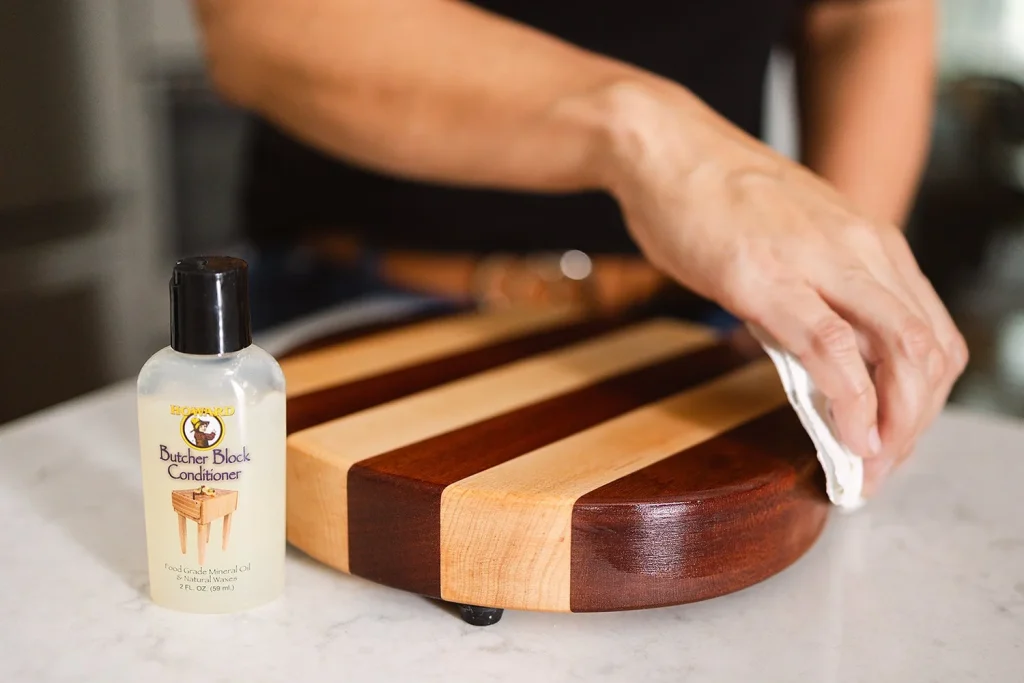
Applying mineral oil with a lint-free cloth.
Why mineral oil is the standard choice
Mineral oil is a stable, food-safe, petroleum-derived oil that doesn’t go rancid. Because it’s odorless, tasteless, and non-drying, it soaks into wood fibers, helping repel moisture, reduce cracking and warping, and make cleanup easier. For food-safety basics on kitchen surfaces, consult USDA food safety guidance (USDA).
A common mistake is treating mineral oil like a finish — it’s a replenishing, penetrating oil, not a hard protective coating. That’s why many woodworkers recommend repeating applications and using a wax topcoat for extra surface protection.
Choosing the right product
- Use food-grade (USP) mineral oil or a block-board-specific oil labeled food-safe. Avoid vegetable oils (olive, canola) — they can oxidize and become rancid.
- Consider a beeswax-and-mineral-oil balm for easier water beading on the surface.
- If you prefer alternative finishes, know the trade-offs: tung or polymerizing oils provide a harder finish but require different prep and curing and may darken the wood. Walnut oil is natural but can be an allergen for some people.
For quick product comparisons and care approaches, see this short guide on oiling a cutting board that outlines oils and blends: oiling a cutting board.
Prep: clean, dry, and (if needed) sand
- Clean thoroughly: Wash with hot, soapy water after use; do not submerge large boards. For routine deodorizing and sanitizing, many people use vinegar or hydrogen peroxide methods — see tips to clean with vinegar for simple steps.
- Dry fully: Stand the board on its edge to air-dry. Oiling a damp board traps moisture and can promote warping.
- Repair and sand: If the surface is rough, stained, or has shallow cuts, sand with 120–150 grit to smooth, then finish with 220 grit for an even surface. After sanding, remove dust with a tack cloth or vacuum and wipe with a damp rag; dry completely.
- Restore badly worn boards: If your board is deeply scarred or dry, follow a more involved restoration routine before oiling — instructions for how to restore a wooden board provide stepwise repair guidance.
Step-by-step: how to apply mineral oil
Follow these steps for either a new board or regular maintenance:
- Choose a lint-free cloth or food-safe brush and a bottle of food-grade mineral oil. Keep paper towels on hand to remove excess.
- Pour a quarter to half a cup of oil (adjust by board size) onto the board; you’ll use more for an initial treatment.
- Rub the oil into the surface in the direction of the grain, covering the top, bottom, and especially the end grain and edges. End grain soaks up more oil, so don’t skip it.
- Let the oil penetrate:
- For routine maintenance: allow 15–30 minutes, then wipe off surface excess.
- For initial sealing of a dry board: allow 2–12 hours or overnight if the board was especially dry — repeat until the wood stops absorbing oil.
- Wipe away all surface oil with a clean, dry cloth so the board doesn’t feel tacky.
- For the initial conditioning, apply 3–4 coats over 24 hours until the board is saturated and water beads off. For ongoing maintenance use 1 thin coat each time.
If you want a visual retry or alternative product tips, check this practical mineral oil guidance for additional notes.
How often to oil your cutting board
- Light use (few times per week): every 2–3 months.
- Heavy daily use: monthly.
- Visual cues: if water soaks into the wood, the surface looks dry or dull, or you see micro-cracking, it’s time to oil.
A short FAQ on coat count explains more about how many layers work best: see the page about how many coats.
Special notes: end-grain vs edge-grain and bamboo
- End-grain boards absorb oil faster and benefit from more thorough initial conditioning because their fibers act like open ends of straws.
- Edge-grain (strip) boards absorb slower and typically need fewer coats.
- Bamboo is denser and less absorbent; apply oil the same way but expect less uptake and slightly more frequent touch-ups. For bamboo-specific care, read the guide on bamboo cutting boards.
Aftercare: cleaning and disinfection best practices
- Clean with hot, soapy water immediately after use. Never put wooden boards in the dishwasher.
- For raw meat contact: wash immediately, then sanitize by wiping with white vinegar or a diluted bleach solution if desired. For general food-safety recommendations, rely on USDA food safety guidance (USDA).
- If odors persist, coarse salt and a lemon half can act as an abrasive deodorizer; let sit for a few minutes, then rinse and dry.
- Avoid leaving boards to soak. Store standing upright to ensure airflow and even drying.
For a deeper cleaning routine including natural sanitizers and stain removal, consult this method to restore and care for boards.
Common mistakes and how to avoid them
- Using cooking oils (olive, canola): these can go rancid and leave sticky residues.
- Oiling a wet board: traps moisture and may encourage mold or warping.
- Applying oil and leaving the surface greasy: always wipe excess off after the board has absorbed what it needs.
- Skipping the edges and end grain: those are the most vulnerable areas.
- Assuming mineral oil waterproofs the board: it repels moisture but doesn’t make a board fully waterproof. If you want additional surface resistance, apply a food-safe wax after oiling or use a wax-oil combo balm.
For safe tool and utensil choices that complement board care, see the list of safest utensils to avoid surface damage.
When to replace a cutting board
Replace a cutting board when:
- Deep gouges and grooves cannot be sanded out.
- Significant warping or splitting occurs.
- Persistent odor or discoloration remains after cleaning and restoration. If repairable, sanding and reconditioning can restore many boards; see steps to restore a wooden board.

Credit: www.amazon.ca
Alternatives to mineral oil
- Beeswax and mineral oil blends: good surface resistance and easy application.
- Polymerizing oils (e.g., cured tung or some food-safe finishes): provide a harder surface but require careful application and curing time.
- Natural oils (e.g., walnut oil): may be food-safe but could trigger nut allergies for sensitive users.
Weigh pros and cons: mineral oil is low-maintenance and reversible; harder finishes offer more durability but complicate future repairs.
FAQs
Q: Is food-grade mineral oil safe? A: Yes — choose USP or food-grade labeled mineral oil. It’s non-toxic and appropriate for food-contact surfaces.
Q: Can mineral oil waterproof my board? A: No. Mineral oil repels water and discourages immediate absorption, but it does not make wood waterproof. Use wax for extra surface resistance.
Q: How long does oil take to soak in? A: Routine coats absorb within 15–30 minutes. For an initial deep conditioning, allow 2–12 hours or overnight depending on how dry the wood is.
Q: Can I apply oil to a new board? A: Yes. New boards benefit from an initial 3–4 light coats over 24 hours to saturate fibers; always allow time to absorb and wipe excess.
Q: How do I disinfect a wooden cutting board after raw meat? A: Wash with hot, soapy water. For extra sanitation, wipe with white vinegar or follow USDA guidance on kitchen surface hygiene (USDA).
Conclusion and next step
A routine of cleaning, drying, and regular mineral oil applications will keep your cutting board attractive and serviceable for years. Start with a thorough cleaning and apply 3 initial coats if the board is dry; then maintain monthly or as needed based on use.
Ready to protect your cutting board? Apply mineral oil now — three initial coats for a dry board, then schedule monthly touch-ups to preserve it.

I’m Abby Lu, a passionate home cook who loves simplifying everyday meals. At PlugChef.com, I share product reviews and cooking guides to help you find the best tools for your kitchen.
Related posts:
 How to Make a Fruit Basket for a Gift: Easy DIY Guide
 Do You Need a Basket? Essential Guide for Air Fryers
 What Blenders Do Tropical Smoothie Use: Expert Insights
Stainless Steel Vs White Kitchen Appliances: Ultimate Showdown
What Blenders Do Tropical Smoothie Use: Expert Insights
Stainless Steel Vs White Kitchen Appliances: Ultimate Showdown
 Kitchen Appliances for Wedding Registry: Must-Have Essentials
 Top 10 Best Non-Toxic Cooking Utensils – Safe & Durable Choices for Healthy Homes

