LED Lights Under Cabinet Kitchen: Illuminate Your Space with Style and Ease
Under-cabinet LED lighting is one of the highest-impact, lowest-effort upgrades a kitchen can get. A bare counter under a fluorescent range hood casts harsh shadows toward the back wall, which is exactly where you chop, read recipes, and wipe down surfaces. The right strip, puck, or bar light puts a pool of even illumination directly on the work surface, cuts eye strain, and makes small kitchens feel noticeably larger.
This guide covers ten of the most popular under-cabinet options on the market right now, grouped by power type so you can match the fixture to your situation. We also break down the specs that actually matter — lumens, color temperature, CRI, beam angle, battery capacity, and dimming — plus a step-by-step install walkthrough for both wireless and hardwired setups. For more on this, see our guide on best blenders for smoothies under 100.
What Actually Makes Under-Cabinet Lighting Worth It
Task lighting is the missing layer in most kitchens. Ceiling downlights and range hoods are aimed at the whole room, not at the specific twelve inches of countertop where work happens. Adding under-cabinet light fixes this in three ways:
- Eliminates shadow zones. When you stand at the counter, your body blocks ceiling light. A fixture mounted on the cabinet underside illuminates around you rather than through you.
- Improves task accuracy. Sharper light means safer knife work, easier reading of measuring cups, and better color rendering when you're matching food to a recipe.
- Adds architectural depth. Even low-wattage strips create a "floating cabinet" effect, making upper cabinets feel lighter and less bulky visually.
In practice, the biggest jump in kitchen usability comes not from total brightness but from layering — a fixture that runs only when the counter is in use, and steps back during dinner parties or evening relaxation. That's why dimming and motion sensing, not raw wattage, are the features worth paying extra for.
Wireless Rechargeable Options
These are the fastest path to illuminated counters — no electrician, no permanent wiring, and most of them install in under ten minutes with a screwdriver you may not need. For more on this, see our guide on kitchen hood cleaning certification online.
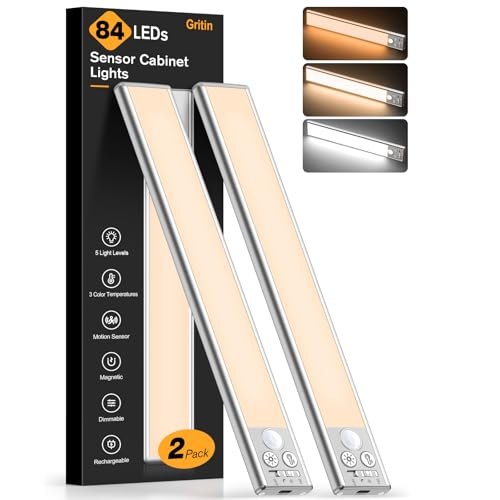
Gritin 10.2" Rechargeable Under Cabinet Lighting

[Amazon product page for the Gritin 10.2" rechargeable under cabinet light, 2-pack.]
The Gritin is the fixture to grab if you want a set-it-and-forget-it setup with hands-free convenience. Eighty-four LEDs per unit push a lot of light for a 10.2-inch footprint, and the three-color, five-level dimming matrix means you can dial it from warm ambient glow to bright task light without adjusting anything else.
Best for: Renters, frequent rearrangers, or anyone who wants motion-activated lighting at the sink or island without running wiring. For more on this, see our guide on kitchen brushes for cleaning.
Pros
- 84 LEDs per unit deliver strong output for the size
- Three color temperatures, five brightness steps
- Motion sensor for hands-free operation
- Magnetic backing means repositioning takes seconds
- USB-C rechargeable — no battery buying
Cons
- Heavy daily use does shorten time between charges
- Motion sensor can trigger on pets or passing activity behind you
- Mounting strip requires a clean, flat substrate to hold
At Amazon, the two-pack typically covers an island plus one secondary counter area. For a full galley kitchen, budget two to three more packs.
Rihvy 8" Rechargeable Motion Sensor Light (3-Pack)

[Amazon listing for the Rihvy 3-pack of 8" rechargeable motion sensor under cabinet lights.]
Where the Gritin prioritizes output, the Rihvy prioritizes coverage at a budget price point. Three 8-inch units per pack gives you a starter set that fits most single-wall kitchens, and the compact length makes them ideal for shallow base cabinets, pantry shelves, and stair risers where longer bars physically won't clear other fixtures. For more on this, see our guide on commercial kitchen hood cleaner.
Best for: Multi-zone lighting on a budget — pantry, stairwell, and hallway all at once.
Pros
- Three units per pack at a low entry price
- Motion sensor with three color dimming modes
- Magnetic stick-on mounting, no drilling
- Rechargeable USB battery eliminates recurring battery cost
Cons
- 8" length under-covers longer counters; you'll need multiple units
- Indoor-rated only — not suited for garages or outdoor cabinets
- Battery capacity scales with usage; nightly motion-activated operation shortens cycle
Grab the 3-pack at Amazon if your kitchen is compact and you're experimenting with a wireless approach before committing to hardwired.
AMETHEUS 6-Pack Wireless Under Cabinet Lighting

[Amazon product page for the AMETHEUS 6-pack of 8" wireless motion sensor under cabinet lights.]
The AMETHEUS pack is the value play for anyone who wants a whole-kitchen wireless system in one order. Six 8-inch bars means you can cover a full L-shaped kitchen, a long island, and secondary spots like the broom closet — and every unit shares the same controls. For more on this, see our guide on industrial kitchen cleaning companies.
Best for: Kitchen-wide coverage without committing to permanent wiring.
Pros
- Six lights in one pack — most complete coverage per dollar
- Motion sensor plus manual override via remote
- USB rechargeable battery across the set
- Three color temperatures and adjustable brightness
- Compact profile fits under standard base cabinets
Cons
- Each unit is only 8 inches, so spacing matters — leave gaps smaller than 4" between units for even light
- Runtime per charge depends heavily on motion sensor sensitivity
- 8" length limits single-unit use on very large counters
Check current pricing and stock at the Amazon listing.
DiDiSky 2-Pack Motion Sensor Under Cabinet Lighting

[Amazon product page for the DiDiSky 2-pack of USB rechargeable motion sensor under cabinet lights.]
The DiDiSky's 2200mAh battery is the largest capacity we've seen in the compact 2-pack format, which translates to longer intervals between charges. For readers who want motion-activated convenience without weekly charging choreography, this is the pragmatic pick.
Best for: A single counter or island where you want one fixture pair that rarely needs attention.
Pros
- 2200mAh battery extends runtime between charges
- Motion sensor plus dimmable control
- Magnetic stick-on installation
- Wireless — no outlet hunting near the cabinet
Cons
- Only two units per pack; larger kitchens need more
- Single light color option
- Battery-operated, so heavy use still means regular charging
Get the 2-pack from Amazon.
MCGOR 14.7" Rechargeable Under Cabinet Lighting (2-Pack)

[Amazon product page for the MCGOR 14.7" rechargeable under cabinet lights, 2-pack.]
At 14.7 inches, the MCGOR is the longest of the wireless bars here, and the beam spread means fewer units are needed to cover the same counter. Two units handle most islands and a good portion of a straight counter without gaps.
Best for: Covering large counter sections with fewer units.
Pros
- Longest wireless bar length in this roundup
- Five brightness levels give fine dimming control
- Motion sensor saves energy and adds hands-free use
- Magnetic mounting for easy removal
- Warm white output pairs well with wood and stone counters
Cons
- Only one color temperature — no cool or daylight option
- Heavier unit may need secondary support on light cabinets
- Two-pack may not cover a full kitchen
Check the Amazon listing.
LED Strip Lights
Strip lighting is the go-to when you want to follow the contour of an irregular cabinet run, wrap a corner, or illuminate open shelving. The trade-off is that strips are more work to measure, cut, and secure than self-contained bars — but the payoff is a continuous line of light.
DAYBETTER 6-Pack LED Strip Lights with Remote

[Amazon product page for the DAYBETTER 6-pack of 9.8 ft dimmable LED strip lights.]
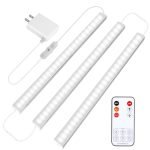
Six 9.8-foot strips — roughly 60 feet total — is enough to light an entire two-wall kitchen plus a pantry run. The 2700K to 6500K color range and dimmable remote give DAYBETTER the widest adjustment envelope in this group, and the battery operation means no outlet required.
Best for: Full-kitchen coverage with maximum flexibility on color and brightness.
Pros
- 60 feet of strip covers most full kitchens
- Dimmable with remote control
- Color temperature range 2700K to 6500K
- Energy-efficient LED output
- No wiring required
Cons
- Adhesive backing can fail on glossy or dusty cabinet undersides — clean first
- Remote needs line of sight to function reliably
- Individual strip length may be too short for very long counters without joining
Check pricing at the Amazon listing.
TECOMLIGHT 6-Pack LED Puck Lights

[Amazon product page for the TECOMLIGHT 6-pack of color changing LED puck lights.]
Puck lights are a different beast from strips — round, self-contained, and often multi-color. The TECOMLIGHT set skips traditional under-cabinet task duty in favor of accent lighting: a warm wash under open shelving, a color shift for a dinner party, or a soft night light along a stairwell.
Best for: Accent lighting, color-mood setups, and renters who want zero-permanent-change fixtures.
Pros
- Multi-color capability for mood lighting
- Remote control for all six pucks
- Adhesive mounting, no drilling
- Battery operated, no outlet needed
- Compact puck shape fits tight spaces
Cons
- Not bright enough as primary task lighting
- Adhesive on smooth or painted surfaces needs thorough prep
- Battery life varies with color mode intensity
- Best as accent, not work, lighting
Get the 6-pack at Amazon.
Hardwired Permanent Options
Hardwired fixtures use more upfront effort and often an electrician, but they run off your home's circuit with no batteries to swap and no USB cable to find. The output is usually higher quality — better beam control, higher lumens, and consistent color across the strip — which matters most for anyone who'll run the lights daily at full brightness.
UltraPro 24" Hardwired Under Cabinet Lights
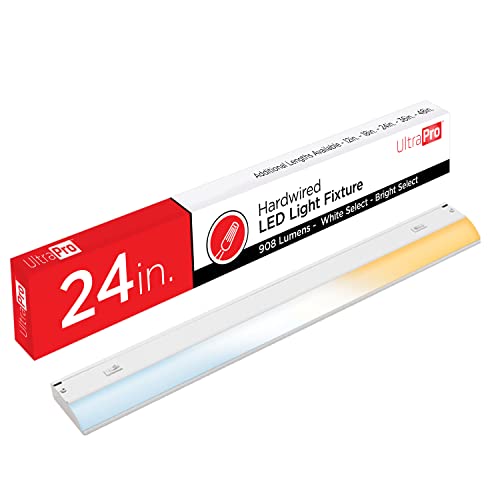
[Amazon product page for the UltraPro 24" hardwired under cabinet light.]
UltraPro's three-step color change — 2700K, 4000K, 5000K — pairs with dimming to cover nearly every kitchen scenario. At 24 inches long, each unit covers roughly one base cabinet, so four to six units will light most kitchens.
Best for: Homeowners who want a permanent install with color temperature flexibility.
Pros
- 24" length covers one full base cabinet per unit
- Three-step color temperature switching
- Dimmable brightness control
- Hardwired for consistent power
- Efficient LED output with a long service life
Cons
- Hardwired install requires electrician work
- Three discrete color steps, not a smooth CCT adjustment
- Requires planning for junction boxes and wiring paths
View current availability at the Amazon listing.
Nicor 18" LED Direct Wire Under Cabinet Light

[Amazon product page for the Nicor 18" UCB series hardwired under cabinet light.]
The Nicor UCB series is one of the better-performing hardwired options at its wattage: 9 watts producing 612 to 648 lumens is close to 70 lumens per watt, which is solid efficiency. Selectable CCT from 2700K to 5000K covers warm kitchen glow to daylight-accurate task lighting.
Best for: A serious hardwired install where efficiency and lumens per watt matter.
Pros
- 612 to 648 lumens from just 9 watts
- Selectable CCT across 2700K to 5000K
- Dimmable with compatible dimmer
- Slim profile fits under shallow cabinets
- Efficient LED with low heat output
Cons
- Hardwired setup should be done by a qualified electrician
- White housing limits finish options — black cabinet installs may clash
- Requires junction box at installation point
Check the Amazon listing.
Vovamo Plug-in Under Cabinet Lighting

[Amazon product page for the Vovamo 12" plug-in under counter light, 2-pack.]
The Vovamo is the middle path — plug in rather than hardwire, which trims the electrician cost while still avoiding battery management. The 6000K cool white output is bright and accurate, and the linkable USB design means you can extend runs by daisy-chaining units if you have the outlet reach.
Best for: A plug-in install where you want consistent power without a full rewiring project.
Pros
- Dimmable brightness across the range
- Linkable USB for extending coverage
- 6000K cool white is crisp and task-friendly
- Very compact profile (0.27" height)
- 12" length fits most shallow cabinets
Cons
- Wired design requires an accessible outlet
- Only one color temperature available
- Plug-in placement may require cable management
Check the Amazon listing.
Buying Guide: The Specs That Actually Matter
Color Temperature (CCT)
Measured in Kelvin, CCT determines how warm or cool the light feels. Matching the wrong CCT to your kitchen creates a jarring look — warm wood next to a 6000K strip looks wrong immediately.
| CCT Range | Appearance | Best Use |
|---|---|---|
| 2700K | Warm white | Cozy ambiance, evening dining, wood cabinetry |
| 3000K | Soft white | General kitchen use, mixed finishes |
| 3500K | Neutral white | Balanced general-purpose |
| 4000K | Cool white | Task lighting, white cabinets |
| 5000K | Daylight | Bright task work, professional feel |
| 5000–6500K | Bright daylight | Workshop counters, very bright tasks |
In practice, most kitchens settle on 3000K to 4000K as a compromise. If your existing ceiling light is warm (2700K), don't introduce a 6000K strip — the mismatch will be obvious every time both run.
Lumens and Watts
Lumens measure actual visible light; watts measure power draw. Modern LEDs produce 60 to 80 lumens per watt, which is why a 9-watt strip can outshine a 60-watt incandescent. For under-cabinet task lighting, look for fixtures producing at least 250 to 400 lumens per linear foot of counter — that's enough to read fine print on a recipe card without strain.
A common mistake is judging brightness by wattage alone. Two strips at 10 watts can look completely different if one has 350 lumens and the other has 250 — beam angle and optics matter more than the number on the box.
CRI (Color Rendering Index)
CRI measures how accurately the light shows true colors. Anything below 80 makes food look off and finishes look dull. For kitchens, target CRI 90 or higher if you're plating food, working with stone counters, or doing any task where color accuracy matters. Many budget strips sit at 80 or below; the premium options hit 95.
Beam Angle
Wide beam angles (110° to 120°) fill space evenly but wash out contrast. Narrow angles (30° to 60°) focus light onto a work zone but leave shadows. Under-cabinet fixtures usually land between 60° and 90° — wide enough to light a counter, narrow enough to keep the wall behind you in shadow rather than blindingly lit.
Wireless vs. Hardwired
The choice depends less on aesthetics and more on lifestyle:
- Wireless — renter-friendly, no wiring, easy to move. Trade-off is charging schedule and slightly lower peak output.
- Hardwired — always-on, higher quality optics, no battery anxiety. Requires an electrician and a junction box.
- Plug-in — the middle path, no permanent wiring but requires outlet access. Cable management is the main annoyance.
For anyone keeping a home long-term, hardwired wins over time. For renters, wireless is non-negotiable.
Where to Verify Product Efficiency
When comparing LEDs across brands, ENERGY STAR maintains the certified product database and explains how the lumens-per-watt rating is measured. It's a good baseline for confirming that a marketing claim actually reflects tested efficiency.
Installation Guide
Wireless Bars and Pucks
- Clean the mounting surface thoroughly. Denatured alcohol or a dedicated adhesive cleaner removes the oils that break adhesive bonds. Skip this step and you'll be replacing mounts within months.
- Measure and mark positions first. Use painter's tape to mark centers before you peel anything. Uneven spacing is the most common cause of an amateur look.
- Peel and press with firm pressure for 30 seconds. Adhesives need contact time to bond properly.
- Verify level with a phone level app. Most strips look crooked until corrected by a millimeter.
- Test before final placement. Turn on, check beam direction, and check that no shadow falls on your counter when you stand in the normal working position.
Hardwired Fixtures
Hardwired installation should be done by a licensed electrician — this isn't advice to take lightly. Under-cabinet hardwiring involves running a new circuit or tapping into an existing one, mounting junction boxes, and possibly adding a dedicated switch or dimmer circuit. Electrical safety work in kitchens has specific code requirements, and the Underwriters Laboratories (UL) directory is the standard reference for confirming that products have been independently safety-tested for their intended use.
If you're DIY-inclined and the job involves only plugging in a low-voltage system, follow the manufacturer's instructions to the letter and use a non-contact voltage tester before touching any wiring.
Common Mistakes and How to Avoid Them
Buying the cheapest strips you can find. The $15 strip lights with "1500 lumens" claims often deliver less than half that at best color temperature. Stick with brands that publish real lumens, CRI, and warranty terms.
Using one CCT for the whole kitchen. Kitchen islands, prep areas, and dining zones can each justify different color temperatures. A 2700K strip at a cozy breakfast bar and a 4000K strip at a cutting counter can live happily together if dimmers allow them to blend at overlap points.
Mounting strips flush to the wall. A 1-inch standoff from the back wall improves light spread and reduces hotspot glare at the base of the cabinet.
Forgetting the switch location. Under-cabinet lights mounted behind closed cabinets with only a remote control mean reaching over the cabinet every time. Add a wall switch or put a switch on the fixture face.
Ignoring cable management on plug-in systems. A loose cord dangling under a cabinet is ugly and a trip hazard. Use adhesive cable clips or raceway to keep runs hidden.
Setting motion sensors too sensitive. A motion sensor in a high-traffic kitchen can cycle on and off constantly, draining batteries and creating a strobing effect. Adjust sensitivity to ignore motion outside the counter zone.
Maintenance and Longevity
LED fixtures are low-maintenance but not zero-maintenance:
- Dust accumulation on clear diffusers cuts output noticeably within a year. Wipe with a microfiber cloth every few months.
- Adhesive failure is the most common wireless light failure mode. Re-tack every 12 to 18 months with fresh adhesive if bonding weakens.
- Battery degradation on rechargeable units is gradual — most last 300 to 500 full charge cycles before noticeably shorter runtime. Keep charging cycles shallow (top up rather than full discharge) to extend life.
- Driver failures on hardwired units are rarer but often covered by a 3 to 5 year warranty — keep receipts.
- Replace rather than repair. Consumer under-cabinet lights aren't designed for internal repair; warranty replacement is almost always cheaper and faster than soldering a failed driver.
Quick Comparison Table
| Fixture | Type | Length | Power | CCT Range | Dimmable | Motion |
|---|---|---|---|---|---|---|
| Gritin 10.2" | Bar, 2-pack | 10.2" | Rechargeable | 3-step | 5-level | Yes |
| Rihvy 8" | Bar, 3-pack | 8" | Rechargeable | 3-step | Yes | Yes |
| AMETHEUS 6-pack | Bar, 6-pack | 8" | Rechargeable | 3-step | Yes | Yes |
| DiDiSky 2-pack | Bar, 2-pack | Compact | Rechargeable (2200mAh) | Single | Yes | Yes |
| MCGOR 14.7" | Bar, 2-pack | 14.7" | Rechargeable | Warm | 5-level | Yes |
| DAYBETTER 6-pack | Strip, 6×9.8 ft | 9.8 ft each | Battery | 2700–6500K | Yes | No |
| TECOMLIGHT 6-pack | Puck, 6-pack | Compact | Battery | Multi-color | Yes | No |
| UltraPro 24" | Bar, single | 24" | Hardwired | 2700/4000/5000K | Yes | No |
| Nicor 18" | Bar, single | 18" | Hardwired | 2700–5000K | Yes | No |
| Vovamo 12" | Bar, 2-pack | 12" | Plug-in | 6000K | Yes | No |
Frequently Asked Questions
How Do Motion Sensor LED Lights Work?
Most consumer motion sensors use passive infrared (PIR) technology. Two pyroelectric sensors detect the change in infrared heat signature when a warm body enters the beam. When movement is registered, the driver sends power to the LEDs, which then run for a set duration (commonly 15 to 30 seconds) before turning off. Adjusting sensitivity means changing the detection zone size — lower sensitivity catches only close movement, higher sensitivity triggers on pets or passing shadows.
Can I Dim LED Under-Cabinet Lights?
Yes, but dimmability depends on the fixture type. Battery and plug-in strips usually have step dimming (3 to 5 discrete levels) controlled by a button or remote. Hardwired fixtures with compatible drivers work with standard triac dimmers or smart-home dimmers. Check the fixture's dimming range — some only dim down to 50%, which limits the ambient glow effect.
How Long Do Rechargeable Under-Cabinet Lights Last Per Charge?
Runtime depends on battery capacity, brightness level, and whether motion sensing is on. Budget packs typically deliver a few hours of continuous full-brightness use, or many more hours at lower settings with motion sensing limiting total run time. A daily kitchen light run for short sessions will usually need charging weekly; a light used as a permanent on counter illumination needs charging every few days.
Can I Install Under-Cabinet Lights Without Drilling?
Absolutely. Magnetic strips, 3M-style adhesive, and stick-on mounts handle most cabinets without a single hole. The one exception is hardwired fixtures, which require electrical work by a licensed professional. If your cabinet underside is glossy, textured, or painted with a soft finish, use double-sided mounting tape rather than adhesive alone — the tape is easier to reposition and less likely to leave residue.
What Color Temperature Should I Choose?
Match your existing kitchen lighting where possible. Warm kitchens with wood, brass, and warm tile look best at 2700K to 3000K. Modern kitchens with white cabinets, stainless steel, and cool countertops shine at 3500K to 4000K. If you're doing task-heavy work — chopping, fine detail, reading recipes closely — 4000K or higher gives the sharpest contrast. When in doubt, 3500K is the safest compromise.
Are LED Under-Cabinet Lights Energy Efficient?
Yes, significantly. A 10-watt LED strip typically replaces a 60-watt incandescent tube for the same visual output, a five-to-six-fold reduction. Running a 20-foot kitchen setup of 10-watt strips for two hours daily uses roughly 0.2 kWh per day, or around 73 kWh per year — a small bill line item that scales with usage. Hardwired installations on smart controls add further savings by dimming automatically during low-use hours.
Do I Need an Electrician for Hardwired Under-Cabinet Lights?
For any fixture that connects to a permanent junction box and runs on 120V mains, yes. Kitchens have specific electrical code requirements around GFCI protection, box placement, and circuit loading, and the [National Electrical Code](https://www.nfpa.org/codes-and-standards/nfpa-70-national-electrical-code- nec) governs installation standards in the United States. Wireless and plug-in options sidestep this entirely, which is why they dominate the rental market.
How Many Fixtures Do I Need for a Kitchen?
A rough rule of thumb: one 10-to-15-inch bar per base cabinet, or one strip per 3 feet of continuous counter. For islands, plan for at least one fixture per side that needs task lighting. Add fixtures to pantry shelves, drawer tops, and any work wall beyond the main counter — those are the spots that most benefit from the extra light but are often skipped.
Conclusion
Under-cabinet LED lighting delivers more visual return per dollar than almost any other kitchen upgrade. The right fixture turns a shadowed counter into a working surface, softens the room at dinner, and quietly makes the whole kitchen feel more intentional.
The decision comes down to your constraints. Renters and DIY-first readers should start with a wireless rechargeable bar like the Gritin or MCGOR, or go larger with the AMETHEUS 6-pack for whole-kitchen coverage. Anyone planning a long-term home or a full remodel should budget for hardwired fixtures — the Nicor 18" offers the best lumens-per-watt here, and the UltraPro 24" adds three-step color flexibility. For mood lighting and accent zones, the TECOMLIGHT pucks and DAYBETTER strips round out the palette.
Take a look at your counter tonight with only ceiling lights on. Notice the shadow at your cutting board. That's the problem under-cabinet lighting solves, and any of the ten fixtures above will solve it this weekend.

Hi, I’m Daniel Brooks—a food lover and kitchen gear enthusiast. I enjoy testing cookware, utensils, and gadgets to see what really works in everyday cooking. At PlugChef.com, I share honest reviews, comparisons, and simple guides to help you choose the best tools for a safer, smarter, and more enjoyable kitchen.
Similar Posts