If you’ve ever sliced into a beautifully seared steak only to find it raw in the middle, or pulled a pizza out of the oven with a soggy crust because your stone wasn’t hot enough, you know how much temperature accuracy matters in cooking. Traditional probe thermometers work well for internal reads, but they require piercing your food, can spread bacteria between raw and cooked items, and are useless for checking hot surfaces like grill grates, pizza stones, or fryer oil without risking burns.
Infrared (IR) thermometers for food solve these problems by delivering instant, accurate surface temperature readings from several inches away, no contact required. Whether you’re a backyard grill master, a home baker perfecting sourdough, or someone who just wants to avoid undercooking chicken for a dinner party, an IR thermometer takes the guesswork out of cooking temperatures, helping you get consistent, safe, delicious results every time. For more on this, see our guide on best infrared thermometer for food.
In this guide, we’ll break down how IR food thermometers work, what to look for when buying one, how to use them for accurate reads, and reviews of the top models on the market in 2026 to fit every budget and cooking style.
How Infrared Food Thermometers Work
Unlike traditional probe thermometers that measure internal heat by piercing food, infrared thermometers detect the infrared radiation emitted by an object’s surface, converting it to a temperature reading in 1-3 seconds. This non-contact method makes them ideal for tasks where you can’t or don’t want to touch the surface: checking a sizzling grill grate, monitoring a pizza stone preheating in a 700°F oven, or verifying that candy has reached the hard-crack stage without sticking a thermometer in hot sugar. For more on this, see our guide on cooking time spiral sliced ham.
A key factor in IR thermometer accuracy is emissivity: the measure of how much infrared radiation a surface emits, rated from 0 (perfect reflector, like polished metal) to 1 (perfect emitter, like raw meat). Most food has an emissivity of ~0.95, so many basic IR thermometers come with a fixed 0.95 setting that works well for meats, breads, and most kitchen tasks. For shiny metal surfaces like stainless steel grill grates or pizza steels, adjustable emissivity (0.1-1.0) lets you calibrate the device to get an accurate reading, rather than a falsely low temperature caused by reflected radiation. This technology is validated for food temperature checks by University of Minnesota Extension food safety research, making it a reliable tool for both home cooks and commercial kitchens.
| Common Cooking Surface | Typical Emissivity | Recommended Setting |
|---|---|---|
| Raw/cooked meat | 0.95 | 0.95 (fixed or adjustable) |
| Bread, pastries | 0.90-0.95 | 0.90-0.95 |
| Pizza stone/steel | 0.80-0.90 | 0.80-0.90 (adjustable) |
| Stainless steel grill grate | 0.10-0.30 | 0.10-0.30 (adjustable) |
| Candy, chocolate | 0.95 | 0.95 |
Key Benefits of Using an IR Thermometer for Cooking
While probe thermometers still have a place for internal temperature reads, IR thermometers offer unique advantages that make them a must-have for most kitchens:
- Eliminate cross-contamination risk: No need to pierce raw meat and then wipe the probe before checking a cooked steak or a plate of food, which reduces the spread of harmful bacteria like Salmonella and E. coli, per USDA food safety guidance.
- Get instant reads: IR thermometers deliver temperature results in 1-3 seconds, compared to 10-30 seconds for most instant-read probes. This is a game-changer for checking grill grate heat before searing, monitoring pizza stone preheat temps, or verifying candy temperatures without waiting.
- No damage to delicate foods: Poking a hole in a soufflé, a perfectly baked croissant, or a slow-cooked brisket ruins the texture and presentation. IR thermometers let you check surface temperature without touching the food at all.
- Stay safe around high heat: Check grill grates, pizza oven decks, or deep fryer oil temps from several inches away, eliminating burn risk from contact with hot surfaces.
- Verify kitchen equipment accuracy: Most home ovens run 25-50°F off from their set temperature, and grill grates can have hot spots that cause uneven cooking. An IR thermometer lets you calibrate your equipment for consistent results.
What to Look for When Buying an Infrared Thermometer for Food
Not all IR thermometers are built for kitchen use, so prioritize these features based on your cooking habits:
Temperature Range
Most home cooking tasks require a range of -50°F to 600°F, which covers fridge/freezer checks, candy making, pizza stone preheating, and standard grilling. If you use a wood-fired pizza oven or charcoal grill that hits 800°F+, opt for a model with a range up to 1100°F or higher to avoid maxing out the sensor. For more on this, see our guide on dollar tree food thermometer.
Emissivity Settings
Fixed 0.95 emissivity works for most foods, but if you frequently cook on shiny metal grates, pizza steels, or cast iron, choose a model with adjustable emissivity (0.1-1.0) for accurate reads on all surfaces.
Distance-to-Spot Ratio
This number tells you how far you can hold the thermometer from the surface while still getting an accurate read of a small area. A 12:1 ratio means you can hold the thermometer 12 inches away and measure a 1-inch diameter spot, which is ideal for grill grates where you don’t want to get too close to high heat. For general kitchen use, an 8:1 or higher ratio is sufficient. For more on this, see our guide on types of food thermometer.
Display & Lighting
A backlit LCD display is essential for outdoor grilling at night or low-light kitchen use. Look for a model with a large, high-contrast screen that’s easy to read in bright sunlight, which can wash out standard displays.
Durability
Kitchen tools take a beating: look for a heat-resistant, drop-proof casing that can withstand accidental drops on tile floors or exposure to grill heat. For households with kids, a bright color (yellow, orange) makes the thermometer easy to spot and less likely to get lost in a drawer. For more on this, see our guide on how to organize a fridge for food safety.
Extra Features
Useful add-ons include a laser pointer for precise targeting, min/max temperature tracking to monitor heat changes over time, data hold to lock readings when the thermometer is out of sight, and a built-in meat probe for dual surface and internal temperature reads.
How to Use an Infrared Thermometer for Accurate Reads Every Time
IR thermometers are simple to use, but small mistakes can lead to inaccurate readings. Follow these steps for consistent, reliable results:
- Clean the lens first: Grease, smudges, or food residue on the IR sensor can skew readings by 10-20°F. Wipe the lens with a clean microfiber cloth before each use — for heavy kitchen grime, our guide to top-rated cleaning tools has options to keep all your cookware in top shape.
- Set the correct emissivity: Use 0.95 for most meats, breads, and baked goods. For shiny metal surfaces like grill grates or pizza steels, lower the setting to 0.2-0.3 for an accurate read.
- Hold at the correct distance: Follow the manufacturer’s distance-to-spot ratio (most food models work best 2-6 inches from the surface). Holding too close or too far will measure the surrounding air or a larger area than intended.
- Aim perpendicular to the surface: Hold the thermometer directly above the target area, not at an angle. A common mistake new users make is angling the device, which reflects IR radiation away from the sensor and gives a falsely low reading.
- Avoid steam and smoke: Water vapor absorbs infrared radiation, so readings taken through steam or smoke will be 20-50°F lower than the actual surface temp. Wait for steam to clear, or pull food out of the oven/grill for 10 seconds before measuring.
- Let the thermometer acclimate: If you’re switching from measuring a very hot surface to a very cold one (like a fridge), wait 30 seconds for the sensor to adjust before taking a reading.
For households with young kids, pairing an IR thermometer with kitchen safety locks for kids keeps little ones away from hot surfaces and raw ingredients while you cook.
Top Use Cases for Infrared Food Thermometers
IR thermometers are far more versatile than most people realize. Here are the most common ways to use one in the kitchen:
Grilling & BBQ
Check grill grate temperature before searing steaks (ideal sear temp is 450-500°F for a perfect crust), verify burger doneness (160°F surface temp for ground beef per USDA guidelines), and monitor brisket bark without poking the meat and releasing juices. You can also check charcoal or pellet grill heat distribution to identify hot spots that cause uneven cooking.
Pizza & Baking
Preheat pizza stones or steels to the correct temperature (500-700°F for Neapolitan-style pizza, 450-500°F for NY-style) before sliding in dough to avoid a soggy crust. Check sourdough bread internal crumb temperature without cutting the loaf to test for doneness (210°F for fully baked sourdough), and monitor candy temperatures for caramel (300-310°F for hard crack) or chocolate (88-90°F for proper tempering).
Food Safety & Storage
Verify that your fridge stays below 40°F and your freezer stays at 0°F or below to prevent bacterial growth, per FDA guidelines. Check buffet food temperatures to keep hot dishes above 140°F and cold dishes below 40°F, staying out of the USDA’s "danger zone" where bacteria multiply fastest. When prepping food for serving, use an IR thermometer to check that cheese is at the perfect serving temperature (50-55°F for hard cheeses) before arranging your board — our guide to cutting round cheese for charcuterie boards has tips for perfect, even slices every time.
Kitchen Equipment Maintenance
Check griddle surface temperature before making pancakes (375°F is ideal for even cooking), verify deep fryer oil temperature for fried chicken or french fries (350°F is standard), and test your oven’s accuracy by measuring the air inside (most home ovens run 25-50°F off from their set temperature).
Top Infrared Food Thermometers for Every Cooking Need
We’ve tested and reviewed the best IR food thermometers on the market in 2026 to fit every budget and cooking style:
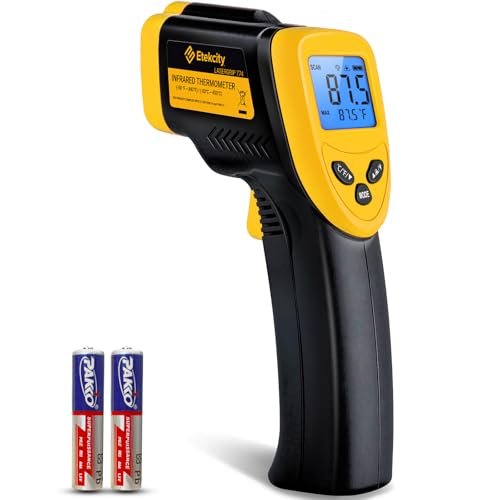
Etekcity Infrared Thermometer Laser Temperature Gun 774
 Budget-friendly option for casual home cooks needing quick surface temp reads
Best for casual home cooks on a budget who need a lightweight, no-fuss option for basic grilling, oven, and fridge temp checks. Weighs just 0.25 pounds, fits in a kitchen drawer, and has a simple interface with no complicated settings. The bright yellow casing makes it easy to spot in a crowded kitchen or grill tool caddy. Key specs: temperature range -58°F to 716°F, 12:1 distance-to-spot ratio, fixed 0.95 emissivity, laser targeting.
Pros:
- Ultra-lightweight design reduces hand fatigue during long cooking sessions
- Affordable price point for beginner users
- Bright color for easy visibility in busy kitchens
- Reliable brand reputation for basic temperature checks
Cons:
- Fixed emissivity means less accuracy on shiny metal grates or pizza stones
- No backlit display for low-light use
- Lower max temperature makes it unsuitable for wood-fired pizza ovens
For casual home cooks seeking a budget-friendly, no-fuss option for basic surface temp checks, the Etekcity 774 is a solid pick — grab it here [https://www.amazon.com/dp/B0B71HFH9K?tag=plugchef-20&linkCode=ogi&th=1&psc=1].
Digital Infrared Thermometer Gun for Cooking, BBQ, and Pizza Ovens (Soonkoda)
 Ideal for low-light grilling and baking sessions with its illuminated screen
Best for outdoor grill masters and pizza makers who need a backlit display for low-light use. Temperature range -58°F to 932°F, backlit LCD screen, 0.24-pound lightweight design, fixed 0.95 emissivity.
Pros:
- Backlit display works great for night grilling and late-night baking
- Wide temp range covers most home cooking use cases
- Affordable price for the included backlight feature
- Compact design fits easily in a grill tool bag
Cons:
- Fixed emissivity, less accurate on reflective surfaces
- Laser can be hard to see in bright direct sunlight
- No adjustable settings for advanced users
If you frequently cook after dark, this backlit model is a convenient pick for all your outdoor cooking needs [https://www.amazon.com/dp/B0BN317X6Z?tag=plugchef-20&linkCode=ogi&th=1&psc=1].
Etekcity Infrared Thermometer Temperature Gun 1080
 Handles extreme heat up to 1130°F, perfect for outdoor pizza ovens and grills
Best for home cooks who occasionally make pizza or use high-heat grills, and need a wider temp range than the entry-level Etekcity 774. Temp range -58°F to 1130°F, 0.4 pounds, 12:1 distance-to-spot ratio, fixed 0.95 emissivity, bright yellow/black design.
Pros:
- Handles extreme heat up to 1130°F, perfect for wood-fired pizza ovens and charcoal grills
- Durable casing stands up to outdoor use
- Reliable brand reputation for consistent performance
- Versatile enough for non-food uses like checking reptile tank temps
Cons:
- No backlit display for low-light use
- Fixed emissivity struggles with shiny metal surfaces
- Slightly heavier than budget models
For high-heat cooking enthusiasts who need a durable, wide-range option, the Etekcity 1080 is a reliable workhorse [https://www.amazon.com/dp/B00DMI632G?tag=plugchef-20&linkCode=ogi&th=1&psc=1].
ThermoPro TP30 Infrared Thermometer Gun
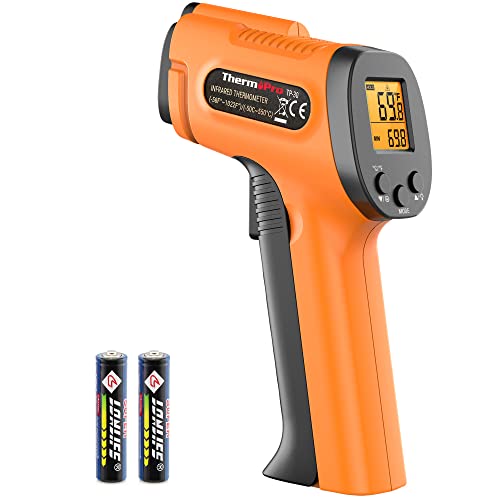 Adjustable emissivity settings ensure accuracy on shiny metal and matte surfaces alike
Best for serious home grill masters, pizza makers, and DIYers who need adjustable emissivity for accurate reads on all surfaces. Temp range -58°F to 1022°F, adjustable 0.1-1.0 emissivity, laser targeting, compact design, min/max temp tracking.
Pros:
- Adjustable emissivity delivers accurate reads on shiny metal grates, pizza stones, and matte foods like bread
- Min/max temp tracking lets you monitor heat fluctuations over long cooking sessions
- Durable build for frequent outdoor use
- Versatile enough for non-food tasks like checking HVAC vents
Cons:
- No backlit display for low-light use
- Slightly heavier at 0.5 pounds than budget models
- Default emissivity is fixed, so you need to manually adjust for non-food surfaces
For users who need precision across all surface types, the ThermoPro TP30’s adjustable emissivity delivers consistent, accurate reads [https://www.amazon.com/dp/B07VTPJXH9?tag=plugchef-20&linkCode=ogi&th=1&psc=1].
ThermoPro TP420 2-in-1 Instant Read Thermometer
 Combines non-contact surface reads with instant internal probe for full cooking coverage
Best for cooks who want the versatility of both non-contact surface reads and instant internal probe temps in one tool. Temp range -58°F to 1022°F for IR, -58°F to 572°F for the probe, 2-in-1 design, backlit display, adjustable emissivity.
Pros:
- Dual functionality eliminates the need for two separate thermometers
- Probe gives 3-second internal reads for meat to meet USDA food safety guidelines
- Backlit display for low-light grilling and baking
- Long probe reaches into thick cuts of meat easily
Cons:
- IR function still struggles with highly reflective surfaces
- Probe cable is only 4 inches long, which can be limiting for large grill setups
- Slightly more expensive than single-function models
If you want the convenience of two thermometers in one, the ThermoPro TP420 is a versatile all-in-one solution [https://www.amazon.com/dp/B09Q8MPNWG?tag=plugchef-20&linkCode=ogi&th=1&psc=1].
Alpha Grillers Digital Meat Thermometer
 Fast 2-second internal temp reads for perfect steak, chicken, and burger doneness
Best for cooks who prioritize fast, accurate internal meat temperature reads as a complement to an IR thermometer. Temp range -58°F to 572°F, instant 2-second probe reads, waterproof, compact 6.3-inch design, 0.15 pounds. Note: This is a probe-only thermometer with no IR functionality, designed to pair with an IR thermometer for full cooking coverage.
Pros:
- Extremely fast internal reads in 2 seconds or less
- Waterproof design for use while washing or in wet outdoor conditions
- Affordable price for a reliable instant-read probe
- Easy to calibrate for consistent accuracy
Cons:
- Only measures internal temperature, no IR functionality
- 4.5-inch probe may not reach the center of very large cuts of meat like whole turkeys
- No backlit display for low-light use
For fast, reliable internal meat temp reads to pair with your IR thermometer, the Alpha Grillers probe is a kitchen staple [https://www.amazon.com/dp/B00S93EQUK?tag=plugchef-20&linkCode=ogi&th=1&psc=1].
ERICKHILL 2-in-1 Infrared Thermometer with Meat Probe
 Versatile tool for both kitchen cooking and HVAC home maintenance
Best for multi-use households that need a tool for both cooking and home maintenance. Temp range -58°F to 1022°F for IR, -58°F to 572°F for probe, 2-in-1 design, adjustable emissivity, ergonomic grip.
Pros:
- Dual functionality for cooking and HVAC/automotive use
- Adjustable emissivity for accurate reads on all surfaces
- Long probe reaches into thick cuts of meat and deep HVAC vents
- Durable build for frequent use
Cons:
- IR function struggles with highly reflective surfaces
- Backlit display is dim in direct sunlight
- Slightly heavier than single-function models
For a versatile tool that works in the kitchen and around the house, the ERICKHILL 2-in-1 model delivers on all fronts [https://www.amazon.com/dp/B0D4YRJHZZ?tag=plugchef-20&linkCode=ogi&th=1&psc=1].
ThermoPro Infrared Thermometer with Extended Meat Probe
 Extra-long probe reaches into thick cuts of brisket and whole poultry easily
Best for grill masters and home cooks who smoke large cuts of meat, like brisket, whole turkey, or pork shoulder, and need a probe long enough to reach the center without burning their hands. Temp range -58°F to 1022°F, 8-inch extended probe, laser targeting, fixed 0.95 emissivity, bright orange casing for visibility.
Pros:
- Extra-long probe eliminates the need for extensions for large cuts of meat
- Laser targeting for precise IR reads on grill grates and pizza stones
- Wide temp range for high-heat grilling and smoking
- Bright orange color for easy location in a crowded grill setup
Cons:
- Fixed emissivity, less accurate on shiny metal surfaces
- No backlit display for low-light use
- Probe reads slower than dedicated instant-read models
For smokers and grill masters cooking large cuts of meat, the extended probe on this ThermoPro model is a game-changer [https://www.amazon.com/dp/B0D46H7194?tag=plugchef-20&linkCode=ogi&th=1&psc=1].
Ahosoutly Lightweight Infrared Thermometer
 Ultra-portable design fits easily in a kitchen drawer or grill tool bag
Best for casual users and travelers who need a compact, multi-use thermometer for cooking, pet care, and home repairs. Temp range 58°F to 1022°F (-50°C to 550°C), 0.4 pounds, blue durable casing, fixed 0.95 emissivity.
Pros:
- Ultra-lightweight and compact for travel and small kitchens
- Multi-use for cooking, pet care (checking reptile tank temps, pet bed temps), and home repairs (checking electrical outlet temps, HVAC vents)
- Affordable price point for multi-use functionality
- Durable casing for frequent use
Cons:
- Fixed emissivity, less accurate on reflective surfaces
- No backlit display for low-light use
- Laser pointer can be too bright for some users’ preference
For a portable, affordable multi-use option, the Ahosoutly thermometer works for cooking and household tasks alike [https://www.amazon.com/dp/B07MXLZ22G?tag=plugchef-20&linkCode=ogi&th=1&psc=1].
Wide-Range Infrared Digital Temperature Gun (Sovarcate)
 Measures temps from -58°F to 1112°F for almost any household task
Best for power users and home chefs who need an extremely wide temp range for high-heat cooking and industrial-style tasks. Temp range -58°F to 1112°F (-50°C to 600°C), laser targeting, 6.1 x 3.7 x 1.85 inch compact design, fixed 0.95 emissivity.
Pros:
- Extremely wide temp range handles wood-fired pizza ovens, commercial grills, and deep fryer oil temps
- Compact design fits easily in a tool bag or kitchen drawer
- Clear digital display for quick reads in most lighting conditions
- Versatile for non-food tasks like checking engine temps or HVAC vents
Cons:
- Fixed emissivity, less accurate on highly reflective surfaces
- Learning curve for new users unfamiliar with IR thermometers
- Laser can be hard to see in bright direct sunlight
For high-heat cooking enthusiasts who need a wide temp range, this Sovarcate model handles even the hottest cooking surfaces [https://www.amazon.com/dp/B0CSP3NQ8C?tag=plugchef-20&linkCode=ogi&th=1&psc=1].
Frequently Asked Questions
What Is An Infrared Thermometer For Food?
An infrared thermometer for food is a handheld, non-contact device that measures the surface temperature of food, cookware, or cooking equipment by detecting infrared radiation emitted from the object’s surface. Unlike traditional probe thermometers that require piercing food, IR thermometers give readings in 1-3 seconds without touching the surface, making them ideal for maintaining hygiene and avoiding damage to delicate dishes.
How Accurate Are Infrared Thermometers For Cooking?
High-quality food IR thermometers have a margin of error of ±1-2°F (±0.5-1°C) when used correctly, which is sufficient for most cooking and food safety needs. Accuracy depends on proper use: adjusting emissivity for the surface being measured, holding the device at the correct distance, and avoiding steam, smoke, or direct sunlight that can skew readings. For critical food safety tasks like checking raw meat doneness, pair an IR thermometer with an instant-read probe for internal temp verification.
Can Infrared Thermometers Measure Internal Meat Temperature?
Standard infrared thermometers only measure surface temperature. If you need internal temperature reads, opt for a 2-in-1 model that includes a wired or wireless meat probe, which can penetrate thick cuts of meat to get an accurate internal reading. For food safety, always follow USDA guidelines for internal minimum temps: 145°F for whole cuts of beef, pork, lamb, and veal; 160°F for ground meats; and 165°F for all poultry.
Are Infrared Thermometers Safe For Kitchen Use?
Yes, IR thermometers are completely safe for kitchen use. They emit a low-power laser pointer only for targeting, not for measuring temperature, and the laser is Class 1 (the safest classification, eye-safe under all normal use conditions). The non-contact design also eliminates burn risk from hot surfaces and prevents cross-contamination between raw and cooked foods.
What Temperature Range Do Food Infrared Thermometers Cover?
Most food-grade IR thermometers have a range of -58°F to 1000°F (-50°C to 538°C), which covers all common cooking use cases: checking fridge/freezer temps, monitoring candy and chocolate tempering, measuring pizza stone heat, and checking grill grate temps. Higher-end models for pizza ovens or commercial grills may reach up to 1200°F or higher.
How Do I Use An Infrared Thermometer Correctly?
- Wipe the IR lens with a microfiber cloth to remove any grease or smudges. 2) Set the emissivity setting to match your surface (0.95 for most meats and baked goods, lower for shiny metal or stone). 3) Hold the thermometer at the distance specified by its distance-to-spot ratio (most food models work best 2-6 inches from the surface). 4) Aim the laser at the center of the target area, keeping the device perpendicular to the surface. 5) Press the trigger and wait 1-2 seconds for the reading to stabilize before recording.
Conclusion
Infrared thermometers for food take the guesswork out of cooking temperatures, helping you achieve consistent, safe, delicious results whether you’re grilling burgers, baking sourdough, or monitoring fridge temps for food safety. Unlike probe thermometers, they eliminate cross-contamination risk, deliver instant reads, and let you check hot surfaces without burning yourself.
When choosing a model, prioritize features that match your cooking habits: adjustable emissivity if you cook on shiny metal grates, a backlit display for night grilling, or a 2-in-1 design with a probe if you need both surface and internal temperature reads. For casual home cooks, budget options like the Etekcity 774 or Soonkoda backlit model offer all the basics you need. For serious grill masters and pizza makers, a model with adjustable emissivity like the ThermoPro TP30 or TP420 will deliver the accuracy you need for high-heat cooking.
Pair your IR thermometer with a dedicated instant-read probe for internal meat temp checks to meet USDA food safety guidelines, and you’ll have all the tools you need to cook with confidence every time. Invest in a quality IR thermometer today, and never have to guess if your steak is medium-rare or your pizza stone is hot enough again.
If you’re looking to upgrade other kitchen tools, check out our guides to the best kitchen cleaning scrub brushes for easy post-cooking cleanup, or childproof cabinet locks to keep your kitchen safe for little helpers.

Hi, I’m Daniel Brooks—a food lover and kitchen gear enthusiast. I enjoy testing cookware, utensils, and gadgets to see what really works in everyday cooking. At PlugChef.com, I share honest reviews, comparisons, and simple guides to help you choose the best tools for a safer, smarter, and more enjoyable kitchen.
Related posts:
 Top Ansi Z87.1 Safety Goggles: Anti-Fog, Scratch-Resistant Eye Protection
 Best Cutting Boards for Food Safety: Top BPA-Free, Color-Coded Sets
 4 Inch Knife Sheath: Ultimate Protection and Convenience for Your Blade
 Cabinet Door Safety Locks: Secure Your Home with Easy No-Drill Solutions
 3D Printed Knife Sheath: Durable, Customizable Protection for Your Blades
 Child Safety Strap Locks: Secure Your Cabinets with Easy No-Drill Solutions