
Workplace injuries cost U.S. employers an estimated $1 billion per week in 2026, per National Safety Council data, and a fully stocked, OSHA-compliant first aid kit is one of the simplest, most cost-effective tools to reduce injury severity and avoid costly citations. Far from a generic box of bandages, your first aid kit is a regulated safety asset that must align with OSHA’s 29 CFR 1910.151 standard, match your workplace’s specific hazards, and be accessible to every employee at a moment’s notice. This guide breaks down exact 2026 compliance requirements, common pitfalls, and actionable steps to keep your workplace safe and violation-free, no matter your industry or team size.
Core OSHA First Aid Kit Standards (Baseline Rules for 2026)
A common misconception is that OSHA mandates a one-size-fits-all list of first aid kit contents for all workplaces. In practice, OSHA’s standard focuses on adequacy for your specific work environment, rather than a rigid checklist of supplies. Understanding this baseline will help you avoid overstocking unnecessary items while ensuring you meet all legal requirements.
The Legal Foundation: 29 CFR 1910.151
OSHA’s first aid requirement is outlined in 29 CFR 1910.151, which states that employers must provide "first aid supplies that are adequate for the workplace" and ensure kits are "readily available" to employees during working hours. The standard does not publish a fixed mandatory contents list, but explicitly references ANSI Z308.1 as the consensus industry benchmark for kit contents and best practices. OSHA inspectors use ANSI Z308.1 as their primary compliance baseline during workplace visits, so aligning with this standard is the most reliable way to avoid citations. For full official guidance, refer to OSHA's official first aid compliance resources.
Minimum Kit Contents (ANSI Z308.1-2021 Benchmarks)
While OSHA does not mandate a fixed list, ANSI Z308.1-2021 (the current version as of 2026) outlines minimum contents for two general workplace hazard categories. Employers must add supplies tailored to their specific risks (e.g., burn gel for welding shops, eyewash for labs) beyond these baseline requirements.
| Kit Type | Minimum Required Contents |
|---|---|
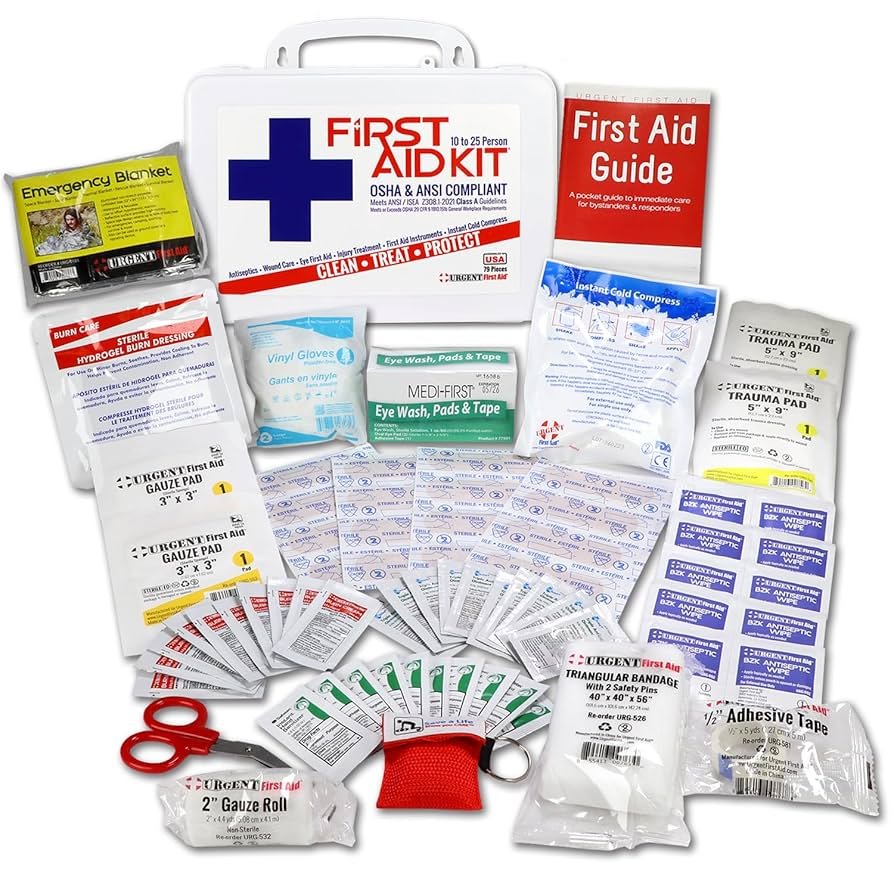
| Low-Hazard (offices, retail, administrative spaces) | Adhesive bandages (various sizes), sterile gauze pads, adhesive tape, antiseptic wipes, disposable non-latex gloves, blunt-tip scissors, tweezers, 4×4 inch burn dressing, triangular bandage, first aid instruction booklet |
| High-Hazard (construction, manufacturing, labs, food processing) | All low-hazard items, plus: tourniquet (CAT or SOF-T style), burn gel/cream, sterile eyewash solution, instant cold packs, elastic bandages, hemostatic gauze, CPR face shield, emergency blanket |
For unique workplace risks, add specialized supplies: outdoor worksites need sunscreen and insect sting relief, food processing facilities need extra antiseptics and cut-resistant gloves, and remote field teams need splints and trauma shears for injury stabilization.
Accessibility and Placement Rules (Avoid Costly Citations)
A fully stocked first aid kit is useless if employees cannot access it quickly during an emergency. OSHA enforces strict placement rules to ensure kits are usable when needed most:
- Kits must be located within 3–5 seconds of travel from any work area, with no long walks, stairwells, or locked doors between hazards and the nearest kit.
- Kits cannot be stored in locked, unlabeled cabinets unless a designated, trained employee on each shift has immediate access to the key.
- All kits must be clearly marked with a white cross on a green background per ANSI standards, so they are visible even in low-light or high-stress emergency scenarios.
- Large facilities (over 50,000 square feet or multiple floors) require multiple kits, placed within 75 feet of every work area.
- Outdoor, remote, or field worksites need weatherproof, portable kits stored in vehicles or sealed, insulated lockers to protect supplies from moisture, extreme temperatures, and physical damage.
- Kits cannot be placed in areas exposed to direct heat, cold, or moisture that could degrade supplies (e.g., next to a boiler, in an uninsulated outdoor shed).
 Credit: www.amazon.com
A properly mounted, clearly labeled first aid kit meets OSHA accessibility requirements for most low-hazard workplaces.
Credit: www.amazon.com
A properly mounted, clearly labeled first aid kit meets OSHA accessibility requirements for most low-hazard workplaces.
How to Select the Right First Aid Kit for Your Workplace
Choosing a kit that meets your needs without overpaying for unnecessary supplies starts with a clear assessment of your workplace. Follow these steps to select a compliant, effective option:
- Conduct a formal workplace hazard assessment: Per OSHA 29 CFR 1910.132, document all potential workplace hazards, including machinery, chemicals, extreme temperatures, and remote work locations, to determine required kit contents.
- Match kit size to your team: ANSI recommends 1 kit per 25 employees for low-hazard workplaces, and 1 kit per 10 employees for high-hazard workplaces.
- Choose the right kit type: Wall-mounted kits work for fixed office or shop floors, portable kits for remote or multi-site teams, and vehicle-mounted kits for field or construction work.
- Opt for ANSI-certified pre-assembled kits if possible: Pre-certified kits meet all minimum ANSI requirements, reducing the risk of missing supplies, and can be customized with hazard-specific items as needed.
For sites needing bulk storage of backup first aid supplies, durable, airtight 10-gallon storage bins protect items from moisture, pests, and temperature fluctuations, keeping supplies viable until needed. Small office teams can use compact 12-quart storage containers to store backup bandages and antiseptics in break rooms or supply closets.
 Credit: www.amazon.com
Pre-assembled ANSI-certified kits are a convenient option for workplaces with specialized hazard risks.
Credit: www.amazon.com
Pre-assembled ANSI-certified kits are a convenient option for workplaces with specialized hazard risks.
Maintenance, Inspections, and Record-Keeping
A compliant first aid kit requires ongoing maintenance, not just a one-time setup. OSHA requires regular checks and documentation to prove compliance during inspections.
Inspection and Restocking Protocols
- OSHA recommends inspecting kits at least monthly, with weekly inspections recommended for high-hazard or high-traffic worksites.
- During inspections, check for expired medications or antiseptics, damaged packaging, missing supplies, and degraded items (e.g., brittle gloves, torn gauze).
- Restock immediately after any use or inspection, using a pre-made checklist of required items to avoid missing critical supplies.
- Assign a specific, trained employee or team to oversee inspections and restocking to ensure accountability, rather than leaving it to ad-hoc staff.
Required Documentation
OSHA does not mandate a specific format for records, but expects proof of compliance during all inspections. Keep the following for at least 3 years:
- Date of each inspection, and the name of the person who conducted it
- List of all items checked, and any expired/missing items replaced
- Dates of employee first aid training, and topics covered
- Location of all first aid kits across the facility Digital spreadsheets or dedicated safety management software work well for multi-site teams, but even a simple printed logbook is acceptable for small businesses. For teams looking to streamline inventory tracking for safety and break room supplies, compartmentalized 4-compartment food storage containers make it easy to organize small first aid items like bandages, antiseptic wipes, and tweezers for quick access.
Employee Training Requirements
OSHA does not require every employee to be first aid certified, but it does enforce strict training rules to ensure teams can respond effectively during emergencies:
- At least one trained first aid responder must be on each work shift, with certification in first aid, CPR, and AED use.
- If your workplace does not have emergency medical services (EMS) that can arrive within 4 minutes (the OSHA standard for emergency response time), you must have enough trained responders to cover all shifts and work areas.
- Training must be hands-on (not solely online) and refreshed at least every 2 years, or immediately if workplace hazards or kit contents change.
- All employees must be trained on the location of all first aid kits, how to access locked or stored kits, and when to call 911 vs. provide first aid.
All compliant kits include heavy-duty scissors for cutting clothing or bandages during emergencies; keeping cutting tools sharp and well-maintained ensures they work when needed, a practice covered in cutting tool care guides.
Common Compliance Pitfalls and How to Avoid Them
Even well-intentioned workplaces often miss small details that lead to costly citations or delayed emergency response. Avoid these frequent mistakes:
- Pitfall 1: Using a generic low-hazard kit for a high-hazard workplace: A construction site with only basic bandages and antiseptics will fail an OSHA inspection if a worker suffers a severe laceration or burn. Fix: Conduct a formal hazard assessment and add hazard-specific supplies (tourniquets, burn gel, eyewash) as needed.
- Pitfall 2: Inaccessible kit storage: Locking kits in a supply closet without a clearly posted key location, or storing them in a basement far from work areas, violates accessibility rules. Fix: Post clear signage with kit locations and key access info near all work areas.
- Pitfall 3: Incomplete record-keeping: Even a fully stocked, accessible kit will lead to a citation if you cannot produce proof of regular inspections and training. Fix: Use a shared digital log for all inspections and training, accessible to managers and OSHA inspectors.
- Pitfall 4: Failing to train all shifts: Night shift or remote workers often miss first aid training, leaving them unprepared for emergencies. Fix: Schedule training sessions at varying times, or offer recorded hands-on modules for shifts that can’t attend live sessions.
 Credit: firstaidsuppliesonline.com
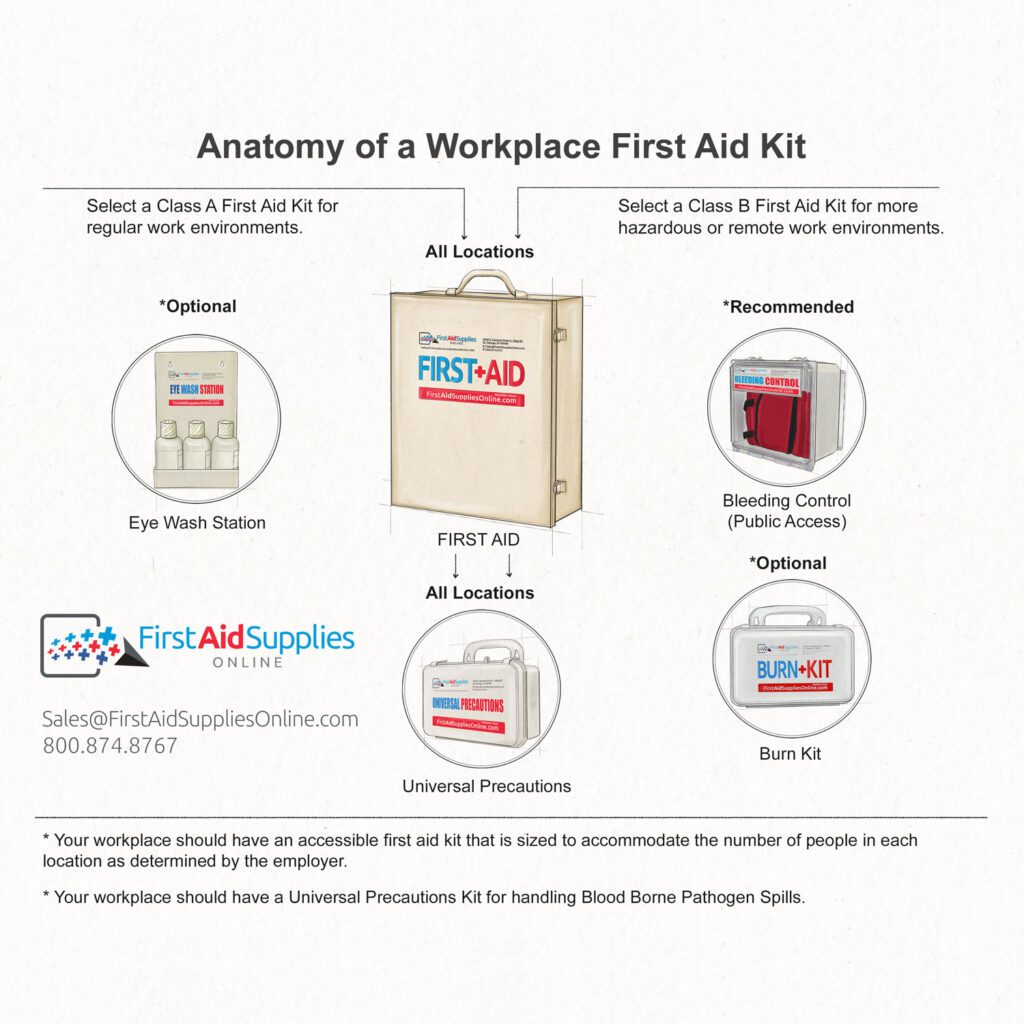
Visual guides can help teams quickly identify gaps in their first aid program compliance.
Credit: firstaidsuppliesonline.com
Visual guides can help teams quickly identify gaps in their first aid program compliance.
2026 Compliance Updates and Future-Proofing Your Program
As of 2026, OSHA has not issued new standalone first aid kit regulations, but recent enforcement prioritization for construction, healthcare, and manufacturing workplaces has led to a sharp increase in first aid-related citations, with inspectors now checking for hazard-specific kit contents and proof of regular training in addition to basic stock levels. To future-proof your program:
- Review your hazard assessment annually, or immediately if you introduce new machinery, chemicals, or work processes.
- Stay up to date with ANSI Z308.1 standard updates, which are revised every 5 years; the next revision is scheduled for late 2026, so check ANSI’s official standard page for new requirements mid-year.
- Consider adding smart inventory trackers or QR code access to first aid instructions to reduce response time and improve record-keeping.
- Conduct annual emergency drills to test employee response times and kit accessibility.
Maintaining clear inventory of first aid supplies ensures you never run out of critical items, a practice that works equally well for dry goods storage in break rooms or first aid stockrooms.
Frequently Asked Questions
What are the exact OSHA first aid kit requirements for 2026?
OSHA’s 29 CFR 1910.151 standard requires employers to provide first aid kits with supplies adequate for their workplace’s specific hazards, ensure kits are readily accessible to all employees, and conduct regular inspections and maintenance. While OSHA does not mandate a fixed contents list, it references ANSI Z308.1-2021 as the industry benchmark for minimum kit supplies, which inspectors use as the compliance baseline.
How often do OSHA first aid kits need to be inspected?
OSHA recommends inspecting first aid kits at least monthly, with weekly inspections recommended for high-hazard or high-traffic worksites. Inspections must check for expired supplies, missing items, and damaged packaging, and all inspection records must be retained for at least 3 years.
Are employers required to train employees on first aid kit use?
Yes, employers must ensure at least one trained first aid responder is on each work shift, with training in first aid, CPR, and AED use that is refreshed every 2 years. All employees must also be trained on the location of all first aid kits and basic steps for accessing supplies during an emergency.
What happens if my workplace fails an OSHA first aid kit inspection?
Fines for non-compliance range from $15,625 per serious violation to $156,259 per willful violation as of 2026, per OSHA’s penalty schedule. Additionally, unaddressed first aid gaps can lead to increased injury severity and liability in the event of a workplace emergency.
Conclusion
Staying compliant with OSHA first aid kit requirements is not just about avoiding fines—it’s about protecting your team and reducing the impact of workplace injuries. By aligning your kit contents with ANSI benchmarks, following accessibility and maintenance rules, and training all employees on proper use, you can build a first aid program that meets 2026 regulations and supports a culture of safety. Start by conducting a formal hazard assessment this week, scheduling your next monthly kit inspection, and assigning a team member to oversee record-keeping to ensure you’re always prepared for an inspection or emergency. For more foundational workplace safety guidance, visit our workplace safety resource hub to access guides on hazard mitigation and emergency preparedness.

I’m Abby Lu, a passionate home cook who loves simplifying everyday meals. At PlugChef.com, I share product reviews and cooking guides to help you find the best tools for your kitchen.
Related posts:
 Herbs to Use With Salmon: Enhance Flavor with Fresh, Zesty Picks
 Sweet Pickled Watermelon Rind Recipe: Irresistible Tangy Delight
 Cook Eggs in Cast Iron: Perfect Tips for Flawless Breakfasts
 Wd40 to Clean Stainless Steel: Ultimate Shine & Rust Removal Guide
 How to Eat Fresh Dates: Easy Tips for Maximum Flavor and Health
 Cook Salmon in Slow Cooker: Easy, Delicious, and Healthy Recipes

