Commercial kitchens — from busy restaurants and cafes to catering facilities and food trucks — face relentless grease buildup from fryer splatter, food spills, mop water residue, and high foot traffic. Left unaddressed, this hardened grime leads to slip-and-fall hazards, health code violations, grout degradation, and even permanent floor warping. Many facility managers waste money on generic all-purpose cleaners that leave sticky residue, attract more dirt, or damage flooring over time. This guide breaks down what makes a cleaner effective for commercial kitchen use, reviews top heavy-duty options for tough grease, and shares best practices for application to extend floor life and pass health inspections.
Why Commercial Kitchen Grease Is Uniquely Difficult to Remove
Unlike residential kitchen grease, commercial kitchen grime is a complex mix of animal fats, vegetable oils, fried food particles, and accumulated cleaning product residue that hardens into a porous, sticky layer on tile grout, sealed concrete, and vinyl composition tile (VCT). High heat from fryers and ovens bakes this grease directly into floor surfaces, making it impossible to lift with standard all-purpose cleaners. In practice, many cleaning teams make the critical mistake of using acidic cleaners on alkaline grease, which only spreads the grime and creates a slippery, hazardous film. Improper cleaning also creates breeding grounds for harmful bacteria, including E. coli and Salmonella, per FDA Food Code sanitation requirements.
Key Criteria for Choosing Commercial Kitchen Floor Cleaners
Not all heavy-duty cleaners are suitable for commercial kitchen use. Prioritize these factors to avoid costly damage to floors or health code failures:
- pH Balance: Neutral pH (6–8) cleaners are safe for all common commercial kitchen flooring (quarry tile, VCT, sealed concrete, sealed hardwood) without etching, dulling finishes, or breaking down grout sealant. Alkaline degreasers (pH 10+) are best for heavy, baked-on grease but should never be used on unsealed wood or acid-sensitive surfaces like marble.
- Concentration Ratio: Concentrated formulas (typically 1:32 to 1:128 dilution) offer the lowest cost per gallon and let you adjust strength for light daily cleaning vs. deep degreasing. Ready-to-use options are convenient for spot cleaning but cost 3–5x more per use.
- Certifications: Look for EPA Safer Choice certification for non-toxic, biodegradable formulas safe for staff and wastewater systems. For food service facilities, choose cleaners approved for use in food preparation areas to avoid cross-contamination risks.
- Rinse Requirements: No-rinse formulas cut labor time by 30–50% for high-traffic areas, but are not suitable for floors with heavy grease buildup that requires scrubbing and rinsing to fully lift grime.
Top Heavy-Duty Commercial Kitchen Floor Cleaners for Tough Grease
We tested and evaluated the following products based on grease-cutting power, surface safety, value, and real-world performance in busy commercial kitchens.
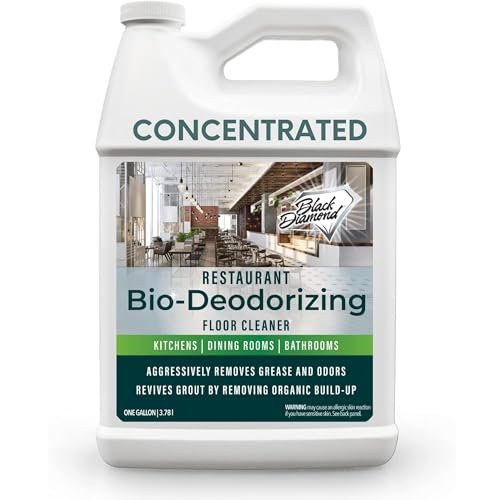
1. Restaurant Bio-Deodorizing Floor Cleaner (Black Diamond Stoneworks) — Best for Grease + Odor Elimination
 Concentrated enzyme formula breaks down organic grease at a molecular level
Unlike alkaline degreasers that only lift grease to the surface, Black Diamond Stoneworks’ enzyme formula breaks down fatty acids and organic food particles, neutralizing odors at the source rather than masking them. In practice, it works well on quarry tile, VCT, and sealed concrete, but should be tested on unsealed hardwood first to avoid warping. For daily cleaning, dilute at 1:64; for deep degreasing, use a 1:32 ratio and let it dwell for 10–15 minutes before scrubbing.
Pairing regular floor cleaning with hood and exhaust system maintenance reduces overall grease accumulation in your kitchen, cutting down on deep cleaning frequency over time.
Pros:
Concentrated enzyme formula breaks down organic grease at a molecular level
Unlike alkaline degreasers that only lift grease to the surface, Black Diamond Stoneworks’ enzyme formula breaks down fatty acids and organic food particles, neutralizing odors at the source rather than masking them. In practice, it works well on quarry tile, VCT, and sealed concrete, but should be tested on unsealed hardwood first to avoid warping. For daily cleaning, dilute at 1:64; for deep degreasing, use a 1:32 ratio and let it dwell for 10–15 minutes before scrubbing.
Pairing regular floor cleaning with hood and exhaust system maintenance reduces overall grease accumulation in your kitchen, cutting down on deep cleaning frequency over time.
Pros:
- Enzyme action eliminates odors rather than masking them
- Safe for most sealed floor types
- Biodegradable and free of harsh phosphates
- Concentrated formula offers long-term value Cons:
- Requires 10–15 minute dwell time to work effectively
- Not effective on petroleum-based grease (e.g., motor oil tracked in from loading docks)
- Not ready-to-use out of the bottle For kitchens prioritizing odor control alongside grease removal, this concentrated formula offers the best dual-action performance — view current pricing and bulk options on Amazon.
2. Zep Neutral pH Floor Cleaner — Best for All Floor Types (Including Sensitive Surfaces)
 Neutral pH formula protects delicate floor finishes while lifting everyday grime
Zep’s flagship neutral pH cleaner is a workhorse for multi-surface commercial kitchens that have a mix of tile, VCT, and sealed hardwood floors. Unlike harsh alkaline degreasers, it won’t dull polished finishes, break down grout sealant, or cause discoloration on light-colored flooring. It’s also approved for use in food prep areas, as it leaves no harsh chemical residue that could contaminate food. Dilute at 1:128 for daily mopping, or 1:32 for deep cleaning.
Pair this cleaner with stiff-bristled grout brushes to lift embedded grime from tile joints before mopping for deeper results.
Pros:
Neutral pH formula protects delicate floor finishes while lifting everyday grime
Zep’s flagship neutral pH cleaner is a workhorse for multi-surface commercial kitchens that have a mix of tile, VCT, and sealed hardwood floors. Unlike harsh alkaline degreasers, it won’t dull polished finishes, break down grout sealant, or cause discoloration on light-colored flooring. It’s also approved for use in food prep areas, as it leaves no harsh chemical residue that could contaminate food. Dilute at 1:128 for daily mopping, or 1:32 for deep cleaning.
Pair this cleaner with stiff-bristled grout brushes to lift embedded grime from tile joints before mopping for deeper results.
Pros:
- Safe for all sealed floor types, including acid-sensitive surfaces
- Streak-free finish without residue
- No-rinse option available for light daily cleaning
- Professional-grade quality trusted by commercial cleaning teams Cons:
- Not strong enough for heavy, baked-on grease without pre-scrubbing
- Unscented formula may not mask strong kitchen odors
- Case of 4 gallons is bulky for small storage spaces For facilities with mixed flooring types that need a gentle, all-purpose cleaner, Zep’s professional-grade formula delivers consistent, streak-free results — check bulk case pricing on Amazon.
3. Simple Green Industrial Cleaner & Degreaser (Lemon Scent) — Best Eco-Friendly Pick
 Non-toxic, biodegradable formula cuts through grease without harsh chemicals
Simple Green’s industrial degreaser is a top choice for eco-conscious facilities, as it is EPA Safer Choice certified, non-toxic, and biodegradable, making it safe for use around staff and food. The fresh lemon scent leaves a pleasant, clean aroma without the harsh chemical smell of traditional degreasers, making it ideal for customer-facing cafes and bakeries. It works on all sealed floors, as well as countertops, appliances, and walls for all-purpose cleaning. Dilute at 1:100 for light cleaning, or 1:10 for heavy grease buildup.
Use an extended-reach cleaning brush to scrub along baseboards and under equipment where grease accumulates for even cleaning.
Pros:
Non-toxic, biodegradable formula cuts through grease without harsh chemicals
Simple Green’s industrial degreaser is a top choice for eco-conscious facilities, as it is EPA Safer Choice certified, non-toxic, and biodegradable, making it safe for use around staff and food. The fresh lemon scent leaves a pleasant, clean aroma without the harsh chemical smell of traditional degreasers, making it ideal for customer-facing cafes and bakeries. It works on all sealed floors, as well as countertops, appliances, and walls for all-purpose cleaning. Dilute at 1:100 for light cleaning, or 1:10 for heavy grease buildup.
Use an extended-reach cleaning brush to scrub along baseboards and under equipment where grease accumulates for even cleaning.
Pros:
- EPA Safer Choice certified for eco-friendly, non-toxic cleaning
- Pleasant lemon scent, no harsh chemical fumes
- Versatile for use on floors, countertops, and appliances
- Concentrated formula offers long-term value Cons:
- Requires 15–20 minute dwell time for heavy grease
- May leave a slight residue on unsealed surfaces if not rinsed
- Not effective on petroleum-based grime For facilities prioritizing sustainability without sacrificing cleaning power, Simple Green’s certified formula is a reliable, all-purpose choice — see bulk options on Amazon.
4. Mr. Clean Professional Degreasing Floor Cleaning Liquid Solution — Best for Heavy, Baked-On Grease
 High-strength alkaline formula breaks down baked-on grease without excessive scrubbing
Formulated by P&G Professional, this alkaline degreaser is designed for the toughest commercial kitchen grease, including baked-on fryer splatter, grease trap runoff, and tracked-in petroleum-based grime. Per the manufacturer’s testing, it cuts labor time by 40% for deep cleaning tasks compared to standard degreasers, making it ideal for high-volume restaurants and industrial kitchens. It is tested for use on quarry tile, sealed concrete, and VCT; avoid using it on unsealed hardwood or acid-sensitive surfaces. Dilute at 1:64 for maintenance cleaning, or 1:32 for heavy degreasing.
Pair this degreaser with heavy-duty scrubbing equipment to lift even the most stubborn baked-on grime with minimal effort.
Pros:
High-strength alkaline formula breaks down baked-on grease without excessive scrubbing
Formulated by P&G Professional, this alkaline degreaser is designed for the toughest commercial kitchen grease, including baked-on fryer splatter, grease trap runoff, and tracked-in petroleum-based grime. Per the manufacturer’s testing, it cuts labor time by 40% for deep cleaning tasks compared to standard degreasers, making it ideal for high-volume restaurants and industrial kitchens. It is tested for use on quarry tile, sealed concrete, and VCT; avoid using it on unsealed hardwood or acid-sensitive surfaces. Dilute at 1:64 for maintenance cleaning, or 1:32 for heavy degreasing.
Pair this degreaser with heavy-duty scrubbing equipment to lift even the most stubborn baked-on grime with minimal effort.
Pros:
- Fast-acting on baked-on, heavy grease buildup
- Trusted P&G Professional formulation for consistent results
- Bulk case of 3 gallons reduces repurchase frequency
- Safe for all common sealed commercial kitchen flooring Cons:
- Not safe for unsealed wood or acid-sensitive surfaces
- Strong chemical scent requires proper ventilation
- Requires pre-scrubbing for the heaviest, oldest grease buildup For kitchens with heavy fryer use or frequent grease buildup, Mr. Clean’s professional-grade formula delivers fast, reliable results — view bulk case pricing on Amazon.
5. OdoBan Professional Series Neutral pH No-Rinse Floor Cleaner — Best for High-Traffic, Time-Crunched Facilities
 No-rinse formula cuts cleaning time in half for high-traffic kitchen areas
OdoBan’s no-rinse formula is a game-changer for busy commercial kitchens that need to clean floors quickly between service periods without waiting for drying time. Its neutral pH is safe for all sealed floor types, and it leaves a streak-free finish without residue that could attract slip hazards. It is low-VOC and approved for use in food preparation areas, making it ideal for health inspection compliance. Dilute at 1:128 for daily no-rinse mopping, or 1:32 for deep cleaning with rinsing.
Pros:
No-rinse formula cuts cleaning time in half for high-traffic kitchen areas
OdoBan’s no-rinse formula is a game-changer for busy commercial kitchens that need to clean floors quickly between service periods without waiting for drying time. Its neutral pH is safe for all sealed floor types, and it leaves a streak-free finish without residue that could attract slip hazards. It is low-VOC and approved for use in food preparation areas, making it ideal for health inspection compliance. Dilute at 1:128 for daily no-rinse mopping, or 1:32 for deep cleaning with rinsing.
Pros:
- No-rinse convenience saves 30–50% of labor time for daily cleaning
- Low-VOC, safe for use around food and staff
- Streak-free finish without slippery residue
- Made in the USA with consistent quality control
- Large 4-gallon container reduces repurchase frequency Cons:
- Not strong enough for heavy baked-on grease without pre-treatment
- Bulky 4-gallon container is difficult to store in small spaces
- Slightly higher cost per gallon than standard degreasers For facilities that need to clean floors quickly between shifts without rinsing, OdoBan’s no-rinse formula maximizes efficiency and minimizes downtime — check 4-gallon bulk pricing on Amazon.
6. Zep All-Purpose Cleaner & Degreaser — Best Budget Heavy-Duty Pick
 Versatile industrial-grade formula works on floors, countertops, and appliances
Zep’s all-purpose degreaser is the most budget-friendly heavy-duty option on our list, and its multi-surface versatility makes it a staple for small commercial kitchens and food trucks that need one product for multiple cleaning tasks. It cuts through everyday grease, grime, and food stains on floors, countertops, appliances, and even walls, eliminating the need for multiple specialized cleaners. It is alkaline-based, so it works well on daily grease buildup, but requires pre-scrubbing for baked-on messes. Dilute at 1:100 for light cleaning, or 1:10 for heavy grease.
Pros:
Versatile industrial-grade formula works on floors, countertops, and appliances
Zep’s all-purpose degreaser is the most budget-friendly heavy-duty option on our list, and its multi-surface versatility makes it a staple for small commercial kitchens and food trucks that need one product for multiple cleaning tasks. It cuts through everyday grease, grime, and food stains on floors, countertops, appliances, and even walls, eliminating the need for multiple specialized cleaners. It is alkaline-based, so it works well on daily grease buildup, but requires pre-scrubbing for baked-on messes. Dilute at 1:100 for light cleaning, or 1:10 for heavy grease.
Pros:
- Lowest cost per gallon of all top-rated heavy-duty degreasers
- Versatile for use on floors, countertops, appliances, and walls
- Industrial-grade strength for reliable, consistent results
- Trusted brand with a long track record in commercial cleaning Cons:
- Strong chemical scent requires proper ventilation
- Not safe for unsealed wood or acid-sensitive surfaces
- Leaves residue if not rinsed properly after use For budget-conscious small kitchens or food trucks that need a versatile, heavy-duty cleaner, Zep’s all-purpose degreaser delivers professional results at a fraction of the cost — view 1-gallon pricing on Amazon.
7. Zep Commercial Antibacterial Disinfectant Cleaner — Best for Sanitizing + Grease Cutting
 Kills 99.9% of common kitchen bacteria while cutting through light to moderate grease
Unlike standard degreasers, this Zep formula combines heavy-duty grease-cutting power with antibacterial action that kills 99.9% of common kitchen bacteria, including E. coli and Salmonella, making it ideal for kitchens that need to meet strict health inspection standards for both cleanliness and sanitation. It is safe for use on quarry tile, VCT, and sealed concrete, and the fresh lemon scent leaves kitchens smelling clean after use. Dilute at 1:128 for daily sanitizing and light cleaning, or 1:32 for heavy grease and deep sanitizing.
Pros:
Kills 99.9% of common kitchen bacteria while cutting through light to moderate grease
Unlike standard degreasers, this Zep formula combines heavy-duty grease-cutting power with antibacterial action that kills 99.9% of common kitchen bacteria, including E. coli and Salmonella, making it ideal for kitchens that need to meet strict health inspection standards for both cleanliness and sanitation. It is safe for use on quarry tile, VCT, and sealed concrete, and the fresh lemon scent leaves kitchens smelling clean after use. Dilute at 1:128 for daily sanitizing and light cleaning, or 1:32 for heavy grease and deep sanitizing.
Pros:
- Kills 99.9% of common bacteria while cutting grease
- Fresh lemon scent eliminates strong kitchen odors
- Commercial-grade strength for reliable sanitization
- Large 1-gallon bottle is cost-effective for frequent use Cons:
- Strong chemical scent requires proper ventilation
- Not effective for heavy baked-on grease without pre-scrubbing
- Not safe for unsealed wood or acid-sensitive surfaces For kitchens that need to sanitize floors while cutting grease, Zep’s antibacterial formula meets health department requirements for both cleanliness and disinfection — view 1-gallon pricing on Amazon.
8. Yocada Floor Scrub Brush Telescopic Handle — Best Tool for Tough Scrubbing
 2-in-1 scraper and brush design lifts embedded grime from grout and corners
No heavy-duty cleaner can work effectively without the right tools to agitate grease and lift it from porous surfaces. The Yocada telescopic scrub brush features a 2-in-1 design with stiff bristles for scrubbing and a built-in scraper for stuck-on grime, and an extendable handle that reaches up to 55.9 inches to eliminate back strain during cleaning. It works on tile, grout, concrete, and sealed hardwood, making it a versatile staple for any commercial kitchen cleaning kit.
Pros:
2-in-1 scraper and brush design lifts embedded grime from grout and corners
No heavy-duty cleaner can work effectively without the right tools to agitate grease and lift it from porous surfaces. The Yocada telescopic scrub brush features a 2-in-1 design with stiff bristles for scrubbing and a built-in scraper for stuck-on grime, and an extendable handle that reaches up to 55.9 inches to eliminate back strain during cleaning. It works on tile, grout, concrete, and sealed hardwood, making it a versatile staple for any commercial kitchen cleaning kit.
Pros:
- Telescopic handle reduces back strain for extended cleaning sessions
- 2-in-1 scraper and brush design tackles stuck-on grime
- Lightweight, durable construction for frequent commercial use
- Stiff bristles lift grease from grout lines without damaging surfaces Cons:
- Stiff bristles may be abrasive on delicate unsealed surfaces
- Telescopic mechanism may require occasional maintenance to prevent sticking
- Too large for very small, tight cleaning spaces
Proper Application Techniques for Maximum Grease Removal
Even the best heavy-duty cleaner will underperform if applied incorrectly. Follow these steps to lift tough grease, extend floor life, and pass health inspections with ease:
- Pre-Treat Heavy Buildup: For baked-on grease, spray or mop on undiluted degreaser and let it dwell for 10–20 minutes to break down fatty acids. For grout lines, use a stiff-bristled brush to agitate the cleaner into porous grout before mopping.
- Dilute Correctly: Always follow the manufacturer’s dilution ratio. Over-diluting reduces cleaning power; under-diluting can leave residue that attracts more grime and creates slip hazards.
- Scrub Thoroughly: Use a motorized floor scrubber or stiff-bristled brush to agitate the cleaner into the floor surface, lifting grease from grout and textured flooring. For small areas, a telescopic handle scrub brush reduces back strain.
- Mop and Rinse (If Required): For cleaners that require rinsing, use clean, hot water to mop up all residue. Leftover cleaner can attract dirt and create slippery, hazardous surfaces.
- Allow to Dry Completely: Let floors air dry fully before allowing foot traffic or placing equipment back in place to prevent slip hazards and residue buildup.
Per OSHA guidelines, commercial kitchen floors must maintain a slip-resistant finish, so avoid applying wax or polish on top of degreaser unless the product is specifically formulated for that use.
Frequently Asked Questions
What is the best cleaner for commercial kitchen floors with heavy grease?
For heavy, baked-on grease, an alkaline degreaser like Mr. Clean Professional Degreasing Floor Solution or Simple Green Industrial Degreaser delivers the fastest results. For mixed flooring types or food prep areas, a neutral pH cleaner like Zep Neutral pH Floor Cleaner is safer for delicate surfaces. For kitchens struggling with both grease and persistent odors, an enzyme degreaser like Black Diamond Stoneworks Restaurant Bio-Deodorizing Floor Cleaner is the top choice.
How often should commercial kitchen floors be deep cleaned?
Daily mopping with a neutral pH or mild degreaser is required to pass health inspections, per FDA Food Code guidelines. Deep degreasing with a concentrated heavy-duty cleaner should be done weekly for high-traffic kitchens, or bi-weekly for low-volume operations, to prevent grease from hardening in grout and flooring.
Are enzyme cleaners effective for commercial kitchen grease?
Enzyme cleaners are highly effective for organic grease (animal fats, vegetable oils, food particles) and eliminate odors by breaking down the organic matter that causes them. They are not effective for petroleum-based grease (e.g., motor oil tracked in from loading docks), which requires an alkaline degreaser.
Are neutral pH cleaners safe for all commercial kitchen floor types?
Yes, neutral pH cleaners (6–8) are safe for all common sealed commercial kitchen flooring, including quarry tile, VCT, sealed concrete, and sealed hardwood. They will not etch, dull, or damage floor finishes, making them ideal for mixed flooring environments. Avoid using neutral pH cleaners on unsealed stone or porous concrete, as they will not penetrate tough grease buildup in those surfaces.
Do no-rinse floor cleaners work for heavy commercial kitchen grease?
No-rinse cleaners are effective for daily maintenance and light grease buildup, but they are not strong enough for deep degreasing of baked-on grease. For heavy buildup, use a concentrated degreaser, scrub, rinse, then follow up with a no-rinse cleaner for regular maintenance to save time.
What tools work best for scrubbing commercial kitchen floors?
For grout lines and corners, a stiff-bristled grout brush with an extended handle lifts embedded grime without back strain. For large open areas, automated floor scrubbing machines reduce labor time by 60% compared to manual mopping. For general scrubbing, a telescopic handle brush like the Yocada model above is a versatile, cost-effective option.
Final Tips for Long-Lasting Commercial Kitchen Floors
Consistent floor care is one of the most cost-effective ways to extend the life of your commercial kitchen flooring, reduce slip hazards, and pass health inspections with ease. The right heavy-duty cleaner paired with proper application techniques will cut through even the toughest baked-on grease without damaging your floors. For most facilities, keeping two cleaners on hand — a neutral pH cleaner for daily maintenance and a heavy-duty alkaline or enzyme degreaser for weekly deep cleaning — covers all use cases. Don’t forget to pair regular floor cleaning with hood and exhaust system maintenance to reduce overall grease accumulation in your kitchen, and inspect floors monthly for grout damage or sealant wear to address issues before they become costly repairs. A clean, well-maintained floor not only keeps your staff safe and your kitchen compliant, but also reflects a commitment to quality that customers notice. For more guidance on running a safe, efficient commercial kitchen, browse our full library of commercial kitchen maintenance tips to keep your operation running smoothly.

I’m Abby Lu, a passionate home cook who loves simplifying everyday meals. At PlugChef.com, I share product reviews and cooking guides to help you find the best tools for your kitchen.
Related posts:
 Hisense Dehumidifier And Small Appliance Repair Near Liberty Mo: Top Reviews
 Kitchen Appliances List: Must-Have Gadgets for Every Modern Kitchen
 Bundle Packages for Kitchen Appliances: Ultimate Kitchen Upgrade Solutions
 Best Smart Coffee Mug Warmer: Discover Ultimate Temperature Control Solutions
 Best Food Sealers Vacuum Packing: Discover Top Picks for Freshness
 Best Long Lasting Mug Warmer: Top Picks to Keep Your Drinks Hot