
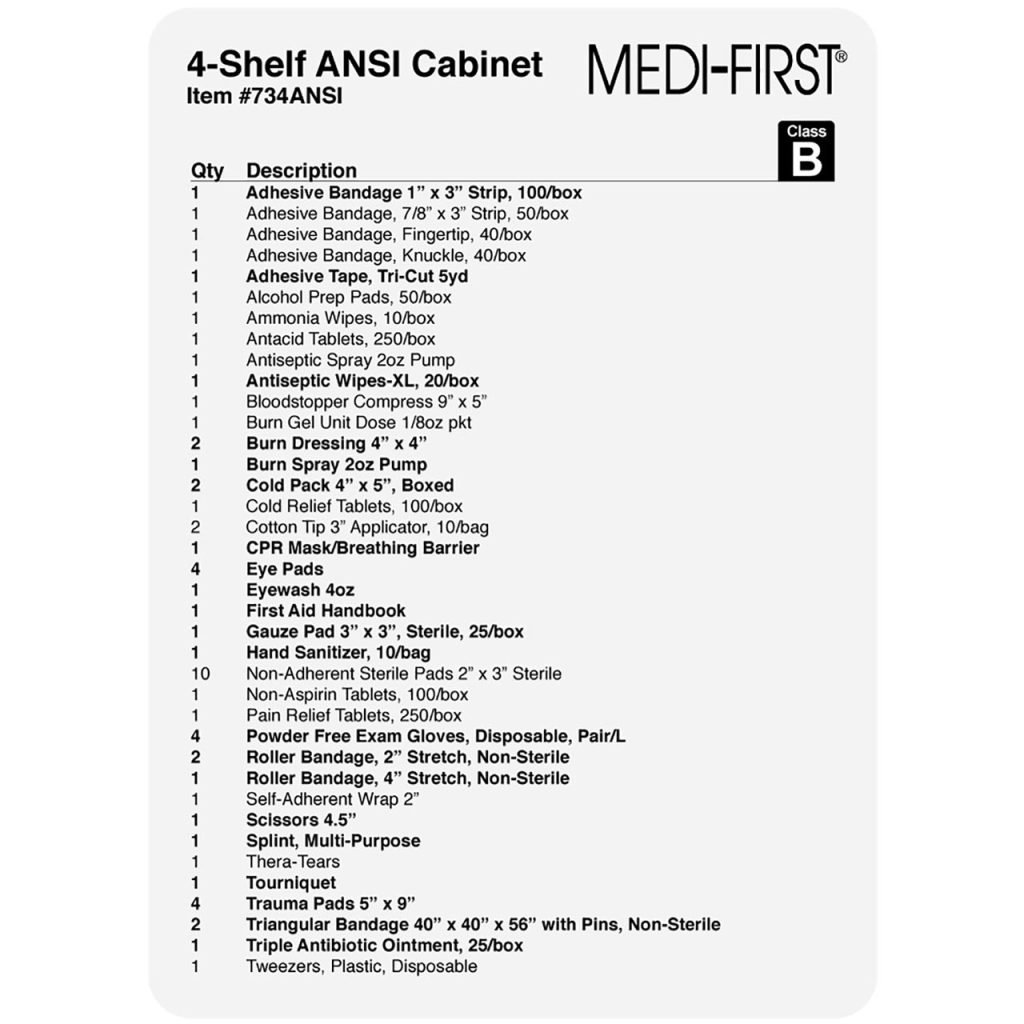
Workplace first aid compliance is non-negotiable: a properly stocked, accessible first aid kit is your first line of defense against minor injuries escalating into serious medical events, and failure to meet OSHA requirements can result in fines of up to $16,131 per violation (2026 rates) and increased liability for workplace injuries. Many business owners and safety managers assume “OSHA Class B” is a formal OSHA classification, but the standard actually references the ANSI/ISEA Z308.1 industry benchmark, which defines Class A and Class B kits based on workplace hazard levels.
This guide breaks down exactly what a compliant Class B first aid kit includes, how to select and place it for your specific worksite, and how to maintain compliance year-round to protect your team and your business. Whether you run a 10-person manufacturing shop or a 200-person construction site, you’ll walk away with actionable steps to avoid costly citations and ensure your team has access to care when seconds count.
What Is an OSHA Class B First Aid Kit?
While OSHA does not explicitly define “Class A” or “Class B” first aid kit categories, its workplace first aid standard 29 CFR 1910.151 references the ANSI/ISEA Z308.1 standard as the industry benchmark for compliant kit contents and classification. The most recent 2022 update to the ANSI/ISEA Z308.1 standard raised minimum supply counts and added new requirements for bleeding control tools to align with modern emergency medical guidance.
Class B kits are designed for medium to high-hazard workplaces with elevated injury risk, while Class A kits are reserved for low-hazard environments like offices and retail stores with 10 or fewer employees.
Class B vs. Class A: Key Differences
Class B kits have higher minimum supply counts, include trauma and burn supplies not required in Class A kits, and are built to treat more serious injuries like deep lacerations, chemical exposure, and sprains. A typical Class B kit is 2-3 times larger than a Class A kit, with enough supplies to treat multiple injured workers at once. In practice, many small business owners mistakenly assume a basic Class A kit is sufficient for a 10-person construction crew, only to face significant fines during an OSHA inspection when a worker suffers a deep laceration and the kit lacks sterile gauze or burn dressings.
Which Workplaces Require Class B Kits?
Class B kits are required for any worksite that meets one or more of the following criteria:
- Has 25 or more employees per shift
- Has a documented history of moderate to severe workplace injuries
- Uses heavy machinery, sharp tools, or hazardous chemicals
- Involves extreme temperatures, fall risks, or physical strain (e.g., construction, manufacturing, food processing, warehousing, landscaping) Even smaller high-hazard sites (e.g., a 5-person welding shop) may require Class B supplies based on a formal risk assessment.
Mandatory Class B First Aid Kit Contents (2022 ANSI/ISEA Standards)
The 2022 ANSI/ISEA Z308.1 update set strict minimum supply counts for Class B kits, so any pre-2022 kits may be non-compliant even if they were previously approved. All required items must be sterile, unexpired, and appropriate for the workplace’s identified hazards.
Core Required Supplies (Minimum Counts)
Class B kits must include all of the following at a minimum:
- Adhesive bandages (assorted sizes): 75 minimum
- Sterile 2×2 gauze pads: 30 minimum
- Sterile 4×4 gauze pads: 15 minimum
- Roller bandages (2 inch wide): 1 minimum
- Adhesive tape (1 inch wide): 1 roll (minimum 5 yards)
- Antiseptic wipes: 10 minimum
- Burn dressing (4×4 inch, sterile): 1 minimum
- Eye wash solution (1 oz minimum, sterile): 1 unit
- CPR face shield with one-way valve: 1 minimum
- Disposable non-latex medical gloves (assorted sizes): 10 pairs minimum
- Trauma shears: 1 pair
- Instant cold packs (2 inch x 4 inch): 2 minimum
- Elastic bandages (3 inch wide): 2 minimum
- First aid instruction booklet: 1 minimum
Optional Add-Ons for High-Hazard Workplaces
Tailor your kit to your site’s specific risks with these common add-ons:
- Hemostatic gauze for severe bleeding control
- Chemical burn neutralizer for sites handling corrosive materials
- SAM splints for fracture stabilization
- Antihistamines for worksites with common allergen exposure
- Automated external defibrillators (AEDs): recommended by OSHA for high-hazard sites, though not mandated
Placement, Accessibility, and Labeling Rules
A fully stocked Class B kit is useless if workers cannot access it quickly during an emergency. OSHA enforces strict placement rules to ensure kits are reachable when needed:
- Kits must be accessible within 3-5 seconds of travel time from any work area
- Kits cannot be stored in locked cabinets or closets unless a designated employee is on-site to unlock it immediately during an emergency
- All kits must have clear, standardized signage: a white cross on a green background, visible from 10 feet away
- Large worksites require multiple kits: at least one per 25,000 square feet of space, plus one per floor of multi-story buildings, and one per high-hazard zone (e.g., chemical storage, loading docks)
- Outdoor or industrial worksite kits must be housed in water-resistant, dust-proof containers to protect supplies from the elements. Store kits in rugged, clearly marked containers that resist dust and moisture, similar to the build quality of heavy-duty food storage designed for industrial worksites.
 All Class B kits must be housed in a durable, water-resistant container with clear first aid signage for quick identification during emergencies.
Credit: www.amazon.com
All Class B kits must be housed in a durable, water-resistant container with clear first aid signage for quick identification during emergencies.
Credit: www.amazon.com
Step-by-Step Workplace Hazard Assessment for Kit Selection
OSHA requires employers to tailor first aid supplies to their site’s specific hazards, so a generic pre-assembled Class B kit may not be sufficient for your needs. Follow this step-by-step process to select the right kit for your worksite:
Step 1: Map Your Worksite Hazards
Walk through every area of your worksite and document all identified hazards: sharp tools, heavy machinery, chemical exposure, extreme temperatures, fall risks, etc. Review past injury reports to identify common incident types. Don’t overlook low-risk areas like break rooms, where slip-and-fall hazards from spills are common; using sealed food storage can reduce these risks.
Step 2: Match Supplies to Identified Risks
Use the table below to align your kit contents with your site’s most common hazards:
| Hazard Type | Required Class B Supplies | Optional Add-Ons |
|---|---|---|
| Cuts, lacerations, abrasions | Assorted adhesive bandages, sterile gauze pads (2×2 and 4×4), roller bandages, adhesive tape, antiseptic wipes | Hemostatic gauze for severe bleeding, wound closure strips |
| Burns (thermal, chemical) | Burn dressing (4×4 minimum), burn cream, cold packs | Chemical burn neutralizer, gel burn dressings |
| Eye injuries | Eye wash solution (1 oz minimum), eye pads | Full-face splash guard for chemical handling sites |
| Sprains, strains, fractures | Elastic bandages (2 and 4 inch), conforming roller bandages | SAM splints, cold compresses |
| Cardiac/respiratory emergencies | CPR face shield with one-way valve, resuscitation mask | Automated external defibrillator (AED) — note: OSHA does not mandate AEDs but recommends them for high-hazard sites |
Step 3: Calculate Kit Quantity and Placement
Count the number of employees per shift, map travel time from each work area to the nearest kit, and add one extra kit for every 25,000 square feet of workspace. Add extra kits for remote or high-risk areas (e.g., one per construction zone, one per chemical storage area) to ensure no worker is more than 3-5 seconds away from supplies.
Maintenance, Inspection, and Record-Keeping Requirements
A compliant Class B kit is only effective if it is fully stocked, unexpired, and ready for use at all times. OSHA requires strict maintenance protocols to ensure kits remain functional:
Monthly Inspection Checklist
Perform a full inspection of every kit at least once per month, and more frequently for high-hazard sites with regular minor injuries. Your checklist should include:
- Check all supplies for damage, moisture, or tampering
- Verify expiration dates on antiseptics, burn cream, and medications
- Confirm all dressings and bandages are sealed and sterile
- Test trauma shears for functionality
- Restock any used or expired items within 24 hours
- Log inspection date, inspector name, and any restocking actions in a centralized record
Restocking and Disposal Protocols
Expired or damaged supplies must be disposed of per local medical waste regulations. Keep a 20% overstock of high-use items (adhesive bandages, antiseptic wipes) to avoid shortages during busy periods. In practice, many businesses assign a dedicated safety officer to handle restocking to ensure consistency and avoid missed inspections.
Employee Training and Emergency Response Protocols
A fully stocked kit is ineffective if employees do not know where it is or how to use its supplies. OSHA requires employers to provide first aid training to all employees, with more extensive training for designated first aid responders.
Required Training Topics
All training must cover:
- Exact locations of all first aid kits on site
- How to use each supply in the kit (e.g., how to apply a tourniquet, how to properly flush eye injuries with eye wash solution)
- When to administer first aid vs. when to call 911
- How to document incidents per company policy
- How to report damaged or expired supplies
Drill and Refresher Frequency
Conduct quarterly emergency response drills for high-hazard sites, and provide annual refresher training for all employees. All new hires must complete first aid kit training within their first week of employment. Include first aid kit training in your broader workplace safety onboarding, alongside protocols for safe food handling in shared kitchen spaces to reduce cross-contamination and related injury risks. Keep all training records on file to prove compliance during OSHA inspections.
Common Compliance Mistakes to Avoid
Many businesses face avoidable OSHA citations due to simple, easy-to-fix errors. Avoid these common pitfalls:
- Using a Class A kit for a high-hazard worksite: Class A kits lack the supply counts and trauma supplies required for medium to high-hazard environments, leading to citations and inadequate care during serious injuries.
- Storing kits in locked, inaccessible locations: OSHA requires kits to be accessible immediately during an emergency; locked cabinets are only permitted if a designated employee is on-site to unlock them at all times.
- Failing to customize kits for site-specific hazards: A construction site needs burn dressings and trauma supplies, while a chemical plant needs eye wash and neutralizers—generic kits often lack these critical items.
- Skipping monthly inspections: Expired supplies are one of the most common OSHA first aid citations, and a kit with expired antiseptic or bandages is useless during an emergency.
- Not training employees on kit location and use: A fully stocked kit is ineffective if no one knows where it is or how to use its supplies during a crisis.
Compliance Strategies for Long-Term Readiness
Building a compliant first aid program is not a one-time task—it requires ongoing maintenance and policy updates to stay aligned with changing workplace hazards and regulatory standards.
Documentation Best Practices
Keep a centralized log for each first aid kit, including inspection dates, restocking records, incident reports, and training records. Store digital copies of all logs in a shared, accessible location for OSHA inspections. Document your hazard assessment and kit selection process to prove you tailored supplies to your site’s specific risks.
Policy Implementation
Create a written first aid policy that outlines inspection schedules, restocking responsibilities, training requirements, and incident reporting procedures. Assign a dedicated safety officer to oversee first aid compliance, review the policy annually, and update it when workplace hazards or OSHA standards change. Pair your monthly first aid kit inspections with regular audits of other workplace emergency supplies, including large-volume food storage for severe weather or extended power outage scenarios.
Frequently Asked Questions
What Are The OSHA Class B First Aid Kit Requirements?
OSHA does not publish its own explicit Class A/B first aid kit list, but it mandates that all workplace first aid supplies meet the ANSI/ISEA Z308.1 standard. Class B kits, designed for medium to high-hazard workplaces with 25+ employees or significant injury risk, must include minimum counts of wound care supplies, burn treatments, bleeding control tools, and resuscitation barriers, plus any hazard-specific add-ons for your site. Kits must be accessible within 3-5 seconds of any work area, clearly marked, and inspected monthly.
How Often Should OSHA Class B Kits Be Inspected?
OSHA requires all workplace first aid kits to be inspected at least once per month. During inspections, verify all supplies are present, unexpired, and undamaged. For high-hazard sites with frequent minor injuries, consider bi-weekly inspections to ensure supplies stay stocked. All inspections must be logged in a centralized record to prove compliance during OSHA audits.
Can OSHA Class B Kits Be Customized For Workplaces?
Yes, customization is not only allowed—it is required to meet OSHA’s mandate that first aid supplies match your site’s specific hazards. For example, a food processing plant should add extra burn dressings and antiseptics, while a chemical handling site must include eye wash solution and chemical burn neutralizer. Avoid adding unnecessary supplies that take up space and make it harder to find critical items during an emergency.
Where Should OSHA Class B First Aid Kits Be Placed?
Kits must be placed in areas with high injury risk, within 3-5 seconds of travel time from any work area. Ideal locations include near heavy machinery, chemical storage areas, loading docks, break rooms, and main work corridors. Avoid placing kits in closets, locked cabinets, or areas with limited access during emergencies. For multi-story or large worksites, place at least one kit per floor and one per 25,000 square feet of space.
Do I Need Multiple Class B Kits For My Worksite?
If your worksite is large, multi-story, or has multiple high-hazard zones, you will need multiple kits to ensure all employees can access one within 3-5 seconds. For example, a 50,000 square foot manufacturing facility will need at least two Class B kits, plus additional kits for each production line and chemical storage area.
Conclusion
Meeting OSHA Class B first aid kit requirements is a critical part of protecting your team and avoiding costly regulatory citations. By selecting a kit tailored to your site’s specific hazards, placing it in accessible locations, performing regular inspections, and training your employees on proper use, you can build a robust first aid program that reduces injury severity and supports a culture of safety.
Compliance is not a one-time task: review your first aid program annually, update kits when OSHA or ANSI/ISEA standards change, and adjust supplies as your workplace hazards evolve. Take 15 minutes this week to audit your current first aid kits against the 2022 ANSI/ISEA Z308.1 requirements, restock any expired items, and schedule annual training for your team to ensure full compliance and worker safety.
 A compliant Class B kit includes trauma supplies, burn treatments, and bleeding control tools per 2022 ANSI/ISEA standards.
Credit: www.hclco.com
A compliant Class B kit includes trauma supplies, burn treatments, and bleeding control tools per 2022 ANSI/ISEA standards.
Credit: www.hclco.com
 Class B kits include one-way valve CPR face shields to protect both responders and injured workers during resuscitation.
Credit: www.amazon.com
Class B kits include one-way valve CPR face shields to protect both responders and injured workers during resuscitation.
Credit: www.amazon.com
Responding to Common Workplace Injuries With Class B Supplies
A compliant Class B kit is only as valuable as your team’s ability to use its supplies correctly during an actual emergency. Below are evidence-based protocols for treating the most frequent worksite injuries using required Class B kit items, aligned with guidance from the American Red Cross and OSHA first aid recommendations:
Cuts and Lacerations
For deep cuts that bleed heavily, first put on disposable non-latex gloves to avoid bloodborne pathogen exposure. Apply direct pressure with a sterile 4×4 gauze pad for 5–10 minutes to slow bleeding. If bleeding does not stop after 10 minutes of firm pressure, use hemostatic gauze (if included in your customized kit) and apply a pressure bandage to the wound. Clean the wound with an antiseptic wipe once bleeding subsides, then cover with an adhesive bandage or larger sterile dressing secured with adhesive tape. For severe lacerations that expose fat, muscle, or bone, do not attempt to close the wound—apply a sterile non-stick dressing, secure it tightly, and call 911 immediately while monitoring the worker for signs of shock.
Burns
For thermal burns (from hot equipment, steam, or flames), cool the affected area with cool (not cold) running water for 10–20 minutes, or apply an instant cold pack wrapped in a cloth to avoid frostbite. Do not apply ice, butter, petroleum jelly, or ointment directly to the burn, as these can trap heat and worsen tissue damage. Cover the burn with a sterile 4×4 burn dressing to prevent infection, and administer over-the-counter pain reliever if the injured worker is conscious, alert, and not allergic to the medication. For chemical burns, flush the area with copious amounts of water for 15+ minutes while removing contaminated clothing, then apply a burn dressing and call 911 if the burn covers more than 10% of the body or is located on the face, hands, feet, or genitals.
Eye Injuries
For chemical splashes, flush the eye with eye wash solution for a full 15 minutes, holding the eyelid open to ensure solution reaches under the lid. Do not allow the worker to rub their eye, as this can further damage the cornea. For foreign objects (e.g., metal shavings, dust, debris), do not attempt to remove embedded objects with tweezers—cover the eye with an eye pad and seek emergency medical care immediately. For minor irritation from dust or debris, flush with eye wash solution and use an eye pad to protect the eye from further irritation.
Sprains and Strains
For ankle, wrist, or back sprains, have the worker rest the injured area immediately and apply an instant cold pack wrapped in a cloth for 15–20 minutes to reduce swelling. Secure the area with an elastic bandage, being careful not to wrap it so tight it cuts off circulation or causes numbness. If the worker cannot bear weight or has severe, unrelenting pain, splint the area with a SAM splint (if included in your customized kit) and call 911 to rule out fractures or torn ligaments.
OSHA Inspection Preparedness for First Aid Kits
OSHA conducts random and triggered inspections of worksites across all industries, and first aid kit compliance is one of the most common citation points for small and medium businesses. Proactive preparation will help you avoid costly fines and demonstrate your commitment to worker safety:
Pre-Inspection Quick Checklist
Run through this list 1–2 weeks before any scheduled OSHA inspection, or as part of your quarterly safety audit:
- Verify all kits are accessible, clearly marked with ANSI-compliant green cross signage, and stocked with 2022 ANSI/ISEA Z308.1 minimum supplies
- Confirm all supplies are unexpired, undamaged, and sealed in original packaging
- Review monthly inspection logs to confirm no gaps in maintenance or restocking
- Ensure all employees can locate the nearest first aid kit and describe basic first aid protocols for common worksite injuries
- Keep your hazard assessment documentation and customized kit supply lists on file for inspectors to review
Most Frequent First Aid-Related OSHA Citations
The top first aid citations OSHA issues to employers include:
- Inaccessible or locked kits without on-site staff available to unlock them immediately during an emergency
- Expired, used, or missing required Class B supplies
- No documented hazard assessment to justify kit contents for the worksite’s specific risks
- No evidence of regular monthly inspections or employee first aid training 2026 fines for these violations range from $15,625 per serious violation to $156,259 per willful or repeated violation, so proactive compliance is far more cost-effective than paying penalties after an inspection.
Upgrading Legacy Kits to 2022 ANSI/ISEA Class B Standards
If your worksite uses pre-2022 first aid kits, they are almost certainly non-compliant with current ANSI/ISEA Z308.1 requirements, even if they were fully compliant when originally purchased. Follow these steps to upgrade your kits efficiently and cost-effectively:
- Audit all existing kits against the 2022 minimum supply list to identify missing or insufficient items, noting which pre-2022 supplies no longer meet count requirements
- Prioritize adding trauma and burn supplies (hemostatic gauze, 4×4 burn dressings, CPR face shields with one-way valves) that were not required in pre-2022 standards
- Replace all expired supplies first, then add missing items to meet minimum count thresholds
- Upgrade to a durable, water-resistant container with ANSI-compliant green cross signage if your current kit is stored in a damaged, unmarked, or non-weatherproof box
- Update your inspection logs to reflect the upgrade date and new supply counts for each kit
Many employers find that purchasing a pre-assembled 2022-compliant Class B kit is more cost-effective than buying individual supplies, as bulk kits meet all minimum requirements out of the box. For high-hazard sites, add site-specific supplies (chemical burn neutralizer, SAM splints, extra eye wash solution) to the pre-assembled kit to meet your tailored hazard assessment requirements. Store extra non-perishable supplies like bandages and antiseptic wipes in airtight food storage containers to protect them from moisture and dust in industrial worksites.
Frequently Asked Questions
What Are The OSHA Class B First Aid Kit Requirements?
OSHA does not publish its own explicit Class A/B first aid kit list, but it mandates that all workplace first aid supplies meet the ANSI/ISEA Z308.1 standard. Class B kits, designed for medium to high-hazard workplaces with 25+ employees per shift or significant injury risk, must include minimum counts of wound care supplies, burn treatments, bleeding control tools, and resuscitation barriers, plus any hazard-specific add-ons for your site. Kits must be accessible within 3–5 seconds of any work area, clearly marked with ANSI-compliant signage, and inspected monthly to ensure all supplies are unexpired and fully stocked.
How Often Should OSHA Class B Kits Be Inspected?
OSHA requires all workplace first aid kits to be inspected at least once per month. During inspections, verify all supplies are present, unexpired, and undamaged. For high-hazard sites with frequent minor injuries (e.g., construction, manufacturing), consider bi-weekly inspections to ensure supplies stay stocked between monthly audits. All inspections must be logged in a centralized, accessible record to prove compliance during OSHA inspections.
Can OSHA Class B Kits Be Customized For Workplaces?
Yes, customization is not only allowed—it is required to meet OSHA’s mandate that first aid supplies match your site’s specific hazards. For example, a food processing plant should add extra burn dressings and antiseptic wipes, while a chemical handling site must include eye wash solution and chemical burn neutralizer. Avoid adding unnecessary supplies that take up space and make it harder to find critical items during an emergency.
Where Should OSHA Class B First Aid Kits Be Placed?
Kits must be placed in areas with high injury risk, within 3–5 seconds of travel time from any work area. Ideal locations include near heavy machinery, chemical storage areas, loading docks, break rooms, and main work corridors. Avoid placing kits in closets, locked cabinets, or areas with limited access during emergencies unless a designated employee is on-site to unlock them at all times. For multi-story or large worksites, place at least one kit per floor and one per 25,000 square feet of space.
Do I Need Multiple Class B Kits For My Worksite?
If your worksite is large, multi-story, or has multiple high-hazard zones, you will need multiple kits to ensure all employees can access one within 3–5 seconds. For example, a 50,000 square foot manufacturing facility will need at least two Class B kits, plus additional kits for each production line and chemical storage area.
What Happens If I Fail To Comply With OSHA Class B Requirements?
Non-compliance can result in fines of up to $156,259 per willful or repeated violation (2026 rates), plus increased liability if an employee is injured due to inadequate first aid supplies. OSHA may also issue stop-work orders for high-hazard sites until compliance is verified, leading to costly downtime.
Conclusion
Meeting OSHA Class B first aid kit requirements is a critical, non-negotiable part of protecting your team and avoiding costly regulatory citations. By selecting a kit tailored to your site’s specific hazards, placing it in accessible, clearly marked locations, performing regular monthly inspections, and training your employees on proper use, you can build a robust first aid program that reduces injury severity and supports a culture of safety across your entire worksite.
Compliance is not a one-time task: review your first aid program annually, update kits when OSHA or ANSI/ISEA standards change, and adjust supplies as your workplace hazards evolve. Take 15 minutes this week to audit your current first aid kits against the 2022 ANSI/ISEA Z308.1 requirements, restock any expired or missing items, and schedule annual refresher training for your team to ensure full compliance and worker safety. If you need help selecting the right Class B kit for your worksite, reach out to a workplace safety specialist or consult the OSHA first aid guidelines for site-specific recommendations.

I’m Abby Lu, a passionate home cook who loves simplifying everyday meals. At PlugChef.com, I share product reviews and cooking guides to help you find the best tools for your kitchen.
Related posts:
 How to Cook Shrimp Frozen: Easy Steps for Perfect Flavor
 Whip Cream With Immersion Blender: Quick, Easy & Fluffy Results
 Make Yogurt With Instant Pot: Easy, Creamy & Homemade Delight
 Pistachio Chocolate Cherry Ice Cream: Irresistible Summer Delight
 How to Build an End Grain Cutting Board: Ultimate Step-by-Step Guide
 How to Get Fruit Stains Out of Wood Cutting Board: Easy & Fast Tips

