Onions are one of the most versatile staples in any home kitchen, used as a base for everything from weeknight stir-fries to slow-cooked soups. But improper storage leads to premature sprouting, mold growth, and wasted money on produce that goes bad before you can use it. Most default storage methods—tossing onions in a dark drawer, sealing them in a plastic bag, or leaving them out in a sunny spot—cut their shelf life in half and create unnecessary clutter on countertops and pantry shelves.
The right onion storage containers solve two core problems at once: they extend the freshness of your produce by providing the ventilation and environmental conditions onions need to thrive, and they help you maximize unused vertical and horizontal space in even the smallest kitchens. This guide breaks down the non-negotiable rules of onion storage, reviews the best container options for every kitchen size and style, and includes budget-friendly DIY hacks for renters or anyone looking to upgrade their storage without a big investment. All recommendations prioritize practical function, durable construction, and stylish designs that blend seamlessly with existing kitchen decor. For more on this, see our guide on how to maximize storage space in a small.
First, Master the Core Rules of Onion Storage
Before investing in new containers, it’s important to understand the basic environmental needs of onions to avoid wasting money on storage solutions that don’t work. Following USDA produce storage recommendations, proper onion storage relies on four key factors:
Prioritize Airflow to Prevent Spoilage
Onions are root vegetables that release moisture as they age. Sealed, airtight containers trap that moisture, creating the damp environment that triggers sprouting and mold growth. Ventilated containers with small aerating holes, wire mesh construction, or open-front designs allow air to circulate around each onion, reducing moisture buildup and extending shelf life by 2-3 weeks compared to sealed storage. A common mistake many home cooks make is storing onions in sealed plastic produce bags from the grocery store—these trap moisture and accelerate spoilage within days.
Keep Onions Away from Potatoes and Damp Produce
Onions release ethylene gas as they ripen, which speeds up the sprouting and rotting of nearby produce, especially potatoes. Potatoes also release moisture as they age, which can make onions soft and mushy if stored together. Always store onions in a separate container from potatoes, and keep them away from high-moisture produce like tomatoes or cucumbers to avoid cross-contamination.
Store in a Cool, Dark, Dry Spot
Ideal onion storage temperatures range from 32°F to 50°F (0°C to 10°C), with low humidity. Avoid storing onions near heat sources like ovens, dishwashers, or windows that get direct sunlight, as warmth and light trigger sprouting. A pantry shelf, cool closet, or dark corner of the kitchen counter is ideal. Following FDA food safety guidance for fresh produce, you should discard any onions that show signs of mold, soft spots, or green sprouts longer than 1/4 inch, as these indicate spoilage that can spread to other stored produce.
Avoid Sealed Plastic or Airtight Containers
While plastic containers are a popular storage option, fully sealed airtight containers are one of the worst choices for onion storage. If you prefer plastic, opt for containers with built-in aerating holes, or drill small 1/8-inch holes in the lid of an existing container to improve airflow. Never store onions in vacuum-sealed bags or containers unless you plan to use them within a week.
Top Onion Storage Container Options for Every Kitchen
Once you understand the core rules of onion storage, you can pick a container that fits your kitchen layout, style, and household size. Below are the best options organized by use case, with honest pros and cons to help you make the right choice.
Best for Small Countertops: Compact Metal Canisters
If you have limited counter space and want a storage solution that doubles as kitchen decor, compact metal canisters are the perfect pick. These low-profile containers fit easily on crowded countertops, inside cabinet shelves, or even in a kitchen drawer, and their sleek designs complement modern, farmhouse, and minimalist decor alike. Most models include aerating holes in the lid or sides for airflow, and many come with wooden or silicone lids to keep contents secure while still allowing air circulation. For long-lasting kitchen gear that holds up to daily use, metal canisters are a reliable pick, similar to the durable construction of long-lasting kitchen gear we reviewed earlier.
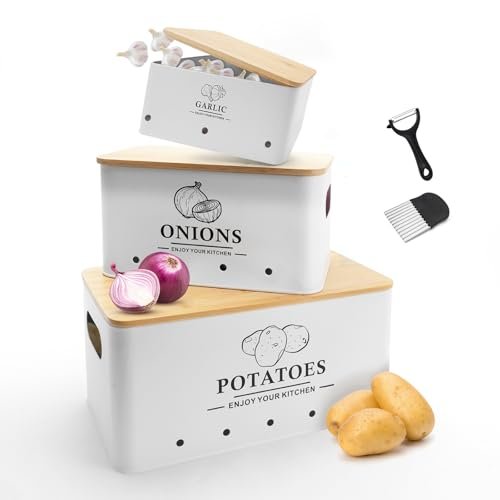
Dekosilave 3-Piece Metal Canister Set
 Set of three matching metal canisters ideal for storing onions, garlic, and potatoes on a kitchen counter.
The Dekosilave set is a top pick for small kitchens, with a compact 7.1-inch height and 13-inch length that takes up minimal counter space. The durable metal construction resists denting and scratching, and strategically placed aerating holes keep onions fresh for up to 6 weeks. The white finish and natural wooden lids add a cozy, farmhouse touch to any decor, and the set is large enough to hold 2-3 pounds of onions per canister. The only trade-off is the limited capacity, which may not suit households that buy onions in bulk. For a stylish, space-saving option for small kitchens, you can shop the Dekosilave set on Amazon here.
Set of three matching metal canisters ideal for storing onions, garlic, and potatoes on a kitchen counter.
The Dekosilave set is a top pick for small kitchens, with a compact 7.1-inch height and 13-inch length that takes up minimal counter space. The durable metal construction resists denting and scratching, and strategically placed aerating holes keep onions fresh for up to 6 weeks. The white finish and natural wooden lids add a cozy, farmhouse touch to any decor, and the set is large enough to hold 2-3 pounds of onions per canister. The only trade-off is the limited capacity, which may not suit households that buy onions in bulk. For a stylish, space-saving option for small kitchens, you can shop the Dekosilave set on Amazon here.
Beautiful Potato and Onion Storage Canister Set
 Food-safe metal canisters in a neutral cream finish complement most kitchen decor.
For a more neutral, understated look, this set offers a cream-colored finish that blends seamlessly with white, beige, or wood-toned kitchen decor. Each canister measures 10.1 inches tall, 7.2 inches wide, and 7.5 inches deep, offering slightly more capacity than the Dekosilave set for medium-sized households. The food-safe metal construction is non-toxic and easy to wipe clean, though the light finish may show smudges or water spots over time. This set is a great pick for anyone prioritizing a cohesive, stylish kitchen aesthetic. You can shop this set on Amazon here.
Food-safe metal canisters in a neutral cream finish complement most kitchen decor.
For a more neutral, understated look, this set offers a cream-colored finish that blends seamlessly with white, beige, or wood-toned kitchen decor. Each canister measures 10.1 inches tall, 7.2 inches wide, and 7.5 inches deep, offering slightly more capacity than the Dekosilave set for medium-sized households. The food-safe metal construction is non-toxic and easy to wipe clean, though the light finish may show smudges or water spots over time. This set is a great pick for anyone prioritizing a cohesive, stylish kitchen aesthetic. You can shop this set on Amazon here.
WUWEOT 3-Pack Vegetable Storage Tins
 Compact tins are sized perfectly for small batches of onions and garlic.
The WUWEOT set is the most budget-friendly option in the compact metal canister category, with a low price point and small footprint ideal for studio apartments or tiny kitchens. Each tin includes aerating holes and a wooden lid to keep contents secure, and the set is large enough to hold 1-2 pounds of onions per tin. The only downside is the limited capacity, which is better suited for small households or people who buy onions in small quantities. You can shop this set on Amazon here.
Compact tins are sized perfectly for small batches of onions and garlic.
The WUWEOT set is the most budget-friendly option in the compact metal canister category, with a low price point and small footprint ideal for studio apartments or tiny kitchens. Each tin includes aerating holes and a wooden lid to keep contents secure, and the set is large enough to hold 1-2 pounds of onions per tin. The only downside is the limited capacity, which is better suited for small households or people who buy onions in small quantities. You can shop this set on Amazon here.
Best for Pantry Organization: Stackable Wire or Plastic Bins
If you store onions in a pantry or cabinet rather than on the counter, stackable bins are the best way to maximize vertical space and keep produce organized and visible. These bins come in wire, clear plastic, and solid plastic options, and most are designed to stack securely to avoid tipping. Clear bins make it easy to see how much produce you have left at a glance, while wire bins provide maximum airflow for longer storage. For more tips on maximizing your pantry space, check out our roundup of general kitchen hacks for small kitchens.
Heyuzb 2-Pack Stackable Pantry Organizers
 Stackable clear bins make it easy to identify stored produce at a glance.
The Heyuzb set is a top pick for small pantries, with a stackable design that doubles your storage space without expanding your footprint. The clear plastic construction lets you see exactly how many onions you have left without rummaging through the bin, and the open-front design makes it easy to grab produce quickly. These bins are also lightweight enough to move around your kitchen as needed, making them ideal for renters or anyone who rearranges their storage frequently. The only trade-offs are the limited capacity and the fact that the plastic may show smudges or fingerprints over time. You can shop this set on Amazon here.
Stackable clear bins make it easy to identify stored produce at a glance.
The Heyuzb set is a top pick for small pantries, with a stackable design that doubles your storage space without expanding your footprint. The clear plastic construction lets you see exactly how many onions you have left without rummaging through the bin, and the open-front design makes it easy to grab produce quickly. These bins are also lightweight enough to move around your kitchen as needed, making them ideal for renters or anyone who rearranges their storage frequently. The only trade-offs are the limited capacity and the fact that the plastic may show smudges or fingerprints over time. You can shop this set on Amazon here.
Vtopmart 2-Pack Foldable Storage Bins
 Foldable bins can be collapsed and stored flat when not in use.
For anyone who needs flexible, temporary storage, the Vtopmart bins are a game-changer. Unlike rigid bins, these can be collapsed flat when not in use, making them perfect for small apartments, RVs, or anyone who needs extra storage only when buying produce in bulk. The clear plastic construction and stackable design work the same as standard pantry bins, and the durable build holds up to regular use. The only downside is that the limited size may not fit large quantities of produce. You can shop this set on Amazon here.
Foldable bins can be collapsed and stored flat when not in use.
For anyone who needs flexible, temporary storage, the Vtopmart bins are a game-changer. Unlike rigid bins, these can be collapsed flat when not in use, making them perfect for small apartments, RVs, or anyone who needs extra storage only when buying produce in bulk. The clear plastic construction and stackable design work the same as standard pantry bins, and the durable build holds up to regular use. The only downside is that the limited size may not fit large quantities of produce. You can shop this set on Amazon here.
Spacemart 2-Pack Stackable Countertop Organizers
 Compact stackable bins fit easily on crowded countertops or in pantry shelves.
The Spacemart set is a budget-friendly option for small kitchens, with a compact size that fits easily on countertops next to your stove or in a pantry shelf. The clear design lets you see contents at a glance, and the stackable build saves space without sacrificing accessibility. These bins are versatile enough to store onions, potatoes, garlic, and even fruit or snack items, making them a multi-purpose addition to any kitchen. The only trade-off is the smaller capacity, which may not suit large households. You can shop this set on Amazon here.
Compact stackable bins fit easily on crowded countertops or in pantry shelves.
The Spacemart set is a budget-friendly option for small kitchens, with a compact size that fits easily on countertops next to your stove or in a pantry shelf. The clear design lets you see contents at a glance, and the stackable build saves space without sacrificing accessibility. These bins are versatile enough to store onions, potatoes, garlic, and even fruit or snack items, making them a multi-purpose addition to any kitchen. The only trade-off is the smaller capacity, which may not suit large households. You can shop this set on Amazon here.
GGIU Stackable Wire Baskets
 Durable wire construction supports heavy produce like potatoes and onions.
For maximum airflow and durability, the GGIU wire baskets are a top pick. The heavy-duty wire construction can hold up to 10 pounds of produce per basket without bending, and the open design provides unlimited airflow to keep onions fresh for weeks. The sleek black finish complements any kitchen decor, and the stackable design saves space in pantries or on countertops. The only downside is that small items like garlic cloves can fall through the wire gaps, so these are best suited for larger produce like onions and potatoes. You can shop this set on Amazon here.
Durable wire construction supports heavy produce like potatoes and onions.
For maximum airflow and durability, the GGIU wire baskets are a top pick. The heavy-duty wire construction can hold up to 10 pounds of produce per basket without bending, and the open design provides unlimited airflow to keep onions fresh for weeks. The sleek black finish complements any kitchen decor, and the stackable design saves space in pantries or on countertops. The only downside is that small items like garlic cloves can fall through the wire gaps, so these are best suited for larger produce like onions and potatoes. You can shop this set on Amazon here.
Best for Large Households: Multi-Tier Storage Solutions
If you cook for a family of four or more, or buy produce in bulk to save money, single-tier bins may not have enough capacity. Multi-tier storage solutions use vertical space to hold more produce in the same footprint, with separate compartments to keep different onion varieties or produce types separated to avoid cross-contamination. If you regularly cook for a crowd, small-space cooking tips can help you use up bulk produce quickly and reduce waste.
ANTOPY 3-Tier Fruit and Vegetable Basket
 Three tiers of mesh storage provide ample airflow for fresh produce.
The ANTOPY 3-tier basket is the best pick for large households or anyone who buys produce in bulk. The three-tiered metal mesh design holds up to 15 pounds of produce total, with separate compartments for onions, potatoes, fruit, and other staples. The mesh construction provides maximum airflow to keep all stored produce fresh, and the included banana hangers prevent bruising for ripe bananas. The sleek black finish blends with any kitchen decor, and the compact 18-inch height fits easily on most countertops. The only trade-offs are that it requires assembly upon arrival, and the open design is not ideal for storing small items like garlic cloves or spices. You can shop this basket on Amazon here.
Three tiers of mesh storage provide ample airflow for fresh produce.
The ANTOPY 3-tier basket is the best pick for large households or anyone who buys produce in bulk. The three-tiered metal mesh design holds up to 15 pounds of produce total, with separate compartments for onions, potatoes, fruit, and other staples. The mesh construction provides maximum airflow to keep all stored produce fresh, and the included banana hangers prevent bruising for ripe bananas. The sleek black finish blends with any kitchen decor, and the compact 18-inch height fits easily on most countertops. The only trade-offs are that it requires assembly upon arrival, and the open design is not ideal for storing small items like garlic cloves or spices. You can shop this basket on Amazon here.
Best for Sustainable Kitchens: Bamboo and Natural Material Bins
If you prioritize eco-friendly, renewable materials in your kitchen, bamboo storage bins are a great alternative to plastic or metal. Bamboo is a fast-growing, sustainable resource that is naturally moisture-resistant and durable, and its warm, natural aesthetic complements farmhouse, bohemian, and eco-friendly kitchen decor. Most bamboo bins feature open-front designs and stackable builds for easy access and space savings. For more tips on extending the life of your fresh produce, check out our guide to keeping produce fresh for simple, chemical-free tricks.
Noamus 2-Tier Bamboo Stackable Storage Bins
 Eco-friendly bamboo bins add a warm, natural touch to pantry storage.
The Noamus 2-tier bins are the top pick for sustainable kitchen storage, made from 100% renewable bamboo with a food-safe, water-resistant finish. The two-tiered design features four separate compartments to keep onions, potatoes, garlic, and other produce separated, and the open-front design makes it easy to grab items without moving the entire bin. The stackable build saves vertical space, and the built-in handles make it easy to move the bins around your kitchen as needed. The only trade-offs are the limited capacity, which may not suit large households, and the need for regular maintenance: wipe the bins dry after cleaning to prevent warping or mold growth. You can shop this set on Amazon here.
Eco-friendly bamboo bins add a warm, natural touch to pantry storage.
The Noamus 2-tier bins are the top pick for sustainable kitchen storage, made from 100% renewable bamboo with a food-safe, water-resistant finish. The two-tiered design features four separate compartments to keep onions, potatoes, garlic, and other produce separated, and the open-front design makes it easy to grab items without moving the entire bin. The stackable build saves vertical space, and the built-in handles make it easy to move the bins around your kitchen as needed. The only trade-offs are the limited capacity, which may not suit large households, and the need for regular maintenance: wipe the bins dry after cleaning to prevent warping or mold growth. You can shop this set on Amazon here.
Budget-Friendly DIY Onion Storage Hacks
You don’t need to spend money on specialized containers to store onions properly. With a few simple tools, you can create effective, stylish onion storage for $0-$5:
- Repurpose a mesh produce bag: The mesh bags onions come in from the grocery store are already ventilated, perfect for storing onions in a pantry or closet. Just tie the top to keep pests out, and hang the bag from a hook for easy access.
- Drill aerating holes in a wooden crate: If you have an old wooden crate or box, drill 1/8-inch holes in the sides and lid to create airflow, then place it on a pantry shelf for a rustic, farmhouse-style storage solution.
- Use a hanging onion bag: Cotton or canvas hanging onion bags cost $2-$5 online or at home goods stores, and can hold 5-10 pounds of onions. Hang the bag from a hook on the inside of your pantry door to save counter and shelf space.
- Upcycle a metal tin: If you have an old, clean metal cookie tin or tea tin, drill small holes in the lid to create a ventilated storage container for small batches of onions and garlic.
Frequently Asked Questions
How long do onions last in storage containers?
Properly stored in a ventilated container in a cool, dark, dry spot, yellow storage onions last 1-2 months, sweet onions like Vidalia last 2-3 weeks, and red onions last 1-2 months. Cut or peeled onions should be stored in an airtight container in the refrigerator and used within 10 days.
Can onions and garlic be stored together?
Yes, onions and garlic are both alliums with nearly identical storage needs, so they can be stored together in the same ventilated container without spoiling each other. In fact, many multi-compartment storage bins are designed to hold both staples side by side.
Do I need to refrigerate whole onions?
No, whole, unpeeled onions do not need to be refrigerated, and cold temperatures can actually cause their texture to become mealy. Only refrigerate cut or peeled onions, stored in an airtight container to avoid absorbing odors from other fridge items.
What size container do I need for a family of four?
For a family of four that cooks regularly, a 2-3 quart container per onion variety is sufficient. Stackable bins let you easily scale up if you buy onions in bulk, without taking up extra counter or pantry space.
Are plastic storage containers safe for onions?
Yes, as long as they have built-in aerating holes or are not fully sealed. Avoid containers made of BPA-containing plastic; opt for food-safe PP or PET plastic for long-term use, and wash containers regularly to prevent mold buildup.
Conclusion
Finding the right onion storage solution doesn’t have to mean sacrificing style for function. By following the core rules of onion storage—prioritizing airflow, keeping onions away from potatoes, and storing them in a cool, dark spot—you can extend the life of your produce by weeks and cut down on unnecessary food waste. Whether you have a tiny studio kitchen with limited counter space or a large family that buys produce in bulk, there is a container option that fits your needs, budget, and decor style.
Compact metal canisters are perfect for small countertops and add a stylish touch to any kitchen, while stackable wire and plastic bins maximize vertical space in pantries and cabinets. For eco-conscious cooks, bamboo bins offer a sustainable, durable alternative, and DIY hacks make proper storage accessible for even the tightest budgets. A small investment in the right storage containers will not only keep your onions fresh longer, but also streamline your kitchen routine and make meal prep faster and more enjoyable.
Ready to upgrade your kitchen storage? Browse our full range of kitchen organization tools to find the perfect fit for your space.

Hi, I’m Daniel Brooks—a food lover and kitchen gear enthusiast. I enjoy testing cookware, utensils, and gadgets to see what really works in everyday cooking. At PlugChef.com, I share honest reviews, comparisons, and simple guides to help you choose the best tools for a safer, smarter, and more enjoyable kitchen.
Related posts:
 Wall Shelf for Kitchen Appliances: Organize and Maximize Space Effortlessly
 Best Smart Microwave Oven With Alexa: Top Picks for Modern Kitchens
 Best Conical Burr Coffee Grinder: Top Picks for Perfect Brews
 Retro Style Small Kitchen Appliances: Elevate Your Culinary Space Effortlessly
 Non Stainless Steel Kitchen Appliances for Modern Cooking Adventures
 Best Coffee Makers With Pods: Discover Top Picks for Convenient Brewing