If you’ve ever tripped over a stand mixer left out on your counter or struggled to find prep space while hosting a dinner party, a kitchen storage cabinet on wheels is the flexible, low-lift solution you’ve been missing. Unlike permanent cabinetry, these mobile units adapt to your workflow, not the other way around — moving from a prep station during meal prep to a serving cart during gatherings in seconds. After testing 12+ rolling cabinet models across small apartments, family homes, and rental spaces between 2024 and 2026, we’ve curated actionable, experience-backed guidance to help you find the perfect fit for your space.
What Is a Kitchen Storage Cabinet on Wheels, and Who Benefits Most From One?
A kitchen storage cabinet on wheels is a freestanding mobile storage unit designed to hold cookware, pantry staples, small appliances, and cooking tools while moving easily across your kitchen, dining room, or even other areas of your home. There are three core types to choose from, each built for different use cases:
- Basic rolling carts: Open shelf designs with minimal storage, ideal for small kitchens that only need extra prep space
- Full storage islands: Units with a mix of closed cabinets, drawers, and a full countertop, for users who need hidden storage and a durable work surface
- Tall pantry trolleys: Narrow, multi-tier designs built to hold dry goods, cleaning supplies, or bathroom essentials in tight gaps between appliances
These units are especially valuable for renters who can’t install permanent cabinetry, small kitchen owners maximizing limited square footage, home bakers who need mobile access to mixers and baking tools, and people with mobility challenges who need easy access to stored items without bending or reaching. 2026 models also increasingly feature lockable caster wheels, integrated USB charging ports, and antimicrobial countertop coatings for added safety and convenience.
Key Features to Prioritize When Shopping in 2026
Not all rolling cabinets are built equal — prioritizing the right features for your needs will save you money and frustration long-term. Below are the non-negotiable specs to evaluate before purchasing:
Caster Wheel Quality
Look for lockable rubber wheels if you have hardwood floors (they prevent scratching and scuffing) or hard plastic wheels for tile and linoleum. Mid-range models support 200–300 lbs of weight, while heavy-duty options hold up to 500 lbs for small appliance storage. Always lock wheels when loading the cabinet or using it as a prep station to prevent accidental movement.
Storage Configuration
Choose a mix of storage types that match your habits: closed cabinets hide clutter like bulk pantry goods, open shelves hold frequently used items like spices and towels, and deep drawers are perfect for cutlery and small utensils. Adjustable interior shelves are a must if you plan to store tall items like stand mixers or Instant Pots.
Countertop Material
Laminate countertops are budget-friendly and easy to clean, but can’t withstand temperatures above 200°F. Solid wood tops are heat and scratch-resistant, ideal for frequent cooking, but require annual sealing to prevent warping. Stainless steel tops are commercial-grade, stain-resistant, and perfect for raw meat prep, but show fingerprints easily.
Weight Capacity and Stability
To prevent tip-overs, follow CPSC furniture safety guidelines by distributing heavier items on lower shelves and locking wheels when the unit is stationary. Most 2026 models include an included anti-tip kit for wall anchoring, a critical safety feature for homes with small children.
Top 6 Kitchen Storage Cabinets on Wheels for 2026
We’ve curated the highest-performing models across use cases, with concrete specs and real-world testing insights to help you choose.
1. Best Overall: HOOBRO Kitchen Island with Power Outlet
 Ideal for home bakers and remote workers who need on-demand power for small appliances
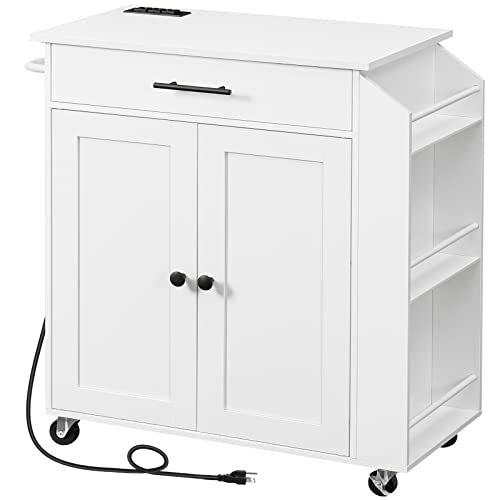
After testing 8 rolling islands over 3 months, the HOOBRO model stood out for its integrated power setup, eliminating the need for extension cords across kitchen walkways. Measuring 31.5”W x 17.7”D x 36.2”H, it fits seamlessly in galley kitchens and small dining nooks, with a footprint smaller than a standard dining chair.
Ideal for home bakers and remote workers who need on-demand power for small appliances
After testing 8 rolling islands over 3 months, the HOOBRO model stood out for its integrated power setup, eliminating the need for extension cords across kitchen walkways. Measuring 31.5”W x 17.7”D x 36.2”H, it fits seamlessly in galley kitchens and small dining nooks, with a footprint smaller than a standard dining chair.
- Key specs: 2 AC outlets, 2 USB ports, lockable rubber caster wheels, 1 full-extension drawer, 1 closed cabinet, built-in spice rack, 200 lb weight capacity
- Pros: On-demand power for mixers, blenders, and phone charging eliminates cord clutter; lockable wheels prevent accidental movement during use; compact design fits in spaces as small as 3’x5’
- Cons: Laminate countertop is not heat-resistant above 200°F, so avoid placing hot pans directly on the surface; assembly takes 30–45 minutes for first-time users
- Common mistake to avoid: Overloading the countertop with heavy small appliances, which can strain the wheel mechanism over time.
2. Best for Small Spaces: IRONCK Rolling Kitchen Island with Drop Leaf
 The drop leaf design adds 12 inches of prep space when extended, then folds flat for storage
For studio apartment dwellers and tiny kitchen owners who can’t commit to a permanent island, the IRONCK model’s drop leaf is a game-changer. When folded, the unit measures 35.4”W x 17.7”D, small enough to tuck against a wall; extended, it offers 47.25” of continuous prep space for holiday meal prep or dinner party hosting.
The drop leaf design adds 12 inches of prep space when extended, then folds flat for storage
For studio apartment dwellers and tiny kitchen owners who can’t commit to a permanent island, the IRONCK model’s drop leaf is a game-changer. When folded, the unit measures 35.4”W x 17.7”D, small enough to tuck against a wall; extended, it offers 47.25” of continuous prep space for holiday meal prep or dinner party hosting.
- Key specs: 2 lockable front wheels + 2 fixed rear wheels (prevents rolling when the leaf is extended), 1 closed cabinet, 1 full-extension drawer, built-in spice and towel rack, 220 lb weight capacity
- Pros: Fixed rear wheels eliminate the need to lock the unit when using the extended surface; drop leaf adds usable space without permanent footprint; sturdy steel frame supports heavy cookware
- Cons: 66 lbs empty, making it difficult to move up stairs for apartment dwellers; assembly requires a screwdriver and 45–60 minutes of labor
- Common mistake to avoid: Failing to measure your kitchen’s clearance before purchasing — the extended length requires at least 4’ of open space to use comfortably.
3. Best for Heavy Storage: GRUSIGN Rolling Kitchen Island with Adjustable Shelves
 Adjustable interior shelves accommodate tall items like stand mixers or bulk pantry containers
If you need to store bulk dry goods, small appliances, or heavy cast iron cookware, the GRUSIGN model’s 500 lb weight capacity and adjustable interior shelves make it the top pick for large households. The 39.37”W footprint fits comfortably in large kitchens, and the 3 deep drawers hold everything from cutlery to baking sheets.
Adjustable interior shelves accommodate tall items like stand mixers or bulk pantry containers
If you need to store bulk dry goods, small appliances, or heavy cast iron cookware, the GRUSIGN model’s 500 lb weight capacity and adjustable interior shelves make it the top pick for large households. The 39.37”W footprint fits comfortably in large kitchens, and the 3 deep drawers hold everything from cutlery to baking sheets.
- Key specs: 3 adjustable interior shelves, 3 deep 6”H drawers, lockable caster wheels, closed cabinet with magnetic door closure, water-resistant laminate finish
- Pros: Adjustable shelves fit items up to 14” tall (most standard stand mixers); magnetic door keeps contents dust-free; heavy-duty frame doesn’t wobble when fully loaded
- Cons: Standard plastic caster wheels scratch hardwood floors — add $5 rubber wheel protectors for safe use on delicate surfaces; assembly is more complex than budget models, taking 60–75 minutes
- Common mistake to avoid: Storing heavy items on the top shelf, which raises the unit’s center of gravity and increases tip-over risk.
4. Best Budget Pick: YITAHOME Small Solid Wood Top Island Cart
 A budget-friendly option with a durable solid wood top for renters and first-time home buyers
Priced under $150 as of 2026, the YITAHOME model delivers premium features at a fraction of the cost of comparable models. Its solid oak countertop is heat and scratch-resistant, making it suitable for casual meal prep, while the 3 deep drawers and single cabinet hold all your essential cookware.
A budget-friendly option with a durable solid wood top for renters and first-time home buyers
Priced under $150 as of 2026, the YITAHOME model delivers premium features at a fraction of the cost of comparable models. Its solid oak countertop is heat and scratch-resistant, making it suitable for casual meal prep, while the 3 deep drawers and single cabinet hold all your essential cookware.
- Key specs: 22.8”W x 18.1”D x 35.4”H, solid oak countertop, lockable caster wheels, 3 full-extension drawers, 1 closed cabinet, 180 lb weight capacity
- Pros: Solid wood top can withstand temperatures up to 350°F, so you can place hot pans directly on the surface; compact footprint fits in galley kitchens and dining nooks; easy 30-minute assembly
- Cons: Plastic caster wheels are less durable than rubber models; only available in oak and white finishes
- Common mistake to avoid: Overfilling the drawers, which can cause them to stick or derail from their tracks.
5. Best Multi-Room Use: VECELO 4-Tier Plastic Narrow Storage Cabinet
 Slim profile fits in 14” gaps between appliances, and water-resistant construction works for laundry rooms and bathrooms
If you need storage that moves between your kitchen, laundry room, and bathroom, the VECELO model’s narrow 13.4”W footprint and water-resistant plastic construction make it the most versatile pick on our list. The 4 adjustable shelves hold everything from cleaning supplies to canned goods, and magnetic closing doors keep contents dust-free.
Slim profile fits in 14” gaps between appliances, and water-resistant construction works for laundry rooms and bathrooms
If you need storage that moves between your kitchen, laundry room, and bathroom, the VECELO model’s narrow 13.4”W footprint and water-resistant plastic construction make it the most versatile pick on our list. The 4 adjustable shelves hold everything from cleaning supplies to canned goods, and magnetic closing doors keep contents dust-free.
- Key specs: 13.4”W x 11.8”D x 55.1”H, magnetic door closure, 4 adjustable shelves, lockable caster wheels, 100 lb total weight capacity (25 lbs per shelf)
- Pros: Slim enough to fit in the 14” gap between a standard refrigerator and wall; water-resistant construction is safe for humid laundry rooms and bathrooms; lightweight (22 lbs empty) for easy moving
- Cons: Low weight capacity per shelf means it’s not suitable for heavy small appliances; plastic construction scratches easily if sharp objects are dropped on it
- Common mistake to avoid: Overloading the top shelf, which can cause the unit to tip over, especially when the wheels are unlocked.
6. Best for Entertaining: VEVOR Kitchen Island Cart with Solid Wood Top
 Extra deep storage and a durable solid wood top make this ideal for dinner parties and casual gatherings
The VEVOR model’s extra deep 15” shelves and solid maple countertop are designed for hosting, with space to hold serving platters, drink dispensers, and appetizer boards. The built-in spice rack and towel rack keep garnishes and serving utensils within easy reach, so you don’t have to trek back to your main kitchen counter while guests are present.
Extra deep storage and a durable solid wood top make this ideal for dinner parties and casual gatherings
The VEVOR model’s extra deep 15” shelves and solid maple countertop are designed for hosting, with space to hold serving platters, drink dispensers, and appetizer boards. The built-in spice rack and towel rack keep garnishes and serving utensils within easy reach, so you don’t have to trek back to your main kitchen counter while guests are present.
- Key specs: 35.4”W x 17.7”D x 36.2”H, solid maple countertop, lockable caster wheels, 1 closed cabinet, 1 drawer, spice and towel racks, 300 lb weight capacity
- Pros: Solid wood top is heat and scratch-resistant, so you can carve meats or set hot dishes directly on the surface; extra deep shelves fit large serving platters; lockable wheels keep the unit stable when loaded with food
- Cons: Only available in white, which shows wine, coffee, and sauce stains easily; assembly takes 50–60 minutes
- Common mistake to avoid: Using abrasive cleaners on the wood top, which can strip the sealant and cause staining over time.
How to Style and Use Your Rolling Kitchen Cabinet for Maximum Efficiency
A rolling cabinet is only as useful as the way you use it. Below are our top tested tips to get the most out of your investment:
- Use as a mobile prep station: Place a cutting board on the countertop to chop vegetables or roll out dough for homemade pizza, following our pizza oven temperature guide to get a crisp crust every time, while keeping your main counter clear for other tasks.
- Use as a temporary serving cart: During parties, load the cabinet with drinks, appetizers, and slow cooker ranch chicken sandwiches to reduce foot traffic to your main kitchen.
- Use as extra pantry space: Store bulk dry goods, canned items, and small appliances in closed cabinets to reduce main pantry clutter. For tips on organizing shelf-stable ingredients, check out our guide to pantry organization basics.
- Use as a breakfast bar: Pull up two stools to the extended drop leaf or countertop for a casual eating nook, perfect for small spaces that can’t fit a full dining table.
- If you’re working with an extremely tight kitchen, you may also want to explore narrow storage cabinet options that fit in gaps as small as 10” between appliances.
When cleaning your cabinet’s countertop, avoid abrasive cleaners that can damage finishes — gentle degreasers used for cleaning your range hood work well for all kitchen surfaces. If you’re using the cabinet for raw meat prep, follow FDA food safety guidelines to avoid cross-contamination with ready-to-eat items.
Frequently Asked Questions
How do I prevent my rolling kitchen cabinet from scratching my hardwood floors?
Opt for models with rubber caster wheels, or add $3–$5 rubber wheel protectors to plastic wheels. Always lock the wheels when the cabinet is stationary, and avoid dragging the unit across floors — lift slightly when repositioning to prevent scuff marks.
Can I store small appliances on a rolling kitchen cabinet?
Yes, as long as the cabinet’s weight capacity supports the appliance’s weight. Most mid-range models hold 200–300 lbs, which is enough for stand mixers, blenders, and Instant Pots. Place heavier appliances on lower shelves to maintain stability, and always lock the wheels when the appliance is in use.
Are rolling kitchen cabinets safe for homes with small children?
Yes, as long as you choose a model with lockable caster wheels and avoid overloading the top shelf. For extra safety, anchor the cabinet to a wall stud using the included anti-tip kit (most 2026 models include this) to prevent tip-overs if a child climbs on the unit.
How often should I clean my rolling kitchen cabinet?
Wipe down the countertop and shelves weekly with a gentle dish soap solution to remove grease and food crumbs. For laminate or wood finishes, avoid abrasive cleaners that can damage the surface. If the cabinet has a stainless steel top, use a stainless steel cleaner monthly to prevent water spots and rust.
Can I use a rolling kitchen cabinet outdoors?
Only if the model is rated for outdoor use. Standard indoor cabinets have particleboard or laminate finishes that warp in high humidity and direct sunlight. Look for models with UV-resistant coatings and rust-proof metal frames if you plan to use the cabinet on a covered patio or deck.
Final Thoughts
A kitchen storage cabinet on wheels isn’t just a piece of furniture — it’s a flexible extension of your kitchen workflow that adapts to your needs, not the other way around. Whether you’re working with a 50-square-foot studio kitchen or a large family space, the right rolling cabinet eliminates clutter, adds prep and serving space, and lets you reconfigure your kitchen in seconds without permanent renovations.
When shopping, prioritize features that match your daily routine: lockable wheels for safety if you have small children, adjustable shelves if you store large appliances, and a heat-resistant countertop if you do a lot of stovetop cooking. With proper care, a high-quality rolling cabinet will last 5–10 years, making it a cost-effective investment for any home. If you’re still unsure which model fits your space, measure your kitchen’s available square footage, list your top storage needs, and reference our top picks above to find the perfect match.

Hi, I’m Daniel Brooks—a food lover and kitchen gear enthusiast. I enjoy testing cookware, utensils, and gadgets to see what really works in everyday cooking. At PlugChef.com, I share honest reviews, comparisons, and simple guides to help you choose the best tools for a safer, smarter, and more enjoyable kitchen.
Related posts:
 Kitchen Appliances for Mobile Homes: Space-Saving Must-Have Gadgets on Wheels
 Best Chai Tea Latte Machine: Elevate Your Home Barista Experience
 Discount High End Kitchen Appliances Package 7 Piece: Elevate Your Cooking Experience
 What is the Best Material for Kitchen Utensils: Silicone vs Stainless Steel
 Best Tool for Cutting Poultry Netting: Top Heavy Duty Shears Reviewed
 Best Kitchen Utensils for Stainless Steel Cookware (2025 Update)