
Reheating a glazed ham so it stays moist, flavorful, and glossy is simple once you understand the meat, the temperatures to target, and the finishing steps that rebuild that fresh-baked shine. This guide gives step-by-step instructions for whole, spiral-cut, and sliced hams; clear target temperatures; practical timing tables; glaze recipes and finishing techniques; troubleshooting for common problems; and quick checklists you can use at the table. Read straight through for the full method, or jump to the section you need.
Why this matters: reheating improperly dries or toughens ham and wastes an expensive centerpiece. In practice, the difference between rubbery and succulent ham usually comes down to temperature control, moisture retention, and a short high-heat finish.
Note on safety: for official food-safety guidance consult the USDA guidance and the FDA safe food handling advice. They recommend reheating leftovers to safe internal temperatures and following proper storage timelines.
Quick decision guide: which method to use
- Oven — Best overall for whole and spiral-cut hams: even heat, easy glaze finishing.
- Microwave — Fast for 1–6 slices, use only for small portions.
- Slow cooker — Best for keeping portions moist during buffet service; no browning.
- Sous-vide — Most precise moisture retention, ideal when texture is a priority.
- Skillet or stovetop — Fast for single slices when you want a quick sear and glaze.
- Broiler — Use only as a final finishing step (2–5 minutes) to caramelize glaze.
Pick the oven for the best balance of texture and appearance. Use microwave or skillet for convenience and sous-vide when you need the best possible texture.
Know your ham: types and how they change technique
- Fully cooked, store-bought (commercially cured) ham: safe to eat cold; reheat to 140°F when you want it hot without drying.
- Leftover cooked ham (refrigerated): reheat to 165°F for safety when serving leftovers.
- Spiral-cut ham: thin slices near the surface heat quickly and dry easily; reheat gently and cover.
- Bone-in vs. boneless: bone-in takes longer to heat and often stays moister; boneless heats faster and needs more moisture protection.
- Glazed vs. unglazed: glazed hams need careful glazing and a short broil at the end — avoid tenting foil directly on top of the glaze.
Common practice tip: treat spiral-cut hams like delicate slices, not a roast — use lower heat, steam in the pan, and glaze early enough to finish under heat.
Thermometer, temperatures, and food safety
- Thermometer types: instant-read digital thermometer (thermocouple or probe) is best for quick checks. If you use an oven probe, avoid touching bone.
- Target temperatures:
- Reheating ready-to-serve, commercially cooked ham to serve hot: aim for 140°F (60°C) for best texture.
- Reheating refrigerated leftovers for safety: 165°F (74°C).
- Insert the thermometer into the thickest part of the ham, avoiding bone. Check several spots for large hams.
- Why two temperatures? Commercially cooked hams are precooked and safe at eating cold; 140°F warms without overcooking. Leftovers that have been cooled and stored can harbor bacteria, so USDA/FDA recommend reheating to 165°F.
Practical safety tip: if you’re serving a buffet, keep hot ham at 140°F or hotter and discard any portion that has been between 40–140°F for over 2 hours.
Oven method — best for whole & spiral hams (step-by-step)
Why the oven: even gentle heat, easy to add moisture, and you can finish glaze neatly.
Step-by-step:
- Preheat oven to 275°F (135°C). Lower temps (250–300°F) reduce drying risk.
- Remove packaging, plastic netting, and any metal clips. Place ham cut-side down (if bone-in) in a shallow roasting pan.
- Add 1/2–1 cup liquid to the pan for every 5–8 lb ham (apple juice, orange juice, low-sodium broth, or a mix). For spiral-cut hams, add 1/4–1/2 cup liquid to the base to create steam.
- Tightly tent the ham with heavy-duty foil, leaving a small air gap so foil doesn’t touch the glaze. Seal edges to trap steam.
- Reheat using timing below (verify with thermometer):
- Whole ham: ~10–12 minutes per pound at 275°F.
- Half ham: ~10–12 minutes per pound.
- Spiral-cut: target the lower end, check early — many spiral hams are warmed through in 8–10 min per pound.
- About 20–30 minutes before serving, remove foil, brush on glaze (see glaze recipes), and return to oven uncovered. For a caramelized finish, finish 2–5 minutes under a hot broiler—watch closely to prevent burning.
- Rest 10–15 minutes before carving to let juices redistribute.
In practice: for a 10 lb whole ham, plan roughly 1 hour 40 minutes to 2 hours of gentle heating, then 10–15 minutes glaze finish. Always use the thermometer rather than clock-only estimates.
Microwave method — fast for slices (how to avoid drying)
Best use: reheating 1–6 slices quickly.
How to:
- Place slices single-layer on a microwave-safe plate. Separate slices slightly.
- Cover with a damp paper towel or microwave-safe lid to trap steam.
- Use 50–70% power (medium to medium-high). Heat in short bursts: start with 30–45 seconds for thin slices, 60–90 seconds for thicker slices. Add 15–30 second increments as needed.
- Let rest 30 seconds to allow heat to distribute before checking temperature. Use the instant-read thermometer if safety temp is needed.
Microwave pitfalls: full-power heating makes ham rubbery. Covering and reduced power are the simplest fixes.
Slow cooker (crockpot) — low-and-slow for buffet service
Best use: keeping portions warm and moist for serving.
Method:
- Place ham portions or slices in the slow cooker in a single layer or slightly overlapped.
- Add liquid: 1/4–1/2 cup per pound (apple juice, cola, cider, or broth). For a sweet profile, cola or apple cider works well.
- Heat on LOW for 2–4 hours for portions; larger single pieces can take 3–6 hours. Check internal temperature periodically.
- In the final 20–30 minutes, brush on glaze and switch to HIGH or uncover to let glaze set. If you want a browned top, transfer to a sheet pan and broil briefly.
Trade-off: slow cookers keep meat moist but won’t crisp or caramelize the glaze — finish under broiler for that glossy top.
Sous-vide — the precision option
Why use it: exact water-bath temperature prevents overcooking and keeps ham moist.
How to:
- Vacuum-seal ham slices or portions; use a heavy-duty freezer bag with the water-displacement method if you lack a vacuum sealer.
- Set water bath to 130–140°F (54–60°C). For reheating only: slices need ~30–60 minutes; large portions 1–3 hours until uniformly warm.
- Remove, pat dry, brush glaze, and briefly broil or sear to caramelize.
Practical note: sous-vide gives outstanding texture but requires extra time and equipment.
Stovetop skillet — quick sear for slices
Good when you want a crunchy edge and fast serving:
- Heat a skillet over medium heat, add a pat of butter or a splash of oil.
- Place slices flat, brush with glaze or a bit of liquid, and heat 30–60 seconds per side until warmed and slightly browned.
- Avoid overheating — slices heat quickly.
This method is excellent for small dinner parties and gives a great presentation for plated servings.
Glaze touch-up: recipes and technique
Refreshing the glaze restores flavor and shine. Apply glaze in the final 20–30 minutes of heating so sugars don’t burn.
Sticky brown-sugar glaze (yields ~3/4 cup):
- 1/2 cup firmly packed brown sugar
- 1/4 cup honey or maple syrup
- 2 tbsp orange juice or apple cider
- 1 tbsp Dijon mustard (optional)
- Pinch ground cloves or cinnamon
Whisk until smooth. Brush on ham in thin coats 20–30 minutes before serving; repeat once and finish under broiler 2–5 minutes.
Savory-mustard glaze:
- 1/3 cup brown sugar, 2 tbsp Dijon, 2 tbsp apple cider vinegar, 1 tbsp soy sauce.
Citrus-maple glaze:
- 1/3 cup maple syrup, 2 tbsp orange marmalade, 1 tbsp lemon juice.
Technique tip: multiple thin coats set more evenly than a single thick layer. For spiral hams, brush between a few slices to get flavor between layers.

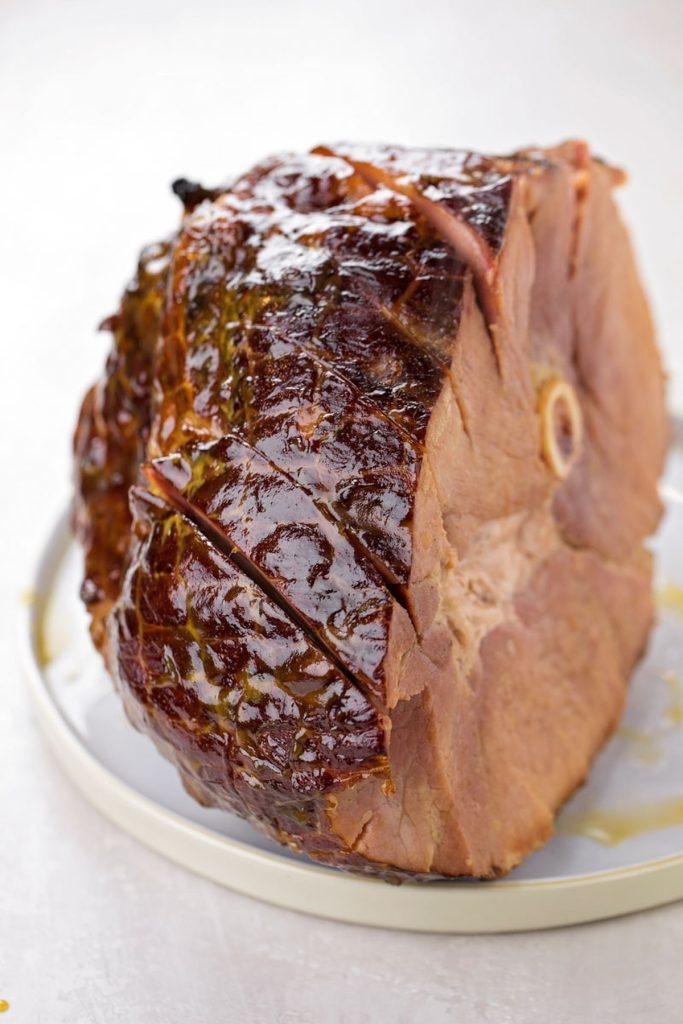
Glaze brushed and caramelized at serving time.
Credit: www.tasteofhome.com
Carving, resting, and serving
- Rest 10–15 minutes after reheating to let juices redistribute.
- For bone-in: slice parallel to the bone for even pieces; for spiral-cut, lift whole slices and serve.
- Carve against the grain where possible for more tender bites.
- Keep finished ham on a warm preheated platter and return to oven/slow-cooker briefly if it starts to cool during service.
Pairing ideas: roasted root vegetables, creamy mashed potatoes, tangy chutneys (apple or cranberry), grain salads, and crisp greens balance the ham’s sweet-salty profile.
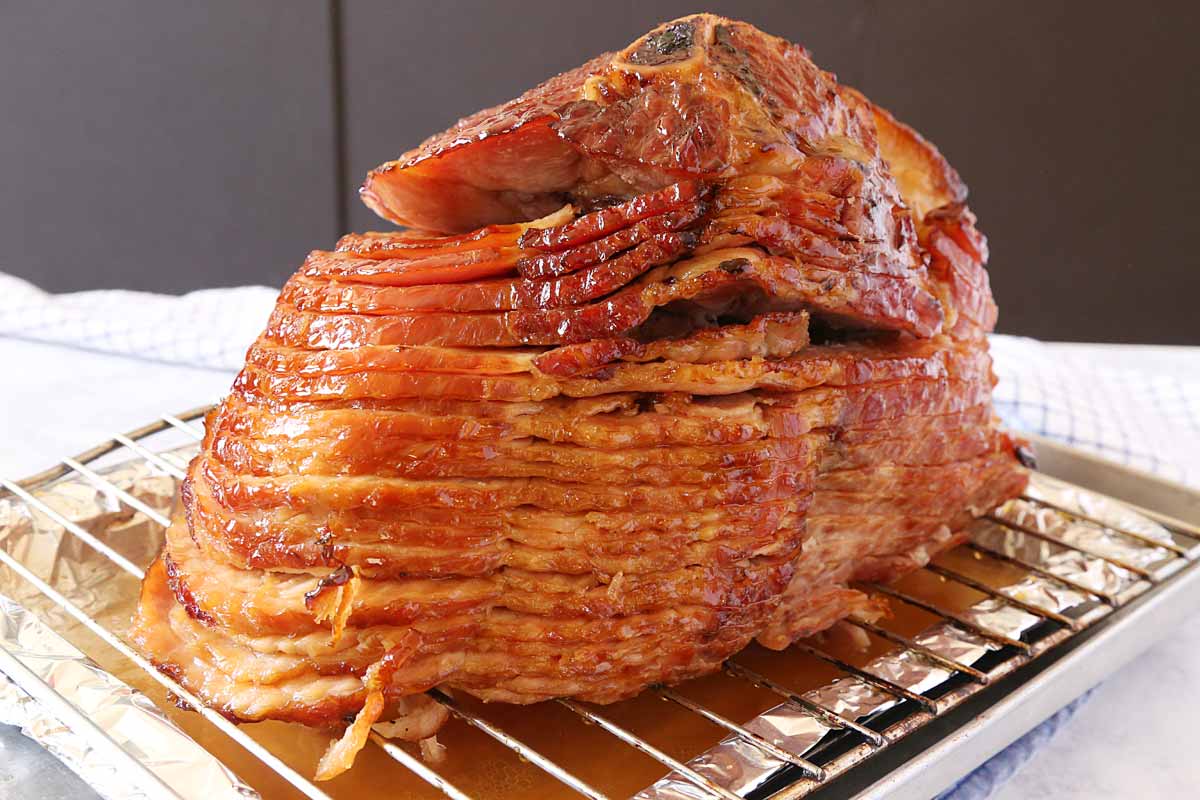
Thin, evenly sliced ham ready for plating.
Credit: www.todaysdelight.com
Troubleshooting: fix common reheating problems
- Dry exterior, moist interior: baste with pan juices, brush a little glaze, and tent with foil while it rests. For future reheats, add more pan liquid and reduce oven temp.
- Gummy or stewed texture: usually overheated or steamed too long. Reduce reheating temperature or time next time; use sous-vide or quick oven method instead.
- Cold spots in spiral ham: remove outer slices and warm individually, or re-cover and allow more gentle heating until center reaches target temp.
- Burned glaze: sugars caramelize quickly — finish under the broiler for only 1–3 minutes and stand by to watch.

Close-up showing glossy brown-sugar Dijon glaze.
Credit: bakeatmidnite.com
Quick reference table: methods, temps, and approximate times
| Method | Temp (oven/water) | Typical timing |
|---|---|---|
| Oven (covered) | 275°F (135°C) | 10–12 min/lb whole; 8–10 min/lb spiral |
| Microwave | Medium power (50–70%) | 30–90 sec per slice (start short) |
| Slow cooker (LOW) | Low steady heat | 2–6 hours depending on portion |
| Sous-vide | 130–140°F (54–60°C) | 30 min slices — 1–3 hours larger portions |
| Skillet | Medium | 30–60 sec per side (slices) |
| Finish (broiler) | High broil | 1–5 minutes to caramelize glaze |
Always verify with an instant-read thermometer: 165°F for refrigerated leftovers, ~140°F for reheating commercially cooked ham to serve hot.
Frequently asked questions
Q: Can I reheat a frozen glazed ham?
A: Thaw fully in the refrigerator first (allow ~24–48 hours depending on size). Reheating from frozen causes uneven warming and risks overcooking the outside before the center is warm.
Q: Is it safe to reheat ham more than once?
A: Not recommended. Reheat only the portion you intend to eat. Multiple reheats increase bacterial risk and degrade texture.
Q: How long will reheated ham keep?
A: Store in airtight containers in the refrigerator and use within 3–4 days. Reheat to 165°F when serving leftovers.
Q: Can I glaze and freeze a ham?
A: Yes — apply a thin glaze, freeze, then thaw in the refrigerator before reheating and add fresh glaze when finishing.
Q: What’s the best thermometer for checking ham?
A: A fast-response instant-read digital thermocouple is ideal. For oven monitoring, an oven-safe probe thermometer can track internal temperature during reheating.
Conclusion
Reheating glazed ham well comes down to low, even heat; trapped moisture; accurate temperature checks; and a short high-heat finish to restore shine. For most home cooks, the oven at 275°F with a shallow pan of liquid and tightly tented foil produces reliably juicy results; finish with a glaze and a brief broil for that caramelized look. Use a thermometer, avoid repeated reheating, and apply thin, layered glazes for best texture.
Print or save this checklist and keep an instant-read thermometer on hand — reheating your next glazed ham will be predictable, juicy, and delicious.
Call to action: Save or print this reheating checklist now so your next ham comes out perfectly juicy and glossy.

I’m Abby Lu, a passionate home cook who loves simplifying everyday meals. At PlugChef.com, I share product reviews and cooking guides to help you find the best tools for your kitchen.
Related posts:
 How to Make a Fruit Basket for a Gift: Easy DIY Guide
 Do You Need a Basket? Essential Guide for Air Fryers
 What Blenders Do Tropical Smoothie Use: Expert Insights
Stainless Steel Vs White Kitchen Appliances: Ultimate Showdown
What Blenders Do Tropical Smoothie Use: Expert Insights
Stainless Steel Vs White Kitchen Appliances: Ultimate Showdown
 Kitchen Appliances for Wedding Registry: Must-Have Essentials
 Top 10 Best Non-Toxic Cooking Utensils – Safe & Durable Choices for Healthy Homes

