
If you’ve ever stood in the tea aisle staring at two nearly identical-looking packages labeled English and Irish Breakfast Tea, you’re not alone. Both are staple black tea blends for morning routines across the UK, Ireland, and beyond, but their differences in flavor, strength, and use case are far more distinct than their similar names suggest. Picking the right one can transform your morning cup from a generic caffeine hit to a tailored experience that matches your taste preferences and breakfast spread. In this guide, we’ll break down every key difference between these two iconic blends, from their 19th-century origins to optimal brewing methods and food pairings, so you can pick the perfect brew for your routine.
If you store your tea bags, loose leaves, and brewing equipment under your kitchen sink, regular under-sink organization will keep your supplies dry, fresh, and easy to grab on busy mornings.
 Side-by-side pour showing the brighter amber English breakfast (left) next to the darker, richer Irish breakfast (right)
Image source: teauniverses.com
Side-by-side pour showing the brighter amber English breakfast (left) next to the darker, richer Irish breakfast (right)
Image source: teauniverses.com
Origins And Cultural History
Both English and Irish Breakfast Teas emerged in the 19th century as the global black tea trade expanded, with each blend shaped by the cultural preferences and trade access of its home country. Their histories are tied to class, colonial trade routes, and daily ritual, making them far more than just generic morning brews.
Roots Of English Breakfast Tea
English Breakfast Tea was formalized as a named blend in the late 1800s, originally combining Chinese black teas before shifting to include teas from British colonial territories. The modern standard blend balances high-grown Ceylon (from Sri Lanka) for bright citrus top notes, Assam (from India) for malty body, and Kenyan tea for a clean, brisk backbone. The blend was designed to be versatile enough to stand up to milk and sugar, which were common additives for both working-class factory workers and upper-class households alike. It quickly became a symbol of British hospitality and daily routine, remaining a global staple to this day.
Irish Breakfast Tea Heritage
Irish Breakfast Tea emerged slightly later, in the late 19th century, as cheap, high-quality Assam tea became widely available to Irish consumers. Irish drinking culture historically favored stronger, bolder brews to cut through the country’s dairy-heavy diet (rich in butter, milk, and cheese), so blenders ramped up the Assam ratio to create a more intense cup. It became a non-negotiable staple of Irish daily life: Ireland has one of the highest per capita tea consumption rates in the world, with the average adult drinking 4+ cups daily, most of which are Irish Breakfast. The blend is tied to Irish social ritual, offered unconditionally to every guest from a quick neighborly visit to a family gathering.
Core Blend Composition
There is no regulated global standard for either blend, so flavor can vary slightly by brand, but the core ratio of base teas is consistent across reputable producers. The table below breaks down the key differences:
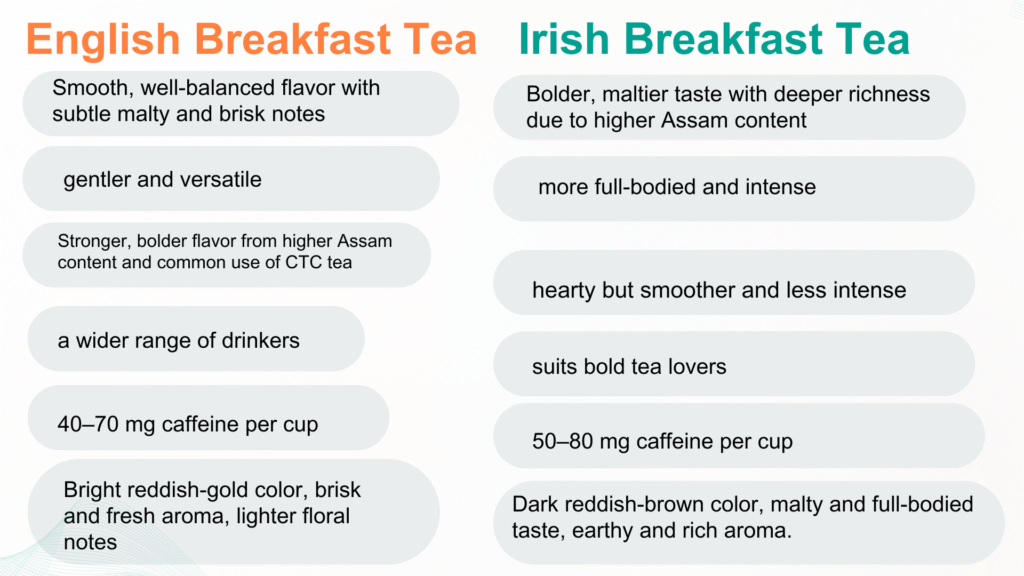
| Component | English Breakfast Tea | Irish Breakfast Tea |
|---|---|---|
| Primary Base Tea | 40–50% Assam, 30–40% Ceylon, 10–20% Kenyan | 70–80% Assam, 10–20% Kenyan, <10% Ceylon (optional) |
| Flavor Goal | Balanced, smooth, versatile, bright | Bold, malty, robust, full-bodied |
| Typical Tannin Content | 2–3% | 3.5–4% |
| Common Additives | Milk, sugar, lemon | Milk, sugar, rarely lemon |
| Best Use Cases | Morning brew, afternoon tea, iced tea | Hearty breakfasts, high-caffeine needs, milk-forward drinks |
According to the UK Tea and Infusions Association’s official blend standards, these ratio guidelines are used by most major commercial and specialty blenders to maintain consistent flavor profiles for each blend type.
Flavor Profile Breakdown
While both are robust black breakfast teas, their distinct base tea ratios create dramatically different tasting experiences, even when brewed identically.
English Breakfast Flavor Notes
English Breakfast has a layered, balanced profile with three distinct notes: a bright, citrusy top note from Ceylon tea, a smooth malty middle from Assam, and a clean, brisk finish from Kenyan tea. Its medium body and lower tannin content mean it rarely tastes harsh or astringent when brewed correctly, with a subtle natural sweetness that doesn’t require added sugar for many drinkers. Brand variations exist: some blends lean into more Kenyan tea for a brisk, iced-tea-friendly profile, while others use more Ceylon for a softer, smoother cup ideal for afternoon service.
Irish Breakfast Flavor Notes
Irish Breakfast is dominated by bold, earthy, malty Assam notes, with almost no citrus brightness from Ceylon. Its higher tannin content gives it a heavier, more full-bodied mouthfeel, with a deep amber color and a characteristic "puckering" astringency if overbrewed. For many drinkers, this intensity is the appeal: the strong flavor cuts through milk and sugar without getting lost, making it a favorite for those who take their tea with generous dairy. Some specialty blends add small amounts of Keemun tea for a subtle smoky depth, but this is less common in mass-market versions.
 Loose-leaf Irish breakfast tea steeping in hot water, releasing its deep, malty color
Image source: mikeomearashow.com
Loose-leaf Irish breakfast tea steeping in hot water, releasing its deep, malty color
Image source: mikeomearashow.com
Caffeine Content And Strength Comparison
A common point of confusion for new tea drinkers is which blend has more caffeine. While exact levels vary based on brew time, leaf amount, and water temperature, general guidelines hold true:
- English Breakfast Tea: 30–50mg of caffeine per 8oz serving, with a moderate, gentle lift that won’t cause jitters for most people.
- Irish Breakfast Tea: 40–70mg of caffeine per 8oz serving, with a more noticeable, sustained energy boost ideal for busy mornings.
Both blends have decaf versions widely available if you want the flavor without the caffeine kick, and you can adjust strength by using more loose leaf or extending steep time by 30–60 seconds.
Brewing Techniques For Optimal Flavor
Brewing method makes or breaks both blends, as their different tannin and flavor profiles respond to slightly different parameters.
Brewing English Breakfast Tea
Use freshly boiled water at 200–212°F (93–100°C) and steep 1 tsp of loose leaf (or 1 standard tea bag) per 8oz of water for 3–4 minutes. Shorter steep times will produce a lighter, brighter cup, while steeping longer than 5 minutes will extract excess tannins and create bitter, astringent flavors. If you add milk, pour it after steeping to avoid scalding the dairy and muting the tea’s bright citrus notes. A common mistake is using water that’s not hot enough, which will fail to extract the full flavor of the black tea leaves. For best results, warm your cup or teapot with hot water before adding tea and steeping water to keep the brew at a consistent temperature longer.
Brewing Irish Breakfast Tea
Use water at a full rolling boil (212°F / 100°C) and steep 1.5 tsp of loose leaf per 8oz of water for 4–5 minutes. Its higher tannin content means it can handle a longer steep without turning bitter, bringing out its full malty, robust flavor. Don’t exceed 6 minutes of steep time, however, as this will create an unpleasantly harsh cup. If you use a metal loose-leaf infuser, keep it rust-free with a quick vinegar and baking soda soak every few weeks to avoid metallic aftertastes in your brew. Like English Breakfast, add milk after steeping to balance its intensity without muting its flavor.
Cultural Significance And Daily Rituals
Tea is far more than a morning caffeine source in both England and Ireland, with each blend tied to distinct social norms and national identity.
English Tea Traditions
English Breakfast is the workhorse of British tea culture, served at breakfast, during work breaks, and as a welcoming offering for guests. It’s the base for the classic "builder’s tea"—a strong, milky cup favored by manual laborers and office workers alike for its reliable energy boost. While afternoon tea (served with scones and finger sandwiches) often uses lighter blends like Earl Grey, English Breakfast is the default for casual daily consumption, tied to values of hospitality and comfort.
Irish Tea Customs
In Ireland, tea is the center of social and family life, with Irish Breakfast the undisputed default blend. It’s served at every meal, during work breaks, and to every visitor, no matter how brief their stop. The ritual of "putting on the kettle" is a universal signal of welcome, and it’s common for Irish households to drink 3–5 cups of Irish Breakfast per day. The blend’s bold flavor is specifically designed to stand up to the generous amount of milk and sugar typical of Irish tea service, and it’s the traditional accompaniment to a full Irish fry (a hearty breakfast of sausages, black and white pudding, eggs, and soda bread).
If you regularly host tea services for friends and family, keeping your kitchen sink in good condition will make cleanup after serving snacks and brews much faster—our sink upkeep tips make maintenance quick and easy.
Food Pairing Recommendations
Both blends pair best with foods that complement their distinct flavor profiles, rather than overpowering them.
Pairings For English Breakfast Tea
English Breakfast’s balanced, bright notes work well with a wide range of breakfast and snack items:
- Buttered scones or English muffins, where the tea’s citrus notes cut through rich butter and jam
- Full English breakfast components: fried eggs, bacon, baked beans, and fried tomatoes
- Mild cheeses like cheddar or brie
- Lightly sweet pastries, shortbread, or lemon drizzle cake
- Savory omelets or quiche
Whip up a batch of homemade baked beans to serve alongside a full English breakfast, and use this simple can-opening hack if you don’t have a can opener on hand.
Pairings For Irish Breakfast Tea
Irish Breakfast’s bold, malty profile stands up to richer, more intense flavors:
- Brown soda bread with salted butter
- Sharp aged cheddar or blue cheese
- Hearty beef stew, lamb stew, or vegetable soup
- Smoked salmon, smoked mackerel, or black pudding
- Dark chocolate (70%+ cacao) or spiced fruit cake
- Potato-based dishes like boxty or colcannon
If you’re slicing cheese or smoked salmon to pair with your Irish Breakfast, always use a properly sanitized wooden cutting board to avoid cross-contamination and preserve the clean flavor of your tea.
Health And Wellness Benefits
Both English and Irish Breakfast Teas are made from fully oxidized black tea leaves, so they share nearly identical core health benefits, with small variations due to their different base tea ratios.
Benefits Of English Breakfast Tea
English Breakfast is rich in theaflavins and catechins, antioxidant compounds that protect cells from oxidative damage. Research from the University of Minnesota Extension confirms that these antioxidants support cardiovascular health by improving blood vessel function and reducing low-density lipoprotein (LDL) cholesterol levels. Its moderate caffeine content boosts alertness and focus without causing jitters for most people, and small amounts of manganese and potassium in the leaves support overall metabolic function. Regular consumption has also been linked to improved digestion and reduced stress levels.
Benefits Of Irish Breakfast Tea
Irish Breakfast’s higher Assam content gives it a slightly higher concentration of antioxidants, with similar cardiovascular and anti-inflammatory benefits to English Breakfast. Its higher caffeine content (40–70mg per 8oz serving) provides a more noticeable boost to mental clarity and stamina, making it a popular choice for busy mornings. The bold, malty flavor also stimulates digestion, making it a traditional post-meal digestif in Irish culture. As with all black teas, its benefits are maximized when consumed without excessive added sugar or cream.
How To Choose Between The Two
There is no universally "better" blend—your choice comes down to taste preferences, caffeine needs, and what you’re pairing your tea with:
- Pick English Breakfast if you prefer a smooth, balanced, bright brew with subtle citrus notes, want a moderate caffeine lift, plan to drink your tea plain or with a splash of milk, or want a versatile blend that works for iced tea, afternoon tea, or pairing with light snacks.
- Pick Irish Breakfast if you love bold, malty, robust flavors, need a stronger caffeine boost to start your day, take your tea with generous amounts of milk and sugar, or are serving it alongside a hearty full breakfast or savory meal.
If you’re still unsure, grab a bag of each and run a side-by-side taste test: brew both with the same water temperature, steep time, and amount of milk to isolate the flavor differences.
Frequently Asked Questions
What Is The Main Difference Between English And Irish Breakfast Tea?
The core difference lies in their base tea composition. English Breakfast is a balanced blend of Assam, Ceylon, and Kenyan black teas, with a bright, smooth, medium-bodied profile. Irish Breakfast is dominated by Assam (70%+ of the blend), giving it a bolder, maltier, more robust flavor that stands up well to milk and sugar. There is no regulated standard for either blend, so flavor can vary slightly by brand, but the Assam ratio is the consistent defining factor.
Which Tea Is Stronger: English Or Irish Breakfast Tea?
Irish Breakfast is consistently stronger in both flavor and caffeine content. Its high Assam base gives it a deeper, more malty taste and 40–70mg of caffeine per 8oz serving, compared to English Breakfast’s 30–50mg per 8oz serving. That said, "strength" can be adjusted via brew time and leaf amount, so you can make a milder Irish cup or a stronger English cup to match your preference.
How Do Brewing Methods Differ For English Vs Irish Tea?
Both use boiling (212°F / 100°C) water, but steep times vary slightly to match their flavor profiles. English Breakfast steeps best for 3–4 minutes to avoid bitterness from over-extraction, while Irish Breakfast’s higher tannin content lets it steep for 4–5 minutes without turning harsh, bringing out its full malty depth. For both, add milk after steeping to preserve the tea’s natural flavor, and warm your cup or pot beforehand to keep the brew at temperature longer.
Is Irish Breakfast Tea Better With Milk Than English Breakfast Tea?
Irish Breakfast’s bold, high-tannin profile is specifically designed to cut through milk and sugar, making it a classic choice for drinkers who take their tea with a generous splash of dairy. English Breakfast’s smoother, brighter notes work well with a small amount of milk, but many drinkers prefer it plain or with a touch of lemon to highlight its citrusy Ceylon notes. There is no "better" option—it comes down to personal taste.
Final Thoughts
At the end of the day, the English vs Irish Breakfast Tea showdown comes down to personal taste and morning routine. English Breakfast offers a balanced, bright, versatile brew that works for everything from a quick morning cup to an afternoon pick-me-up paired with scones or toast. Irish Breakfast delivers the bold, malty, energizing kick that’s perfect for hearty full breakfasts, busy mornings that need an extra boost, or anyone who loves a rich, dairy-friendly cup.
There’s no wrong choice here—most tea lovers keep both on hand to match their mood and meal. If you’re still unsure, grab a bag of each and run a side-by-side taste test to find your perfect match.
Ready to perfect your morning routine? Our guide to under-sink kitchen organization will help you keep your tea supplies, breakfast ingredients, and brewing gear neatly stored and easy to access for busy mornings.

I’m Abby Lu, a passionate home cook who loves simplifying everyday meals. At PlugChef.com, I share product reviews and cooking guides to help you find the best tools for your kitchen.
Related posts:
 How to Make a Fruit Basket for a Gift: Easy DIY Guide
 Do You Need a Basket? Essential Guide for Air Fryers
 Small Kitchens With Black Appliances: Maximizing Style
 Allied Blenders And Distillers IPO: Investment Insights
 Whirlpool 4 Piece Kitchen Appliance Package: Ultimate Upgrade
 Kitchen Sink Cleaning: Ultimate Tips for a Sparkling Shine

