

Marble’s timeless veining and luxurious finish make it a top choice for countertops, bathroom vanities, floors, and accent walls, but one of the most common complaints from homeowners is the appearance of dull, cloudy marks that won’t wipe away no matter how much you scrub. These marks are called etching, and unlike surface stains, they are a permanent chemical change to the stone if left untreated. Many people also confuse accidental household etching with intentional decorative acid etching, a controlled professional process used to carve custom patterns into marble for signage and artwork. This guide covers only the unwanted, accidental etching that damages residential marble surfaces, including what causes it, how to repair it, and how to prevent it entirely.
What Exactly Is Marble Etching?
Marble is a metamorphic rock formed from limestone, and its primary component is calcium carbonate (CaCO₃), which makes up 90-95% of most commercial marble slabs. Etching occurs when a substance with a pH lower than 7 (acidic) comes into contact with the marble surface, triggering a chemical reaction: the acid dissolves the calcium carbonate, creating a microscopic indentation in the stone’s top layer. Unlike stains, which sit on or slightly below the surface and are caused by pigmented liquids penetrating the stone’s pores, etching is a physical change to the stone itself. It appears as a dull, frosted, or rough spot that is lighter in color than the surrounding marble, and it cannot be wiped away with standard cleaners. For more on this, see our guide on modular kitchen maintenance tips.
A common misconception is that sealed marble is completely immune to etching. While penetrating sealers fill the stone’s pores to block staining from liquids like coffee or wine, they do not create a chemical barrier against acidic reactions. Even perfectly sealed marble will etch if exposed to strong enough acids for long enough. This risk is well-documented by the Natural Stone Institute, which lists calcium carbonate-based stones like marble, limestone, and travertine as the most vulnerable to acid damage among all natural building materials.
The Most Common Causes of Marble Etching
Virtually any acidic substance can cause etching if left in contact with marble long enough, but some of the most frequent culprits in households include:
- Food and drink spills: Citrus juices (lemon, lime, orange) have a pH of 2.0-2.8, wine has a pH of 3.0-3.8, soda and carbonated water have a pH of 2.5-3.0, and tomato-based sauces have a pH of 3.5-4.0. Even a few drops left on marble for 30 seconds can start the etching reaction.
- Cleaning products: Many common household cleaners are highly acidic, including white vinegar (pH 2.4), citrus-based all-purpose sprays, bathroom grout cleaners, and toilet bowl cleaners. Even "natural" cleaning products often contain citric acid, which is just as damaging to marble as lab-grade acids.
- Bathroom products: Acne treatments containing salicylic acid, bath bombs with citric acid, and even some hair care products can leave acidic residues on marble vanities that cause etching over time.
- Hard water and mineral deposits: While hard water itself is not acidic, mineral buildup can trap acidic residues against the marble surface, speeding up etching. In rare cases, acidic tap water (common in areas with industrial runoff) can cause etching directly from water exposure.
- Outdoor elements: Acid rain, bird droppings, and pollen with acidic properties can etch exterior marble surfaces like patios, facades, and pool surrounds if not cleaned regularly.
How to Identify Etch Marks vs. Other Marble Damage
Etch marks are often misidentified as stains, scratches, or hard water rings, but they have distinct characteristics that make them easy to spot with a quick visual and tactile check. For more on this, see our guide on kitchen hood maintenance tips.
Visual and Tactile Signs of Etching
Etch marks typically appear as dull, frosted, or cloudy spots that are lighter than the surrounding marble, often with an irregular shape matching the spilled substance (e.g., circular rings from drinking glasses, irregular splotches from food spills). Unlike stains, which are usually darker and sit on the surface, etches alter the stone’s texture: run a clean finger over the spot, and you will feel a slight roughness or indentation that is not present on the surrounding polished or honed surface. They will not wipe away with a damp cloth, even after scrubbing.
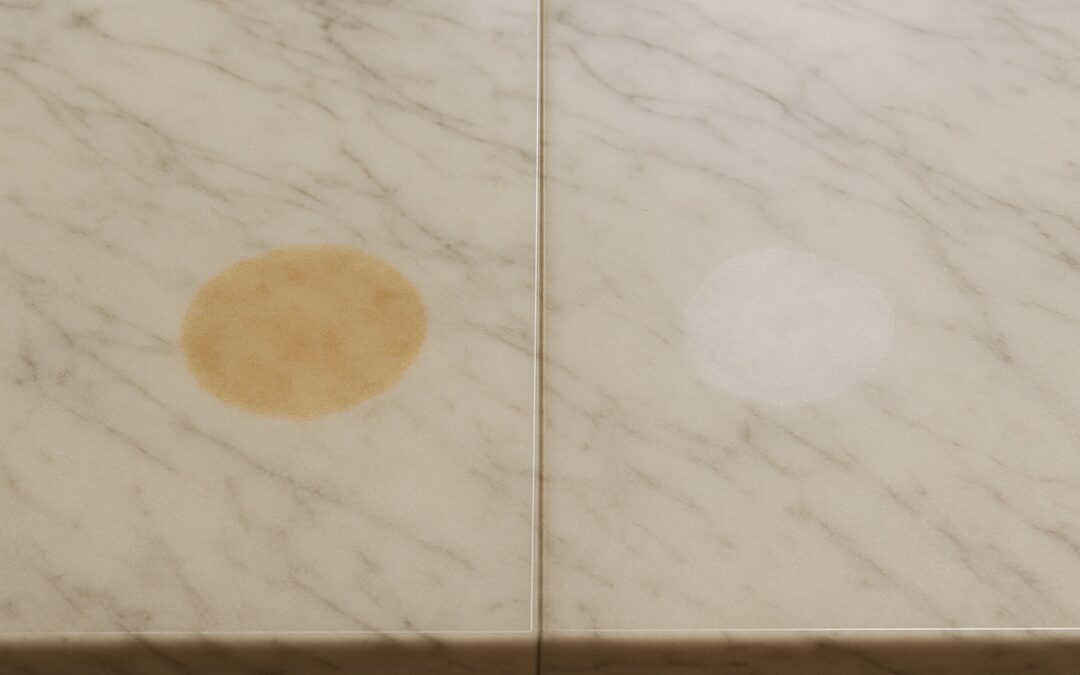 This image shows the distinct difference between a dull, frosted etch mark (left) and a dark, superficial stain (right) on white marble.
Credit: atlantastoneandtilecare.com
This image shows the distinct difference between a dull, frosted etch mark (left) and a dark, superficial stain (right) on white marble.
Credit: atlantastoneandtilecare.com
Etching vs. Staining: Key Differences
| Aspect | Etching | Stains |
|---|---|---|
| Root Cause | Acidic substances reacting chemically with marble’s calcium carbonate | Pigmented liquids (coffee, wine, ink, oil) penetrating the stone’s pores |
| Appearance | Dull, frosted, light-colored spots that alter the surface texture | Dark, discolored spots that sit on or slightly below the surface |
| Texture | Slightly rough or indented to the touch | Smooth and flush with the rest of the stone |
| Removal Method | Polishing, honing, or diamond abrasion to restore the surface layer | Poultices, specialized stain removers, or gentle scrubbing to lift the pigment from pores |
| Prevention | Avoid acid exposure, use protective barriers | Regular sealing to close pores, immediate spill cleanup |
 This faint, circular etch mark was caused by leaving an acidic glass of orange juice on a bathroom countertop overnight.
Credit: www.reddit.com
This faint, circular etch mark was caused by leaving an acidic glass of orange juice on a bathroom countertop overnight.
Credit: www.reddit.com
A common mistake is scrubbing a suspected etch mark with abrasive cleaners, which can worsen the damage by scratching the already softened stone surface. If you are unsure whether a mark is an etch or a stain, test it with a small amount of pH-neutral stone cleaner: if it does not lighten after gentle scrubbing, it is almost certainly an etch. For more on this, see our guide on marble top kitchen island cart.
Step-by-Step Fixes for Marble Etch Marks
The right repair method depends on the severity of the etch: light etches are barely visible and only detectable by touch, moderate etches are clearly visible and slightly rough, and deep etches have a distinct groove that you can feel with your fingernail.
DIY Fixes for Light to Moderate Etching
For light etches (smaller than a quarter, no visible groove), you can restore the finish at home with minimal cost:
- Clean the etched area thoroughly with a pH-neutral marble cleaner and a soft microfiber cloth to remove any dirt or residue, then dry completely.
- Apply a small amount of marble-specific polishing powder (formulated for calcium carbonate stones) to a damp, non-abrasive cloth.
- Rub the powder into the etch mark in gentle circular motions for 1-2 minutes, applying light pressure.
- Wipe away all powder residue with a clean damp cloth, then buff the area with a dry microfiber cloth to restore shine.
For moderate etches, you can use a commercial marble etch remover paste: apply a thin layer to the damaged area, let it sit for 5-10 minutes per the product instructions, then buff off with a soft cloth. Always test any product on a hidden area (like the underside of the countertop) first to ensure it does not lighten or discolor the marble. Note that homemade remedies like baking soda paste can work for very light etches, but baking soda is mildly abrasive and can cause micro-scratches on polished marble if scrubbed too hard, so use it with caution. For deep etches (larger than a quarter, with a visible groove), DIY methods will not work, as they cannot restore the missing stone layer. In these cases, professional restoration is required. For more on this, see our guide on marble top kitchen island with storage.
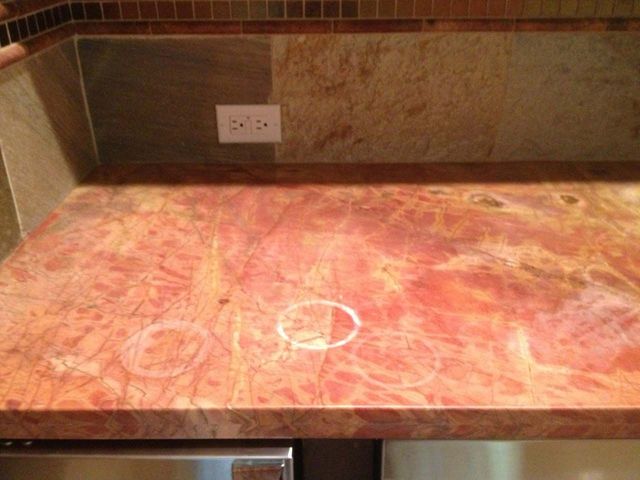 This deeper etch mark from a spilled soda requires professional diamond abrasion to restore the original finish.
Credit: www.marblerepairmarblepolishing.com
This deeper etch mark from a spilled soda requires professional diamond abrasion to restore the original finish.
Credit: www.marblerepairmarblepolishing.com
Professional Restoration for Deep or Widespread Etching
Professional stone restorers use a progression of diamond abrasives (from coarse to fine grit) to grind down the damaged top layer of the marble, then polish or hone the area to match the existing finish of the rest of the surface. For polished marble, they will buff the area to a high-gloss match; for honed (matte) marble, they will hone the repaired area to match the low-sheen finish. The process usually takes 1-3 hours for small areas, and can make even heavily etched marble look nearly new. Many professionals also apply a fresh layer of sealer after repair to protect the surface from future staining and minor etching. In practice, professional repair is cost-effective for widespread etching (covering more than 10-15% of a countertop) or for high-value marble slabs like Calacatta, where replacement would be far more expensive than refinishing.
Proven Prevention Tips to Stop Etching Before It Starts
The vast majority of marble etching is entirely preventable with small, consistent habits. The most effective prevention strategies focus on limiting acid exposure and protecting the stone’s surface. For more on this, see our guide on blog.
Immediate Spill Response
Acidic spills will start etching marble within 30 seconds of contact, so wiping them up immediately is the single most important prevention step. Keep a stack of soft microfiber cloths on hand for quick cleanup, and for dried, stuck-on spills, use a soft cleaning brush with handle to lift residue without scratching the stone. Never let acidic liquids sit on marble, even for a few minutes.
Safe Cleaning Practices
Only use pH-neutral cleaners specifically formulated for natural stone on marble surfaces. Avoid all acidic products, including vinegar, lemon-based sprays, citrus cleaners, and standard bathroom or tile cleaners, even if they are marketed as "all-purpose." For non-marble kitchen surfaces like tile or stainless steel, a professional kitchen cleaning brush can tackle stuck-on food without acidic chemicals, reducing the risk of splashes reaching nearby marble.
Sealing and Protective Barriers
While sealers do not prevent etching entirely, they block staining, which makes etches easier to spot and clean early. Apply a high-quality penetrating siloxane sealer to marble surfaces every 6-12 months, depending on use: test the sealer by dropping a few drops of water on the surface; if the water beads up within 10 seconds, the sealer is still effective, but if it absorbs quickly, it is time to reapply. Use physical barriers to limit acid contact: place coasters under all drinking glasses (especially those holding citrus drinks, wine, or soda), use trivets under hot dishes and acidic foods, and always use a cutting board for food prep—never cut citrus, tomatoes, or other acidic foods directly on marble. If you have young children, installing childproof cabinet locks can keep acidic drinks and cleaning supplies out of reach, reducing the risk of accidental spills. For bathroom vanities, avoid leaving acidic bath products (bath bombs, acne treatments, hair dye) on the marble surface, and wipe down the vanity daily with a soft bathroom and kitchen cleaning brush and pH-neutral cleaner to remove residue.
Choosing Marble or Alternatives for Low-Maintenance Spaces
If you are selecting marble for a new installation, choosing the right material for your space can drastically reduce etching risk and maintenance work.
Marble Varieties and Etch Resistance
Not all marble is equally prone to etching. Marble with higher calcium carbonate content (typically bright white marbles with minimal mineral inclusions) is the most vulnerable: Carrara marble, a popular choice for countertops, has a very high calcium carbonate content and etches easily when exposed to acids. Marble with more mineral inclusions (like grey veining, quartz, or dolomite) is denser and more resistant to etching: Vermont Danby white marble and Calacatta with high quartz content are more durable options for kitchen countertops. Keep in mind that even the most etch-resistant marble will still etch if exposed to strong acids, so prevention habits are still required.
Low-Maintenance Alternatives for High-Traffic Areas
For spaces that see heavy use, like family kitchens, busy bathrooms, or commercial areas, consider alternatives that mimic marble’s look without the high maintenance:
- Quartzite: A natural metamorphic stone that is harder and denser than marble, with almost no calcium carbonate content, making it nearly immune to etching. It is available in white and grey veined patterns that look nearly identical to marble.
- Granite: A durable igneous rock that is far more resistant to etching than marble, available in a wide range of colors and patterns.
- Engineered quartz: A man-made material made of crushed stone bound with resin, which is highly resistant to etching and staining, and can be formulated to match the look of natural marble. For more guidance on selecting the right surfaces for your home, check out our full blog archive for detailed material comparisons and care guides.
Frequently Asked Questions
What causes etching on marble surfaces?
Etching is caused by a chemical reaction between acidic substances and marble’s calcium carbonate content. Common culprits include citrus juices, wine, soda, vinegar, citrus-based cleaners, and even some bath and beauty products. Even mild acids can cause etching if left in contact with the stone for 30 seconds or longer, and sealed marble is not fully immune to this reaction.
How can I prevent etching on marble countertops?
The most effective prevention steps are: wiping up acidic spills immediately, using only pH-neutral natural stone cleaners, applying a penetrating sealer every 6-12 months, using coasters, trivets, and cutting boards to limit acid contact, and avoiding all acidic cleaning products on or near marble surfaces. For gentle daily cleaning, use a soft kitchen cleaning brush set paired with a pH-neutral cleaner to avoid scratching the surface.
Can etching on marble be repaired?
Yes, light to moderate etching can often be repaired at home with marble polishing powder or commercial etch remover. Deep etches with visible grooves, or widespread etching covering large areas, require professional restoration using diamond abrasives to grind down the damaged layer and restore the original finish. Honed (matte) marble requires a different repair process than polished (glossy) marble, so be sure to match the finish when repairing.
Is etching the same as staining on marble?
No, etching and staining are two completely different types of damage. Etching is a chemical reaction that dissolves the top layer of the stone, causing dull, rough spots, while staining is when pigmented liquids penetrate the stone’s pores, causing dark discoloration. Etching requires polishing or abrasion to repair, while stains can usually be removed with poultices or specialized stain removers.
Conclusion
Etching on marble is a common but entirely manageable issue for homeowners. Unlike the intentional decorative acid etching used to create custom marble art and signage, accidental household etching is a preventable chemical reaction that damages the stone’s surface, but it can be fixed with DIY methods for minor damage or professional restoration for deeper issues. The key to keeping marble looking its best is consistent prevention: wipe up acidic spills immediately, use only marble-safe cleaners, and seal your surfaces regularly. If you do notice etch marks early, you can often restore the finish with minimal effort before the damage becomes permanent. For more guides on maintaining your home’s surfaces and childproofing your space to prevent accidental spills, browse our full library of home tips for actionable, expert-backed advice.

I’m Abby Lu, a passionate home cook who loves simplifying everyday meals. At PlugChef.com, I share product reviews and cooking guides to help you find the best tools for your kitchen.
Related posts:
 How to Make a Fruit Basket for a Gift: Easy DIY Guide
 Do You Need a Basket? Essential Guide for Air Fryers
 How to Adjust Syrup Dispenser Pressure: Expert Tips
 Kitchen Cabinets With Black Appliances: Trendy Design Tips
 White Kitchen And Stainless Steel Appliances: A Perfect Duo
 Kitchen Colors With White Cabinets And White Appliances: Vibrant Ideas

