

Have you ever paused to wonder about the simple things in life, like how many holes a straw has? It’s a question that might seem trivial at first, yet it sparks curiosity and debate among many.
You probably use a straw without giving it much thought, but this everyday item holds a fascinating question that challenges our perception. Is it one continuous hole, or are there two distinct openings? Understanding this can change the way you see objects around you.
Dive into this intriguing topic, unravel the mystery, and discover the surprising answer that has puzzled even the sharpest minds. Once you start exploring, you might find yourself questioning other ordinary items in your daily life. Are you ready to shift your perspective? Let’s get into it!
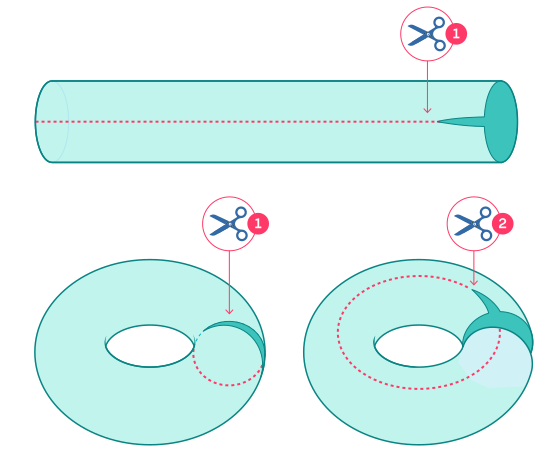
Credit: www.quantamagazine.org
The Straw Dilemma
The Straw Dilemma—it’s a topic that has sparked debates, fueled discussions, and even inspired scientific curiosity. Have you ever paused to consider how many holes a straw actually has? This seemingly simple question has divided opinions and spurred countless conversations. Whether you’re sipping your favorite drink or pondering life’s little mysteries, understanding the straw dilemma can offer unexpected insights.
One Hole Or Two?
Imagine you’re holding a straw in your hand. Does it have one hole or two? Some argue that a straw has two holes—one at each end. But others suggest it has just one continuous hole that connects both ends. The debate is not just about straws but how we perceive everyday objects.
The Definition Of A Hole
Understanding what qualifies as a hole is essential. A hole is typically defined as an opening or gap. By this definition, a straw could be seen as having one long hole running from one end to the other. Yet, if we view each end separately, it might seem like two distinct holes.
A Practical Perspective
Think about how you use a straw. You place one end in the drink and the other in your mouth. Does it matter if it’s one hole or two? Not really. What matters is that it functions perfectly, delivering your beverage with ease. This highlights that sometimes, practical use outweighs technical definitions.
A Personal Insight
Years ago, I found myself in a lively debate over this very topic at a family gathering. We laughed, argued, and even drew diagrams. In the end, the debate didn’t change how we used straws. It did, however, remind us that simple questions can lead to intriguing discussions.
Your Thoughts?
So, what do you think? Is it one hole or two? Consider how you define a hole and how it applies to the straw in your hand. Share your thoughts and join the conversation. Sometimes, the simplest questions make us think the most.
Defining A Hole
A straw often sparks debate about its holes. Some argue it has two holes, one at each end. Others believe it has just one continuous hole. This simple object challenges our understanding of geometry and everyday items.
Have you ever thought about how many holes a straw has? It’s a question that seems simple at first but quickly spirals into a debate. Understanding what exactly constitutes a “hole” is key to unraveling this mystery. Let’s dive into the idea of defining a hole and see how different perspectives can lead to varied answers.Mathematical Perspective
From a mathematical viewpoint, a straw is often considered to have one continuous hole. This is because the straw is akin to a torus, a shape with a single surface that loops through itself. Topologists, who study these shapes, might argue that a straw is essentially a donut shape, with one hole running through it. Mathematics can be tricky, though. It forces us to think beyond what our eyes see. If a straw is like a tunnel, then it has one hole from this perspective. This idea might seem abstract. But it challenges us to rethink our understanding of something as basic as a straw.Everyday Understanding
In everyday language, many people might say a straw has two holes—one at the top and one at the bottom. If you look at a straw, you see two distinct openings. Our daily experiences often guide us to count each visible opening as a separate hole. Think about using a straw in your drink. You see the liquid enter one end and exit the other. This practical interaction leads most of us to recognize two holes. This everyday logic is relatable. It highlights how our experiences shape the way we define things around us. The next time you sip a drink through a straw, ask yourself: How many holes do you think it has? Your answer might depend on whether you lean more toward mathematical logic or everyday experience. Each perspective offers a unique lens through which to view something as simple as a straw.Philosophical Views
Have you ever wondered how many holes a straw really has? It’s a surprisingly philosophical question that has sparked debates across the globe. At first glance, it may seem trivial, but when you dive deeper, you discover a world of intriguing thought and interpretation. This seemingly simple question invites you to explore the complexities of definitions and perspectives.
The Debate
The debate about the number of holes in a straw is more than a mere discussion about a drinking tool. It hinges on your perspective of what constitutes a hole. Is a hole defined by its entrance and exit points, or is it simply a continuous space? If you consider a straw as a cylinder with open ends, it might be tempting to say it has two holes.
Conversely, some argue that a straw has just one continuous hole running through its length. This perspective challenges you to think about how we define and perceive objects. It’s not just about what you see, but how you interpret what you see. Have you ever considered how your viewpoint could change with a shift in definition?
Implications Of Definitions
Definitions shape the way you understand the world. When you redefine what a hole is, it influences your perception of everyday objects. If you believe a straw has one hole, you might start seeing other cylindrical objects differently. This shift in thinking can open up new ways to approach problems or innovate solutions.
Imagine applying this concept to other areas of your life. What happens when you redefine a problem or challenge? Could a change in definition lead to breakthroughs or new insights? Consider how a simple question about a straw could impact your approach to problem-solving. It’s fascinating how redefining something as simple as a hole can spark broader philosophical discussions.
So, what do you think? Does a straw have one hole or two? Your answer might reveal more about your perspective than you realize.
Scientific Analysis
Scientists often debate the number of holes in a straw. Some argue it has one continuous hole, while others suggest two separate openings. This intriguing question challenges our understanding of geometry and perception.
Scientific Analysis Have you ever found yourself in a debate about how many holes a straw has? It may seem trivial, but this question actually ties into fascinating scientific concepts. Let’s delve into the geometry and topology of straws and explore their physical properties.Geometry And Topology
When you think of a straw, you might visualize a long tube. But does this tube have one hole or two? Geometry tells us that a straw is a cylindrical shape, but topology dives deeper into its structure. Imagine a straw as a rectangle rolled into a cylinder. There’s a continuous surface with openings at both ends. Topologically, this structure is akin to a torus, which has one hole. Picture a doughnut; it’s similar to a straw. Both have a single hole passing through them. This might surprise you, but the straw’s geometry and topology suggest it has one hole.Physical Properties Of Straws
Consider the physical properties of a straw. It’s a hollow tube designed to carry liquid from one end to the other. If you were to cut a straw in half, would it still be functional? Cutting a straw would create two separate pieces, each with its own opening. This suggests each piece has one hole. Yet, a complete straw allows liquid to flow through seamlessly, indicating one continuous hole. Think about the utility of a straw. Its design is optimized for liquid transport, highlighting its singular hole’s effectiveness. This functional perspective might shift how you perceive the straw’s structure. So, how many holes does a straw really have? It’s a question that merges science with everyday observation. Next time you sip through a straw, consider its intriguing scientific aspects.Cultural Interpretations
How many holes does a straw have? This question might seem straightforward, but it opens up a fascinating discussion about cultural interpretations. Different cultures can perceive this seemingly simple object in diverse ways, influenced by language, context, and even philosophical perspectives. You might be surprised at how a straw can spark debates that delve into the heart of cultural understanding.
Language plays a crucial role in shaping our perception of the world, and this extends to the humble straw. In English, we often describe a straw as having one hole running through it. Yet, in other languages, the terminology might differ, altering the perception entirely. Consider how you describe the straw to someone who speaks another language. Would they see it as having one continuous hole or two separate openings?
Context adds another layer to this discussion. Think about explaining the straw’s design to a child versus an engineer. The child might focus on the straw’s function—how it helps sip a drink—while an engineer might analyze its structural properties. Your own explanation could shift based on who you are talking to, highlighting how context can change our interpretation.
Globally, cultural interpretations of a straw’s design can vary. Some cultures might emphasize practical use, while others might focus on the philosophical aspect of what defines a hole. Consider how design thinking in Japan often revolves around simplicity and functionality. A Japanese designer might describe the straw in terms of its efficiency rather than its structure.
Alternatively, in philosophical circles, the discussion might revolve around concepts of infinity and continuity. Does a straw have infinite holes, as it never truly ends? Or is it merely a single loop, reflecting continuity? These questions are not just academic; they reflect how cultures interpret everyday objects like a straw.
When you think about these perspectives, how does it change your own understanding of something as simple as a straw? Are there objects in your daily life that might have hidden layers of cultural interpretation, waiting to be explored?
Public Opinion
The question of how many holes a straw has sparks debate. It’s a topic that divides people into different camps. Some say one, others claim two. This debate has captured public attention and curiosity. Let’s explore the various opinions.
Social Media Discussions
Social media platforms buzz with discussions about the straw’s holes. People eagerly share their thoughts and theories. Many enjoy engaging in friendly debates. Comments often reflect diverse perspectives. Some users argue passionately for their viewpoint. Others enjoy reading the lively exchanges. The topic continues to trend on social networks.
Survey Results
Surveys reveal intriguing insights into public opinion. Many respondents believe a straw has one continuous hole. Others think there are two separate holes. Some surveys show an even split in opinions. This demonstrates the complexity of the topic. Data from these surveys help understand the general consensus. People enjoy expressing their thoughts through these polls.
Impacts On Design And Manufacturing
The question of how many holes a straw has influences design and manufacturing processes. Designers and manufacturers consider this to create efficient production techniques. Understanding this concept helps optimize material usage and design functionality.
The debate about how many holes a straw has might seem like a trivial topic at first glance. Yet, this seemingly simple question can have significant impacts on the design and manufacturing of straws. This topic opens doors to fascinating discussions about practical considerations and the intricacies of material science that play pivotal roles in the industry.Practical Considerations
Designing a straw may seem straightforward, but it’s a process that involves careful thought. If you consider a straw to have two holes, like a tube, it influences the design approach. Manufacturers might prioritize ensuring that both ends are perfectly round and smooth, avoiding any potential discomfort when you sip your drink. In contrast, considering a straw as having just one continuous hole can lead to different manufacturing priorities. The emphasis might be on the straw’s internal diameter consistency. This affects how easily liquids flow through the straw, which is crucial for both user experience and product functionality. Have you ever wondered why certain straws feel sturdier than others? The design choice impacts the material thickness and flexibility. Practical considerations like these ensure that the straw performs its intended function efficiently while maintaining user satisfaction.Material Science
Material science is at the heart of straw manufacturing. The choice of material determines the straw’s durability, flexibility, and environmental impact. If you think about a straw having one continuous hole, the material’s ability to withstand pressure from liquids becomes paramount. Materials like plastic, paper, and even stainless steel are selected based on their properties. For instance, plastic straws offer flexibility and durability but raise environmental concerns. Paper straws address environmental issues but may compromise on durability and user experience. Innovations in material science are leading to the development of biodegradable or compostable materials. This is a response to growing environmental awareness and consumer demand. As you sip your favorite drink, consider the science behind the straw in your hand—it’s more complex than it seems. The debate on the number of holes in a straw might not change your drinking habits, but it certainly sheds light on the thoughtful design and material choices behind everyday objects. Next time you use a straw, think about the design and material science that make it possible.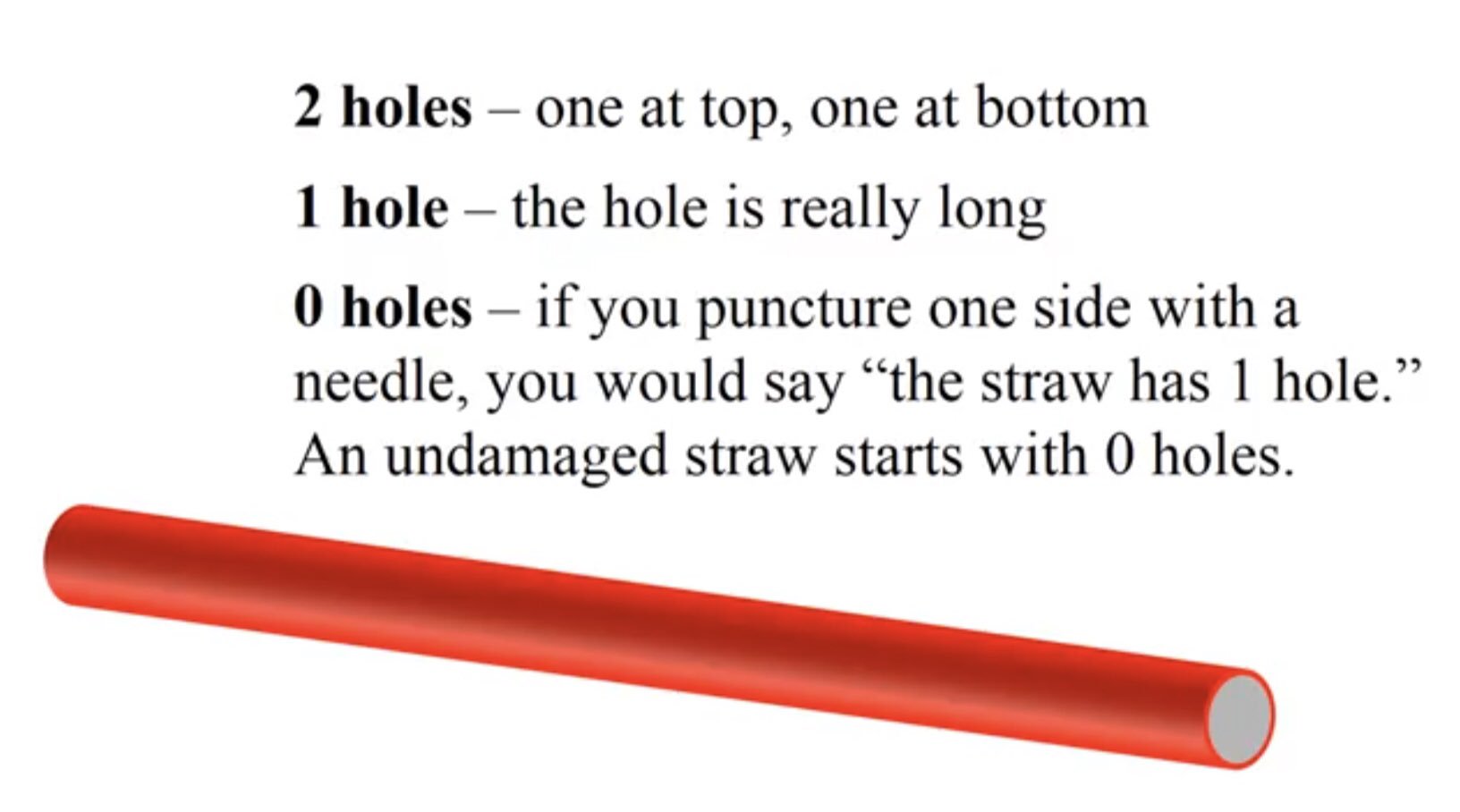
Credit: x.com
Concluding Thoughts
As we reach the end of this intriguing topic, there’s much to ponder. The debate on how many holes a straw has can spark lively discussions. It’s fascinating how something so simple can lead to complex thoughts.
Understanding The Straw’s Structure
At first glance, a straw seems straightforward. A cylindrical tube used for sipping drinks. Yet, examining its structure reveals more complexity. Is it a single hole or two? This question challenges our perception of holes in everyday objects.
The Single Hole Perspective
Some argue a straw has one hole. Imagine a tunnel through a mountain. It has a single opening that extends from one end to the other. In this view, the straw is similar. A continuous passage that allows liquid to flow smoothly.
The Two Hole Argument
Others see two distinct holes. Picture a donut with a hole in the center. Each end of the straw represents a separate opening. This perspective considers each end as an individual entry or exit point.
Reflections On Everyday Objects
Exploring how many holes a straw has opens broader reflections. How do we define holes in other objects? It challenges our understanding of shapes and forms. This helps us look at everyday items with a curious eye.
Final Thoughts On Simplicity And Complexity
Simple objects often hide complex truths. The straw exemplifies this beautifully. It teaches us to appreciate the nuances in everyday life. This discussion invites us to rethink how we view simplicity and complexity.

Credit: mindyourdecisions.com
Frequently Asked Questions
Does Straw Have 1 Or 2 Holes?
A straw has one continuous hole. It’s a single tunnel-like structure that connects both ends. This debate often arises from different interpretations of what defines a “hole. ” In geometry, it’s seen as one hole.
Does A Tunnel Have 1 Or 2 Holes?
A tunnel typically has two holes: an entrance and an exit. These openings allow passage through the tunnel.
Does A Donut Have 1 Or 2 Holes?
A donut typically has one hole in the center. This iconic shape defines its classic design and appeal.
Does A Straw Have 1 Hole Or 2 Reddit?
A straw has one continuous hole. It is a single cylindrical opening that runs from one end to the other. This topic often sparks debates on platforms like Reddit, but the consensus leans towards one hole.
Conclusion
Understanding a straw’s holes sparks curiosity. Is it one or two? Many agree on two, considering each end. Others see one continuous hole. This debate brings fun and insight. Shapes and definitions matter. Exploring everyday objects can be fascinating. Straws teach us about perception.
Conversations like these challenge our thinking. Next time you sip, ponder the straw’s mystery. It’s not just a simple tube. It’s a way to explore ideas. Keep questioning. Keep learning. Simple objects can lead to deep thoughts. It’s all about perspective.

I’m Abby Lu, a passionate home cook who loves simplifying everyday meals. At PlugChef.com, I share product reviews and cooking guides to help you find the best tools for your kitchen.
Related posts:
 What Type of Cooking Utensils are Safe: Expert Picks
 What Innovations Could Blenders Make: Unleashing Future Tech
 Smart Strategies to Organize a Small Kitchen: Maximize Space
 How to Organize a Kitchen Cabinet: Expert Tips & Tricks
 How to Organize Kitchen Drawers: Expert Tips and Tricks
 How to Organize a Corner Kitchen Cupboard: Expert Tips