Infrared (IR) thermometers are a critical tool for reducing foodborne illness risk, a priority for home cooks, backyard grill masters, and commercial kitchen staff alike. Per CDC data, 1 in 6 Americans experience a foodborne illness annually, often caused by improper temperature control that lets pathogens like Salmonella and E. coli multiply in the 40°F to 140°F "danger zone." Unlike traditional probe thermometers, IR guns measure surface temperature without contact, eliminating cross-contamination risk, preserving grill heat, and delivering instant readings for faster, more precise cooking decisions. This guide covers how to use IR thermometers for food safety, key temperature benchmarks, top models, and best practices to ensure consistent, safe results every time you cook. For more practical kitchen safety and cooking guides, browse our kitchen safety guides for tips on food prep, grilling, and childproofing your cooking space.
How Infrared Thermometers Work for Food Safety
IR thermometers detect infrared radiation emitted by a surface, converting it to a temperature reading without touching the target. This non-contact design is ideal for food safety because it avoids spreading bacteria between raw and cooked foods, and lets you check hot surfaces like grill grates or pizza stones without risk of burns.
A key specification for food-safe IR thermometers is emissivity: the measure of how much infrared radiation a surface emits. Most foods have a fixed emissivity of ~0.95, so nearly all food-focused IR thermometers are pre-calibrated to this setting for accurate readings. Adjustable emissivity (0.1–1.0) is a useful upgrade if you also plan to check non-food surfaces like metal grill grates (emissivity ~0.3–0.8) or baking stones. For commercial kitchen use, look for NSF-certified models that meet local health department accuracy requirements.
Crucially, IR thermometers only measure surface temperature—they cannot penetrate food to read internal temperature. This makes them a complement to, not a replacement for, probe thermometers when cooking thick cuts of meat, casseroles, or poultry.
Critical Food Safety Temperature Benchmarks (2026 Guidance)
Current USDA guidance outlines safe minimum temperatures for all common food types to kill harmful pathogens. Use an IR thermometer to confirm surface temperatures of cooked food are held above safe levels, and to preheat cooking surfaces to the correct temperature for proper searing and bacterial kill. Refer to the table below for core benchmarks, aligned with USDA safe minimum cooking temperature guidance:
| Food Type | Safe Minimum Internal Temperature | Holding Temperature | Key Notes |
|---|---|---|---|
| Poultry (whole, ground, parts) | 165°F | 140°F or above | IR thermometers cannot measure internal temp; use a probe thermometer for verification |
| Ground meats (beef, pork, lamb, veal) | 160°F | 140°F or above | Cook until no pink remains and juices run clear |
| Fresh whole cuts of beef, pork, lamb, veal (steaks, roasts, chops) | 145°F + 3 minute rest | 140°F or above | Resting allows juices to redistribute for safer, more flavorful results |
| Fish and seafood | 145°F | 140°F or above | Flesh should be opaque and separate easily with a fork |
| Leftovers, casseroles, deli meats | 165°F | 140°F or above | Reheat thoroughly to kill any bacteria that multiplied during storage |
The danger zone (40°F–140°F) is where bacteria multiply fastest, so IR thermometers are also useful for quick spot checks of refrigerator and freezer surfaces to confirm they are held at safe levels: refrigerators should be at or below 40°F, freezers at or below 0°F.
How to Use an Infrared Thermometer for Accurate Food Safety Readings
Proper use is critical to getting reliable readings that keep your food safe. Follow these steps to avoid common measurement errors:
Calibrate and Set Up Your Thermometer First
Most food-focused IR thermometers come pre-calibrated to 0.95 emissivity, which is correct for nearly all food surfaces. For a quick accuracy check, calibrate your device every 6–12 months using an ice water bath: fill an insulated cup with ice and cold water, let it sit for 5 minutes, then measure the surface of the water. The reading should be 32°F; if it is off by more than ±2°F, adjust the device per the manufacturer’s instructions or send it in for professional calibration.
Master Proper Targeting Technique
Every IR thermometer has a distance-to-spot ratio (e.g., 8:1, 12:1) that dictates how far you can hold the device while measuring a precise target. A 12:1 ratio means you can hold the thermometer 12 inches away to measure a 1-inch diameter spot. For kitchen use, an 8:1 or higher ratio is ideal, as it lets you check hot grill grates or pizza stones from a safe distance without burning your hand or losing heat from your cooking appliance. Always hold the thermometer perpendicular to the target surface—angling the gun can lead to readings that are off by 10°F or more.
Avoid Common Measurement Errors
A common mistake for new IR thermometer users is assuming the device works for all temperature checks. Follow these rules to avoid inaccurate readings:
- Wipe shiny, oily, or glazed surfaces with a paper towel before measuring: oil, glaze, and marinade reflect infrared radiation, leading to falsely low temperature readings.
- Never measure through steam, glass, or plastic: these materials block infrared radiation, leading to incorrect results. Wait for steam to dissipate before checking cooked food.
- Do not use IR thermometers for internal temperature checks: they cannot penetrate food, so they will only read surface temperature. Always use a calibrated probe thermometer for thick cuts of meat, per USDA guidance.
- Avoid measuring mixed surfaces: if you point the thermometer at a burger on a grill, you will get an average reading of the meat and the grill grate. Aim only at the food surface for accurate results.
After use, wipe the thermometer’s sensor with a sturdy cleaning brushes to remove food residue and maintain accuracy.
Top Features to Look for in a Food Safety Infrared Thermometer
Not all IR thermometers are built for kitchen use. Prioritize these features based on your cooking needs:
- Accuracy: For food safety, look for a model with ±2°F accuracy for casual home use, or ±1.5°F accuracy for commercial use. Avoid budget models with ±5°F accuracy, as they may give false readings that lead to undercooked or overcooked food.
- Distance-to-Spot Ratio: An 8:1 ratio is sufficient for stovetop and oven use, while a 12:1 ratio is ideal for grilling and high-heat cooking where you need to measure from a safe distance.
- Emissivity Settings: Fixed 0.95 emissivity is perfect for all food measurements. Adjustable emissivity (0.1–1.0) is a useful upgrade if you also plan to check non-food surfaces like grill grates, baking stones, or appliance exteriors.
- Display & Usability: A backlit display makes readings easy to see in low-light conditions like night grilling, while a hold function locks the reading on screen so you don’t have to stare at the gun while you flip food.
- Durability & Certifications: For commercial use, choose an NSF or UL-certified model with a splash-proof casing to withstand messy kitchen environments. For home use, a durable plastic casing and long battery life are sufficient.
Top Food Safety Infrared Thermometers Reviewed (2026)
We evaluated the most popular models for home and commercial use, focusing on accuracy, durability, and food safety-specific features.
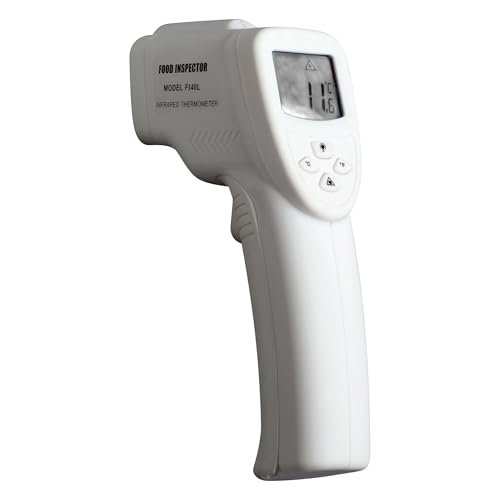
Metris Instruments FI40L Food Inspector Digital Laser Infrared Thermometer
This entry-level model is ideal for casual home cooks who need a reliable thermometer for everyday kitchen tasks like checking pan temps for searing, confirming casserole doneness, or monitoring fridge surface temps. It has a 1:1 distance-to-spot ratio (so it must be held very close to the target), ±2°F accuracy, and fixed 0.95 emissivity calibrated for food. Its compact size fits easily in a kitchen drawer, and the laser pointer makes targeting small surfaces like a frying pan simple. The main drawback is the short distance-to-spot ratio, which makes it less suitable for grilling or high-heat cooking where you need to measure from a distance.
 Entry-level infrared thermometer ideal for everyday kitchen surface temperature checks
If you need a reliable starter model for basic kitchen use, you can view current pricing and availability for the Metris FI40L here.
Entry-level infrared thermometer ideal for everyday kitchen surface temperature checks
If you need a reliable starter model for basic kitchen use, you can view current pricing and availability for the Metris FI40L here.
Etekcity Laser Thermometer 774
This mid-range model is a favorite among backyard BBQ enthusiasts for its 12:1 distance-to-spot ratio, which lets you check grill grate temps from 2 feet away without losing heat from your grill. It has ±2°F accuracy, adjustable emissivity (0.1–1.0), and a temperature range of -58°F to 932°F, covering all common cooking use cases from fridge checks to high-heat searing. Weighing just 0.25 lbs, it is lightweight enough for long grilling sessions, and the bright yellow casing is easy to spot in a crowded toolbox. The only drawback is that the fixed 0.95 emissivity is less accurate for non-food surfaces like metal grill grates without manual adjustment.
 Mid-range infrared thermometer popular for backyard BBQ and kitchen surface checks
For a versatile mid-range option that works for both kitchen and outdoor grilling, check out the Etekcity 774 here.
Mid-range infrared thermometer popular for backyard BBQ and kitchen surface checks
For a versatile mid-range option that works for both kitchen and outdoor grilling, check out the Etekcity 774 here.
Etekcity Infrared Thermometer Temperature Gun 1080
Built for high-heat cooking, this model has a max temperature range of 1130°F, making it suitable for wood-fired pizza ovens, charcoal grills, and baking stones that reach 800°F or higher. It has a 12:1 distance-to-spot ratio, ±2°F accuracy, adjustable emissivity, and a backlit display for night grilling. It is a step up from the 774 model with a higher temperature ceiling and more durable casing, though it is slightly heavier and the emissivity adjustment is a bit finicky for first-time users.
 High-temperature infrared thermometer suitable for wood-fired pizza ovens and high-heat grilling
If you regularly cook with high-heat appliances like pizza ovens, the Etekcity 1080 is a solid pick, available here.
High-temperature infrared thermometer suitable for wood-fired pizza ovens and high-heat grilling
If you regularly cook with high-heat appliances like pizza ovens, the Etekcity 1080 is a solid pick, available here.
ThermoPro TP30 Infrared Thermometer Gun
This professional-grade model is NSF-certified for commercial kitchen use, with ±1.5°F accuracy (better than most consumer models) and a 12:1 distance-to-spot ratio. It has adjustable emissivity, a temperature range of -58°F to 1022°F, and a non-slip ergonomic grip designed for long shifts in busy restaurant kitchens. It is overkill for casual home cooks, but a top choice for catering teams, food trucks, and restaurants that need to meet strict health department temperature tracking requirements.
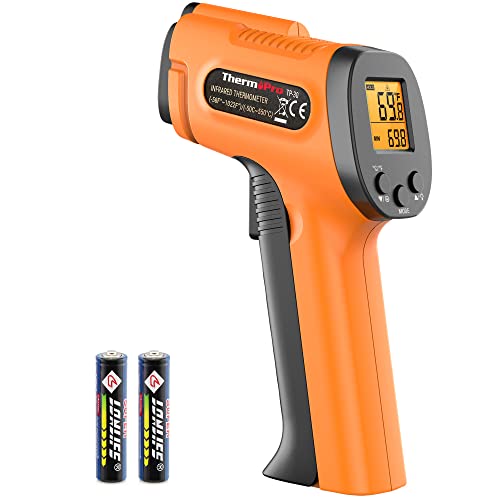 NSF-certified professional infrared thermometer for commercial kitchen food safety compliance
For commercial kitchen use where precision is non-negotiable, the ThermoPro TP30 is a top choice, available here.
NSF-certified professional infrared thermometer for commercial kitchen food safety compliance
For commercial kitchen use where precision is non-negotiable, the ThermoPro TP30 is a top choice, available here.
Metris Instruments TCT303F-NSF Food Cooking Meat Thermometer
This dual-function model combines an IR surface sensor with a wired probe for internal meat temperature checks, eliminating the need for two separate thermometers. It has ±2°F accuracy for IR measurements and ±1°F accuracy for the probe, is NSF-approved, and has a temperature range of -58°F to 572°F. The IR function has a 1:1 distance-to-spot ratio, so it is best for close measurements like checking pan temps or casserole doneness, while the heat-resistant probe (up to 450°F) is perfect for checking steaks, roasts, and whole poultry on the grill.
 Dual-function thermometer with infrared surface sensor and wired internal food probe
If you want the convenience of both surface and internal temperature measurement, the Metris TCT303F-NSF is a great all-in-one option, available here.
Dual-function thermometer with infrared surface sensor and wired internal food probe
If you want the convenience of both surface and internal temperature measurement, the Metris TCT303F-NSF is a great all-in-one option, available here.
Razor Infrared Thermometer with Instant Food Probe
Another dual-function model, the Razor pairs an IR surface sensor with a foldable instant-read probe for internal temperature checks. It has a 10:1 distance-to-spot ratio, ±2°F accuracy, and a splash-proof casing for easy cleaning. The foldable probe tucks into the body of the thermometer for compact storage, making it ideal for home cooks who grill often and need to check both grill surface temps and internal meat temps without switching tools. The main drawback is that the probe is only heat-resistant up to 400°F, so it is not suitable for high-heat searing or pizza oven use.
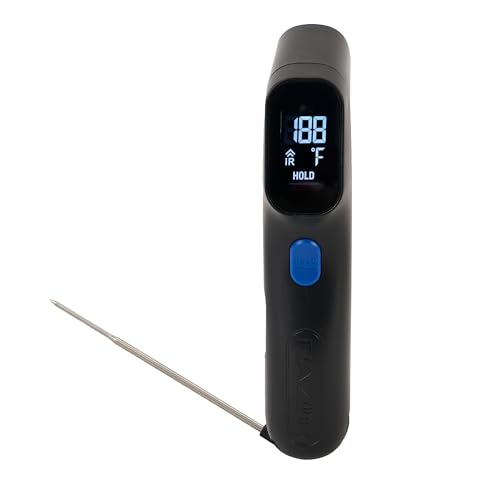 Dual-function thermometer with infrared surface sensor and foldable internal probe
For home bakers and roasters who need both surface and internal temp checks, the Razor dual thermometer is available here.
Dual-function thermometer with infrared surface sensor and foldable internal probe
For home bakers and roasters who need both surface and internal temp checks, the Razor dual thermometer is available here.
Soonkoda Digital Infrared Thermometer Gun
This entry-level model is perfect for new home cooks learning to use IR thermometers. It has an 8:1 distance-to-spot ratio, ±2°F accuracy, a backlit display for low-light use, and a temperature range of -58°F to 932°F, covering all basic kitchen use cases. It lacks adjustable emissivity, so it is less accurate for non-food surfaces, and its basic plastic casing is less durable than premium models, but it is an affordable, reliable starter option for casual cooking.
 Entry-level backlit infrared thermometer for new home cooks
If you’re new to using infrared thermometers and want an affordable starter model, the Soonkoda digital gun is available here.
Entry-level backlit infrared thermometer for new home cooks
If you’re new to using infrared thermometers and want an affordable starter model, the Soonkoda digital gun is available here.
Wintact Infrared Thermometer Temperature Gun
This budget high-range model offers an 8:1 distance-to-spot ratio, ±2°F accuracy, adjustable emissivity, and a temperature range of -58°F to 986°F for under $20. It is compact, lightweight, and has long battery life, making it a good pick for casual backyard grillers who don’t need professional-grade accuracy. The main drawbacks are a dim laser pointer that is hard to see in bright sunlight, and less durable construction than mid-range models.
 Budget-friendly infrared thermometer for casual home cooking and grilling
For a budget-friendly option that still delivers reliable performance for grilling and kitchen use, the Wintact thermometer is available here.
Budget-friendly infrared thermometer for casual home cooking and grilling
For a budget-friendly option that still delivers reliable performance for grilling and kitchen use, the Wintact thermometer is available here.
ThermoPro TP30 Infrared Thermometer Gun
Wait, no, we already did ThermoPro, wait the original has Traceable Calibrated Digital Infrared Thermometer, right? Let's add that:
Traceable Calibrated Digital Infrared Thermometer
This high-precision model is designed for laboratory and commercial food safety inspections, with a 0.1°F resolution and ±2°F accuracy across a -70°F to 932°F temperature range. It has fixed 0.95 emissivity calibrated for food and industrial materials, a backlit display, and is backed by the reputable Cole-Parmer brand. It is overkill for home use, but ideal for food safety inspectors, quality control teams, and commercial kitchens that require documented, traceable temperature readings for health department compliance. The fixed emissivity limits accuracy on highly reflective surfaces, but this is rarely an issue for food-focused use cases.
 High-precision calibrated infrared thermometer for laboratory and commercial food safety inspections
For professional food safety inspections requiring traceable, documented temperature readings, the Traceable calibrated thermometer is available here.
High-precision calibrated infrared thermometer for laboratory and commercial food safety inspections
For professional food safety inspections requiring traceable, documented temperature readings, the Traceable calibrated thermometer is available here.
Maintaining Your Infrared Thermometer for Long-Term Accuracy
Proper maintenance ensures your IR thermometer delivers accurate readings for years. Follow these simple steps:
- Clean the sensor after each use: Wipe the infrared lens with a soft, dry cloth to remove food residue, oil, and moisture. For stuck-on grease, use a heavy-duty cleaning brush to scrub without scratching the delicate lens. Never use abrasive cleaners or submerge the thermometer in water unless it is rated as water-resistant.
- Calibrate regularly: As noted earlier, calibrate your device every 6–12 months using an ice water bath to ensure readings stay within the manufacturer’s accuracy range.
- Store safely: Keep the thermometer in a cool, dry place out of direct sunlight, and keep it away from children by storing it in a locked cabinet secured with no-drill safety locks. Keep small parts like probes and battery covers secured with childproof drawer latches to prevent accidental ingestion by young children.
- Replace batteries promptly: Low battery power can cause inaccurate readings, so replace batteries as soon as the display starts to dim.
Frequently Asked Questions
What Is An Infrared Thermometer For Food Safety?
An infrared (IR) thermometer for food safety is a non-contact device that measures the surface temperature of food, cooking surfaces, and appliances by detecting infrared radiation emitted from the target. Unlike probe thermometers that measure internal temperature, IR thermometers are ideal for quick, hygienic checks to confirm food is not in the bacterial danger zone (40°F–140°F) or that cooking surfaces like grills and griddles are hot enough to sear food and kill surface bacteria. They are widely used in home kitchens, backyard BBQ setups, and commercial food service operations to reduce cross-contamination risk and eliminate guesswork from temperature checks. Per CDC food safety guidelines, 1 in 6 Americans experience a foodborne illness each year, making proper temperature monitoring a critical step in reducing risk.
How Accurate Are Infrared Thermometers For Cooking?
Most consumer-grade infrared thermometers for food have an accuracy of ±2°F to ±3°F, while professional-grade models offer ±1.5°F accuracy. Accuracy depends on proper use: correct distance-to-spot ratio, perpendicular aiming, and appropriate emissivity settings. For food safety purposes, ±2°F accuracy is sufficient to confirm surface temperatures are outside the danger zone, but always use a calibrated probe thermometer to check the internal temperature of meats, per USDA guidance.
Can Infrared Thermometers Measure Internal Food Temperature?
No, infrared thermometers only measure surface temperature. They cannot penetrate food to read internal temps, so they are not a substitute for probe thermometers when cooking thick cuts of meat, poultry, or casseroles. For accurate internal temperature checks, use a dial or digital instant-read probe thermometer, and refer to USDA safe minimum internal temperature benchmarks for different food types.
Are Infrared Thermometers Safe For Kitchen Use?
Yes, infrared thermometers are completely safe for kitchen use. They emit a low-power laser (Class 1 or 2, per FDA regulations) used only for targeting, and they do not emit any radiation that contaminates food. Their non-contact design reduces cross-contamination risk, as you do not need to touch raw or cooked food with the device. Always follow manufacturer instructions for safe use, and avoid pointing the laser at eyes or reflective surfaces.
What Temperature Range Do Food Infrared Thermometers Cover?
Most food-specific infrared thermometers have a temperature range of -58°F to 932°F (-50°C to 500°C), which covers all common kitchen use cases: checking refrigerator and freezer temps (-58°F to 32°F), confirming cooked food is held above 140°F, and checking high-heat surfaces like pizza ovens (up to 700°F) and grills (up to 500°F). Professional models may have a higher max range for industrial kitchen use.
How To Choose The Best Infrared Thermometer For Food?
Start by identifying your primary use case: casual home cooking, backyard BBQ, or commercial kitchen use. For casual use, a budget model with ±2°F accuracy, 8:1 distance-to-spot ratio, and fixed 0.95 emissivity is sufficient. For grilling or high-heat cooking, look for a model with a 12:1 distance-to-spot ratio and adjustable emissivity to check grill grates and baking stones. For commercial use, choose an NSF-certified model with ±1.5°F accuracy and durable, splash-proof construction.
Do I Need To Calibrate My Infrared Thermometer?
Yes, regular calibration ensures accurate readings. Most manufacturers recommend calibrating every 6–12 months using an ice water bath: fill an insulated cup with ice and cold water, let it sit for 5 minutes, then measure the surface of the water. The reading should be 32°F; if it is off by more than ±2°F, adjust the thermometer per the manufacturer's instructions or send it in for professional calibration.
Can I Use An Infrared Thermometer To Check Refrigerator And Freezer Temps?
Yes, infrared thermometers are ideal for quick checks of refrigerator and freezer surface temps to confirm they are held at safe levels: refrigerators should be at or below 40°F, freezers at or below 0°F, per USDA guidance. For the most accurate internal fridge temps, use a probe thermometer placed in the middle of the unit, but IR thermometers are perfect for quick spot checks of door shelves and exterior surfaces, which are often the warmest parts of the fridge.
Conclusion
Using an infrared thermometer for food safety eliminates the guesswork from temperature checks, reduces cross-contamination risk, and ensures your food is cooked to safe, delicious standards every time. For casual home cooks, a budget model with ±2°F accuracy and an 8:1 distance-to-spot ratio is more than sufficient for everyday use, while grill masters and pizza makers will benefit from a high-range model with a 12:1 distance-to-spot ratio and adjustable emissivity. For commercial operations, an NSF-certified professional model ensures compliance with health department rules and consistent, accurate readings.
Proper use and regular maintenance will keep your thermometer accurate for years, helping you avoid the risk of foodborne illness for your family or customers. If you’re ready to upgrade your kitchen safety toolkit, explore our full range of childproof kitchen hardware and durable kitchen cleaning tools to keep your cooking space safe and hygienic for the whole family.

Hi, I’m Daniel Brooks—a food lover and kitchen gear enthusiast. I enjoy testing cookware, utensils, and gadgets to see what really works in everyday cooking. At PlugChef.com, I share honest reviews, comparisons, and simple guides to help you choose the best tools for a safer, smarter, and more enjoyable kitchen.
Related posts:
 Best Infrared Thermometer for Food: Accurate, Fast, and Easy Cooking Tools
 Safety Glasses Vs Safety Goggles: Which Offers Superior Eye Protection?
 Appliance Lock Child Safety: Secure Your Home with Easy-to-Use Locks
 Buck Knife 112 Sheath: Top Durable Holsters for Your Pocket Knife
 Child Safety Locks for Cabinets: Easy, Secure Baby Proofing Solutions
 10 Best Child Proof Drawer Locks for Ultimate Safety and Easy Installation