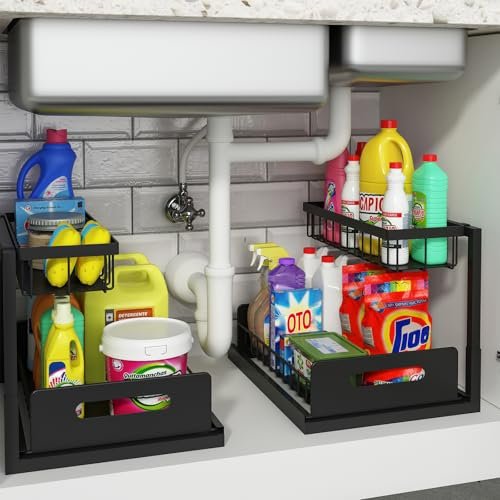
If you’ve ever crawled on the kitchen floor to grab a lost bottle of cleaner from the back of an under-sink cabinet, or dug through a pile of pots to find the one you need, you know how much usable storage space standard cabinets waste. That dark, hard-to-reach "dead space" accounts for 20-30% of most base cabinet interiors, per practical kitchen design observations — and it’s the biggest culprit behind cluttered, inefficient kitchens.
Pull-out organizers are the no-renovation solution to this problem, turning unused under-cabinet space into fully accessible, organized storage for everything from cleaning supplies to cookware. Unlike static shelves that force you to rummage for hidden items, these organizers slide out smoothly on tracks, bringing every item into plain view and reach. They work for renters and homeowners alike, fit most standard cabinet sizes, and cost a fraction of a full kitchen remodel.
In this guide, we break down the best types of pull-out under-cabinet organizers for every use case, share pro tips for choosing and installing them, and highlight top-rated products for small kitchens, under-sink spaces, and tight cabinets. We also cover safety best practices and complementary storage ideas to maximize your entire kitchen’s efficiency.
Why Under-Cabinet Pull-Out Organizers Are a Storage Game-Changer
Most standard lower kitchen cabinets have a fixed shelf that leaves the back 6-12 inches of space completely unreachable without moving items in front. Over time, this leads to lost supplies, expired products, and wasted storage potential. Pull-out organizers solve this by mounting to the cabinet’s existing shelf pins or wall tracks, sliding the entire storage unit out into the open when you need access.
Beyond eliminating dead space, these organizers cut down on the time you spend searching for items, reduce clutter by keeping like items grouped together, and extend the life of perishable supplies (no more forgotten cleaning products or dry goods hidden in the back of cabinets). They’re also versatile: use them in under-sink cabinets for cleaning and personal care items, base cabinets for pots and pans, or even pantry cabinets for snack and dry goods storage. For small apartments or galley kitchens where every inch counts, pull-out organizers can add the equivalent of an extra cabinet’s worth of usable space without any major construction.
Types of Pull-Out Under-Cabinet Organizers (and When to Use Each)
Not all pull-out organizers are built the same — the right choice depends on your cabinet size, what you’re storing, and your installation preferences. Below are the most common types, with recommendations for every use case.
Slide-Out Shelf Organizers (Best for General, Low-Profile Storage)
These are the most basic, affordable pull-out option: a single tier of shelving that slides out on smooth tracks, usually made of coated steel or durable plastic. They’re ideal for storing lightweight to medium-weight items under sinks, in pantry cabinets, or in lower base cabinets for small appliances.
- Pros: Low cost, easy no-tool installation (most mount directly to existing shelf pins), fits nearly all standard cabinet interiors.
- Cons: Single-tier design offers limited vertical storage, lower weight capacity than multi-tier units.
Top picks for this category include:
 A compact, moisture-resistant organizer ideal for under-sink cleaning supply storage
The REALINN 2-pack is a top choice for under-sink spaces, with a slim 11-inch height that fits around most sink plumbing, and a durable black coated steel frame that resists water damage. Its slide-out design lets you grab items from the back of the cabinet without rummaging, and the 2-pack lets you outfit two cabinets (e.g., kitchen and bathroom) for a low cost. A common trade-off is its limited color options (only black is available), but it blends seamlessly with most standard cabinet finishes. For a compact, moisture-resistant option ideal for under-sink cleaning supply storage, the REALINN 2-pack is a durable, budget-friendly pick available on Amazon.
A compact, moisture-resistant organizer ideal for under-sink cleaning supply storage
The REALINN 2-pack is a top choice for under-sink spaces, with a slim 11-inch height that fits around most sink plumbing, and a durable black coated steel frame that resists water damage. Its slide-out design lets you grab items from the back of the cabinet without rummaging, and the 2-pack lets you outfit two cabinets (e.g., kitchen and bathroom) for a low cost. A common trade-off is its limited color options (only black is available), but it blends seamlessly with most standard cabinet finishes. For a compact, moisture-resistant option ideal for under-sink cleaning supply storage, the REALINN 2-pack is a durable, budget-friendly pick available on Amazon.
 Versatile 2-pack organizers that work for both kitchen and bathroom storage
The Ukeetap 2-pack offers a slightly taller 12.8-inch height, making it suitable for cabinets with higher clearance, and a versatile design that works for both kitchen cleaning supplies and bathroom toiletries. Its sturdy plastic frame is lightweight and easy to move when cleaning, though it has a lower weight capacity than steel models, so it’s not ideal for heavy cast iron cookware or large bulk cleaning bottles. If you need versatile organizers for both kitchen and bathroom spaces, the Ukeetap 2-pack offers a lightweight, easy-to-install solution available on Amazon.
Versatile 2-pack organizers that work for both kitchen and bathroom storage
The Ukeetap 2-pack offers a slightly taller 12.8-inch height, making it suitable for cabinets with higher clearance, and a versatile design that works for both kitchen cleaning supplies and bathroom toiletries. Its sturdy plastic frame is lightweight and easy to move when cleaning, though it has a lower weight capacity than steel models, so it’s not ideal for heavy cast iron cookware or large bulk cleaning bottles. If you need versatile organizers for both kitchen and bathroom spaces, the Ukeetap 2-pack offers a lightweight, easy-to-install solution available on Amazon.
 Sleek white steel organizer that matches light-colored cabinetry
For homeowners with white or light wood cabinetry, the Mixeshop organizer offers a low-profile steel build in a matching white finish, so it doesn’t look out of place in open cabinets. Its 13.9-inch height fits most standard under-sink spaces, and the steel construction can hold up to 20 pounds of supplies, making it a durable choice for heavier items. Note that it only comes in a single pack, so you’ll need to purchase multiple units for multiple cabinets. If you have light-colored cabinetry and want a matching organizer for heavy items, the Mixeshop white steel model offers a sleek look and durable construction available on Amazon.
Sleek white steel organizer that matches light-colored cabinetry
For homeowners with white or light wood cabinetry, the Mixeshop organizer offers a low-profile steel build in a matching white finish, so it doesn’t look out of place in open cabinets. Its 13.9-inch height fits most standard under-sink spaces, and the steel construction can hold up to 20 pounds of supplies, making it a durable choice for heavier items. Note that it only comes in a single pack, so you’ll need to purchase multiple units for multiple cabinets. If you have light-colored cabinetry and want a matching organizer for heavy items, the Mixeshop white steel model offers a sleek look and durable construction available on Amazon.
Two-Tier Vertical Organizers (Best for Maximizing Small Cabinet Space)
If you have a narrow cabinet with limited width, a two-tier organizer doubles your usable storage by adding a second level of shelving. These are perfect for under-sink areas with low clearance, or base cabinets where you need to separate items (e.g., cleaning supplies on the bottom tier, personal care items on top).
- Pros: Maximizes vertical space, keeps items separated and easy to find, fits in cabinets as narrow as 9 inches.
- Cons: Taller design may not fit cabinets with less than 12 inches of clearance, most require assembly.
 3-pack of 2-tier organizers for outfitting multiple cabinets at a low cost
The Sevenblue 3-pack is a budget-friendly option for outfitting multiple cabinets, with a 2-tier design that adds extra storage without taking up extra floor space. Its sliding drawers let you access items from the back of the cabinet without pulling the entire unit out, and the compact 12.8-inch height fits most standard under-sink spaces. The only downside is its limited weight capacity, so it’s best for lightweight to medium-weight items. If you need to outfit multiple cabinets on a budget, the Sevenblue 3-pack of 2-tier organizers offers a low-cost, space-saving solution available on Amazon.
3-pack of 2-tier organizers for outfitting multiple cabinets at a low cost
The Sevenblue 3-pack is a budget-friendly option for outfitting multiple cabinets, with a 2-tier design that adds extra storage without taking up extra floor space. Its sliding drawers let you access items from the back of the cabinet without pulling the entire unit out, and the compact 12.8-inch height fits most standard under-sink spaces. The only downside is its limited weight capacity, so it’s best for lightweight to medium-weight items. If you need to outfit multiple cabinets on a budget, the Sevenblue 3-pack of 2-tier organizers offers a low-cost, space-saving solution available on Amazon.
 2-pack with sliding bottom baskets for easy access to bulky items
The MEAFBIRD 2-pack stands out for its sliding bottom tier, which pulls out independently of the top shelf, making it easy to grab bulky items like large cleaning bottles without moving everything on the top tier. Its sturdy steel frame holds up to 25 pounds, and the compact design fits even narrow under-sink cabinets. Note that it may not fit cabinets with large central plumbing obstructions, so measure your space before purchasing. If you need easy access to bulky under-sink items without moving everything on the top tier, the MEAFBIRD 2-pack features a sliding bottom basket for independent access available on Amazon.
2-pack with sliding bottom baskets for easy access to bulky items
The MEAFBIRD 2-pack stands out for its sliding bottom tier, which pulls out independently of the top shelf, making it easy to grab bulky items like large cleaning bottles without moving everything on the top tier. Its sturdy steel frame holds up to 25 pounds, and the compact design fits even narrow under-sink cabinets. Note that it may not fit cabinets with large central plumbing obstructions, so measure your space before purchasing. If you need easy access to bulky under-sink items without moving everything on the top tier, the MEAFBIRD 2-pack features a sliding bottom basket for independent access available on Amazon.
L-Shaped Corner Organizers (Best for Tight, Awkward Spaces)
Standard rectangular pull-out organizers don’t work for corner cabinets or under-sink spaces with large P-traps and plumbing lines that take up most of the cabinet width. L-shaped organizers are designed to wrap around these obstructions, making use of the otherwise wasted space on either side of the pipes.
- Pros: Fits around plumbing and in corner cabinets, no wasted space, perfect for very narrow cabinets.
- Cons: Only works for L-shaped cabinet interiors, limited weight capacity for very heavy items.
 L-shaped 2-tier organizer with built-in hooks for hanging small items
This 2-pack L-shaped organizer is designed for narrow cabinets as small as 9 inches wide, with an L-shaped profile that wraps around under-sink plumbing without blocking access. It includes 4 built-in hooks for hanging sponges, scrubbers, and small towels, adding extra utility without taking up shelf space. The sliding mechanism lets you pull out the entire unit to access items stored behind pipes, a common pain point for static under-sink shelves. For narrow cabinets with under-sink plumbing, the L-shaped 2-pack organizers wrap around pipes and include built-in hooks for extra storage available on Amazon.
L-shaped 2-tier organizer with built-in hooks for hanging small items
This 2-pack L-shaped organizer is designed for narrow cabinets as small as 9 inches wide, with an L-shaped profile that wraps around under-sink plumbing without blocking access. It includes 4 built-in hooks for hanging sponges, scrubbers, and small towels, adding extra utility without taking up shelf space. The sliding mechanism lets you pull out the entire unit to access items stored behind pipes, a common pain point for static under-sink shelves. For narrow cabinets with under-sink plumbing, the L-shaped 2-pack organizers wrap around pipes and include built-in hooks for extra storage available on Amazon.
Rotating Utility Hooks (Best for Utensil and Tool Storage)
If you’re looking to free up drawer and counter space for cooking utensils, pot lids, and small kitchen tools, rotating under-cabinet hooks are the perfect solution. These mount directly to the underside of upper cabinets (no drilling required for most adhesive models) and rotate 360 degrees, so you can access items from any angle.
- Pros: No permanent installation damage, 360-degree access, frees up drawer and counter space.
- Cons: Adhesive may not hold on textured cabinet undersides, limited weight capacity (usually 5-10 pounds per hook).
 2-pack of 360-degree rotating hooks for hanging kitchen utensils
The DEPAOTLUX 2-pack hooks are a no-fuss option for renters or anyone who doesn’t want to drill into their cabinetry, with a strong adhesive backing that holds up to 10 pounds per hook on smooth cabinet surfaces. The 360-degree rotation lets you grab utensils, pot lids, or measuring cups without moving other items out of the way, and the compact black design blends in with most cabinet finishes. Note that the adhesive may not hold as well on textured wood or laminate undersides, so test a small area first before hanging heavy items. If you want to free up drawer space for utensils without drilling into your cabinets, the DEPAOTLUX 2-pack of 360-degree rotating adhesive hooks offers a renter-friendly solution available on Amazon.
2-pack of 360-degree rotating hooks for hanging kitchen utensils
The DEPAOTLUX 2-pack hooks are a no-fuss option for renters or anyone who doesn’t want to drill into their cabinetry, with a strong adhesive backing that holds up to 10 pounds per hook on smooth cabinet surfaces. The 360-degree rotation lets you grab utensils, pot lids, or measuring cups without moving other items out of the way, and the compact black design blends in with most cabinet finishes. Note that the adhesive may not hold as well on textured wood or laminate undersides, so test a small area first before hanging heavy items. If you want to free up drawer space for utensils without drilling into your cabinets, the DEPAOTLUX 2-pack of 360-degree rotating adhesive hooks offers a renter-friendly solution available on Amazon.
Stackable Multi-Tier Organizers with Dividers (Best for Customizable Storage)
For pantry cabinets or larger base cabinets where you need to store small items like spice jars, snack packets, or baking supplies, stackable multi-tier organizers with movable dividers offer full customization. You can adjust the height of each tier and move dividers to create compartments of any size, so nothing rolls around or gets lost.
- Pros: Fully customizable storage, stackable to fit your cabinet height, dividers keep items organized.
- Cons: May not fit very small cabinets, assembly required.
 2-set of stackable 2-tier organizers with 8 movable dividers for custom storage
The Delamu 2-set offers two 2-tier units that can be stacked to create 4 tiers of storage, with 8 movable dividers that let you customize compartment sizes for everything from tall spice jars to small snack packets. The white finish matches most cabinet interiors, and the sturdy plastic construction resists moisture, making it suitable for both kitchen and bathroom use. The only downside is that the stacked height may exceed the clearance of smaller cabinets, so measure your space before purchasing. For customizable pantry or under-sink storage for small items like spices and snacks, the Delamu stackable 2-tier set with movable dividers offers full flexibility available on Amazon.
2-set of stackable 2-tier organizers with 8 movable dividers for custom storage
The Delamu 2-set offers two 2-tier units that can be stacked to create 4 tiers of storage, with 8 movable dividers that let you customize compartment sizes for everything from tall spice jars to small snack packets. The white finish matches most cabinet interiors, and the sturdy plastic construction resists moisture, making it suitable for both kitchen and bathroom use. The only downside is that the stacked height may exceed the clearance of smaller cabinets, so measure your space before purchasing. For customizable pantry or under-sink storage for small items like spices and snacks, the Delamu stackable 2-tier set with movable dividers offers full flexibility available on Amazon.
 3-pack of L-shaped organizers with extra hooks and a hanging cup for utensils
The Sevenblue 3-pack L-shaped set adds extra utility with built-in hooks and a hanging cup for storing small utensils, measuring cups, and scrubbers. Its L-shaped design wraps around under-sink plumbing, and the compact 12.85-inch height fits most standard cabinets. The durable plastic construction resists moisture, making it suitable for both kitchen and bathroom use. For a versatile set of L-shaped organizers with extra hanging storage, the Sevenblue 3-pack includes hooks and a hanging cup for utensils and small tools available on Amazon.
3-pack of L-shaped organizers with extra hooks and a hanging cup for utensils
The Sevenblue 3-pack L-shaped set adds extra utility with built-in hooks and a hanging cup for storing small utensils, measuring cups, and scrubbers. Its L-shaped design wraps around under-sink plumbing, and the compact 12.85-inch height fits most standard cabinets. The durable plastic construction resists moisture, making it suitable for both kitchen and bathroom use. For a versatile set of L-shaped organizers with extra hanging storage, the Sevenblue 3-pack includes hooks and a hanging cup for utensils and small tools available on Amazon.
How to Choose the Right Pull-Out Organizer for Your Kitchen
With so many options on the market, picking the right organizer can feel overwhelming. Follow these guidelines to find the perfect fit for your space and needs:
- Measure your cabinet interior first — this is the most critical step, and a common mistake many buyers make. Measure the width, depth, and height of your cabinet interior, and note the location of any plumbing, pipes, or shelf pins. An organizer that’s even ½ inch too tall won’t slide out fully, and one that’s too wide will block cabinet doors from closing.
- Match the organizer to your use case: If you’re storing items under a sink where moisture is common, opt for moisture-resistant coated steel or plastic organizers that won’t rust. For heavy items like cast iron cookware or bulk cleaning supplies, choose a steel model with a weight capacity of at least 20 pounds. For small items like spices or utensils, a model with built-in dividers or hooks will keep things organized.
- Consider installation requirements: Most slide-out shelf organizers mount directly to existing cabinet shelf pins with no tools needed, making them ideal for renters. If you opt for a track-mounted model, check if it requires drilling into cabinet walls — if you’re renting, look for no-drill track options or stick to pin-mounted designs. For heavy organizers, secure them to the cabinet wall with cabinet safety locks to prevent tip-overs, especially in homes with young children. Follow Consumer Product Safety Commission guidance on securing heavy storage units to avoid accidents.
- Prioritize smooth sliding mechanisms: Cheap organizers often have stiff tracks that stick or slide out unintentionally. Look for models with ball-bearing tracks for smooth, quiet operation, and check reviews for comments about long-term durability of the sliding mechanism.
Pro Tips for Installing and Using Pull-Out Organizers
Getting the most out of your pull-out organizers is easy with these simple, field-tested tips:
- Clear your cabinet fully before installing: Remove all items, wipe down the interior to remove dust and debris, and measure twice before marking any installation points. This ensures your organizer sits level and slides smoothly.
- Group like items together: Store all cleaning supplies on one tier, personal care items on another, and cookware on a third, so you always know where to look for what you need. Pair your under-cabinet pull-outs with kitchen drawer organization strategies to create a full, cohesive storage system for your entire kitchen.
- Use small bins or baskets inside pull-out organizers to keep tiny items (sponges, scrubbers, spice packets, utensils) from rolling around or getting lost. Bins also make it easy to pull out an entire category of items at once for cleaning or cooking.
- Avoid overloading organizers: Most models have a weight capacity of 10-25 pounds; overloading can damage tracks, make sliding difficult, and increase the risk of tip-overs. Distribute heavy items across multiple tiers or cabinets if needed.
- For renters, stick to no-drill options like pin-mounted shelves or adhesive hooks, which won’t damage cabinet finishes and can be removed easily when you move. Test adhesive products on a small, inconspicuous area of your cabinet first to ensure they hold without leaving residue.
Complementary Storage Ideas to Maximize Your Kitchen’s Efficiency
Pull-out organizers are just one part of a functional kitchen storage system. Pair them with these simple additions to unlock even more space and convenience:
- Add low-profile non-slip kitchen rugs in front of your under-cabinet storage areas to prevent slips when pulling out heavy organizers or bending to grab items. Machine-washable options are ideal for kitchen messes.
- For upper cabinet storage of dishes and glassware, install a hanging pot rack to free up lower cabinet space for pull-out organizers, especially in small kitchens where every lower cabinet inch counts.
- Lay a non-slip runner rug for kitchen along high-traffic areas between your cabinets and island or counter space to make accessing storage safer and more comfortable, especially when your hands are full.
- For small kitchen gadgets and specialty tools that don’t fit in pull-out organizers, check out our latest kitchen organization guides for creative storage solutions that fit any layout or budget.
Frequently Asked Questions
What is the best under-cabinet pull-out organizer for small kitchens?
For small kitchens with narrow cabinets (under 10 inches wide), opt for low-profile slide-out shelf organizers or L-shaped models that fit tight spaces without blocking cabinet doors. Stackable two-tier organizers also maximize vertical space without taking up extra floor room. Avoid bulky multi-tier units if your cabinet clearance is under 12 inches.
Do pull-out under-cabinet organizers work for renters?
Yes, most pin-mounted or adhesive-backed pull-out organizers require no drilling, so they won’t damage cabinet finishes and can be removed when you move. Avoid models that require screwing tracks into cabinet walls if you’re renting, and test adhesive products on a small area first to ensure they hold without leaving residue.
How do I choose an organizer that fits around under-sink plumbing?
Measure the width of your cabinet interior and the depth of your sink’s P-trap and supply lines. L-shaped pull-out organizers are designed to wrap around pipes, while standard rectangular organizers work for cabinets with central plumbing that leaves at least 4 inches of clearance on either side.
Can I use pull-out organizers for anything besides under-sink storage?
Absolutely. They work equally well in lower base cabinets for pots, pans, and small appliances, pantry cabinets for dry goods and snacks, and even upper cabinets for dishes and glassware. Rotating utility hooks also work on the underside of upper cabinets for hanging utensils and pot lids.
How much weight can a typical under-cabinet pull-out organizer hold?
Most standard pull-out organizers have a weight capacity of 10 to 25 pounds, depending on construction. Coated steel models hold more weight than plastic ones, so check product specs if you plan to store heavy items like cast iron cookware or large bulk cleaning supply bottles.
Conclusion
Pull-out under-cabinet organizers are one of the simplest, most cost-effective ways to unlock hidden storage space in your kitchen, no renovation required. By eliminating dead space and bringing every item into full view, they reduce clutter, cut down on time spent searching for supplies, and make your kitchen feel more functional and efficient, even in small spaces.
There’s a pull-out organizer design for every use case and cabinet size: slide-out shelves for general storage, two-tier units for small cabinets, L-shaped models for awkward plumbing spaces, rotating hooks for utensils, and stackable dividers for customizable pantry storage. The key to finding the right fit is to measure your cabinet interiors first, match the organizer to what you’ll be storing, and prioritize safety by securing heavy units to cabinet walls.
Pair your new pull-out organizers with complementary storage solutions like non-slip kitchen rugs and hanging pot racks to create a fully optimized kitchen that works for your routine. Ready to tackle your cluttered under-cabinet space? Start by measuring your cabinets this weekend to find the perfect organizer for your needs — you’ll be amazed how much extra storage you unlock without lifting a hammer.

Hi, I’m Daniel Brooks—a food lover and kitchen gear enthusiast. I enjoy testing cookware, utensils, and gadgets to see what really works in everyday cooking. At PlugChef.com, I share honest reviews, comparisons, and simple guides to help you choose the best tools for a safer, smarter, and more enjoyable kitchen.
Related posts:
 Small Kitchen Appliance Cover Sets: Protect & Organize Your Culinary Space
 Sam’s Club Kitchen Appliances: Must-Have Kids Play Kitchen Accessories Set
 Kitchen Appliance Bundles on Sale: Transform Your Cooking Experience Today
 Best Kitchen Knives Sets for Precision, Durability, and Stylish Cooking
 Best Tool for Slicing Vegetables: Durable Stainless Steel Onion Holder Guide
 Best Tools for Baking Bread: Essential Kits for Perfect Artisan Loaves