Few things are more frustrating than opening a new bag of your pet’s favorite kibble only to find it stale, bug-ridden, or rancid after just a few weeks of storage. The right storage containers for pet food do more than just keep kibble fresh—they lock in essential nutrients, block pests, reduce food waste, and make feeding time faster and more convenient for busy pet owners. Whether you have a tiny toy poodle, a large Great Dane, or a flock of pet birds, the right container fits your pet’s dietary needs, your storage space, and your daily routine. We’ve tested the top options on the market to help you find the best pick to keep your pet’s meals fresh and accessible every day.
Why Proper Pet Food Storage Matters
It’s a common scenario: you buy a 30-pound bag of your pet’s favorite kibble, leave it partially opened in a pantry corner, and a few weeks later you notice bugs in the food, or your pet turns their nose up at meals that taste stale. Improper storage doesn’t just lead to wasted money and food—it can pose serious health risks to your pet. When dry pet food is exposed to air, the natural animal fats in the kibble oxidize, causing rancidity that not only ruins flavor but can trigger gastrointestinal distress, including vomiting and diarrhea, with repeated consumption. Moisture from humid pantries or leaky roofs can lead to mold growth, which may produce dangerous mycotoxins that cause liver damage in pets. Pests like ants, pantry moths, and rodents are also drawn to unsealed pet food, and their droppings can spread disease. The FDA’s pet food storage guidance notes that improper storage is one of the top causes of preventable pet food spoilage and related pet health issues. A properly sealed, dedicated storage container blocks oxygen, moisture, and pests, locking in flavor and nutrients for months after opening the original bag.
Key Features to Look for in High-Quality Pet Food Storage Containers
Not all pet food containers are created equal, and prioritizing the right features will ensure your investment keeps food fresh for as long as possible. Below are the core traits to evaluate before purchasing.
Airtight Seal
A high-quality airtight seal is the most important feature of any pet food container, as it is your primary defense against spoilage. Look for containers with silicone gaskets and locking latches, not just simple snap-on lids—you should be able to pull the lid apart with moderate force when it’s locked, confirming no air can seep in. AAFCO, the body that sets nutritional standards for pet food in the U.S., recommends storing dry kibble in airtight containers at temperatures below 80°F to preserve vitamin and mineral content. A common mistake is buying a container with a loose-fitting lid that only stays closed when the container is full; always test the seal with a small amount of food first to confirm it holds.
Material Safety
Prioritize containers made from BPA-free, food-grade plastic to avoid chemical leaching into your pet’s food. Lower-quality plastics can absorb rancid fats from kibble over time, leading to stale odors and potential health risks, especially if the container is stored in warm environments. Containers made in the USA often adhere to stricter manufacturing safety standards, but always check product specifications for explicit BPA-free and food-safe claims. Avoid porous materials like uncoated cardboard or thin plastic, which can hold moisture and attract pests.
Capacity and Size
Choose a container that holds 1.5x the size of your typical pet food bag to account for bulk purchases and avoid frequent refills. For small dogs, cats, or birds, a 5–10lb container is sufficient. Medium pets (30–60lb dogs, multiple cats) typically need 15–25lb capacity. Large breeds, multi-pet households, or people who buy 30lb+ bags of kibble should opt for 30lb or larger containers, or multiple smaller stackable units. A common mistake is buying a container that’s exactly the size of your current pet food bag, leaving no room for bulk purchases later—always measure your typical bag size and add 20% for extra capacity.
Mobility Features
Wheeled containers are ideal for heavy 20lb+ bulk bags, eliminating the need to lift full containers to move them between pantries, garages, or feeding stations. Look for heavy-duty casters that roll smoothly over both tile and low-pile carpet, with a weight capacity that matches your full container’s weight. For smaller containers, ergonomic handles with non-slip grips make carrying full bins easier. Note that wheels can catch on threshold edges or thick carpet, so wheeled models are best suited for homes with mostly hard flooring.
Additional Convenience Features
Stackable designs save floor space in pantries, letting you separate kibble, treats, and supplements in separate units. If you have young children or curious large pets, pair your pet food storage with secure cabinet locks to keep containers out of reach and prevent accidental spills. Transparent or translucent walls let you monitor food levels at a glance without opening the lid, reducing exposure to air and pests. Integrated scoops eliminate the need to find a separate serving utensil, and collapsible designs fold flat for travel or small-space storage.
Top Pet Food Storage Containers Tested for Freshness and Accessibility
We evaluated the most popular options on the market for durability, seal effectiveness, and ease of use, organized by use case to match your household needs.
Best for Bulk Buyers and Multi-Pet Households
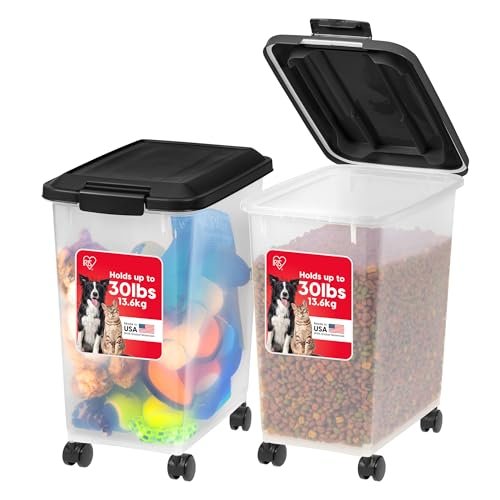
IRIS USA 2-Pack 30lb Airtight Container with Wheels
 Two wheeled IRIS USA 30lb containers for bulk pet food storage.
This 2-pack is the gold standard for households with 2+ large dogs, or a dog and cat that go through a 30lb bag every 2–3 weeks. Each bin features a locking airtight snap-lid seal, one-hand opening for quick serving, and integrated wheels that roll smoothly over most flooring. Made in the USA from BPA-free plastic, the clear body lets you check food levels at a glance.
Two wheeled IRIS USA 30lb containers for bulk pet food storage.
This 2-pack is the gold standard for households with 2+ large dogs, or a dog and cat that go through a 30lb bag every 2–3 weeks. Each bin features a locking airtight snap-lid seal, one-hand opening for quick serving, and integrated wheels that roll smoothly over most flooring. Made in the USA from BPA-free plastic, the clear body lets you check food levels at a glance.
- Pros: 60lb total capacity for bulk buys, easy mobility, one-hand operation, USA-made BPA-free construction
- Cons: Takes up significant floor space, not ideal for small apartments For multi-pet households that buy kibble in bulk, this 2-pack eliminates frequent store runs and keeps large quantities fresh.
IRIS USA 30lb Airtight Container with Wheels
 Single 30lb IRIS USA container with integrated wheels for easy mobility when full.
Identical in features to the 2-pack but sold as a single unit, this container is perfect for households with one large dog that goes through a 30lb bag every 4–6 weeks. The wheeled base makes moving a full 30lb bin effortless, and the one-hand opening is ideal for busy owners multitasking during feeding time.
Single 30lb IRIS USA container with integrated wheels for easy mobility when full.
Identical in features to the 2-pack but sold as a single unit, this container is perfect for households with one large dog that goes through a 30lb bag every 4–6 weeks. The wheeled base makes moving a full 30lb bin effortless, and the one-hand opening is ideal for busy owners multitasking during feeding time.
- Pros: High capacity, easy mobility, clear body to monitor levels
- Cons: Bulky footprint, wheels may catch on thick carpet
IRIS USA 30lb & 11lb Combo Airtight Container
 Stackable IRIS USA combo set separates bulk kibble from treats in one unit.
This stackable combo pairs a 30lb main kibble bin with an 11lb treat bin, both with airtight seals and integrated wheels. The stackable design saves floor space, and the separate bins let you keep treats separate from main meals to avoid overfeeding. The navy finish complements most home decor, and the BPA-free construction is safe for all pet food types.
Stackable IRIS USA combo set separates bulk kibble from treats in one unit.
This stackable combo pairs a 30lb main kibble bin with an 11lb treat bin, both with airtight seals and integrated wheels. The stackable design saves floor space, and the separate bins let you keep treats separate from main meals to avoid overfeeding. The navy finish complements most home decor, and the BPA-free construction is safe for all pet food types.
- Pros: Separate storage for kibble and treats, stackable space-saving design, wheeled mobility
- Cons: Only available in navy, total footprint is still large for small spaces
Gamma2 Vittles Vault 25lb Airtight Container
 Gamma2 Vittles Vault’s compact 25lb design fits neatly in pantries and garages.
For bulk buyers who don’t have floor space for wheeled bins, this compact Gamma2 Vittles Vault is a top pick. Made in the USA from heavy-duty BPA-free plastic, its airtight seal blocks pests and moisture effectively, and its slim profile fits neatly in pantries, garage shelves, or laundry rooms. It fits standard 25lb kibble bags without transferring, reducing mess.
Gamma2 Vittles Vault’s compact 25lb design fits neatly in pantries and garages.
For bulk buyers who don’t have floor space for wheeled bins, this compact Gamma2 Vittles Vault is a top pick. Made in the USA from heavy-duty BPA-free plastic, its airtight seal blocks pests and moisture effectively, and its slim profile fits neatly in pantries, garage shelves, or laundry rooms. It fits standard 25lb kibble bags without transferring, reducing mess.
- Pros: Compact space-efficient design, USA-made, durable heavy-duty construction
- Cons: No mobility features, smaller capacity than 30lb options
Best for Small Spaces and Travel
IRIS USA WeatherPro 10lb Single Airtight Container
 Compact 10lb WeatherPro container fits in small pantries and damp garages.
Perfect for small apartments, single-pet households with small dogs or cats, or treat storage, this 10lb container features IRIS’s WeatherPro seal that blocks humidity, making it safe for storage in damp garages or unclimate-controlled pantries. The translucent body lets you monitor levels at a glance, and the stackable design lets you add more units as needed. It’s BPA-free and made in the USA.
Compact 10lb WeatherPro container fits in small pantries and damp garages.
Perfect for small apartments, single-pet households with small dogs or cats, or treat storage, this 10lb container features IRIS’s WeatherPro seal that blocks humidity, making it safe for storage in damp garages or unclimate-controlled pantries. The translucent body lets you monitor levels at a glance, and the stackable design lets you add more units as needed. It’s BPA-free and made in the USA.
- Pros: Compact size, weather-resistant seal, stackable, USA-made
- Cons: Too small for large pets or bulk kibble purchases
IRIS USA WeatherPro 10lb Stackable Container (2-Pack)
 Stackable 10lb WeatherPro containers are perfect for organizing multiple pet foods.
This 2-pack of 10lb containers is ideal for multi-pet households with small to medium pets, letting you separate kibble, treats, and supplements in one stackable unit. The WeatherPro seal protects against moisture and pests, and the translucent bodies let you track all food levels at once. The navy finish complements most kitchen decor.
Stackable 10lb WeatherPro containers are perfect for organizing multiple pet foods.
This 2-pack of 10lb containers is ideal for multi-pet households with small to medium pets, letting you separate kibble, treats, and supplements in one stackable unit. The WeatherPro seal protects against moisture and pests, and the translucent bodies let you track all food levels at once. The navy finish complements most kitchen decor.
- Pros: Separate storage for multiple food types, stackable space-saving design, weather-resistant
- Cons: Total 20lb capacity may not be enough for large dogs
DDMOMMY 20lb Collapsible Airtight Container
 Collapsible DDMOMMY container folds flat for travel or small-space storage.
Perfect for pet owners who travel often with their pets, or have extremely limited storage space, this 20lb collapsible container folds flat to just 5 inches tall when not in use. The transparent airtight lid lets you monitor food levels, and it includes a pet food scoop and small bonus bowl for feeding on the go. It’s also multifunctional, working for rice, flour, or other dry household goods.
Collapsible DDMOMMY container folds flat for travel or small-space storage.
Perfect for pet owners who travel often with their pets, or have extremely limited storage space, this 20lb collapsible container folds flat to just 5 inches tall when not in use. The transparent airtight lid lets you monitor food levels, and it includes a pet food scoop and small bonus bowl for feeding on the go. It’s also multifunctional, working for rice, flour, or other dry household goods.
- Pros: Collapsible space-saving design, includes feeding accessories, multifunctional
- Cons: Clear material shows dirt and stains easily, 20lb capacity is mid-range
ANVS 20lb Collapsible Container with Casters
 ANVS collapsible container combines space-saving design with rolling mobility.
This unique container combines the space-saving benefits of a collapsible design with integrated casters for easy mobility, even when full. It holds 20lb of dry kibble, includes a scoop and small treat container, and is perfect for pet owners who need to move their food storage between floors, garages, and feeding areas often. The grey finish blends into most storage spaces.
ANVS collapsible container combines space-saving design with rolling mobility.
This unique container combines the space-saving benefits of a collapsible design with integrated casters for easy mobility, even when full. It holds 20lb of dry kibble, includes a scoop and small treat container, and is perfect for pet owners who need to move their food storage between floors, garages, and feeding areas often. The grey finish blends into most storage spaces.
- Pros: Collapsible + mobile design, includes extra treat storage, BPA-free
- Cons: Casters are not ideal for very thick carpet, grey finish may not match all decor
Best for Convenience and Daily Use
IRIS USA 13lb Airtight Container with Scoop
 IRIS USA 13lb countertop container includes a 2-cup scoop for portion control.
This compact 13lb container is perfect for medium-sized pets, fitting standard medium kibble bags with room to spare. The airtight lid locks in freshness, and the included 2-cup scoop makes portion control easy to manage your pet’s weight and diet. Its small footprint fits easily on kitchen counters or in pantry shelves, and the dark gray finish complements most modern decor. It’s BPA-free and made in the USA.
IRIS USA 13lb countertop container includes a 2-cup scoop for portion control.
This compact 13lb container is perfect for medium-sized pets, fitting standard medium kibble bags with room to spare. The airtight lid locks in freshness, and the included 2-cup scoop makes portion control easy to manage your pet’s weight and diet. Its small footprint fits easily on kitchen counters or in pantry shelves, and the dark gray finish complements most modern decor. It’s BPA-free and made in the USA.
- Pros: Included scoop for portion control, counter-friendly size, airtight seal
- Cons: Too small for large pets or bulk purchases
OXO Good Grips 6qt Pet POP Container
 OXO Good Grips POP container features a one-handed push-button airtight seal.
The iconic OXO POP design is a favorite for countertop pet food storage, with a push-button lid that creates an airtight seal with one hand—ideal for owners multitasking during feeding time. The 6qt capacity holds up to 6.5lb of dog food or 4.5lb of cat food, and the included half scoop ensures precise portions. The clear body lets you monitor levels at a glance, and the BPA-free construction is safe for all pet food types. If you store your pet’s food on a counter near your cooking prep area, use our cutting board engraving guide to label the container clearly and avoid mix-ups with human food.
OXO Good Grips POP container features a one-handed push-button airtight seal.
The iconic OXO POP design is a favorite for countertop pet food storage, with a push-button lid that creates an airtight seal with one hand—ideal for owners multitasking during feeding time. The 6qt capacity holds up to 6.5lb of dog food or 4.5lb of cat food, and the included half scoop ensures precise portions. The clear body lets you monitor levels at a glance, and the BPA-free construction is safe for all pet food types. If you store your pet’s food on a counter near your cooking prep area, use our cutting board engraving guide to label the container clearly and avoid mix-ups with human food.
- Pros: One-handed operation, sleek compact design, trusted brand reputation
- Cons: Clear plastic can expose food to light over time, limited capacity for large pets
Pro Tips for Maximizing Pet Food Freshness
Even the best storage container can’t keep food fresh if you don’t use it correctly. Follow these expert tips to get the most out of your purchase:
- Wait to transfer food: A common mistake is transferring kibble to a new container immediately after opening the original bag. Most kibble bags have a internal fat barrier that prevents the plastic container from absorbing rancid oils and odors—wait until the original bag is nearly empty before transferring to avoid stale flavors.
- Store in a cool, dry place: Keep containers away from direct sunlight, ovens, and humid areas like basements or bathrooms. Heat and light break down nutrients and accelerate fat rancidity, per AAFCO storage guidelines.
- Clean containers regularly: Wash your container every 1–2 months with warm, soapy water and a sturdy cleaning brush to remove built-up kibble oil, which can turn rancid and attract pests over time. Rinse thoroughly and let air dry completely before refilling.
- Keep away from chemicals: Store pet food containers separate from cleaning supplies, pesticides, and other chemicals to avoid cross-contamination.
- Use separate containers for allergies: For pets with food allergies, use dedicated containers for hypoallergenic food to avoid cross-contact with other pet food or treats. For homes with toddlers, use no-drill drawer locks on lower cabinet doors to keep pet food out of reach of young children.
Frequently Asked Questions
How do airtight containers keep pet food fresh?
Airtight containers create a barrier against oxygen, moisture, and pests, which are the three main causes of pet food spoilage. Oxygen exposure breaks down the fats in kibble, leading to rancidity that not only makes food unpalatable but can cause digestive upset in pets. Moisture leads to mold growth, which can produce dangerous mycotoxins. A tight seal also blocks ants, pantry moths, and rodents, which are common in homes where pet food is stored in its original bag. For best results, look for containers with silicone gaskets and locking latches, not just snap-on lids.
Are pet food storage containers safe for pets?
Most high-quality containers are made from BPA-free, food-grade plastic that is non-toxic for pet food storage. Look for containers that are labeled as BPA-free and made from food-safe materials, as lower-quality plastics can leach chemicals into food over time, especially if stored in hot environments. Containers made in the USA often adhere to stricter manufacturing safety standards, but always check the product specifications for material safety claims.
Can I store wet pet food in these containers?
Most standard dry pet food containers are designed for kibble, pellets, and treats, not wet food. Wet food should be stored in airtight, refrigerated containers specifically designed for perishable items, and used within 3–5 days of opening. Some larger, airtight containers may work for short-term wet food storage in the fridge, but always check the manufacturer's guidelines before using a dry food container for wet food.
How often should I clean my pet food storage container?
Clean your container every 1–2 months, or immediately if you notice any mold, pest activity, or stale odors. Wash with warm, soapy water, rinse thoroughly, and let air dry completely before refilling. Oil from kibble can build up on the inside of containers over time, creating a breeding ground for bacteria and attracting pests, so regular cleaning is key to keeping food safe.
What capacity do I need for my pet?
As a general rule, choose a container that holds 1.5x the size of your typical pet food bag to account for bulk purchases. For small dogs, cats, or birds, a 5–10lb container is sufficient. Medium pets (30–60lb dogs, multiple cats) typically need 15–25lb capacity. Large breeds, multi-pet households, or people who buy 30lb+ bags of kibble should opt for 30lb or larger containers, or multiple smaller stackable units.
Conclusion
Choosing the right storage container for your pet’s food is a small investment that pays off in less waste, healthier meals, and a simpler feeding routine. For multi-pet households or bulk buyers, wheeled 30lb containers offer unmatched convenience for moving heavy bags of kibble. For small apartments or frequent travelers, collapsible or stackable models save space without sacrificing freshness. No matter your needs, prioritize an airtight seal, BPA-free food-safe materials, and a capacity that matches your pet’s consumption rate to get the most value out of your purchase. For more pet care and home organization advice, browse our practical home guides to simplify every part of your routine. Invest in a high-quality pet food storage container today to keep your furry friend’s meals nutritious, cut down on wasted food, and make feeding time faster and easier for everyone.

Hi, I’m Daniel Brooks—a food lover and kitchen gear enthusiast. I enjoy testing cookware, utensils, and gadgets to see what really works in everyday cooking. At PlugChef.com, I share honest reviews, comparisons, and simple guides to help you choose the best tools for a safer, smarter, and more enjoyable kitchen.
Related posts:
 Best Budget Soda Makers: Top Picks for Refreshing Sparkling Water
 Hamilton Beach Small Kitchen Appliances: Elevate Your Culinary Experience Effortlessly
 Best Food Mills for Baby Food: Top Picks for Homemade Purees
 High End Kitchen Appliances Packages: Elevate Your Culinary Experience
 Best Coffee Making Accessories: Elevate Your Brew With Essential Tools
 Voltage Converter 220 to 110 for Kitchen Appliances: Seamless Power Transition