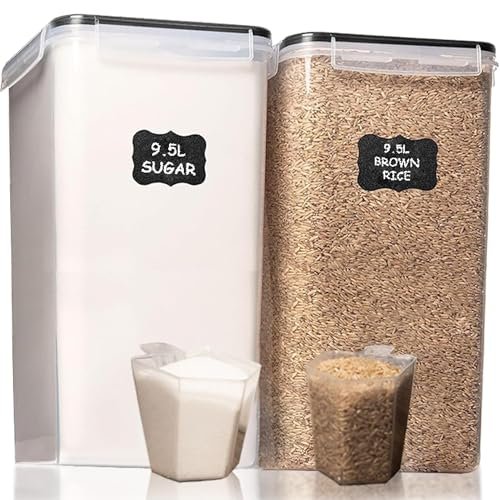
Bulk buying dry goods like flour, rice, cereal, and pet food saves households money and reduces disposable packaging waste, but flimsy original packaging, pest infestations, and cluttered pantry shelves often erase those savings. Airtight bulk food storage containers solve these pain points by keeping ingredients fresh, blocking pests, and streamlining shelf space with uniform, stackable designs. Unlike repurposed margarine tubs or zip-top bags that fail to seal out air and moisture, dedicated airtight containers extend the shelf life of dry goods by months, cut down on time spent searching for ingredients, and make pantries look tidy with minimal effort. Whether you’re a home baker, meal prepper, or multi-pet household owner, the right containers turn a chaotic pantry into a functional, space-efficient storage hub.
Pairing these containers with reliable childproof pantry access measures keeps curious toddlers from accessing bulk staples like nuts, candy, or choking hazards. childproof pantry access
Why Airtight Bulk Food Storage Containers Are a Non-Negotiable Kitchen Staple
The USDA’s official dry food storage safety guidelines recommend storing bulk grains, cereals, and flours in airtight, food-grade containers to prevent spoilage and minimize household food waste. Beyond reducing waste, high-quality airtight containers deliver three core benefits for modern kitchens:
- Extended freshness: A tight seal blocks air, moisture, and odors that cause flour to go rancid, cereal to turn stale, and pet food to lose nutritional value.
- Pest prevention: Weevils, pantry moths, and rodents can chew through paper and thin plastic packaging; an airtight, rigid container creates an impenetrable barrier.
- Space maximization: Uniform, stackable designs eliminate the wasted gaps between mismatched original packaging, letting you fit 20-30% more items on the same shelf space. A common mistake homeowners make is reusing old yogurt tubs, margarine containers, or flimsy zip-top bags for bulk storage. In practice, these makeshift solutions fail to create a consistent seal, leading to stale ingredients and frequent pest issues that cost more to fix than investing in dedicated containers.
Key Features to Prioritize When Shopping for Airtight Bulk Containers
Not all airtight containers are created equal, and prioritizing the right features ensures you get a product that lasts for years and delivers on its space-saving promise. Below are the non-negotiable traits to look for:
Seal Integrity
The seal is the most important feature of any airtight container. Look for models with a thick silicone gasket (not thin rubber, which wears out after 6-12 months of regular use) and secure locking latches or screw-top lids that create even pressure around the container edge. A quick at-home test: close the container with a small slip of paper inside, then try to pull the paper out. If it slides out easily, the seal is insufficient for long-term storage of dry goods.
Material Safety
All reputable airtight bulk containers meet FDA food contact material regulations to ensure no harmful chemicals like BPA leach into your stored food, even with regular use and washing. Opt for BPA-free, food-grade plastic that is dishwasher safe and free of sharp edges. For households that store acidic bulk ingredients like canned tomato sauce or citrus zest, glass containers are a durable, non-porous alternative, though they are heavier and more prone to breakage than plastic.
Capacity & Space-Saving Design
Before buying any container, measure your pantry shelf depth, height, and width to avoid overhang or wasted space. Slim, rectangular containers fit neatly into narrow shelf gaps, while round containers leave unused space on either side. Look for models with flat, stackable lids (not domed) to maximize vertical storage space. For heavy bulk items like 25lb bags of rice, prioritize containers with reinforced bases that won’t warp under full weight.
Accessibility Features
Wide openings make it easy to scoop out ingredients without spilling, while pour spouts are ideal for pouring cereal or flour directly into mixing bowls. One-hand open latches are a helpful feature for users with mobility issues, or for pet owners who need to access kibble while holding a leash or treat bag. Opaque containers block light to preserve nutrient content in light-sensitive ingredients like flour and spices, while transparent containers let you see inventory at a glance without opening the lid.
Pro Tips for Maximizing Pantry & Kitchen Space with Bulk Containers
Even the highest-quality containers will underperform if you don’t organize your space strategically. Follow these expert tips to make the most of your storage setup:
- Store the heaviest bulk items, like 25lb bags of rice or pet food, on lower shelves with secure lower shelf storage solutions to avoid injury from lifting heavy containers overhead. secure lower shelf storage
- Use uniform container sizes to eliminate gaps between items and stack securely, cutting down on wasted vertical space by up to 25% for most standard pantries.
- Label all containers with contents and purchase dates to cut down on time spent searching for ingredients and reduce waste from forgotten items. Most modern container sets include pre-printed labels and markers for this purpose.
- Keep 1-2 small containers of your most frequently used staples (flour, sugar, oats) on the counter for easy meal prep access, and store larger bulk quantities in the pantry to free up counter space.
- For households with young children, add toddler-safe drawer access locks to any pantry drawers storing small, hazardous items like cleaning supplies or choking hazards alongside your food storage. toddler-safe drawer access
- Clean containers regularly to prevent odor buildup: if containers retain strong smells from spices, garlic, or stored sauces, soak them in warm baking soda water and use a brush built for stain removal for plastic to scrub away residue without scratching the surface. stain removal for plastic
Top Airtight Bulk Food Storage Containers for Every Use Case
We’ve tested and reviewed dozens of models to find the best options for every household need, from large bulk dry goods to pet food storage:
Best for Large Bulk Dry Goods (Flour, Rice, Cereal)
Shazo 2-Piece Extra Large Bulk Food Storage Containers
 Opaque black design blocks light to preserve nutrient content in flour and grains
These 9.5L (321oz) containers are ideal for households that buy 25lb+ bags of flour, rice, or cereal regularly. The airtight, leakproof lid keeps ingredients fresh for up to 6 months longer than standard packaging, while the BPA-free plastic construction is safe for all food types. The opaque black finish blocks light to prevent nutrient degradation in light-sensitive ingredients like whole wheat flour.
Pros: Extra-large capacity, leakproof design, BPA-free, light-blocking, durable construction
Cons: Too large for small cabinet shelves, opaque design prevents visibility of contents without opening
Buy on Amazon
Opaque black design blocks light to preserve nutrient content in flour and grains
These 9.5L (321oz) containers are ideal for households that buy 25lb+ bags of flour, rice, or cereal regularly. The airtight, leakproof lid keeps ingredients fresh for up to 6 months longer than standard packaging, while the BPA-free plastic construction is safe for all food types. The opaque black finish blocks light to prevent nutrient degradation in light-sensitive ingredients like whole wheat flour.
Pros: Extra-large capacity, leakproof design, BPA-free, light-blocking, durable construction
Cons: Too large for small cabinet shelves, opaque design prevents visibility of contents without opening
Buy on Amazon
Chef’s Path Extra Large Airtight Food Storage Canisters (2-Pack)
 Transparent walls let you see inventory at a glance without opening the lid
This 2-pack of 6.5L (220oz) canisters is perfect for bakers and home cooks who need quick visibility of their staple ingredients. The airtight seal locks out moisture and pests, while the transparent plastic body lets you see how much flour or sugar you have left mid-recipe without breaking the seal. The stackable design fits neatly on standard pantry shelves.
Pros: Transparent design, stackable, airtight seal, BPA-free
Cons: Large footprint for small kitchens, limited color options
Buy on Amazon
Transparent walls let you see inventory at a glance without opening the lid
This 2-pack of 6.5L (220oz) canisters is perfect for bakers and home cooks who need quick visibility of their staple ingredients. The airtight seal locks out moisture and pests, while the transparent plastic body lets you see how much flour or sugar you have left mid-recipe without breaking the seal. The stackable design fits neatly on standard pantry shelves.
Pros: Transparent design, stackable, airtight seal, BPA-free
Cons: Large footprint for small kitchens, limited color options
Buy on Amazon
PRAKI 24-Piece Airtight Food Storage Container Set
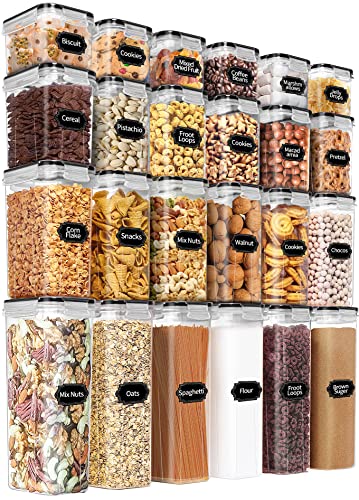 Included labels and marker make identifying small bulk ingredients quick and easy
This 24-piece set includes 8 different sizes, making it versatile for storing everything from 10lb bags of rice to small portions of yeast, spices, and baking soda. The leakproof, BPA-free containers come with a set of pre-printed labels and a marker for easy identification, while the locking latches create a tight seal to keep ingredients fresh.
Pros: Assorted sizes for all staple types, labeling system included, budget-friendly full set, leakproof
Cons: Plastic is less durable than glass, black lids may not match all kitchen decor
Buy on Amazon
Included labels and marker make identifying small bulk ingredients quick and easy
This 24-piece set includes 8 different sizes, making it versatile for storing everything from 10lb bags of rice to small portions of yeast, spices, and baking soda. The leakproof, BPA-free containers come with a set of pre-printed labels and a marker for easy identification, while the locking latches create a tight seal to keep ingredients fresh.
Pros: Assorted sizes for all staple types, labeling system included, budget-friendly full set, leakproof
Cons: Plastic is less durable than glass, black lids may not match all kitchen decor
Buy on Amazon
KEMETHY 24-Piece Airtight Food Storage Canister Set
 Uniform sizing allows for stable, gap-free stacking on pantry shelves
This 24-piece set features slim, rectangular containers designed to fit standard pantry shelf gaps without wasted space. The BPA-free, airtight containers include labels and a marker, and are dishwasher safe for easy cleaning. The uniform sizing lets you stack containers securely to maximize vertical storage.
Pros: Slim space-saving design, gap-free stacking, labeling included, dishwasher safe
Cons: Not suitable for liquid storage, plastic can scratch over time with heavy use
Buy on Amazon
Uniform sizing allows for stable, gap-free stacking on pantry shelves
This 24-piece set features slim, rectangular containers designed to fit standard pantry shelf gaps without wasted space. The BPA-free, airtight containers include labels and a marker, and are dishwasher safe for easy cleaning. The uniform sizing lets you stack containers securely to maximize vertical storage.
Pros: Slim space-saving design, gap-free stacking, labeling included, dishwasher safe
Cons: Not suitable for liquid storage, plastic can scratch over time with heavy use
Buy on Amazon
Best for Mobile & Space-Saving Storage
DDMOMMY 20-30lb Collapsible Rice Storage Container
 Collapsible design saves space when empty, perfect for small apartments or RVs
This collapsible container holds 20-30lb of rice, flour, or pet food, and folds down to 60% of its original size when not in use, making it ideal for small apartments, RVs, or pantries with limited extra storage space. Built-in rolling wheels let you move full containers with minimal effort, while the airtight locking lid keeps ingredients fresh and pest-free. It includes a built-in measuring cup and scoop for easy dispensing.
Pros: Collapsible space-saving design, rolling wheels for mobility, includes dispensing tools, airtight seal
Cons: Only available in grey, large footprint when expanded
Buy on Amazon
Collapsible design saves space when empty, perfect for small apartments or RVs
This collapsible container holds 20-30lb of rice, flour, or pet food, and folds down to 60% of its original size when not in use, making it ideal for small apartments, RVs, or pantries with limited extra storage space. Built-in rolling wheels let you move full containers with minimal effort, while the airtight locking lid keeps ingredients fresh and pest-free. It includes a built-in measuring cup and scoop for easy dispensing.
Pros: Collapsible space-saving design, rolling wheels for mobility, includes dispensing tools, airtight seal
Cons: Only available in grey, large footprint when expanded
Buy on Amazon
IRIS USA 30lb Airtight Pet Food Storage Container with Wheels
 Built-in wheels make moving full 30lb bags of kibble from storage to feeding area effortless
This 30lb capacity container features a snap-lid airtight seal to keep pet food fresh and pest-free, while the clear body lets you see food levels at a glance. Built-in wheels make it easy to roll full containers from a garage or basement storage area to your pet’s feeding station, even on smooth floors.
Pros: Mobile wheeled design, clear visibility, snap-lid seal, BPA-free
Cons: Wheels struggle on thick carpet, limited capacity for large breed dogs
Buy on Amazon
Built-in wheels make moving full 30lb bags of kibble from storage to feeding area effortless
This 30lb capacity container features a snap-lid airtight seal to keep pet food fresh and pest-free, while the clear body lets you see food levels at a glance. Built-in wheels make it easy to roll full containers from a garage or basement storage area to your pet’s feeding station, even on smooth floors.
Pros: Mobile wheeled design, clear visibility, snap-lid seal, BPA-free
Cons: Wheels struggle on thick carpet, limited capacity for large breed dogs
Buy on Amazon
Best for Pet Food Storage
Gamma2 Vittles Vault Airtight Pet Food Storage Container
 Granite finish hides pet food stains and matches most garage or pantry decor
This 50lb capacity container is the top choice for multi-pet households that buy 40lb+ bags of kibble regularly. The airtight seal locks out moisture and pests to keep food fresh for up to 6 months, while the granite finish hides stains and matches most garage, laundry room, or pantry decor. Made in the USA, it meets strict quality and safety standards for pet food storage.
Pros: 50lb large capacity, US-made for quality assurance, pest-proof, stain-hiding finish
Cons: Bulky for small spaces, heavy when full
Buy on Amazon
Granite finish hides pet food stains and matches most garage or pantry decor
This 50lb capacity container is the top choice for multi-pet households that buy 40lb+ bags of kibble regularly. The airtight seal locks out moisture and pests to keep food fresh for up to 6 months, while the granite finish hides stains and matches most garage, laundry room, or pantry decor. Made in the USA, it meets strict quality and safety standards for pet food storage.
Pros: 50lb large capacity, US-made for quality assurance, pest-proof, stain-hiding finish
Cons: Bulky for small spaces, heavy when full
Buy on Amazon
IRIS USA 2-Pack 30lb Airtight Dog Food Storage Container
 One-hand open latch lets you access pet food quickly while holding a leash or treat bag
This 2-pack of 30lb capacity containers is perfect for households with two medium to large dogs. The one-hand open latch lets you access kibble quickly even when your hands are full, while the airtight seal keeps food fresh and pest-free. Made in the USA from BPA-free plastic, it includes built-in wheels for easy mobility.
Pros: Dual 30lb capacity, one-hand access, US-made, mobile wheels
Cons: Takes up significant storage space, wheels not ideal for uneven surfaces
Buy on Amazon
One-hand open latch lets you access pet food quickly while holding a leash or treat bag
This 2-pack of 30lb capacity containers is perfect for households with two medium to large dogs. The one-hand open latch lets you access kibble quickly even when your hands are full, while the airtight seal keeps food fresh and pest-free. Made in the USA from BPA-free plastic, it includes built-in wheels for easy mobility.
Pros: Dual 30lb capacity, one-hand access, US-made, mobile wheels
Cons: Takes up significant storage space, wheels not ideal for uneven surfaces
Buy on Amazon
Komax Extra Large Airtight Pet Food Storage Bin
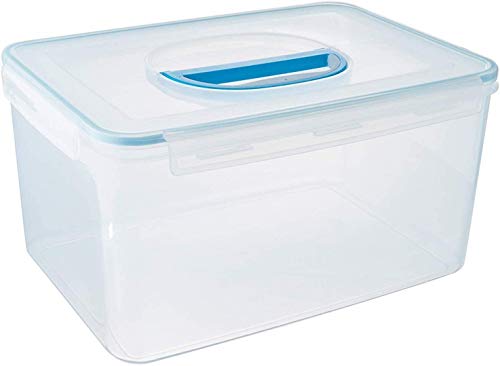 Integrated handles reduce strain when lifting full 40lb+ bags of pet food
This 48.6-cup (12qt) bin holds up to 40lb of dry pet food, and features integrated handles that reduce strain when lifting full containers to high shelves. The water and airtight seal keeps kibble fresh and dry, while the clear body lets you see food levels at a glance.
Pros: Integrated handles for easy lifting, water and airtight seal, clear visibility
Cons: Not stackable, large footprint for small spaces
Buy on Amazon
Integrated handles reduce strain when lifting full 40lb+ bags of pet food
This 48.6-cup (12qt) bin holds up to 40lb of dry pet food, and features integrated handles that reduce strain when lifting full containers to high shelves. The water and airtight seal keeps kibble fresh and dry, while the clear body lets you see food levels at a glance.
Pros: Integrated handles for easy lifting, water and airtight seal, clear visibility
Cons: Not stackable, large footprint for small spaces
Buy on Amazon
Frequently Asked Questions
What makes a bulk food storage container truly airtight?
A truly airtight container relies on three components: a thick, warp-resistant silicone gasket, a secure locking mechanism (latches, screw-top, or snap-lock), and a rigid lid that creates even pressure around the container edge. Cheap containers often have thin gaskets that wear out after 6-12 months of regular use, leading to a broken seal and stale ingredients. In practice, the paper test is a quick way to check seal quality: close the container with a small slip of paper inside, then try to pull it out. If it slides out easily, the seal is not sufficient for long-term dry goods storage.
Are plastic airtight food storage containers safe for long-term food storage?
Yes, as long as they are certified BPA-free and made from food-grade, phthalate-free plastic that meets FDA food contact material regulations. Avoid containers with strong chemical smells when new, as this can indicate residual manufacturing chemicals. Glass is a great alternative for acidic foods like tomato sauce or citrus, but lightweight BPA-free plastic is ideal for heavy bulk staples like flour and rice, as it is less prone to breakage if dropped.
Can I store wet or liquid foods in airtight bulk containers?
Only containers explicitly labeled leakproof are suitable for liquids. Most standard dry goods containers are designed for grains, cereals, and powders, and may leak if filled with soup, broth, or wet ingredients. If you plan to store liquids, look for containers with silicone seals around the lid edge and locking latches that create a pressure seal to prevent leaks.
How do I clean and maintain airtight food storage containers?
Most BPA-free plastic containers are top-rack dishwasher safe, but hand washing with warm, soapy water will extend the life of the lid gasket. Avoid abrasive scrubbers that can scratch the plastic and create spaces for bacteria to grow. If containers retain odors from strong spices or garlic, soak them in a mixture of warm water and baking soda for 30 minutes before washing. Replace lids if the gasket becomes cracked or warped, as this will compromise the airtight seal. Use a soft-bristled brush designed for gentle gasket cleaning to scrub lid crevices without damaging the seal. gentle gasket cleaning
Are airtight bulk containers worth the cost?
For households that buy more than 10lb of dry goods per month, airtight containers typically pay for themselves within 3-6 months by reducing food waste from stale or pest-infested staples. A 25lb bag of flour that goes rancid after 2 months of improper storage costs more than a set of high-quality airtight containers. For casual cooks who only buy small quantities of ingredients, standard airtight jars may be a more cost-effective option.
Conclusion
Airtight bulk food storage containers do more than keep ingredients fresh—they maximize kitchen and pantry space effortlessly, cut down on food waste, and streamline meal prep by keeping staples visible and accessible. The right choice depends on your household’s unique needs: large, opaque containers work best for light-sensitive bulk grains, collapsible wheeled models are ideal for small spaces and pet food storage, and labeled multi-piece sets cater to meal preppers and bakers with diverse ingredient needs. Prioritize containers with durable silicone seals, BPA-free food-grade materials, and stackable designs to get the most value out of your purchase. Ready to transform your cluttered pantry into an organized, space-efficient storage hub? Start by measuring your shelf dimensions and investing in 2-3 versatile containers for your most frequently used bulk staples to see the difference for yourself. For more step-by-step guides to building a functional, safe pantry, check out our collection of pantry organization guides on the Plug Chef blog. pantry organization guides

I’m Abby Lu, a passionate home cook who loves simplifying everyday meals. At PlugChef.com, I share product reviews and cooking guides to help you find the best tools for your kitchen.
Related posts:
 Best Kitchen Gadgets Under $20: Affordable Tools for Every Culinary Task
 Under Cabinet Hidden Kitchen Outlets: Revolutionize Your Space-Saving Solutions
 Shelf for Under Kitchen Sink: Maximize Space with Pull-Out Organizers
 Best Beeswax Wraps for Zero Waste Kitchen: Eco-Friendly Food Storage Solution
 Commercial Kitchen Ventilation Cleaning: Top Tools for Efficient Maintenance
 Restaurant Kitchen Cleaning Company Essentials: Top Tools for Spotless Kitchens