Knife owners — from home cooks to backcountry hunters and everyday carry (EDC) enthusiasts — know the frustration of ill-fitting sheaths. Mass-produced options often have loose gaps that rub and dull blades, are heavy to carry, or fail to hold up to rugged use. 3D printed knife sheaths solve these problems by offering a custom-molded fit, lightweight durable construction, and endless personalization options tailored to your exact blade and carry needs.
Unlike traditional leather, Kydex, or nylon sheaths, 3D printed variants are manufactured layer-by-layer via additive printing, using digital files adjusted to match your knife’s precise dimensions. This eliminates the one-size-fits-all flaws of mass-produced sheaths, delivering consistent blade protection for everything from small paring knives to full-sized survival blades. Whether you need a sheath for kitchen storage, hiking trips, or daily carry, 3D printed options balance performance, customization, and cost-effectiveness better than most traditional alternatives.
What Are 3D Printed Knife Sheaths?
3D printed knife sheaths are protective coverings for knife blades manufactured using fused deposition modeling (FDM) or similar additive printing processes. A digital design file, either sourced from a public library or custom-created, is sent to a 3D printer that deposits thin layers of thermoplastic filament to build the sheath to exact specifications.
These sheaths are designed to match the length, width, thickness, and handle profile of a specific knife, eliminating the gaps that cause blade rub and edge dulling in mass-produced options. Common use cases include home kitchen storage, EDC, hunting, camping, and tactical carry, with designs tailored to fit both folding and fixed-blade knives of nearly any shape or size.
Key Benefits of 3D Printed Sheaths Over Traditional Options
The biggest advantage of 3D printed sheaths is their custom fit, but they also outperform traditional materials in weight, maintenance, and personalization. The table below breaks down how they compare to common sheath materials:
| Material | Weight (vs. 3D printed PETG) | Customization Level | Water Resistance | Edge Protection | Break-In Period | Cost |
|---|---|---|---|---|---|---|
| 3D Printed (PETG/TPU) | Baseline | Fully custom to blade dimensions | Excellent (no absorption) | Zero-gap fit prevents rub | None | $15–$50 for custom prints |
| Leather | 30–50% heavier | Limited to pre-sized options | Poor (absorbs moisture, requires oiling) | Good if broken in, can stretch over time | 2–4 weeks of regular use | $30–$100 for custom |
| Kydex | 10–20% heavier | Limited to pre-sized options | Excellent | Good, but can scratch blades if not fitted perfectly | None | $25–$80 for custom |
| Nylon | 20–30% heavier | Limited to pre-sized options | Moderate (can absorb small amounts of moisture) | Good, but can wear down over time | None | $20–$60 for custom |
Beyond the custom fit, 3D printed sheaths require no maintenance: they won’t crack in cold weather like leather, won’t scratch your blade like unlined Kydex, and don’t need regular oiling to stay functional. Many designs also include customizable features like MOLLE clips, belt loops, lanyard attachment points, and even small storage pockets for sharpening stones or fire starters — features that often cost extra for traditional sheaths.
Best Materials for Functional 3D Printed Sheaths
The filament you choose for your 3D printed sheath will make or break its performance for your use case. The four most common options each have distinct strengths and limitations:
- PLA (Polylactic Acid): Rigid, affordable, and easy to print, PLA is ideal for static home kitchen sheaths that won’t see heavy outdoor use. It is not UV or temperature stable, however, and will become brittle and prone to cracking in temperatures below 40°F or with prolonged sun exposure.
- PETG (Polyethylene Terephthalate Glycol): The most popular all-purpose filament, PETG is impact-resistant, water-resistant, UV-stable, and slightly flexible for easy knife draws. It works well for EDC, hunting, and camping use, and holds up to years of regular handling with no maintenance.
- TPU (Thermoplastic Polyurethane): A flexible, rubber-like filament, TPU is perfect for sheaths that need to hold a knife securely while allowing smooth, one-handed draws. It is also shock-absorbent, making it a good choice for EDC or climbing carry where impacts are common.
- Nylon (PA12): The most durable option for extreme use, nylon is abrasion-resistant, temperature-tolerant (stays flexible in temperatures as low as -20°F), and impact-resistant. It is the best choice for survival scenarios, arctic camping, or heavy-duty tactical use.
A common mistake when selecting filament is choosing PLA for outdoor carry: its low temperature tolerance makes it a safety hazard in cold climates, as it can shatter on impact. Reputable 3D printing services use filaments that meet ASTM International's additive manufacturing standards to ensure the sheath is non-toxic, impact-resistant, and consistent in quality for long-term use.
Customization Options for a Perfect Fit
The biggest draw of 3D printed sheaths is their ability to be tailored to your exact blade and carry preferences. When ordering a custom print or designing your own file, you can adjust every detail of the sheath:
- Exact blade dimensions: Input your knife’s blade length, width, thickness, and handle profile to eliminate all gaps, preventing edge rub and ensuring the knife stays securely in place during movement.
- Retention style: Choose from friction fit for quick, silent draws, snap closures for extra security when carrying on a belt, or magnetic retention for easy one-handed operation.
- Carry attachments: Add belt clips, MOLLE straps, lanyard loops, or pocket clips to match your preferred carry method.
- Functional add-ons: Include drainage holes to prevent moisture buildup for outdoor use, small storage pockets for fire starters or sharpening tools, or non-slip texturing on the outside of the sheath for wet conditions.
- Aesthetic customization: Select custom colors, add text engravings, logo embossing, or unique patterns to match your gear or personal style.
If you have a home 3D printer, thousands of free and paid design files for popular knife models are available online, and you can tweak dimensions and features to fit your needs exactly.
Clarifying the Difference: 3D Printed Sheaths vs. Novelty 3D Knife Products
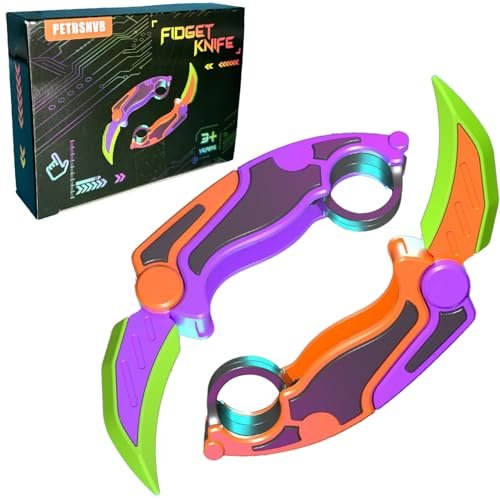
It is important to distinguish between functional 3D printed knife sheaths and the many novelty 3D printed knife products on the market. While 3D printing is used to make both, sheaths are engineered for blade protection and safe carry, while novelty items are designed for play or sensory use.
 A popular 3D printed novelty fidget toy, not a functional knife sheath
 A 3D printed training tool for practicing butterfly knife tricks safely
 A sensory-focused 3D printed fidget toy, not a blade protection sheath
These fidget toys and trainers are not designed to hold sharp blades, and lack the structural integrity and retention features of functional sheaths. When shopping for a 3D printed sheath, look for listings that specify blade compatibility, retention mechanisms, and material thickness to ensure you are purchasing a protective carry accessory, not a novelty item.
Ideal Use Cases for 3D Printed Knife Sheaths
3D printed sheaths are versatile enough for nearly every knife carrying scenario:
- Home Kitchen Storage: For home cooks, a custom 3D printed sheath protects knife edges from dulling against other utensils in crowded drawers. Pairing these sheaths with dedicated countertop organizers keeps frequently used blades accessible without cluttering counter space, while under-cabinet pot organizers free up drawer room for larger cookware. If you’re working with a small kitchen, under-counter storage solutions let you mount sheaths out of reach of children while keeping blades within easy access during meal prep. For cooks with large knife collections, integrating sheaths into streamlined cookware storage systems ensures every tool has a designated, protected spot. Finally, pairing your knife storage with cabinet spice storage keeps all your cooking tools organized in one accessible area.
- Everyday Carry (EDC): Lightweight TPU or PETG sheaths add minimal bulk to pockets or belts, with a custom fit that eliminates snagging when drawing your knife. The low profile blends in with casual or work attire, and flexible TPU variants allow for smooth, silent draws.
- Hunting, Camping & Survival: Water-resistant PETG or nylon sheaths hold up to rain, mud, and rough handling, with optional MOLLE clips to attach to packs or belts. Drainage holes prevent moisture buildup that can rust high-carbon steel blades, and textured outer surfaces provide a secure grip even with wet or gloved hands.
- Tactical Use: Durable nylon sheaths with reinforced retention mechanisms hold up to high-stress scenarios, with customizable features like laser-cut MOLLE slots or low-visibility colorways for mission-specific use.
How 3D Printed Sheaths Compare to Traditional Options
While 3D printed sheaths have many advantages, they do have trade-offs compared to traditional materials. The images below show common traditional sheath options for context:
 A traditional fixed-blade survival knife with a mass-produced nylon sheath
 A traditional leather sheath for fixed-blade knives under 4.33 inches
 A classic leather EDC sheath for pocket folding knives
 A tactical fixed-blade knife often paired with aftermarket 3D printed sheaths
 A standard leather pouch-style sheath for medium-sized pocket knives
 A low-cost alternative to full sheaths for protecting kitchen knife edges
 A handcrafted leather sheath for folding knives and small EDC tools
Leather sheaths offer a classic aesthetic and break in to fit your knife over time, but require regular oiling to prevent cracking, are heavier than 3D printed options, and can stretch out of shape with heavy use. Kydex sheaths are extremely durable and water-resistant, but their rigid construction can scratch blades if not perfectly fitted, and they produce a loud, distinctive noise when drawing a knife. 3D printed sheaths have no break-in period, are quieter than Kydex, and the custom fit eliminates edge rub entirely. The only notable trade-off is that thin-walled 3D printed sheaths may be less impact-resistant than molded Kydex, so opt for a 40%+ infill for heavy outdoor or tactical use to avoid cracking.
How to Choose the Right 3D Printed Knife Sheath for Your Needs
Follow these steps to select a sheath that will last for years and keep your blade in top condition:
- Match the material to your use case: Choose PLA for static indoor storage, PETG for all-purpose EDC and outdoor use, TPU for quick-draw EDC or climbing carry, and nylon for extreme cold or survival scenarios.
- Provide exact blade measurements: When ordering a custom print, measure your knife’s blade length, width, thickness, and handle profile to ensure a zero-gap fit. A common mistake is ordering a sheath based on general blade length alone, leading to a loose fit that lets the knife rattle and dull the edge over time.
- Select the right retention type: Friction fit is best for quick, silent draws, while snap closures add extra security for belt carry or rough outdoor activity.
- Specify infill density: For light home use, 20–30% infill is sufficient. For heavy outdoor, survival, or tactical use, opt for 40–60% infill to prevent cracking on impact.
- Add use-specific features: Include a drainage hole for outdoor use to prevent rust, a lanyard loop for water activities, or non-slip texturing for wet conditions.
The US Consumer Product Safety Commission recommends secure blade retention for all carried knives to reduce laceration risk, a feature easily customized into 3D printed sheath designs.
Frequently Asked Questions
What is the most durable filament for a 3D printed knife sheath?
For all-purpose use, PETG offers the best balance of impact resistance, water resistance, and UV stability, making it suitable for both indoor and outdoor use. For extreme cold or heavy survival use, nylon (PA12) is the most durable, as it resists cracking in temperatures as low as -20°F and holds up to abrasive wear.
Do 3D printed knife sheaths protect blades from dulling?
Yes, if custom-fitted to your exact blade dimensions. A properly designed 3D sheath has zero gaps between the blade and the sheath walls, eliminating the rubbing that dulls edges over time — a common issue with mass-produced one-size-fits-all sheaths.
Are 3D printed knife sheaths safe for high-carbon steel blades?
Absolutely, as long as the sheath is designed with a smooth inner surface and, if needed, a thin felt or foam liner to prevent moisture buildup. High-carbon steel is prone to rust if stored in a damp sheath, so adding a drainage hole or moisture-wicking liner is recommended for long-term storage.
Can I print a 3D knife sheath at home?
Yes, if you have access to a consumer-grade FDM 3D printer. Many free and paid design files are available online for common knife models, and you can adjust dimensions to fit your specific blade. Use a 0.4mm nozzle, 20–40% infill (higher for heavy use), and a layer height of 0.2mm for the strongest, most precise fit.
How do 3D printed sheaths compare to leather for outdoor use?
3D printed PETG or nylon sheaths are water-resistant, require no maintenance, and won’t stretch or warp when wet, unlike leather which needs regular oiling to prevent cracking. They are also 30–40% lighter than equivalent leather sheaths, making them ideal for long hikes or hunting trips where every ounce counts.
Can 3D printed sheaths fit both folding and fixed-blade knives?
Yes, as long as the design is adjusted for the specific knife’s shape. Folding knife sheaths typically include a retention mechanism to hold the knife closed, while fixed-blade sheaths cover the entire blade and part of the handle for secure carry. Custom designs can accommodate almost any knife configuration, from small pocket folders to large machetes.
Conclusion
3D printed knife sheaths offer a rare combination of durability, customization, and practical protection that traditional sheaths often can’t match. By eliminating the gaps that dull blades, cutting down on weight, and letting you tailor every detail to your carry needs, they are a cost-effective upgrade for knife owners of all types. Whether you’re storing a set of kitchen knives, carrying an EDC folder daily, or heading into the backcountry for a weekend hunt, a custom 3D printed sheath will keep your blades sharp, secure, and ready for use.
Ready to upgrade your knife storage? Reach out to a reputable 3D printing service or download a design file to create a sheath tailored perfectly to your blade today.

I’m Abby Lu, a passionate home cook who loves simplifying everyday meals. At PlugChef.com, I share product reviews and cooking guides to help you find the best tools for your kitchen.
Related posts:
 French Food Posters Vintage: Timeless Culinary Art for Kitchen Decor
 Safety 1St Appliance Lock: Secure Your Home with Easy Childproofing
 Pancake Sheath for Fixed Blade Knife: Durable Leather Carry Solution
 Western Knife With Leather Sheath: Durable, Stylish, and Perfect for Outdoor Adventures
 Child Safety Locks for Cabinets: Easy, Secure Baby Proofing Solutions
 Safety Latches for Cabinets: Secure Your Home with Easy No-Drill Locks